

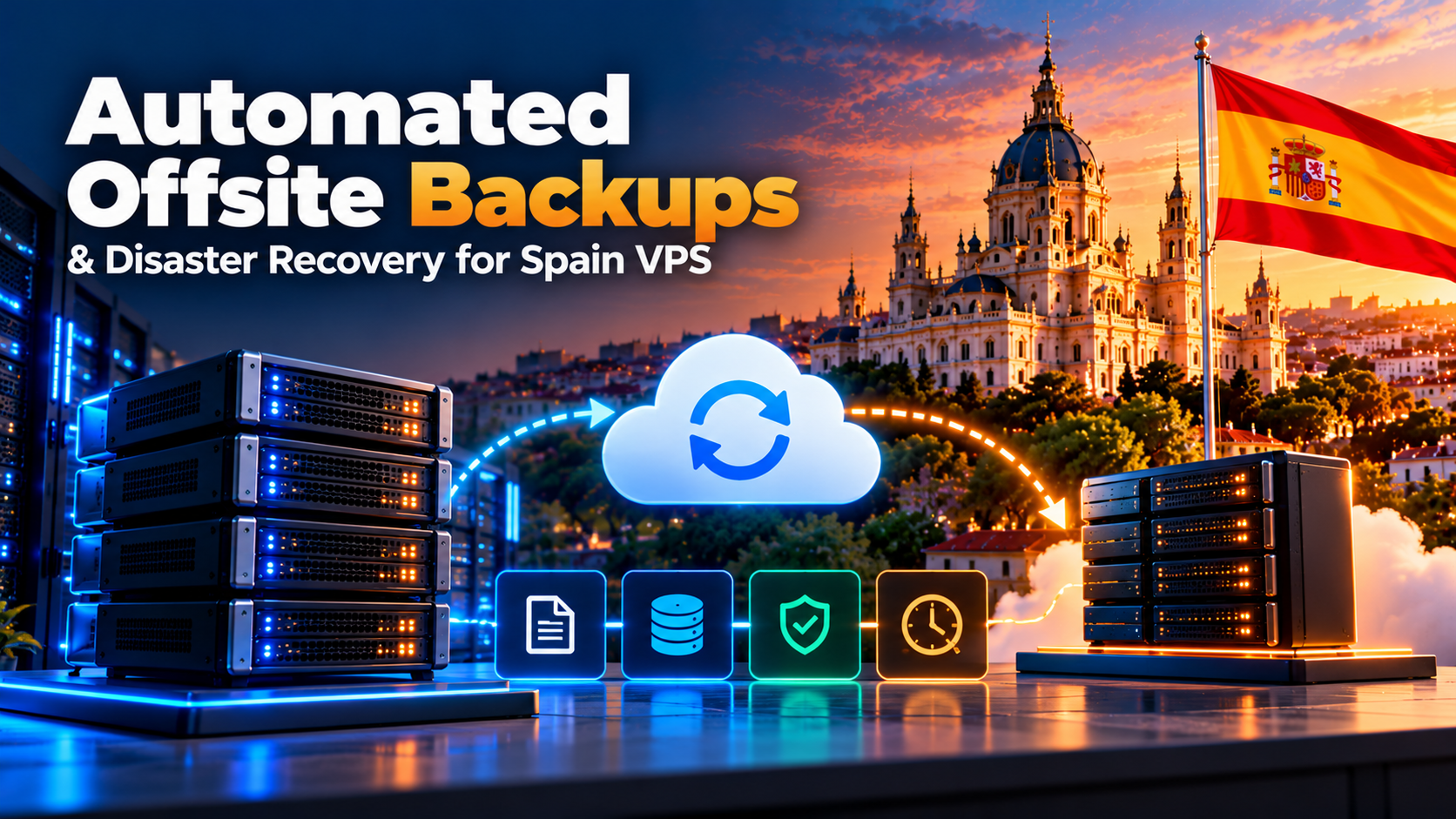
Specifically, architecting an enterprise vps backup spain strategy requires implementing the 3-2-1 backup paradigm: 3 copies of production data, 2 distinct storage media, and 1 offsite encrypted archive geographically separated from Madrid. Combining hypervisor-level KVM snapshots with deduplicated, client-side encrypted BorgBackup repositories synchronized via Rclone to sovereign European S3 object storage guarantees a Recovery Point Objective (RPO) of under 1 hour and a Recovery Time Objective (RTO) under 15 minutes while fully satisfying Spanish AEPD and GDPR Article 32 continuity requirements.
Furthermore, in modern digital business operations, data loss is an existential operational catastrophe. Whether triggered by accidental human command errors (rm -rf), catastrophic database table corruption, malicious ransomware infiltration, or hypervisor hardware failures, organizations that lack a battle-tested vps backup spain architecture face crippling downtime and irreparable data destruction.
Furthermore, for Spanish corporations, e-commerce retailers, and SaaS providers, maintaining robust backup and disaster recovery mechanisms is a strict statutory mandate under European GDPR Article 32 (“Security of processing”) and Spain’s Ley Orgánica 3/2018 (LOPDGDD). The Agencia Española de Protección de Datos (AEPD) explicitly penalizes organizations that cannot restore the availability and accessibility of personal data in a timely manner following a physical or technical incident.
Consequently, this comprehensive disaster recovery architecture blueprint details how to build an automated, zero-trust backup pipeline on OnliveServer’s Madrid VPS platform. We evaluate hypervisor block-level snapshots, demonstrate deduplicated file-level backups with BorgBackup, show how to sync encrypted archives to European offsite object storage via Rclone, calculate real-world RPO and RTO thresholds, and provide an automated bare-metal recovery runbook.
📌 Master Chapter Index
- In addition, vps backup spain: The 3-2-1 Enterprise Backup Rule Applied to Cloud Infrastructure
- In particular, vps backup spain: Hypervisor Block Snapshots vs File-Level Backups: Understanding the Differences
- Therefore, BorgBackup Architecture: Chunk-Level Deduplication & Client-Side AES-256
- Moreover, Offsite Cloud Replication with Rclone: Syncing to European S3 Object Storage
- In fact, Transactional Database Integrity: MySQL, MariaDB & PostgreSQL Hot Backups
- Similarly, Disaster Recovery Metrics: Calculating Real-World RPO and RTO for Spanish Business
- Meanwhile, The Bare-Metal Restoration Runbook: Testing Backups with Zero Downtime
- Additionally, Enterprise Backup Strategy & Tooling Matrix
- Frequently Asked Questions
vps backup spain: The 3-2-1 Enterprise Backup Rule Applied to Cloud Infrastructure
As a result, the gold standard of enterprise business continuity is the 3-2-1 backup rule. For a production virtual private server operating in Madrid, this methodology requires: To confirm that offsite backup archives and encrypted snapshots remain legally compliant with strict AEPD regulations, review our guide to sovereign EU data residency compliance.
3 Total Copies of Data:
Specifically, the primary production data on your Madrid NVMe array, plus two independent backup copies created at scheduled intervals.
2 Different Storage Formats:
Furthermore, utilizing two distinct underlying media technologies (e.g., local hypervisor block-level QCOW2 snapshots plus file-level compressed and encrypted archive chunks).
1 Offsite Geographical Location:
Consequently, at least one complete backup repository must be physically located outside the primary datacenter (e.g., replicated to a secure secondary facility in Frankfurt, Paris, or Amsterdam) to insulate against catastrophic metropolitan regional power or network disruptions.
Storing backups exclusively on the same virtual server’s secondary partition or root disk is an extreme administrative failure. If the local virtual disk image becomes corrupted or compromised by ransomware, the backups perish alongside the production data. True operational resilience demands absolute physical and cryptographic decoupling.
vps backup spain: Hypervisor Block Snapshots vs File-Level Backups: Understanding the Differences
In addition, enterprise disaster recovery requires understanding the operational distinctions between hypervisor image snapshots and guest-level file backups:
Hypervisor Block Snapshots (Full Machine)
In particular, freezes the raw disk state, capturing operating system binaries, kernel modules, and system state. Crucial for bare-metal restoration after ransomware or severe OS corruption.
Guest File-Level Backups (Granular Restore)
Therefore, restic and Borg encrypt database dumps and website directories offsite. Enables restoring an individual accidentally deleted file or database table in seconds.
BorgBackup Architecture: Chunk-Level Deduplication & Client-Side AES-256
Moreover, borgBackup (Borg) is the gold standard for open-source Linux backup automation. Its defining strength is content-defined chunking and deduplication. When migrating production database snapshots between hosting nodes without interrupting live customer sessions, follow our zero-downtime server migration runbooks.
In fact, unlike traditional tar or rsync archives that duplicate entire files whenever a single line changes, Borg breaks files into variable-length blocks (chunks). Only newly created or modified chunks are compressed (using ZSTD or LZ4) and committed to the encrypted repository. This allows an enterprise Spain VPS with 100GB of web data and daily incremental backups to retain 30 daily, 12 monthly, and 5 yearly archives while consuming only 130GB of total backup storage.
Similarly, initializing an encrypted Borg repository on a Madrid VPS:
Meanwhile, # Install BorgBackup
apt install borgbackup -y

# Initialize repository with client-side authenticated encryption (repokey-blake2)
export BORG_REPO="/mnt/backup_storage/borg-repo"
export BORG_PASSPHRASE="EnterpriseMadridPassphrase2026!"
borg init --encryption=repokey-blake2

# Create daily snapshot with ZSTD compression
borg create --stats --progress --compression zstd,3 \
  ::"spain-vps-{now:%Y-%m-%d_%H:%M}" \
  /var/www \
  /etc \
  /var/backups/databases \
  --exclude '/var/www/*/cache/*'

# Prune older archives to enforce retention policy (keep 7 daily, 4 weekly, 6 monthly)
borg prune -v --list --keep-daily=7 --keep-weekly=4 --keep-monthly=6
Offsite Cloud Replication with Rclone: Syncing to European S3 Object Storage
Once Borg has committed deduplicated, encrypted chunks to local mounted storage, Rclone replicates the entire repository directory offsite to an S3-compatible European cloud storage provider (such as Wasabi EU-Central, Backblaze B2 EU, or OVH Cloud Storage). Automated snapshot synchronization and remote cryptographic replication procedures strictly follow the official Rclone cloud storage sync documentation, ensuring resilient 3-2-1 disaster recovery across offsite repositories.
Additionally, rclone provides rock-solid bandwidth management, automated retry logic, and end-to-end MD5 checksum validation. Even if an attacker compromises the Spain VPS and deletes the local Borg repository, the offsite S3 bucket—protected by S3 Object Lock (Immutable WORM storage)—remains completely tamper-proof and impervious to ransomware deletion.
As a result, # Synchronize local encrypted Borg repository to offsite European S3 bucket
rclone sync /mnt/backup_storage/borg-repo remote-eu-s3:madrid-vps-backups-secure \
  --fast-list \
  --transfers 4 \
  --checkers 8 \
  --bwlimit 50M \
  --log-file=/var/log/rclone-backup.log \
  --log-level NOTICE
Transactional Database Integrity: MySQL, MariaDB & PostgreSQL Hot Backups
Backing up raw active database data directories (e.g., /var/lib/mysql) while database daemons are writing pages to disk produces corrupted, unusable backups. Relational databases require transactional, point-in-time consistent dumps.
For high-capacity enterprise storage tiers where multi-terabyte snapshot retention impacts annual IT budgets, compare our bare-metal versus cloud storage economics.
Specifically, for MySQL and MariaDB hosting WordPress, WooCommerce, or PrestaShop instances in Madrid, execute single-transaction hot dumps before invoking Borg:
Furthermore, # Non-blocking single-transaction MySQL hot dump
mysqldump --single-transaction --quick --routines --triggers \
  --events -u root -p'YourMasterDBPassword' --all-databases | \
  gzip -9 > /var/backups/databases/all_databases_$(date +%F_%H%M).sql.gz
The --single-transaction flag utilizes InnoDB’s Multi-Version Concurrency Control (MVCC) to take a snapshot of the database without locking write queries, ensuring continuous e-commerce checkout availability during the backup process.
Disaster Recovery Metrics: Calculating Real-World RPO and RTO for Spanish Business
Consequently, enterprise business continuity is governed by two quantifiable metrics defined in Service Level Agreements (SLAs):
Recovery Point Objective (RPO):
The maximum acceptable age of data files that must be recovered from backup storage for normal operations to resume if an outage occurs. An RPO of 1 hour means that in the worst-case disaster scenario, the business will lose at most 60 minutes of newly recorded transactions.
Recovery Time Objective (RTO):
The maximum acceptable duration of server downtime before systems are fully restored to live production status. An RTO of 15 minutes means systems engineers have a validated workflow to spin up an alternate virtual machine and redirect DNS records within a quarter of an hour.
By combining hourly automated Borg database snapshots with daily hypervisor disk snapshots on OnliveServer’s Madrid cloud infrastructure, Spanish enterprises achieve an RPO of 1 hour and an RTO of under 15 minutes at a fraction of enterprise bare-metal disaster recovery costs.
The Bare-Metal Restoration Runbook: Testing Backups with Zero Downtime
An untested backup is merely an illusion. Disaster recovery plans fail most frequently during live emergencies because systems teams discover that encryption passphrases were mislaid, backup archives were corrupted, or database restoration scripts time out.
We mandate a quarterly automated disaster recovery drill:
- Provision a clean, temporary staging VPS in Madrid.
- Install BorgBackup and authenticate against the offsite S3 backup bucket via Rclone.
- Execute a test extraction:
borg extract --list ::spain-vps-2026-latest. - Import the MySQL dump into the staging database engine.
- Spin up Nginx and execute automated end-to-end health-check curls against the staging IP to confirm 100% data integrity and HTTP 200 responses.
Enterprise Backup Strategy & Tooling Matrix
The following technical matrix outlines each layer of backup architecture, the tooling utilized, storage location, and typical restoration speeds on OnliveServer’s Madrid cloud platform:
| Backup Tier | Tooling | Target Destination | Frequency | Target RPO | Average RTO |
|---|---|---|---|---|---|
| KVM Disk Snapshot | Proxmox / QEMU | Madrid Backup Storage SAN | Daily (Midnight) | 24 Hours | < 5 Minutes |
| File & Config Archive | BorgBackup | Encrypted NAS Mount | Every 4 Hours | 4 Hours | 10 Minutes |
| Database Hot Dump | mysqldump / pg_dump | Local Staging + Borg | Hourly | 1 Hour | 8 Minutes |
| Offsite Disaster Recovery | Rclone Sync | EU S3 Object Lock (Frankfurt) | Every 6 Hours | 6 Hours | 20 Minutes |
Frequently Asked Questions
Core Technical Specifications
Will running automated Borg backups slow down my live website?
nice -n 19) and I/O scheduling (ionice -c 3). Furthermore, because Borg processes deduplicated chunks incrementally, daily incremental runs typically complete in less than 90 seconds, producing negligible CPU and NVMe disk overhead.
How does offsite backup storage satisfy Spanish AEPD GDPR regulations?
What is the primary difference between a backup and a snapshot?
How do immutable S3 object locks protect against ransomware?
Deployment & Operational Inquiries
Can OnliveServer restore my VPS automatically if my server crashes?
What is the operational difference between a hypervisor snapshot and an offsite backup repository?
A snapshot captures the live virtual disk state on the local hypervisor storage array for instant rollback during updates. An offsite backup exports an encrypted, deduplicated copy of your data to an independent physical facility, protecting against total datacenter loss or local array failure.
How do I automate encrypted daily database backups to remote S3-compatible cloud storage?
Install Rclone or BorgBackup, write a shell script running mysqldump piped through GPG encryption, and configure a systemd timer or cron job executing daily at 02:00 CET. The encrypted archive is pushed directly to remote object storage with automated 30-day retention policies.
Secure Your Enterprise with Automated Cloud Backups in Madrid
Eliminate data loss anxiety with enterprise KVM virtualization. Benefit from 1-click hypervisor snapshots, offsite European backup storage options, and NVMe Gen4 speeds starting from €12/month.
