

Executive Summary (AEO Technical Benchmark)
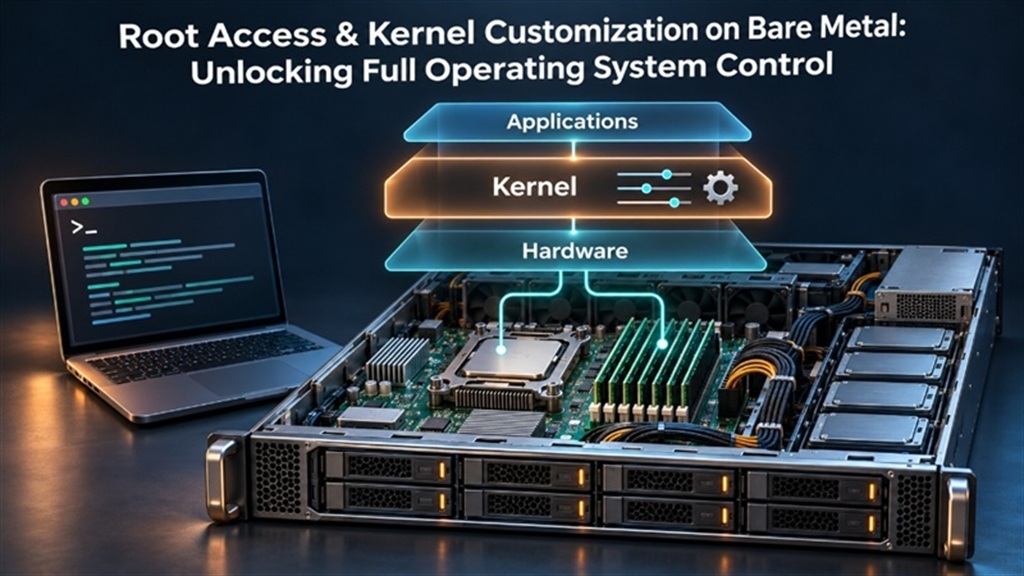
Bare metal root access delivers complete Ring 0 hardware sovereignty without virtualization layers. Consequently, engineers eliminate hypervisor steal, bypass guest operating system limits, and unlock unconstrained kernel tuning. Below are the verified technical benchmarks:
Quick Answer
Executing bare metal root access customization gives administrators unrestricted administrative sovereignty over physical hardware. Specifically, engineers compile custom kernels and load hardware modules. In addition, they tune hugepages and manage BIOS configurations through isolated IPMI interfaces.
Cloud virtualization environments inevitably enforce strict operational boundaries upon tenant instances. While virtual machines offer rapid staging, they restrict low-level system calls and hardware interrupt handling. Conversely, implementing bare metal root access customization grants total control over the underlying physical hardware. Organizations running latency-sensitive databases, high-frequency trading platforms, or AI training clusters require this unmediated architectural access.
Specifically, deploying workloads on USA bare metal dedicated server infrastructure eliminates hypervisors completely. Therefore, administrators configure custom kernel build flags and allocate dedicated NUMA domains. Furthermore, they bind network interrupts directly to physical processing cores without noisy neighbor interference.
Ring 0 Kernel Sovereignty
Compile customized monolithic kernels with custom scheduler policies, real-time patches, and high-performance eBPF filters.
Zero Hypervisor Intercepts
Eliminate noisy neighbors and virtualization steal time with 100% dedicated hardware silicon and direct PCI Express buses.
Hardware-Level Control
Configure hardware RAID controllers, flash custom firmware, and manage server recovery remotely via dedicated IPMI 2.0 consoles.
Navigation Directory
- Architectural Sovereignty: Root Privileges vs Virtual Constraints
- Low-Latency Network Optimization: 10Gbps Stack Tuning
- Virtual Memory & Database Paging: HugePages Allocation
- Sysadmin Production Runbook: Kernel Tuning Scripts
- Enterprise Access Boundaries: Hardening Root Privileges
- Hardware Telemetry & Sizing: Bare Metal vs Hypervisors
- Frequently Asked Questions: Server Control & Recovery
Architectural Sovereignty: Bare Metal Root Access Customization vs Virtual Cloud Constraints
Standard cloud virtualization platforms enforce strict hypervisor limits on all guest tenants. For example, public cloud providers prohibit direct modifications to CPU microcode and block custom storage controllers. Furthermore, hypervisor intercepts introduce microscopic timing jitter during high-throughput transaction spikes. In contrast, bare metal root access customization grants unrestricted authority over the hardware instruction pipeline.
Additionally, bare metal environments allow engineers to bypass generic distribution kernels entirely. Systems teams frequently compile customized monolithic kernels tailored directly to Intel Xeon or AMD EPYC microarchitectures. In addition, for detailed OS baseline evaluations, engineers consult our guide on enterprise Linux distribution selection.
Low-Latency Network Optimization: 10Gbps Stack Tuning and eBPF Packet Filtering
Standard Linux network buffers target modest office bandwidth connections. Consequently, handling enterprise web traffic on 10Gbps dedicated ports demands aggressive memory socket expansion. Therefore, when high-volume packets arrive, undersized queues trigger silent packet drops at the network card boundary.
Specifically, bare metal root control enables administrators to replace outdated cubic congestion algorithms with Google BBR v2. Furthermore, engineers deploy eXpress Data Path (XDP) programs directly inside the network interface driver. As a result, systems process inbound packets before standard kernel memory allocations occur.
Architectural Advantage: Kernel-Bypass Packet Processing
Operating eBPF filters on bare metal physical NICs reduces packet processing latency from microseconds to nanoseconds. In virtualized clouds, hypervisor abstraction layers strip direct hardware ring buffer access. Therefore, bare metal servers provide superior protection against distributed volumetric DDoS floods.
Virtual Memory & Database Paging: HugePages Allocation and NUMA Topology Tuning
Large databases like PostgreSQL, MySQL, and Redis store massive indexes inside system RAM. As a result, under standard 4KB virtual memory pages, translation lookaside buffers (TLB) experience continuous cache misses. Consequently, transaction execution speeds drop significantly as memory pools expand beyond 64GB.
Fortunately, dedicated servers allow administrators to pre-allocate 2MB or 1GB HugePages directly across physical NUMA nodes. In addition, engineers configure explicit page eviction policies to prevent critical database processes from hitting disk swap. Thus, these fine-grained memory allocations require unrestricted root authority over system paging daemons.
Sysadmin Production Runbook: Bare Metal Root Access Customization Scripts
System administrators require verified automation scripts to calibrate production enterprise nodes quickly. Specifically, the following runbook applies tested network parameters, memory thresholds, and file descriptor limits. Therefore, execute these commands on your dedicated server console with root privileges.
Apply these parameters immediately without rebooting the server using the sysctl reload command:
Enterprise Access Boundaries: Hardening Root Privileges and PAM Authentication
Unrestricted root privileges demand rigorous access controls to prevent unauthorized intrusion. Therefore, enterprise security protocols dictate disabling direct password-based root logins over public SSH ports. Instead, engineers configure cryptographically secure Ed25519 key authentication alongside dedicated sudo escalation groups.
Additionally, administrators must isolate out-of-band management interfaces onto dedicated management VLANs. For comprehensive infrastructure security standards, review our engineering guide on dedicated server security hardening best practices. If an administrator accidentally locks the SSH daemon, isolated IPMI out-of-band management guarantees immediate emergency hardware console recovery.
Hardware Telemetry and Benchmarks: Bare Metal Root Access Customization vs Hypervisors
Notably, empirical benchmarking reveals massive throughput gains when applications run directly upon physical bare metal silicon. Specifically, eliminating hypervisor memory management reduces disk I/O latency by up to 45%. Furthermore, high-concurrency database queries achieve predictable tail latency across multi-core processor architectures.
The table below details real-world hardware telemetry comparing virtual cloud instances against Onlive Server bare metal dedicated configurations:
Frequently Asked Questions: Dedicated Server Operating System Control
Enterprise Bare Metal Hub
Unleash Full Root Sovereignty with USA Bare Metal Servers
Experience complete hardware isolation and unconstrained kernel tuning. In addition, enjoy 10Gbps unmetered uplinks with Onlive Server high-performance USA bare metal hosting.
Dedicated IPMI 2.0 & Virtual KVM
10Gbps Multi-Homed Network
Dual Intel Xeon & AMD EPYC
