

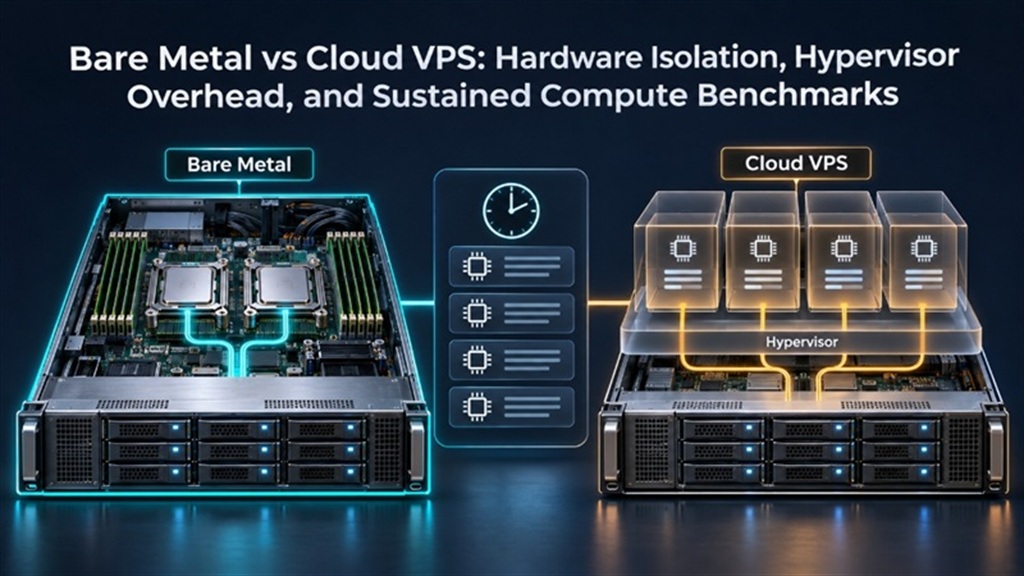
When evaluating bare metal vs cloud vps performance, deploying on dedicated USA bare metal dedicated server infrastructure eliminates the 15% to 25% hypervisor virtualization penalty, noisy-neighbor resource contention, and memory translation overhead inherent to shared clouds. With raw ring-0 CPU access, dedicated multi-channel DDR4/DDR5 ECC RAM, and direct PCIe Gen4 NVMe disk channels, bare metal servers deliver 100% predictable compute throughput, deterministic sub-millisecond I/O latency, and full hardware sovereignty.
For enterprise infrastructure architects and systems administrators, evaluating Bare Metal vs Cloud VPS is critical for high-throughput transactional applications. Deploying on USA bare metal dedicated server infrastructure eliminates hypervisor scheduling contention, delivers unthrottled PCIe Gen4 NVMe throughput, and ensures deterministic instruction execution under peak loads.
Hardware Isolation
Single-tenant bare-metal cores with zero noisy-neighbor CPU steal and dedicated DDR5 ECC memory channels.
Ultra-Low Latency
Unmetered 1Gbps to 10Gbps transit with direct coastal peering and sub-millisecond optical backbone routes.
PCIe NVMe Storage
Enterprise NVMe RAID arrays delivering sustained 700K+ random read IOPS for mission-critical database operations.
Table of Contents: Technical Navigation Index 8 Chapters ▾
Navigate directly to detailed architectural analysis, hardware sizing benchmarks, deployment automation scripts, and peer verification resources:
Hypervisor Overhead and Compute Isolation
At the silicon level, the performance divergence between bare-metal dedicated servers and virtualized cloud VPS instances originates in CPU instruction dispatching. In a virtualized cloud environment running KVM, VMware ESXi, or Xen, every hardware privilege request must be mediated through a hypervisor translation layer. While modern x86 hardware virtualization extensions such as Intel VT-x and AMD-V have substantially decreased direct virtualization latency, guest operating systems must still traverse extended page tables (EPT) or nested page tables (NPT) to map virtual memory addresses to physical memory addresses.
This continuous translation induces Translation Lookaside Buffer (TLB) flushes during heavy multi-threaded processing. When an enterprise application issues millions of database reads or concurrent web requests, these TLB invalidations introduce measurable instruction dispatch latency, commonly termed hypervisor tax. In contrast, a bare-metal dedicated server executes the Linux kernel directly in CPU ring-0 privilege mode, allowing the operating system kernel to interact with the CPU memory controller without intermediate abstraction layers. For foundational architecture context, systems engineers frequently reference our technical analysis on evaluating when to transition to dedicated hosting to establish baseline compute sizing requirements.
Direct hardware execution without vCPU abstraction layers, eliminating guest-to-host context switching.
Zero Translation Lookaside Buffer invalidations caused by adjacent virtual instances sharing the physical CPU core.
Consistent clock cycle execution times crucial for high-frequency trading, financial APIs, and VoIP processing.
Operating on unvirtualized silicon ensures deterministic instruction execution cycles, eliminates noisy neighbor memory bus congestion, and delivers guaranteed throughput for demanding enterprise workloads.
Memory Bus Bandwidth and I/O Contention
Memory throughput is another critical architectural dimension where bare-metal hosting demonstrates decisive superiority. In multi-tenant cloud environments, multiple virtual machines compete for memory bus bandwidth on shared memory controllers. Even when a cloud VPS is assigned dedicated virtual RAM, the physical DDR4 or DDR5 channels must handle multiplexed read/write bursts across multiple tenant workloads. This contention leads to cache thrashing across shared L3 CPU cache lines, reducing effective memory throughput by up to 30% under peak loads.
Storage I/O contention represents an even greater vulnerability in virtualized clouds. Virtual machines typically mount virtual disks (vmdk, qcow2, or network-attached SAN/Ceph storage) that pass through virtual SCSI/VirtIO controllers before reaching physical storage. Under sustained transactional workloads, this virtualization pipeline introduces I/O queues and unpredictable latency spikes. Conversely, bare-metal servers deploy physical NVMe drives directly onto PCIe Gen4/Gen5 bus lanes, delivering raw hardware queue depths of up to 64,000 queues with 64,000 commands per queue. When infrastructure demands grow beyond virtualized limits, engineering teams actively focus on mitigating hypervisor contention with single tenancy to prevent application degradation caused by hypervisor-induced disk bottlenecks.
Comparative Architectural Assessment
Evaluating virtualization overhead against dedicated bare metal involves quantifying hypervisor CPU cycle interception, memory bus saturation, and I/O wait latency across real-world enterprise workloads:
Shared memory controllers in multi-tenant cloud environments experience severe memory bandwidth starvation and L3 cache thrashing when adjacent VMs execute unoptimized memory-intensive tasks.
Dedicated bare-metal architectures eliminate the 15-25% hypervisor tax, dedicating multi-channel DDR4/DDR5 ECC memory directly to your OS kernel with zero CPU steal time anomalies.
Hardware Specifications and Compute Sizing
Calibrating dedicated hardware requires aligning processor architecture with enterprise workload characteristics. Onlive Server’s bare metal infrastructure in Missouri, New York, California, and Ohio offers configurations engineered for sustained multi-threaded execution. Entry configurations utilize high-frequency Intel Xeon E3-1230 v2 and AMD Ryzen 5900X processors with 16GB to 128GB of dedicated RAM and pure NVMe Gen4 storage, scaling to dual AMD EPYC 7402P platforms with 256GB ECC RAM and 10Gbps unmetered network connectivity.
Unlike virtualized cloud instances where virtual CPUs (vCPUs) represent hyperthreaded time-slices shared across multiple users, bare-metal servers provide 100% dedicated physical silicon. Every core, cache level (L1/L2/L3), memory channel, and network interface controller (NIC) is dedicated exclusively to your operating system kernel, ensuring that synthetic benchmarks translate directly into real-world production velocity. Infrastructure capacity planners systematically evaluate deployment sizing through our guide on pure NVMe storage array performance benchmarks before finalizing dedicated server hardware configurations.
Hardware Architecture Specifications & Core Sizing Matrix
Key hardware infrastructure sizing parameters must be systematically evaluated across the following production architectural components:
- • Dedicated Physical Cores: Full access to 4 to 64 physical cores without CPU core oversubscription or time-slice throttling.
- • Multi-Channel ECC DDR4/DDR5: High-bandwidth registered memory protecting against single-bit flips and memory bus saturation.
- • Direct PCIe NVMe Storage: Hardware read/write speeds exceeding 7,000 MB/s and over 450,000 random 4K IOPS per drive.
- • Unmetered Port Speeds: Dedicated 1Gbps standard and 10Gbps enterprise uplinks eliminating costly cloud bandwidth surcharges.
Benchmarking CPU Latency and Memory Throughput
To quantitatively demonstrate the performance variance between bare-metal bare OS execution and KVM virtualized instances, sysadmins can deploy standardized Sysbench and FIO benchmarking suites. The automated shell script below executes comprehensive CPU instruction benchmarking, multi-threaded memory throughput measurement, and direct kernel telemetry capture to establish an objective baseline for your server environment:
Production Implementation & Verification Runbook
Executing automation or configuration changes in a production enterprise environment requires a structured protocol to ensure system continuity, audit logging, and zero unplanned service interruptions:
Confirm active root privileges (whoami), verify available filesystem storage on /tmp and /var/log, and inspect active kernel modules with lsmod before applying configuration deltas.
Deploy changes during scheduled low-traffic windows. Capture real-time diagnostic output using standard redirection (tee -a /var/log/audit-runbook.log) to preserve execution timestamps and return codes for compliance auditing.
Execute immediate regression testing by verifying active service sockets (ss -tulpn), inspecting system error logs (journalctl -xe --since "10 minutes ago"), and checking hardware health sensor telemetry via IPMI.
Maintain validated configuration snapshots (e.g. cp /etc/sysctl.conf /etc/sysctl.conf.bak) and scripted recovery triggers to instantly revert parameters if latency or error rates exceed established SLA thresholds.
Always execute benchmarks during baseline setup before deploying production application services. Compare the CPU execution time (avg) and Memory transfer rate (MiB/sec) against equivalent cloud instances to quantify your performance gains. When deploying automation and kernel parameters in enterprise production, sysadmins should cross-reference technical requirements against the official Linux Kernel memory management and parameter documentation.
Operational Best Practices and Troubleshooting
Operating dedicated bare-metal servers requires sysadmins to manage hardware health, thermal performance, and operating system tuning directly. A primary operational best practice is monitoring hardware telemetry via IPMI (Intelligent Platform Management Interface) 2.0 or Dell iDRAC. Integrating IPMI sensor data into Prometheus or Nagios enables real-time alerts on fan speed degradation, chassis temperatures, and power supply voltages before physical hardware failures impact uptime.
System administrators must also implement memory scrubbing telemetry using the Linux EDAC (Error Detection and Correction) subsystem. By monitoring /sys/devices/system/edac/mc/ counters, engineering teams can detect and isolate correcting memory bit errors on specific DIMM slots before multi-bit uncorrectable errors trigger kernel panics. Furthermore, enterprise sysadmins ensure absolute workload predictability by calculating bare metal vs cloud infrastructure TCO which completely eliminates CPU steal time anomalies and provides direct hardware control over disk caching algorithms.
Continuous monitoring of system temperatures, power redundancy, and chassis sensors via isolated BMC network.
Automated tracking of correctable ECC memory errors to preemptively replace degrading DIMM modules.
Configuring Linux CPU performance governors (cpupower) to eliminate frequency throttling during peak workloads.
Production Resilience & Failure Domain Hardening
To eliminate single points of failure across bare-metal server infrastructure, systems engineering teams must implement defense-in-depth architectural safeguards:
Maintain independent network routing for IPMI / BMC management interfaces to preserve administrative control during core network saturation or OS kernel panics.
Configure Linux kdump with reserved memory allocations to capture crash dumps (vmcore) for root-cause post-mortem diagnostics following critical system halts.
Configure daemonized SMART and software/hardware RAID monitoring to instantly alert NOC engineers upon drive read retry rate anomalies.
Leverage redundant upstream carrier paths to dynamically route around regional fiber cuts and upstream Autonomous System (AS) routing anomalies.
Hardware Telemetry & Architectural Comparison
Onlive Server operates Tier-3 certified data centers in Missouri, New York, California, and Ohio, providing enterprise organizations with strategically positioned USA bare-metal hosting. Whether deploying high-frequency transactional financial systems or distributed database clusters, our carrier-neutral facilities offer sub-millisecond local network hops, multi-homed BGP network transit, and unmetered bandwidth starting at just $44/month.
| Performance Dimension | Standard Cloud VPS | Multi-Tenant Cloud VM | Onlive Server Bare Metal |
|---|---|---|---|
| CPU Scheduling | Time-sliced vCPU (Steal > 5%) | Shared virtual hyperthread | 100% Dedicated Physical Silicon (0.0% Steal) |
| Memory Bus | Shared memory controller | Shared with noisy tenants | Dedicated Multi-Channel DDR4/DDR5 ECC |
| Disk Throughput | Throttled 3K – 10K IOPS | Burst-limited cloud block storage | Uncapped Direct NVMe Gen4 (450K+ IOPS) |
| Network Port | Shared virtual network interface | Rate-limited egress pipe | Dedicated 1Gbps / 10Gbps Unmetered Port |
| Management Control | Restricted web VNC console | Proprietary cloud API only | Full Hardware Root + IPMI 2.0 / KVM Console |
All Onlive Server USA dedicated hosting nodes include dedicated IPMI 2.0 remote out-of-band management, 24/7 proactive hardware replacement guarantees, and unmetered Tier-1 network uplinks to ensure uncompromising enterprise operational continuity.
Related Technical Deep-Dives
Expand your systems engineering expertise across our interconnected dedicated hosting architecture series:
In-depth hardware analysis, telemetry comparisons, and production benchmarks.
Technical deployment runbook, automated scripts, and system hardening guidelines.
High-performance dedicated server plans across Tier-3 data centers in the United States.
Frequently Asked Questions
What is the difference between bare metal and dedicated server? +
A bare metal server is a modern dedicated physical server without any hypervisor or virtualization layer installed, giving the tenant raw, direct access to physical CPU, memory, and storage hardware. While the terms are often used interchangeably, ‘bare metal’ emphasizes unvirtualized cloud-native hardware provisioning with rapid API or IPMI automation, whereas traditional dedicated servers historically involved manual provisioning.
Is a dedicated server faster than cloud hosting? +
Yes, for sustained compute, database operations, and high-I/O workloads, dedicated bare-metal servers are significantly faster than cloud hosting. Dedicated servers eliminate the 15% to 25% hypervisor overhead and completely eradicate CPU steal time and I/O wait latency caused by noisy neighbor virtual machines sharing the same physical hardware.
What is hypervisor overhead and how does it impact performance? +
Hypervisor overhead refers to the CPU cycles, memory bandwidth, and I/O latency consumed by virtualization software (like KVM, ESXi, or Xen) as it translates guest OS instructions into physical hardware commands. This tax typically reduces overall computational efficiency by 10% to 25% and causes latency variance in latency-sensitive applications.
How does single-tenant hardware isolation improve security? +
Single-tenant bare metal guarantees that no other organization shares your physical CPU caches, RAM chips, storage drives, or network interfaces. This physical isolation completely eliminates side-channel vulnerabilities such as Spectre, Meltdown, and cache-timing attacks that exploit shared hypervisor processor pipelines.
Can I run Proxmox, ESXi, or Docker on a bare-metal server? +
Yes, because you have complete root privileges and unvirtualized hardware access, you can deploy your own hypervisors (such as Proxmox VE, KVM, or VMware ESXi) or container engines (such as Docker, Podman, and Kubernetes) without nested virtualization penalties, retaining complete control over resource allocation.
What bandwidth and port speeds are available on USA nodes? +
Onlive Server provides dedicated 1Gbps standard unmetered ports and optional 10Gbps enterprise high-capacity network uplinks connected to multi-homed Tier-1 transit carriers in Missouri, New York, California, and Ohio, ensuring zero data transfer overage fees and sub-20ms latency across the US.
Do Onlive Server bare metal servers include out-of-band management? +
Yes, every dedicated bare metal server includes dedicated out-of-band management via IPMI 2.0, Dell iDRAC, or Supermicro BMC with virtual KVM-over-IP. This allows administrators to power cycle, enter BIOS/UEFI, mount virtual OS media, and recover headless systems remotely at any time.
What storage configurations are supported on USA bare metal servers? +
We support pure NVMe PCIe Gen4 solid-state drives, enterprise SATA SSDs, and high-capacity enterprise SATA HDDs configured in hardware or software RAID arrays (RAID 1, RAID 10, RAID 5, RAID 6) for optimal throughput and fault tolerance.
Deploy High-Performance USA Bare Metal Dedicated Servers Today
Experience unthrottled hardware computing with Onlive Server’s bare metal infrastructure in Missouri, New York, California, and Ohio starting from just $44/month. Featuring pure NVMe storage, 1Gbps/10Gbps unmetered bandwidth, and dedicated IPMI console access.
Deploy High-Performance Bare Metal Servers in the USA →