

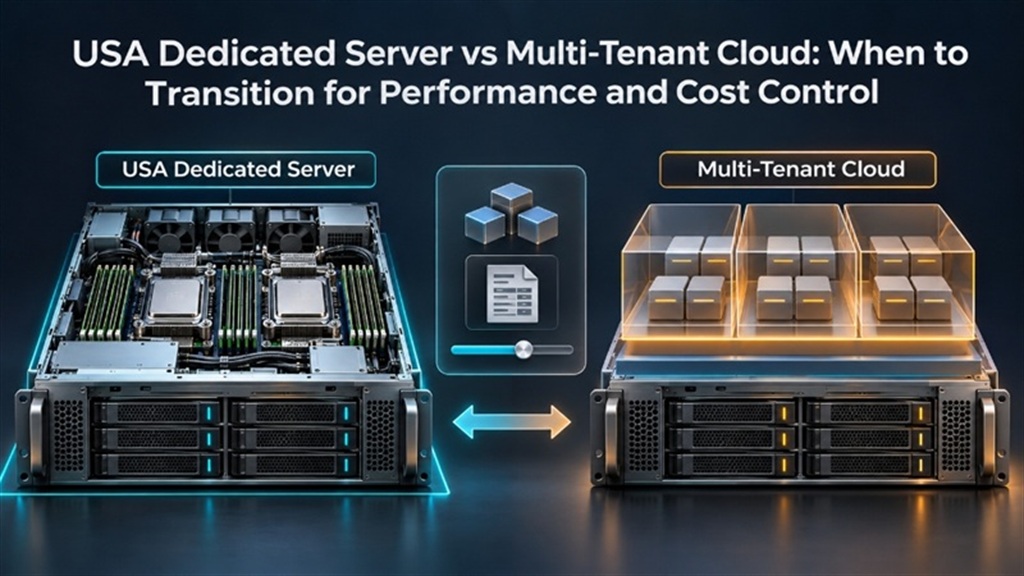
Knowing when to upgrade to dedicated server infrastructure is governed by clear telemetry thresholds: persistent CPU steal time exceeding 5%, storage I/O wait times surpassing 15%, memory overcommit thrashing, or monthly cloud bandwidth egress bills exceeding $500. Upgrading to high-performance USA dedicated servers eliminates virtualization bottlenecks, locks in predictable flat-rate operating costs, and delivers guaranteed physical silicon execution for scaling enterprise applications.
For enterprise infrastructure architects and systems administrators, evaluating USA Dedicated Server vs Multi-Tenant Cloud is critical for high-throughput transactional applications. Deploying on USA bare metal dedicated server infrastructure eliminates hypervisor scheduling contention, delivers unthrottled PCIe Gen4 NVMe throughput, and ensures deterministic instruction execution under peak loads.
Hardware Isolation
Single-tenant bare-metal cores with zero noisy-neighbor CPU steal and dedicated DDR5 ECC memory channels.
Ultra-Low Latency
Unmetered 1Gbps to 10Gbps transit with direct coastal peering and sub-millisecond optical backbone routes.
PCIe NVMe Storage
Enterprise NVMe RAID arrays delivering sustained 700K+ random read IOPS for mission-critical database operations.
Table of Contents: Technical Navigation Index 8 Chapters ▾
Navigate directly to detailed architectural analysis, hardware sizing benchmarks, deployment automation scripts, and peer verification resources:
Performance Degradation Indicators in Multi-Tenant Clouds
The earliest warning sign that an application has outgrown its virtual private server environment is fluctuating page response times that correlate with external multi-tenant activity rather than internal traffic spikes. In a shared cloud architecture, your virtual machine resides on a physical hypervisor host alongside dozens of unrelated tenant instances. When an adjacent tenant launches heavy video transcoding, synthetic compiling, or unoptimized database crawls, your instance experiences CPU steal time.
CPU steal time (reported as %st in Linux top or vmstat) measures the percentage of time that a virtual CPU wants to execute instructions but is denied execution cycles by the hypervisor because the physical CPU is busy serving other tenants. In high-concurrency production environments, even 3% to 5% CPU steal causes severe thread queuing in application runtimes such as PHP-FPM, Node.js, and Java JVM, doubling or tripling API latency. For foundational architecture context, systems engineers frequently reference our technical analysis on bare metal hardware isolation vs virtualized clouds to establish baseline compute sizing requirements.
Steal values consistently exceeding 3-5% directly degrade web server throughput and response consistency.
Disk I/O wait (%wa) exceeding 15% indicates hypervisor storage queue saturation and blocked system calls.
Shared disk latency variance triggers transactional lock escalation in MySQL and PostgreSQL databases.
Operating on unvirtualized silicon ensures deterministic instruction execution cycles, eliminates noisy neighbor memory bus congestion, and delivers guaranteed throughput for demanding enterprise workloads.
Storage Queue Bottlenecks and Memory Saturation
Storage performance constraints typically represent the most disruptive consequence of outgrowing cloud VPS hosting. Cloud providers implement strict IOPS throttling on virtual disks, capping standard virtual storage at 3,000 to 10,000 IOPS unless customers pay prohibitive pricing for provisioned IOPS tiers. As transactional write volume escalates, disk write queues back up, causing the Linux kernel to transition processes into uninterruptible sleep state (D-state).
This storage bottleneck cascades across your web stack: database queries halt, PHP worker pools become exhausted waiting for filesystem writes, and web servers begin returning HTTP 504 Gateway Timeout errors. Understanding the architectural differences between bare metal and virtual disks, and specifically zero-downtime VPS to dedicated migration playbook enables engineering leaders to identify whether storage queue bottlenecks can be resolved with direct PCIe NVMe Gen4 drive access.
Comparative Architectural Assessment
Evaluating virtualization overhead against dedicated bare metal involves quantifying hypervisor CPU cycle interception, memory bus saturation, and I/O wait latency across real-world enterprise workloads:
Standard cloud virtual disks artificially throttle storage queues to 3K-10K IOPS, causing Linux kernel D-state process delays and 504 gateway timeout cascades under sudden transactional surges.
Transitioning to dedicated bare-metal infrastructure unlocks 450,000+ random 4K read/write IOPS directly over PCIe lanes, ensuring deterministic sub-millisecond database response times.
Financial Tipping Points and Cloud Egress Surcharges
Beyond technical performance metrics, infrastructure economics provide a compelling justification for upgrading to USA dedicated server hosting. Hyperscale public clouds (such as AWS, Microsoft Azure, and Google Cloud) employ utility pricing models that penalize high-throughput workloads through punitive data egress fees, typically billing between $0.08 and $0.12 per gigabyte of outbound network traffic.
For an application transferring 20 terabytes of data monthly, cloud egress fees alone add $1,600 to $2,400 to the monthly infrastructure invoice, far exceeding the total rental cost of a high-end bare-metal dedicated server with unmetered 1Gbps or 10Gbps connectivity. Onlive Server’s bare metal plans in Missouri, New York, California, and Ohio provide predictable, fixed monthly billing with zero egress surcharges. Infrastructure capacity planners systematically evaluate deployment sizing through our guide on selecting multi-core Intel Xeon vs AMD EPYC processors before finalizing dedicated server hardware configurations.
Hardware Architecture Specifications & Core Sizing Matrix
Key hardware infrastructure sizing parameters must be systematically evaluated across the following production architectural components:
- • Unmetered Bandwidth Economics: Fixed monthly hosting costs eliminating surprise bandwidth billing spikes during seasonal traffic peaks.
- • Zero Egress Penalties: Transfer tens or hundreds of terabytes monthly without incremental bandwidth penalties or per-GB billing.
- • High Compute Density: Access to up to 24-core AMD EPYC processors and 256GB ECC RAM at a fraction of cloud instance pricing.
- • Hardware Lifecycle Longevity: Deploy custom long-term environments with predictable multi-year total cost of ownership (TCO).
Telemetry Script for Detecting VPS Saturation
System administrators can objectively diagnose whether a virtual private server has surpassed its operational capacity using automated Linux telemetry monitoring. The shell script below collects CPU steal time, I/O wait metrics, memory pressure counters, and disk latency to generate an automated upgrade diagnostic scorecard:
Production Implementation & Verification Runbook
Executing automation or configuration changes in a production enterprise environment requires a structured protocol to ensure system continuity, audit logging, and zero unplanned service interruptions:
Confirm active root privileges (whoami), verify available filesystem storage on /tmp and /var/log, and inspect active kernel modules with lsmod before applying configuration deltas.
Deploy changes during scheduled low-traffic windows. Capture real-time diagnostic output using standard redirection (tee -a /var/log/audit-runbook.log) to preserve execution timestamps and return codes for compliance auditing.
Execute immediate regression testing by verifying active service sockets (ss -tulpn), inspecting system error logs (journalctl -xe --since "10 minutes ago"), and checking hardware health sensor telemetry via IPMI.
Maintain validated configuration snapshots (e.g. cp /etc/sysctl.conf /etc/sysctl.conf.bak) and scripted recovery triggers to instantly revert parameters if latency or error rates exceed established SLA thresholds.
Run this diagnostic audit continuously for 24 to 48 hours covering peak business hours. If CPU steal or I/O wait thresholds trigger CRITICAL alerts during normal operations, immediately plan your dedicated server migration. When deploying automation and kernel parameters in enterprise production, sysadmins should cross-reference technical requirements against the official Linux iostat manual and I/O performance documentation.
Planning the Transition to Dedicated Infrastructure
Executing a seamless transition from a virtual private server to dedicated hardware requires a structured migration roadmap. Sysadmins must perform hardware provisioning and burn-in testing on the new bare-metal node before transferring production traffic. Reviewing our comprehensive playbook for a
ensures that database replication cutovers, DNS TTL reductions, and file delta synchronizations occur without disrupting customer transactions. Furthermore, configuring out-of-band IPMI management on the target bare metal server ensures remote disaster recovery capabilities from day one. Proactive operational reliability and failure domain mitigation require adhering to established guidelines for eliminating noisy neighbor resource contention.
Lowering DNS TTL values to 300 seconds 72 hours prior to cutover to ensure instantaneous IP migration.
Establishing continuous transactional replication to eliminate data drift during final cutover.
Stress-testing physical CPU, ECC memory, and NVMe drives prior to initiating production data transfers.
Production Resilience & Failure Domain Hardening
To eliminate single points of failure across bare-metal server infrastructure, systems engineering teams must implement defense-in-depth architectural safeguards:
Maintain independent network routing for IPMI / BMC management interfaces to preserve administrative control during core network saturation or OS kernel panics.
Configure Linux kdump with reserved memory allocations to capture crash dumps (vmcore) for root-cause post-mortem diagnostics following critical system halts.
Configure daemonized SMART and software/hardware RAID monitoring to instantly alert NOC engineers upon drive read retry rate anomalies.
Leverage redundant upstream carrier paths to dynamically route around regional fiber cuts and upstream Autonomous System (AS) routing anomalies.
Hardware Telemetry & Architectural Comparison
Onlive Server delivers robust, high-performance USA dedicated servers across carrier-neutral facilities in Missouri, Dallas (Texas), Florida, Ohio, California, and New York. Offering raw unthrottled hardware from Intel Core i5/i7 to AMD EPYC 7402P processors with unmetered 1Gbps/10Gbps network connectivity, our infrastructure eliminates cloud virtualization overhead starting at just $44/month.
| Operational Metric | Normal VPS Range | Threshold Requiring Dedicated Server | Onlive Server Dedicated Capacity |
|---|---|---|---|
| CPU Steal (%st) | < 1.0% | > 3.0% – 5.0% sustained | 0.0% (Dedicated Physical Cores) |
| I/O Wait (%wa) | < 5.0% | > 12.0% – 15.0% sustained | < 0.5% (Direct PCIe Gen4 NVMe) |
| Database Latency | < 5ms | > 25ms query execution variance | < 1ms deterministic execution |
| Monthly Outbound Bandwidth | < 2 TB | > 5 TB with cloud egress charges | Unmetered 1Gbps / 10Gbps Standard |
| Resource Isolation | Shared Kernel/Hypervisor | Multi-tenant contention risk | 100% Single-Tenant Physical Isolation |
All Onlive Server USA dedicated hosting nodes include dedicated IPMI 2.0 remote out-of-band management, 24/7 proactive hardware replacement guarantees, and unmetered Tier-1 network uplinks to ensure uncompromising enterprise operational continuity.
Related Technical Deep-Dives
Expand your systems engineering expertise across our interconnected dedicated hosting architecture series:
In-depth hardware analysis, telemetry comparisons, and production benchmarks.
Technical deployment runbook, automated scripts, and system hardening guidelines.
High-performance dedicated server plans across Tier-3 data centers in the United States.
Frequently Asked Questions
When should a business switch to a dedicated server? +
A business should switch to a dedicated server when its applications experience persistent CPU steal time over 3-5%, high disk I/O wait times over 15%, sudden performance degradation during peak hours, monthly cloud bandwidth bills exceeding $500, or when strict regulatory compliance (HIPAA, PCI-DSS Level 1) mandates single-tenant physical hardware isolation.
How much traffic can a dedicated server handle? +
A modern bare-metal dedicated server (such as an AMD Ryzen 5900X or AMD EPYC with 64GB-128GB RAM and NVMe storage) can comfortably handle 10 million to 50 million page views per month or over 5,000 to 15,000 concurrent active users when properly optimized with NGINX, Redis caching, and PHP-FPM/MySQL tuning.
What is CPU steal time and why is it dangerous on a VPS? +
CPU steal time is the percentage of time a virtual CPU spends waiting for real physical CPU cycles because the hypervisor is busy servicing other virtual machines sharing the host. On a VPS, CPU steal over 5% drastically slows database transactions, spikes web response latency, and causes random application timeouts.
How much can I save migrating from AWS or Azure to bare metal? +
Companies running high-compute, database-heavy, or bandwidth-intensive workloads typically save 50% to 75% on infrastructure costs by migrating from AWS EC2 or Azure VMs to dedicated bare metal. Eliminating metered cloud data egress fees ($0.08-$0.12/GB) often accounts for thousands of dollars in monthly operational savings alone.
Is upgrading from VPS to dedicated difficult or disruptive? +
No, with a staged zero-downtime migration strategy utilizing rsync file synchronization, MySQL master-slave replication, and low DNS TTL scheduling, the transition from VPS to dedicated bare metal can be executed with zero data loss and less than 60 seconds of maintenance window cutover.
Do I need advanced sysadmin experience to run bare metal? +
While having Linux sysadmin skills provides maximum flexibility, you can deploy modern web control panels like cPanel/WHM, Plesk, or CloudPanel on your dedicated server to manage domains, databases, emails, and SSL certificates with standard graphical interfaces.
What is the minimum contract commitment for USA dedicated servers? +
Onlive Server offers flexible monthly billing without long-term lock-in, as well as substantial discounts (up to 20% off) for semi-annual, annual, or triennial pre-payment terms across all USA dedicated server models.
Can I upgrade RAM or NVMe storage on my dedicated server later? +
Yes, our dedicated server chassis are fully modular. If your memory or storage requirements expand, our 24/7 datacenter technical team can perform scheduled hardware upgrades to install additional ECC RAM modules or additional NVMe/SATA enterprise storage drives.
Upgrade to Enterprise High-Performance USA Dedicated Servers
Eliminate CPU steal time and cloud bandwidth egress penalties. Deploy high-performance USA dedicated servers in Missouri, New York, California, and Ohio with 100% bare-metal performance, NVMe storage, and unmetered 1Gbps/10Gbps ports.
Upgrade to Dedicated Server Hosting in the USA →