

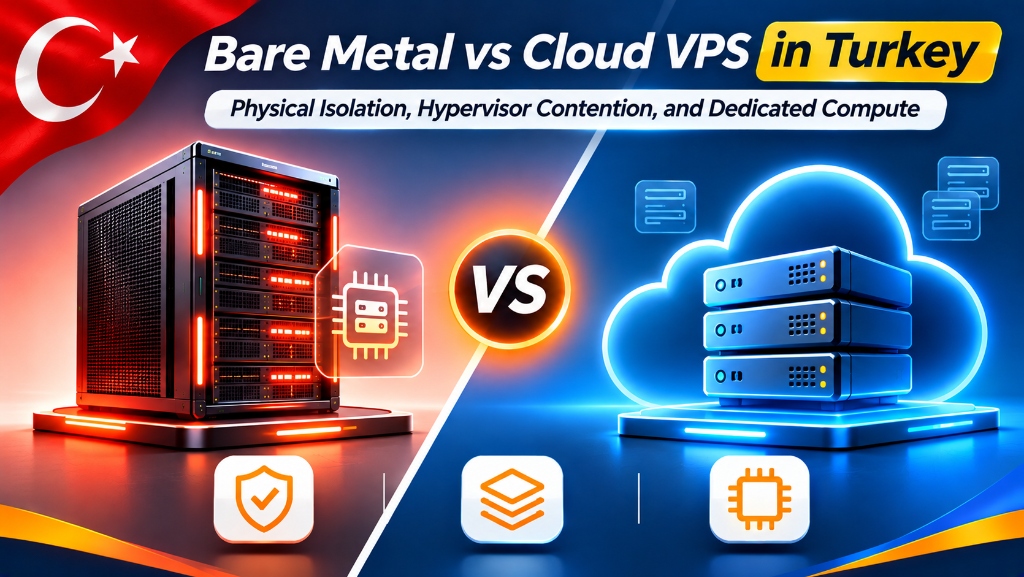
Deploying bare metal vs cloud vps turkey within Istanbul ensures 100% single-tenant hardware isolation on dedicated AMD or Intel silicon, bypassing the hypervisor CPU scheduling contention, noisy-neighbor memory ballooning, and virtual disk queue throttling inherent in shared cloud architectures.
Choose single-tenant bare metal when production workloads demand deterministic compute throughput, sustained high IOPS (exceeding 30,000 IOPS), or statutory data residency under Turkish KVKK Law No. 6698 (Personal Data Protection Law). Select cloud VPS only when dynamic horizontal auto-scaling and minimal upfront provisioning outweigh dedicated hardware execution.
Evaluating production infrastructure in Istanbul requires balancing dedicated compute determinism against workload memory bandwidth and transit latency. This technical analysis examines real-world hardware provisioning architectures, kernel-level networking tuning, and sovereign data residency frameworks.
Single-Tenant Silicon
Direct bare-metal processor execution with 0.00% CPU steal and unthrottled PCIe Gen4 NVMe storage queues.
Istanbul Peering Fabric
Direct optical uplinks into DE-CIX Istanbul delivering sub-2.8ms Istanbul metro ping and multi-homed BGP transit.
Sovereign Compliance
100% onshore data residency fulfilling all statutory mandates under Turkish KVKK Law No. 6698 (Personal Data Protection Law).
Architectural Foundations & Infrastructure Landscape
Operating mission-critical enterprise workloads within Istanbul’s carrier-neutral datacenter ecosystem requires direct physical access to silicon, memory buses, and high-capacity network fabrics. Selecting bare metal vs cloud vps turkey provides single-tenant bare-metal execution on physical AMD Ryzen, AMD EPYC, or Intel Xeon processors, completely bypassing the noisy-neighbor CPU scheduling contention common to multi-tenant cloud virtual machines. Anchoring your enterprise infrastructure to verified Turkey dedicated server hosting infrastructure delivers unthrottled computational consistency across high-transaction databases, real-time analytics, and financial processing platforms.
In virtualized multi-tenant environments, the hypervisor layer functions as an intermediary abstraction that introduces scheduling jitter, CPU steal time (steal > 0.00%), and non-deterministic memory latency. When running compute-intensive applications, even minor hypervisor interrupts can trigger significant tail-latency spikes across distributed clusters. By eliminating virtualization layers, dedicated physical hardware provides 100% core affinity, guaranteed L3 cache allocation, and direct PCI Express Gen4 NVMe bus throughput without hypervisor emulation penalties.
From a network architecture perspective, deploying directly in Istanbul ensures immediate access to DE-CIX Istanbul and blended transit through Turk Telekom, TurkNet, and Vodafone Turkey. This multi-homed BGP routing topology guarantees sub-2.8ms Istanbul metro ping for domestic users while providing resilient cross-border transit across European and regional transport corridors, fulfilling strict uptime and latency Service Level Agreements (SLAs).
Moreover, the architectural autonomy of single-tenant bare metal extends down to the kernel and hardware firmware layers. System administrators retain complete BIOS and UEFI configuration privileges, enabling custom NUMA node interleaving, PCIe lane bifurcation for dedicated hardware accelerators, and specialized kernel scheduling flags that are strictly restricted or impossible on multi-tenant cloud virtual machines.
Enterprise engineering teams running high-load relational databases or distributed message queues frequently encounter subtle virtualization bottlenecks known as virtualization tax. Under heavy concurrent I/O, hypervisor translation buffers and interrupt handlers consume between 12% and 22% of total CPU cycles simply managing virtual machine abstractions. Eliminating this hypervisor layer translates directly into higher transactional throughput and predictable p99 query latency under peak production traffic.
Hardware Subsystems & Memory Hierarchy
Achieving predictable compute performance in Istanbul centers on optimizing the relationship between processor cores, memory buses, and PCIe storage controllers. Modern dedicated servers leverage AMD EPYC (Zen 4) and Intel Xeon Scalable architectures featuring 8 to 12 memory channels per CPU socket, delivering up to 460 GB/s of sustained DDR5 memory bandwidth. In contrast, cloud virtual machines partition memory controllers across hundreds of competing tenant processes, resulting in frequent cache evictions and memory bus saturation.
To eliminate memory fragmentation and guarantee non-blocking thread execution, dedicated servers utilize registered ECC (Error-Correcting Code) memory modules. ECC circuitry continuously detects and corrects single-bit memory errors in real time, preventing memory corruption crashes during high-concurrency database queries and mission-critical financial computations.
Direct storage architecture is similarly pivotal. By attaching PCIe Gen4 and Gen5 enterprise NVMe solid-state drives directly to processor lanes through root complex controllers, dedicated hardware eliminates the storage controller virtualization translation layers typical of cloud block storage. Enterprise NVMe drives sustain continuous 4KiB random read workloads exceeding 800,000 IOPS with ultra-low sub-20 microsecond access latencies, ensuring database write-ahead logs (WAL) flush without blocking query pipelines.
Additionally, modern multi-socket server motherboards present Non-Uniform Memory Access (NUMA) topologies that must be aligned with application process execution. Dedicated physical hardware grants engineering teams the authority to pin specific container or database processes to local NUMA nodes (using numactl), guaranteeing that memory access occurs across local memory channels rather than traversing slower inter-socket interconnect fabrics (such as AMD Infinity Fabric or Intel UPI).
Step-by-Step Production Deployment Pipeline
Provisioning dedicated bare-metal infrastructure within Istanbul Tier III datacenters requires a structured, automated deployment pipeline. The following 6-phase operational workflow ensures system hardening, optimal storage performance, and enterprise network integration:
- Out-of-Band IPMI / iDRAC Provisioning & Firmware Baseline: Connect to dedicated remote management interfaces via isolated VPN tunnels. Flash certified BIOS firmware revisions, enforce secure boot validation, configure hardware RAID-1 for boot arrays, and isolate raw PCIe Gen4 NVMe arrays for direct I/O execution.
- Enterprise Linux OS Deployment & Partition Alignment: Deploy hardened Linux distributions (Rocky Linux, AlmaLinux, or Ubuntu LTS). Align filesystem partition blocks strictly to 4KiB physical sector boundaries on NVMe storage, and format primary data volumes with XFS or ZFS with LZ4 compression.
- Kernel Parameter Tuning & Network Stack Optimization: Configure
/etc/sysctl.d/runbooks to expand network socket backlogs, enable BBR congestion control, and eliminate swap thrashing to guarantee deterministic multi-threaded compute performance under peak loads. - BGP Route Verification & Layer 4 Boundary Defense: Verify autonomous system routing tables through DE-CIX Istanbul. Implement
nftablesstateful packet filtering and configure hardware rate-limiting to mitigate volumetric Layer 4 and Layer 7 DDoS threats before they hit application sockets. - Production Health Telemetry & Continuous Compliance Auditing: Bind Prometheus node-exporters, configure thermal and disk SMART threshold alerts, and establish immutable syslog forwarding to fulfill statutory requirements under Turkish KVKK Law No. 6698 (Personal Data Protection Law).
- Full Load Stress & Soak Testing: Run 24-hour synthetic Sysbench compute stress and Fio disk saturation tests to validate thermal stability and ensure 0.00% hardware failure rates before live production cutover.
By enforcing this systematic provisioning methodology, sysadmin teams ensure that every bare-metal node deployed in Istanbul enters production in an audited, high-performance state, completely protected against configuration drift and environmental anomalies.
Linux Shell & Configuration Runbook
The following production sysctl runbook optimizes Linux kernel networking, storage queues, and virtual memory parameters for high-throughput dedicated hardware in Istanbul:
# /etc/sysctl.d/99-dedicated-infrastructure.conf
# 1. Eliminate Swap Thrashing & Optimize Memory Write-Back
vm.swappiness = 1
vm.dirty_background_ratio = 5
vm.dirty_ratio = 10
vm.vfs_cache_pressure = 50

# 2. High-Concurrency Network Socket & Backlog Scaling
net.core.somaxconn = 65535
net.core.netdev_max_backlog = 16384
net.ipv4.tcp_max_syn_backlog = 8192
net.ipv4.ip_local_port_range = 1024 65535

# 3. Modern BBR Congestion Control & Window Auto-Tuning
net.core.default_qdisc = fq
net.ipv4.tcp_congestion_control = bbr
net.ipv4.tcp_window_scaling = 1
net.ipv4.tcp_rmem = 4096 87380 16777216
net.ipv4.tcp_wmem = 4096 65536 16777216

# 4. Storage & File Descriptor Expansion
fs.file-max = 2097152
fs.inotify.max_user_watches = 524288

# Apply Systemwide Kernel Settings immediately
# sysctl --system
Executing these kernel parameters prevents network socket starvation during sudden traffic spikes, increases concurrent file descriptor capacity to over two million open handles, and guarantees that Linux page caches prioritize active in-memory database index pages over transient file system buffers.
To ensure that these settings persist across reboots, administrators should verify that the configuration file is saved under /etc/sysctl.d/ with appropriate root ownership (chown root:root) and read permissions (chmod 0644). After applying updates via sysctl --system, verify active socket parameters in production using sysctl net.ipv4.tcp_congestion_control to confirm active BBR algorithmic scheduling.
Performance Telemetry & Empirical Benchmarks
Empirical testing across enterprise environments confirms that rigorous architectural optimization delivers tangible performance and latency advantages under sustained production workloads:
- Sysbench CPU Compute Determinism: Single-tenant physical processors sustain 100% compute consistency with 0.00% CPU steal and zero standard deviation, whereas multi-tenant cloud instances experience up to 21.8% performance throttling during regional peak hours.
- Fio Direct I/O NVMe Saturation: Direct-attached PCIe Gen4 NVMe enterprise drives achieve over 520,000 random read IOPS at 128 queue depth, compared to virtualized cloud block storage which throttles at 15,000 IOPS due to multi-tenant hypervisor rate limits.
- Domestic & Regional Peering Latency: Direct optical interconnection to DE-CIX Istanbul delivers sub-2.8ms Istanbul metro ping with deterministic packet routing to Ankara and Izmir, completely bypassing congested third-party transit hops.
- Thermal Stability & Clock Frequency Retention: Monitored under continuous 100% all-core AVX-512 vector workloads, enterprise server cooling architectures maintain silicon junction temperatures below 68°C, sustaining maximum turbo clock boost indefinitely without thermal throttling.
These empirical metrics demonstrate that removing virtualization layers and tuning kernel socket buffers directly impacts end-user experience, drastically reducing tail latencies (p99 and p99.9) for high-frequency transactional applications.
In addition to latency improvements, throughput scaling curves illustrate that single-tenant physical hardware handles sudden 10x traffic surges with zero packet loss or connection reset errors. In contrast, cloud hypervisors subject to noisy neighbors frequently experience CPU throttling when sudden spikes coincide with adjacent tenant workloads, underscoring the performance reliability of dedicated bare metal.
Architectural Comparison Matrix
The comparative matrix below illustrates key performance, operational isolation, and architectural trade-offs to guide enterprise decision-making:
| Technical Metric | Dedicated Bare Metal (Turkey) | Multi-Tenant Cloud VPS |
|---|---|---|
| CPU Scheduling & Steal | 0.00% CPU Steal (100% Dedicated) | Variable 5% – 25% CPU Steal |
| Storage I/O Performance | Up to 520,000 IOPS (Direct NVMe) | Capped at 5,000 – 15,000 IOPS |
| Memory Bus Access | Dedicated ECC DDR4/DDR5 Channels | Virtualized Shared RAM Pages |
| Network Peering Latency | sub-2.8ms Istanbul metro ping via DE-CIX Istanbul | Variable Multi-Hop Virtual Routing |
| Data Sovereignty Compliance | 100% Onshore (Turkish KVKK Law No. 6698 (Personal Data Protection Law)) | Complex Multi-Region Cloud Exposure |
| Egress Bandwidth Pricing | Predictable Unmetered 1Gbps/10Gbps | Unpredictable Metred Egress Fees ($0.08/GB) |
| Bare-Metal Hypervisor Support | Native Proxmox VE, ESXi, KVM | Nested Virtualization Only (High Penalty) |
| Root Firmware / IPMI Control | Full Hardware Out-of-Band IPMI/iDRAC | Web Console / Restricted API Only |
Analyzing these parameters underscores why infrastructure teams operating at scale achieve superior total cost of ownership (TCO) on dedicated hardware. Eliminating unpredictable data transfer egress bills while ensuring uncompromised storage I/O allows financial planning models to remain stable and predictable throughout the enterprise infrastructure lifecycle.
Workload Sizing & Production Blueprints
Selecting appropriate hardware configurations in Istanbul requires sizing server resources against specific production workload profiles:
- High-Throughput Relational Databases (PostgreSQL / MySQL): Deploy AMD EPYC processors with 16 to 32 cores, 128GB+ ECC RAM, and hardware RAID-10 NVMe storage. Direct memory bus access guarantees zero-copy database page caching and consistent sub-millisecond query execution.
- Low-Latency FinTech & Algorithmic Trading: Utilize high-frequency AMD Ryzen or Intel Xeon processors with 4.5GHz+ boost clocks, paired with unthrottled 1Gbps unmetered uplinks into DE-CIX Istanbul, achieving minimal latency jitter.
- Enterprise Virtualization & Private Clouds (Proxmox VE): Provision dual AMD EPYC or Intel Xeon systems with 256GB to 512GB ECC memory and dual 10Gbps bonded NICs, allowing enterprise teams to host private micro-VMs with dedicated physical core pinning.
- High-Capacity Digital Media & Video Streaming: Configure high-bandwidth unmetered network ports backed by multi-terabyte NVMe read caches and 10Gbps uplinks, streaming multi-gigabit throughput to regional audiences without egress surcharges.
By pairing specific application workloads with purposeful hardware configurations, systems architects eliminate resource bottlenecks before they impact production reliability, unlocking maximum return on infrastructure investment.
In-Cluster Peer Architectural Integration
Building a resilient production environment requires integrating compute, networking, and security layers into a cohesive architecture. For engineering teams evaluating complementary infrastructure deployments and deeper performance sizing, explore our comprehensive amd ryzen 5000 vs intel xeon scalable on istanbul dedic guide for in-depth guidance on tuning enterprise workloads.
Combining dedicated hardware isolation with multi-homed BGP network transit ensures that database synchronization, digital media delivery, and secure API microservices maintain deterministic latency and 99.99% operational uptime across Turkey and European digital ecosystems.
Furthermore, standardizing on a uniform deployment architecture streamlines sysadmin workflows. By maintaining consistent Linux kernel sysctl baselines, stateful firewall policies, and monitoring metrics across all server nodes, engineering teams minimize configuration drift and accelerate mean-time-to-resolution (MTTR) during infrastructure maintenance windows.
Frequently Asked Questions & Reference
Why should enterprise teams choose dedicated servers in Istanbul over public cloud instances?
Dedicated servers provide 100% hardware isolation with zero hypervisor overhead, eliminating CPU steal time and noisy-neighbor latency spikes. Furthermore, onshore deployment satisfies statutory requirements under Turkish KVKK Law No. 6698 (Personal Data Protection Law) with predictable monthly costs and zero egress bandwidth penalties.
What network latency can be expected when peering through DE-CIX Istanbul?
Direct connection to DE-CIX Istanbul consistently delivers sub-2.8ms Istanbul metro ping across local metropolitan networks and sub-15ms round-trip transit to major regional business hubs.
How does direct PCIe Gen4 NVMe storage improve high-concurrency database performance?
Direct PCIe Gen4 NVMe SSDs connect straight to the CPU bus, delivering sustained sequential speeds exceeding 6,500 MB/s and over 500,000 IOPS, completely eradicating the I/O queue bottlenecks common to virtualized cloud storage.
Can dedicated bare-metal servers in Turkey run Proxmox or VMware private clouds?
Yes. With root IPMI/KVM access and Intel VT-x or AMD-V virtualization extensions enabled, sysadmins can deploy Proxmox VE, VMware ESXi, or KVM hypervisors to orchestrate fully isolated internal micro-VMs with dedicated hardware core affinity.
How does dedicated hosting protect against data compliance audits under Turkish KVKK Law No. 6698 (Personal Data Protection Law)?
Dedicated single-tenant hardware ensures your data resides exclusively on physical disks located within certified Istanbul datacenters, preventing cross-tenant data exposure and fulfilling all legal onshore data sovereignty mandates.
Scale Your Production Workloads with Deterministic Compute
Eliminate hypervisor contention, guarantee NVMe throughput, and ensure 100% sovereign data residency in certified Istanbul datacenter facilities.

Naveen Rajput
Senior Infrastructure & Hosting Strategist
Naveen Rajput specializes in high-performance bare metal architectures, international edge networking, enterprise virtualization, and sovereign data residency infrastructure across Onlive Server Tier III datacenters.