

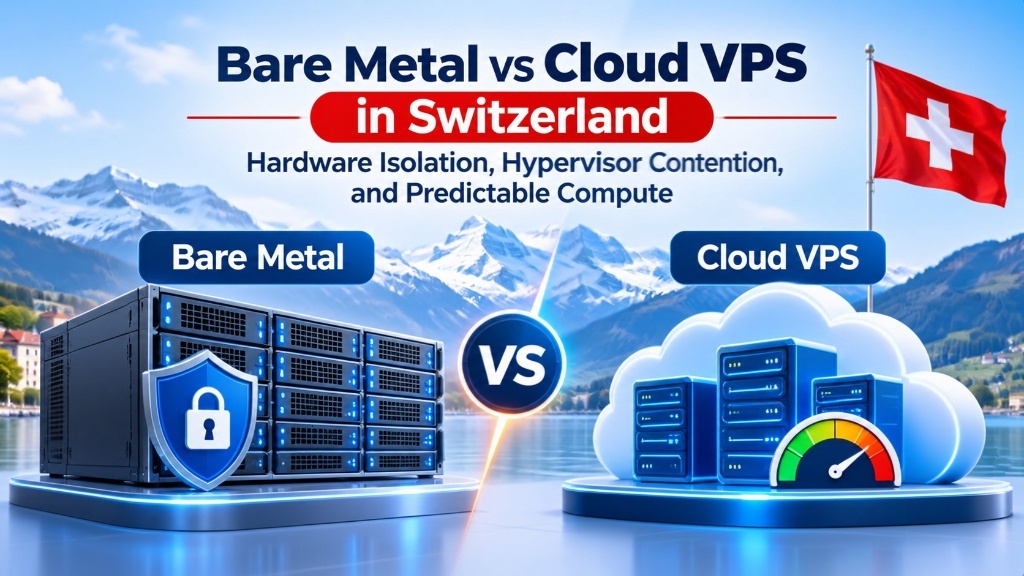
Choosing between a bare metal vs cloud VPS in Switzerland hinges on one measurable threshold: whether shared hypervisors cause CPU steal, storage I/O stalls, or steep egress fees for your workload. A cloud VPS slices one physical host across multiple tenants for rapid elasticity. A Zurich bare-metal server dedicates every physical core, memory channel, and local drive to one tenant, paying off once steady utilization or monthly transfer volume crosses predictable baselines.
Cloud VPS shares host CPUs, L3 cache, and storage fabrics through a hypervisor; bare metal dedicates physical silicon to one tenant.
%steal and storage await on your current VPS before assuming migration is needed.Verified Onlive Server Zurich plans start at $78/mo (DSX29: EPYC 3151, 4C, 32 GB, 2x8TB HDD, 1 Gbps) and $91–$144/mo for single-NVMe tiers (DSX30, DSX31).
DSX30, DSX31) before placing production databases on them.AWS eu-central-2 bills $0.09/GB (first 10 TB after 100 GB free) plus $0.01/GB cross-AZ each way; Azure Switzerland North bills ~$0.087/GB.
Measuring Multi-Tenant VPS Contention Before Migrating
Moving from a Swiss cloud VPS to physical bare metal because an application "feels sluggish" is a frequent architectural mistake. Missing database indexes or undersized PHP/JVM worker pools stay slow on dedicated silicon. Before approving a migration, capture empirical contention telemetry inside your existing virtual instance during peak business hours.
On Linux KVM or Xen cloud guests, three kernel metrics separate multi-tenant contention from application bugs:
- CPU Steal Time (
%steal/st): The share of time a runnable vCPU waits for the host hypervisor to schedule it onto a physical core occupied by sibling VMs. Sustained bursts of 5% to 15% steal directly inflate p95 and p99 response times even under moderate guest CPU load. - Block I/O Latency (
r_await,w_await): Virtualized block devices route writes through virtio queues, network storage fabrics, and volume IOPS caps. When burst credits deplete or neighboring tenants saturate shared storage, commit latency spikes sharply. - Linux Pressure Stall Information (PSI): Exposed under
/proc/pressure/on Linux 4.20+, PSI reports the exact share of wall-clock time tasks stall waiting on CPU, memory, or I/O.
Safe Read-Only Contention Diagnostic Runbook
These commands are strictly read-only and do not alter disks, sysctls, or firewall rules. Run them on your Swiss VPS during peak load and compare against off-peak baselines:
If %steal remains near 0.00% while %usr hits 95%, you have an application concurrency or sizing bottleneck. Recurring %steal above 3%–5%, erratic w_await spikes when cloud storage burst credits run dry, or sustained some avg60 stalls in /proc/pressure/io confirm that hypervisor and shared-storage contention is hurting production latency.
VPS-to-Bare-Metal Migration Trigger Matrix
| Observed Production Symptom | Diagnostic Metric | Primary Bottleneck Source | Recommended Action |
|---|---|---|---|
| Intermittent p99 API spikes at moderate guest CPU | mpstat %steal > 3%–5% during peaks |
Host CPU oversubscription / vCPU scheduling delay | Move to single-tenant Zurich bare metal or dedicated-core tier. |
| Database commit stalls during checkpoints or vacuums | iostat -xz w_await spikes + high aqu-sz |
Virtualized block IOPS caps or depleted burst credits | Place stateful database on mirrored local NVMe bare metal. |
| Bandwidth dominates the monthly cloud bill | Billing report showing >3–5 TB/mo egress | Per-GB cloud transfer fees ($0.087–$0.09/GB) |
Evaluate Zurich bare metal with verified port and traffic policy. |
| Steady 24/7 load >60% on 8+ vCPUs / 32+ GB RAM | 90-day monitoring averages | Paying elastic on-demand premium for static compute | Run a 36-month TCO comparison against fixed-rate bare metal. |
| Spiky dev/staging traffic idle 80% of the week | Utilization graphs with long idle valleys | Short-lived elastic demand | Keep cloud VPS or containers; bare metal wastes idle capacity. |
Single-Tenant Hardware Isolation Across Zurich Entry Tiers
Removing the hypervisor changes three hardware boundaries at once: CPU scheduling, memory locality, and local disk access. Your Linux kernel addresses physical cores, L1/L2/L3 caches, ECC RAM channels (on ECC-capable platforms), and local PCIe or SATA drives directly. No sibling tenant shares your instruction pipeline or evicts hot database pages from last-level cache.
Physical isolation also reduces multi-tenant security exposure. Shared hypervisors continuously patch speculative execution side-channel flaws across co-located customers, adding context-switch overhead and maintenance reboots. Single-tenant metal eliminates third-party guests on your socket.
Be exact, however, about Swiss data-protection law. Under the revised Swiss Federal Act on Data Protection (revFADP / nDSG), in force since September 1, 2023 and supervised by the Federal Data Protection and Information Commissioner (FDPIC / EDÖB), Zurich bare metal supports data-residency goals, yet Swiss hosting alone never guarantees legal compliance or immunity from foreign legal process. Businesses serving EU residents remain subject to EU GDPR Article 3(2), breaches must be reported to the FDPIC "as soon as possible" under revFADP Article 24, and willful statutory violations carry individual criminal fines up to CHF 250,000. Review the technical controls required under the Swiss revFADP (nDSG) before designing regulated systems.
Verified Zurich Bare-Metal Entry and Mid-Range Configurations
Many teams assume dedicated hardware in Zurich starts above $500/month. Onlive Server's verified 32-plan Zurich catalog starts at $78/month and spans entry storage nodes, high-clock Ryzen compute, and multi-socket Xeon builds:
| Plan Code | Processor & Cores | RAM | Storage | Listed Uplink | Monthly USD | Primary Role |
|---|---|---|---|---|---|---|
DSX29 |
AMD EPYC 3151 (4C, 2.7 GHz) | 32 GB | 2x8TB HDD | 1 Gbps | $78 | Entry storage, backup target, low-concurrency apps |
DSX30 |
AMD EPYC 3151 (4C, 2.7 GHz) | 32 GB | 1TB NVMe (single) | 1 Gbps | $91 | Entry NVMe test node (add 2nd NVMe for mirror) |
DSX32 |
AMD EPYC 3151 (4C, 2.7 GHz) | 32 GB | 2x18TB HDD | 1 Gbps | $130 | High-capacity archive, media, or immutable backups |
DSX31 |
AMD Ryzen 9700X (8C, 3.8 GHz) | 64 GB | 1TB NVMe (single) | 1 Gbps | $144 | High-clock compute (add 2nd NVMe for RAID 1/ZFS) |
DSX26 |
2x Xeon Gold 6140 (36C, 2.3 GHz) | 256 GB | 2×1.92TB SSD | 1 Gbps | $260 | High-RAM virtualization or mid-tier database |
DSX1 |
Intel Xeon E-2388G (8C, 3.2 GHz) | 32 GB | 2x500GB SSD | 10 Gbps | $329 | High-clock web/API node with 10 Gbps uplink |
DSX27 |
AMD Ryzen 9950X (16C, 4.3 GHz) | 128 GB | 2x2TB NVMe | 1 Gbps | $375 | Dual-NVMe production compute, CI, or OLTP |
Two procurement differences catch VPS buyers off guard:
- Single-Drive Redundancy Gaps: Cloud VPS storage replicates underneath your VM automatically. On bare metal, five Zurich SKUs—including
DSX30(1TB NVMe) andDSX31(1TB NVMe)—ship with one physical drive. Add a matched second NVMe drive in the cart before running stateful production workloads so you can build RAID 1 or a ZFS mirror. - Explicit Silicon Selection: Bare metal replaces vague vCPU labels with distinct architectures: high-clock Ryzen/Xeon E vs multi-socket Xeon Scalable and EPYC. See our breakdown comparing AMD EPYC, Ryzen, and Intel Xeon processors in Zurich to avoid mismatched cores or memory channels.
Storage, Port Speed, and Memory Economics Compared to Swiss Cloud VPS
Comparing headline compute rates misses the three line items that dominate Swiss cloud invoices over 12 to 36 months: outbound data transfer, provisioned IOPS, and RAM ratios.
Outbound Egress and Cross-AZ Transfer Charges
Under verified pricing for AWS Europe (Zurich) eu-central-2, accounts get 100 GB/month of free internet egress, then pay $0.09/GB for the first 10 TB, $0.085/GB for 10–50 TB, $0.07/GB for 50–150 TB, and $0.05/GB above 150 TB—plus $0.01/GB in each direction for cross-AZ traffic. Azure Switzerland North similarly offers 100 GB/month free, then bills roughly $0.087/GB (first 10 TB), $0.083/GB (10–50 TB), and $0.07/GB (50–150 TB).
Across Zurich dedicated plans, physical uplinks span 1 Gbps (DSX29–DSX32, DSX26, DSX27), 2 Gbps (DSX22, DSX24, DSX25), 10 Gbps (DSX1, DSX3, DSX5, DSX28), 20 Gbps (DSX2, DSX11, DSX12, DSX20), and 40 Gbps (DSX10, DSX13). Because unmetered fair-use vs TB-allotment terms vary by SKU, confirm exact bandwidth terms in the live cart. For port math across all five tiers, see calculating monthly bandwidth capacity across Zurich uplink tiers.
Provisioned Block IOPS vs Local Flash
AWS EBS gp3 volumes include 3,000 IOPS and 125 MB/s baseline throughput; exceeding that baseline incurs recurring per-IOPS and throughput surcharges alongside snapshot fees. Local dual-NVMe bare metal (DSX27 2x2TB NVMe or DSX28 2×3.84TB NVMe) attaches flash directly inside the chassis with zero per-IOPS billing.
Hypothetical Monthly Cost Comparison (Illustrative Model Only)
The table below is a HYPOTHETICAL model showing how egress and steady RAM shift monthly economics—not a quote or guaranteed savings projection. Actual totals depend on cloud commitments, VAT, backup storage, and engineering labor.
| Cost Component | Hypothetical Swiss Cloud Profile (8 vCPU, 64 GB RAM, 1 TB Disk, 10 TB/mo Egress) | Hypothetical Zurich Bare-Metal Profile (DSX27: Ryzen 9950X 16C, 128 GB RAM, 2x2TB NVMe, 1 Gbps) |
Cost Takeaway |
|---|---|---|---|
| Compute + RAM + Storage | Variable by provider/term (often $250–$450/mo on-demand in Swiss regions before extra IOPS) | $375/mo listed catalog rate (verify cart taxes & billing cycle) | Includes 2x RAM (128 GB) and mirrored-ready dual 2TB NVMe upfront. |
| Outbound Egress (10 TB/mo) | ~$891/mo on AWS eu-central-2 (9,900 GB x $0.09) or ~$861/mo on Azure Switzerland North |
Verify included TB / unmetered clause on 1 Gbps port before checkout | Egress alone frequently exceeds the bare-metal lease on transfer-heavy apps. |
N+1 Hardware Redundancy |
Multi-AZ standby adds second instance + $0.01/GB cross-AZ traffic |
Requires budgeting a second physical server if automatic hardware failover is required | Always compare N+1 bare metal against multi-AZ cloud fairly. |
| Backups & Sysadmin Labor | Automated snapshots + managed services reduce ops effort | Budget off-host backups (S3 Object Lock / DSX29) and Linux admin time |
Unmanaged bare metal shifts patching and drive-swap coordination to your team. |
For a complete 5-component financial workbook including staffing labor, review our framework for modeling 36-month total cost of ownership against Swiss public clouds.
When a Swiss Cloud VPS Still Outperforms Bare Metal on Agility and Cost
Dedicated servers introduce fixed capacity boundaries, provisioning lead times, and direct OS ownership. A Swiss cloud VPS remains the better engineering choice in four concrete scenarios:
- Short-Lived Elastic Jobs: CI runners active for an hour daily, QA sandboxes, or burst analytics waste money sitting idle on a 24/7 bare-metal lease whenever weekly utilization averages below 25%–30%.
- Instant Vertical Resizing & Small Utility Nodes: If a launch requires doubling RAM for 48 hours—or if you only need 2 vCPUs and 4 GB RAM for a lightweight webhook or secondary DNS host—cloud APIs resize in minutes at well under the $78/month entry bare-metal tier.
- Zero Internal Linux Ops Capacity: Without Linux sysadmin skills or a managed retainer, handling RAID rebuilds, kernel security patching, and out-of-band IPMI consoles creates avoidable operational risk.
- Cloud-Native PaaS Coupling: Applications tightly coupled to managed cloud queues or serverless pipelines often work best in a hybrid split—provided chatty cross-boundary egress loops are eliminated.
Staged Cutover Triggers and Pre-Order Verification Checklist
Most teams migrate in stages—moving the most contention-sensitive database, virtualization host, or high-egress tier first while keeping stateless frontends flexible. Confirm these six points in the live cart or via pre-sales before ordering:
- Drive Redundancy: Verify two matched drives (
DSX29,DSX32,DSX26,DSX27,DSX1–DSX5) or add a second identical drive on single-drive SKUs (DSX7,DSX16,DSX18,DSX30,DSX31). - Port Speed & Traffic Policy: Confirm both physical link speed (
1to40 Gbps) and exact transfer rules (monthly TB allowance, unmetered fair-use, or 95th-percentile billing). - Out-of-Band Console & Hardware SLA: Verify IPMI / KVM-over-IP access, custom ISO mounting, and written hardware-swap turnaround windows for disks, DIMMs, or PSUs.
- IPv4/IPv6 & Private VLANs: Each SKU lists 1 IPv4; confirm pricing for additional IPv4s, IPv6 blocks, or private inter-server VLANs for multi-node clusters.
- ECC Memory & Controller Mode: Confirm ECC status (especially on Ryzen SKUs) and HBA/JBOD passthrough vs hardware RAID controllers.
- Compliance Documentation: Request the Data Processing Agreement (DPA), sub-processor list, and datacenter physical security certifications before storing regulated personal data.
Safe Staged Cutover Sequence
Operational Safety Warning: Never cancel your Swiss cloud VPS or switch production DNS before passing Day-0 hardware checks, verifying IPMI console recovery, and completing one live backup restore test. Keep a second SSH session open before modifying nftables/ufw or sshd_config.
- Audit Hardware: Run read-only
lscpu,free -h,lsblk, andsmartctl -Hchecks to verify delivered specs match your order. - Harden & Pre-Sync: Enforce SSH key-only login, verify off-host backups, lower DNS TTLs 24–48 hours ahead, and pre-sync files (
rsync) or stream database replicas. - Controlled Cutover: Execute a brief write-freeze for final delta sync, cut over DNS or reverse-proxy upstreams, and hold the legacy VPS in read-only standby for 48–72 hours as a rollback target.
Frequently Asked Questions on Bare Metal vs Cloud VPS in Switzerland
Review Verified Zurich Dedicated Server Configurations
When your VPS telemetry reveals recurring %steal, storage I/O stalls, or growing cloud egress bills, reviewing verified Zurich bare-metal dedicated server configurations lets you map exact CPU, RAM, drive-mirror, and port-speed requirements onto predictable single-tenant hardware.