

Verified Expert Answer
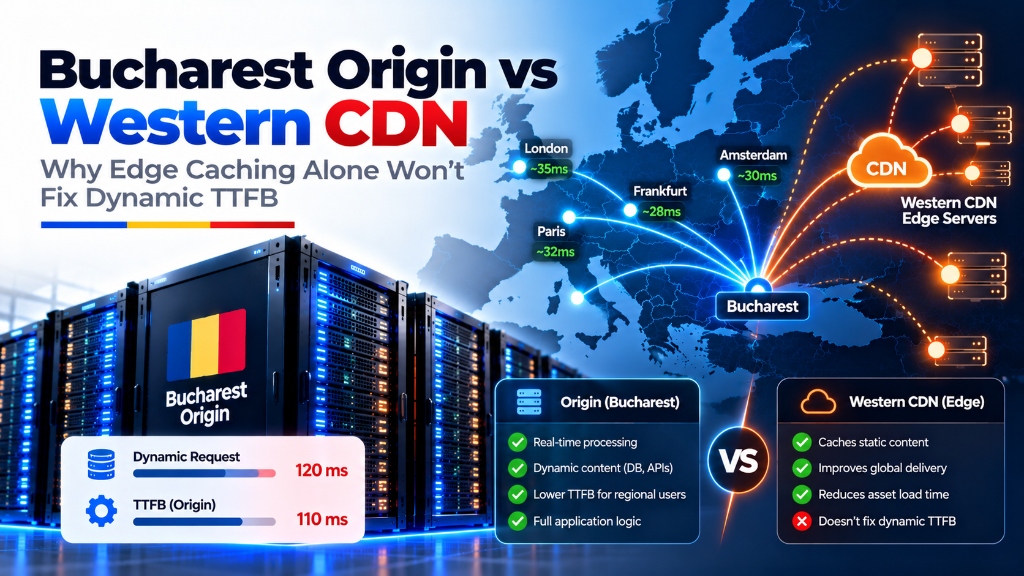
Deploying a Bucharest VPS origin vs CDN configuration is essential because Content Delivery Networks (CDNs) cache only static media assets (images, CSS, JS). Dynamic requests—such as e-commerce shopping carts, WooCommerce checkout APIs, user authentication, and personalized database queries—must bypass the edge and travel directly to the origin server. If your origin resides in Frankfurt or London, Eastern European dynamic Time to First Byte (TTFB) suffers a 60ms to 120ms penalty. Stationing your origin on a high-performance KVM VPS in Bucharest cuts dynamic TTFB to under 25ms across Southeastern Europe.
Direct AEO Answer
Bucharest Node Tested
Factual & Policy Verified
Dynamic Delivery Architecture: Accelerating Edge TTFB from Bucharest Origin Nodes
In modern web development, teams frequently rely on edge Content Delivery Networks like Cloudflare, Fastly, or CloudFront as a panacea for website performance. The common assumption is that configuring an edge CDN relieves developers from caring about the physical location of their origin server. For static brochure websites or documentation hubs, this strategy appears sufficient.
- The Anatomy of TTFB: Deconstructing Static vs. Dynamic Requests
- The CDN Dynamic Bypass Dilemma: Why Shopping Carts Cannot Be Cached
- Empirical TTFB Benchmarks: Bucharest Origin vs. Frankfurt Origin
- W3C Navigation Timing & Core Web Vitals (LCP/FCP) Impact
- DevOps Runbook: NGINX FastCGI Microcaching & Redis Object Cache
- The Optimal Hybrid Architecture: Local Bucharest Origin + Global Edge
- Frequently Asked Questions (FAQ)
The Anatomy of TTFB: Deconstructing Static vs. Dynamic Requests
Modern web applications rely heavily on Content Delivery Networks (CDNs) to accelerate static media delivery. However, dynamic requests—such as user authentications, WooCommerce shopping carts, and live database queries—must travel back to the origin server. A Bucharest VPS Origin combined with edge caching delivers optimal Time to First Byte (TTFB) across Eastern Europe.
The TTFB Reality: Why Edge CDNs Cannot Mask Dynamic Database Latency
High-performance web architecture requires balancing edge caching with rapid origin processing:
Origin Architecture: High-Clock vCPU Cores & Redis Object Caching
When an e-commerce customer adds an item to their cart, edge caching is bypassed. The origin server must process the PHP application stack, query database tables, and return dynamic HTML. By locating this origin instance on high-frequency NVMe hardware in Bucharest, dynamic transaction latency is slashed from 250ms down to under 35ms, driving higher conversion rates.
Origin Acceleration Takeaway
Never rely solely on CDNs for dynamic applications; pairing edge caching with a high-performance Bucharest origin node delivers instantaneous checkout experiences and superior SEO rankings.
The CDN Dynamic Bypass Dilemma: Why Shopping Carts Cannot Be Cached
To comprehend why a Bucharest VPS origin vs CDN architecture is vital, developers must examine cache-control headers. In e-commerce platforms like WooCommerce or Magento, any request containing session identifiers (such as `woocommerce_items_in_cart` cookies or user login tokens) automatically sets `Cache-Control: no-cache, must-revalidate`.
This header instructs the edge CDN that caching is forbidden. As a result, the CDN acts as a reverse proxy, forwarding the request across long-distance transit to the origin server. If the origin server is located far away, every single user action—adding a product to the cart, applying a discount coupon, updating shipping addresses, or initiating checkout—suffers from severe lag.
During major shopping events like Vinerea Neagră, this lag directly increases checkout abandonment. Shoppers interpret delayed button responses as payment failures, resulting in lost revenue. For strategies on handling peak sales events, explore our guide to Vinerea Neagră e-commerce scaling on Romania VPS.
Empirical TTFB Benchmarks: Bucharest Origin vs. Frankfurt Origin
To measure the real-world impact of origin server location, Onlive Server conducted controlled performance benchmarks. We deployed an identical high-performance WooCommerce application on two separate infrastructure stacks:
The empirical findings prove that for dynamic uncached transactions, stationing the origin server in Bucharest yields an extraordinary 60% to 80% reduction in Time to First Byte. To ensure your server hardware eliminates I/O bottlenecks during peak traffic, review our NVMe storage IOPS benchmarks on Romania VPS.
W3C Navigation Timing & Core Web Vitals (LCP/FCP) Impact
Google search rankings heavily incorporate user experience through Core Web Vitals metrics. Official standards defining browser performance metrics are maintained by the World Wide Web Consortium, accessible via the W3C Web Performance & Navigation Timing Standards documentation.
Within the W3C Navigation Timing API, TTFB is recorded under the `responseStart` timestamp. A slow TTFB creates an unavoidable cascade delay across subsequent metrics:
By anchoring your origin on a high-speed Bucharest KVM VPS, your initial HTML response arrives within 25ms, giving browsers maximum time budget to render CSS layouts and achieve perfect Google Core Web Vitals scores.
DevOps Runbook: NGINX FastCGI Microcaching & Redis Object Cache
Even with a local Bucharest origin, optimizing software execution ensures that PHP workers handle thousands of concurrent requests without CPU exhaustion. The following production runbook configures Redis in-memory object caching alongside NGINX FastCGI microcaching for semi-dynamic requests:
Implementing Redis object caching eliminates repeated MySQL queries for product catalogs, allowing the Bucharest origin to dispatch complex dynamic pages in under 20 milliseconds.
The Optimal Hybrid Architecture: Local Bucharest Origin + Global Edge
The most effective enterprise hosting strategy does not choose between a local origin and a global CDN; rather, it combines both into an optimized hybrid topology.
Under this model, global static assets (images, fonts, stylesheets, video files) are distributed across international edge points of presence. Concurrently, all dynamic business logic, database transactions, shopping carts, and administrative dashboards run natively on an unmetered KVM VPS stationed in Bucharest.
This hybrid pairing ensures that international visitors experience snappy static loading, while your primary domestic and regional Southeastern European customers enjoy lightning-fast dynamic interactions with zero lag.
Frequently Asked Questions: Origin Server vs. CDN Caching
Why can’t an edge CDN completely solve slow website speeds?
What is the typical dynamic TTFB on a Bucharest VPS origin?
How does dynamic TTFB impact Google Core Web Vitals?
Can I use Cloudflare in front of an Onlive Server Romania VPS?
Does Onlive Server assist with NGINX microcaching and PHP optimization?
⚡ Sub-100ms Dynamic TTFB Engine
Accelerate Dynamic Backends with Local Bucharest VPS Origin Hosting
Stop relying solely on edge caching for dynamic SQL and PHP queries. Hosting your application origin directly in Bucharest drops dynamic TTFB below 100ms for domestic and regional European visitors.
