

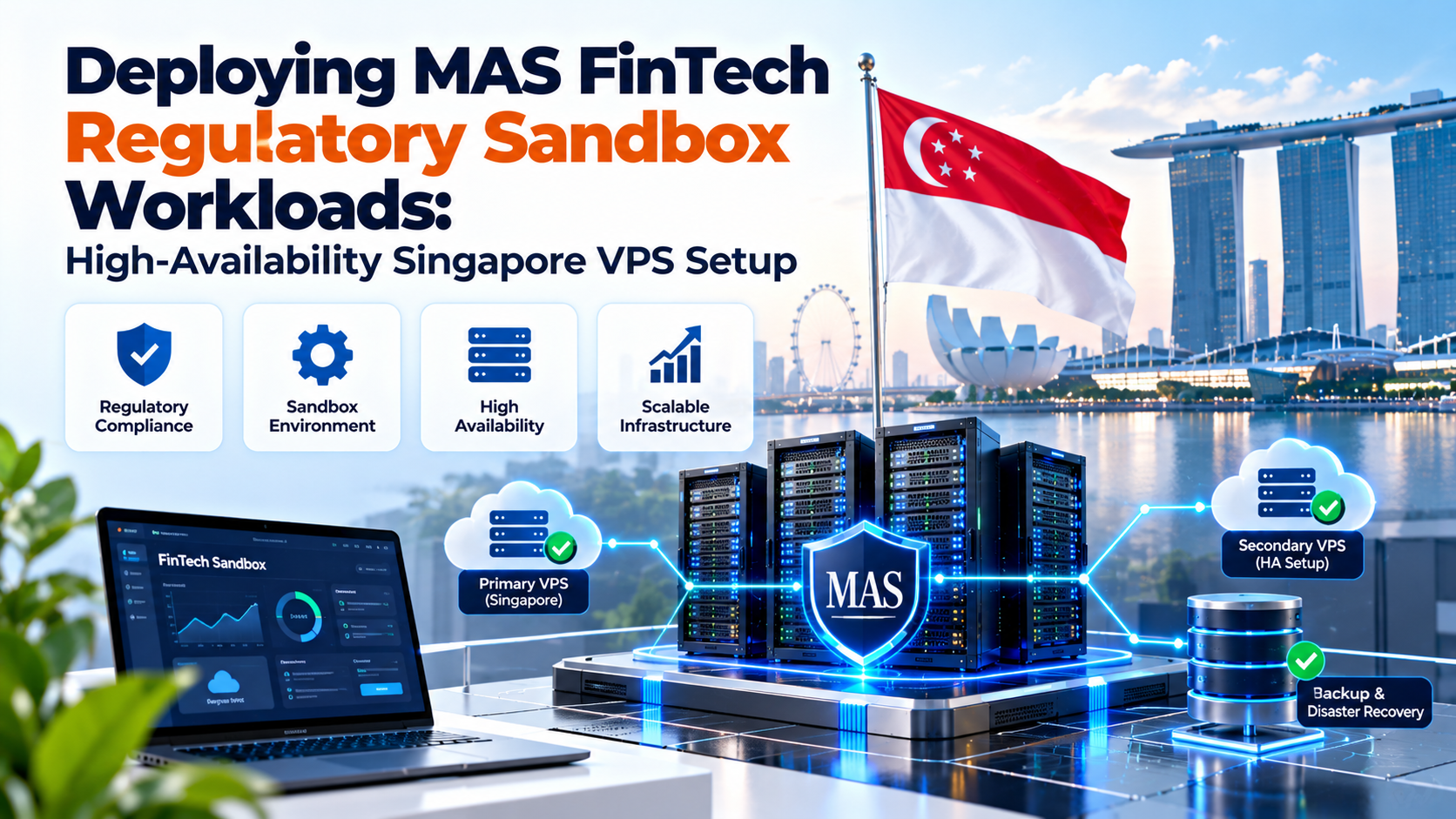
Direct Technical Answer
MAS FinTech Sandbox VPS Architecture
Quick Answer: Sizing High-Availability Singapore VPS for MAS FinTech Sandbox
When architecting a MAS FinTech Sandbox VPS solution, deploying workloads within the MAS FinTech Regulatory Sandbox requires high-availability Singapore VPS architecture that isolates experimental financial algorithms from production banking rails while maintaining strict compliance boundaries. Sizing requires a minimum 8 vCPU dedicated KVM instance with 16 GB RAM, automated point-in-time snapshots, encrypted WireGuard API gateways, and tamper-evident audit trails aligned with MAS Sandbox evaluation criteria.
MAS FinTech Sandbox VPS Infrastructure & Technical Guide
Specifically, Singapore has earned international recognition as a preeminent global capital for financial technology innovation, driven largely by the progressive regulatory stewardship of the Monetary Authority of Singapore (MAS) across your MAS FinTech Sandbox VPS environment. Furthermore, recognizing that cutting-edge financial products—such as decentralized identity ledgers, algorithmic settlement rails, programmable currency, and automated robo-advisory engines—often challenge existing legal statutes, MAS introduced the FinTech Regulatory Sandbox framework. In addition, this supervisory mechanism allows financial institutions and technology startups to experiment with innovative financial services in a live market environment, bounded by well-defined risk controls and temporary statutory relaxations.
However, acceptance into and successful graduation from an MAS Regulatory Sandbox hinges upon an applicant’s ability to demonstrate ironclad risk management across your MAS FinTech Sandbox VPS environment. Consequently, MAS examiners strictly evaluate an applicant’s infrastructure architecture to ensure that systemic failures, cyber incidents, or operational crashes cannot spill over into Singapore’s broader financial ecosystem. Therefore, generic shared cloud hosting or unmanaged budget servers cannot provide the strict boundary controls, zero-leak network segregation, and forensic accountability required by MAS technology risk officers.
Deploying experimental workloads on a dedicated MAS Sandbox compliant Singapore VPS hosting environment equips engineering teams with isolated KVM compute hardware, enterprise NVMe storage arrays, automated snapshot rollbacks, and direct Singapore Internet Exchange (SGIX) network peering required for seamless regulatory validation.
MAS Regulatory Sandbox Frameworks and Infrastructure Demands
Furthermore, the MAS FinTech Regulatory Sandbox operates across three discrete tracks, each imposing distinct technical resilience and auditability standards on the underlying hosting infrastructure:
In addition, 1. Sandbox Express: Tailored for pre-defined, low-risk financial innovations (such as insurance brokerages or remittance platforms), offering fast-track approvals within 21 calendar days. In contrast, infrastructure must feature pre-configured security baselines, automated backup schedules, and verified data residency within Singapore territory.
Consequently, 2. Standard Sandbox: Designed for complex, bespoke fintech models requiring customized regulatory boundary relaxations (such as novel asset tokenization, decentralized lending protocols, or alternative credit scoring). This track requires comprehensive system architecture reviews, multi-region disaster recovery blueprints, and rigorous penetration testing documentation.
Therefore, 3. Sandbox Plus: Expands upon the Standard Sandbox by offering grant support and early stakeholder engagement. Applicants must demonstrate advanced operational resilience, real-time telemetry streaming, and automated boundary isolation controls to prevent customer asset contamination under unexpected market stress.
Technical Comparison: MAS FinTech Sandbox VPS Setup vs Generic Cloud Hosting
Evaluating hosting architectures against MAS sandbox evaluation benchmarks highlights the necessity of specialized infrastructure:
| Technical Parameter | MAS Sandbox Singapore VPS | Generic Shared Cloud | MAS Evaluation Significance |
|---|---|---|---|
| Boundary Isolation | Hardware KVM + Private VLAN Segmentation | Shared public network switches | Guarantees containment of experimental test transactions |
| Rollback Latency | < 5 Seconds via NVMe ZFS Snapshots | Hours via tape/object image restore | Mandatory for rapid test scenario resetting and fault isolation |
| Audit Telemetry | Real-time cryptographically signed streaming | Standard local rotating syslogs | Enables verified milestone audit submissions to MAS |
| Bank API Peering | Direct SGIX Low-Latency Peering (< 1.5ms) | Transcontinental transit routes (> 40ms) | Prevents timeout errors during live bank sandbox API calls |
| Stress Test Predictability | 1:1 Dedicated vCPU / Zero Overcommitment | Burstable / Oversubscribed CPU slots | Produces deterministic performance benchmarks under load |
| Data Residency | 100% Onshore Singapore (Equinix SG1/SG3) | Dynamic multi-country storage clusters | Eliminates cross-border data transfer liabilities |
Architecting the Isolated Test Harness and Chaos Engineering Injection
Fintech software startups deploying experimental decentralized or payment algorithms should consult the PayNow and FAST webhook payment processing for sandbox admission criteria.
Notably, a primary condition imposed by MAS during sandbox trials is the implementation of rigorous boundary limits: test customer caps, maximum transaction value limits, and total transactional volume ceilings. To guarantee that experimental code cannot bypass these limits, the infrastructure must feature an isolated test harness architecture:
In contrast, 1. Network Compartmentalization: The sandbox instance communicates through two isolated network interfaces. The administrative interface connects via WireGuard VPN for management and telemetry. The transactional interface connects to an isolated internal software bridge with hardware-enforced packet filtering (nftables) that strictly restricts outbound API requests to designated banking mock endpoints.
Additionally, 2. Chaos Engineering & Failure Mode Simulation: MAS guidelines require applicants to prove that unexpected outages will not result in financial ledger corruption. Using Linux Traffic Control (tc netem), engineers can inject artificial packet loss, latency jitter, and subsea cable disconnect simulations into the sandbox VPS to validate that transaction rollbacks and two-phase commit protocols function flawlessly under duress.
MAS FinTech Sandbox VPS Infrastructure & Technical Guide
For example, 3. Copy-on-Write Instant Snapshot Rollback: Running the sandbox filesystem on ZFS or enterprise NVMe hardware snapshotting allows engineers to execute high-stress edge-case simulations and immediately restore the system to an identical pre-test state in less than five seconds, enabling continuous iterative testing cycles.
Synthetic Data Generation and Privacy-Preserving Test Harnesses in Singapore
To illustrate, while the MAS Regulatory Sandbox relaxes specific operational barriers, it strictly does not exempt fintech applicants from baseline data privacy standards under the Singapore Personal Data Protection Act (PDPA). Testing experimental payment models, automated credit risk algorithms, or biometric authentication with live consumer records introduces severe compliance liabilities.
In particular, to mitigate this risk, engineering teams utilize on-instance synthetic data generation pipelines running directly on the Singapore VPS. By implementing differential privacy (ε-differential privacy) algorithms, developers synthesize statistically indistinguishable mock test datasets—generating valid-format synthetic Singapore NRIC/FIN numbers, simulated PayNow Virtual Payment Addresses (VPAs), and realistic transaction distributions without exposing real consumer identities.
As a result, this synthetic data architecture allows high-throughput load testing up to 50,000 simulated transactions per minute against database engines, verifying that lock contention, index traversal, and connection pool queuing behave predictably under extreme market volume spikes before any live customer onboarding begins.
Milestone Telemetry and Transitioning from Sandbox to Major Payment Institution (MPI) Licensing
Moreover, graduation from an MAS Regulatory Sandbox requires proving that the financial product operated continuously within pre-agreed performance bounds, error limits, and customer volume thresholds. During periodic regulatory reviews, MAS supervisors demand empirical evidence documenting system availability, peak latency percentiles (p95 and p99), and incident resolution logs.
In fact, by deploying on an enterprise Singapore VPS with integrated Prometheus telemetry and kernel-level audit daemons, engineering teams can export immutable, cryptographically signed operational dashboards directly into their MAS regulatory submissions. When the sandbox trial concludes successfully, the transition to a full Major Payment Institution (MPI) or Capital Markets Services (CMS) license requires zero infrastructure migration: the existing Singapore KVM host can be instantly scaled with additional vCPU cores, ECC RAM, and cross-datacenter active-passive replicas to meet full commercial MAS TRM Notice FSM-N21 compliance.
Sandbox deployments transitioning into commercial operations require verified MAS TRM cloud infrastructure compliance before processing live institutional client transactions.
Configuring Network Boundary Isolation and Chaos Injections in Linux
Similarly, fintech DevOps teams can establish isolated network testing boundaries and simulate adverse network conditions using native Linux kernel tools:
Linux System Shell
# 1. Create isolated network namespace for the experimental sandbox app
ip netns add mas_sandbox_ns

# 2. Create virtual ethernet pair linking host to sandbox namespace
ip link add veth_host type veth peer name veth_sandbox
ip link set veth_sandbox netns mas_sandbox_ns

# 3. Assign dedicated non-routable IPs to prevent accidental internet leak
ip addr add 10.200.1.1/24 dev veth_host
ip link set veth_host up
ip netns exec mas_sandbox_ns ip addr add 10.200.1.2/24 dev veth_sandbox
ip netns exec mas_sandbox_ns ip link set veth_sandbox up
ip netns exec mas_sandbox_ns ip link set lo up

# 4. Inject artificial chaos latency and packet loss (simulating subsea cable stress)
ip netns exec mas_sandbox_ns tc qdisc add dev veth_sandbox root netem delay 45ms 10ms loss 2.5%

# 5. Enforce strict outbound firewall rules (restricting API calls to mock bank gateway)
ip netns exec mas_sandbox_ns iptables -F
ip netns exec mas_sandbox_ns iptables -A OUTPUT -p tcp -d 10.200.1.1 --dport 8443 -j ACCEPT
ip netns exec mas_sandbox_ns iptables -A OUTPUT -j DROP

# 6. Verify isolation and simulated latency jitter
ip netns exec mas_sandbox_ns ping -c 4 10.200.1.1
Importantly, this architectural pattern ensures that even if an experimental trading algorithm or smart contract interface enters an infinite loop or encounters an unhandled exception, network traffic is physically constrained to designated mock endpoints, preventing accidental execution against live Singapore FAST settlement rails.