

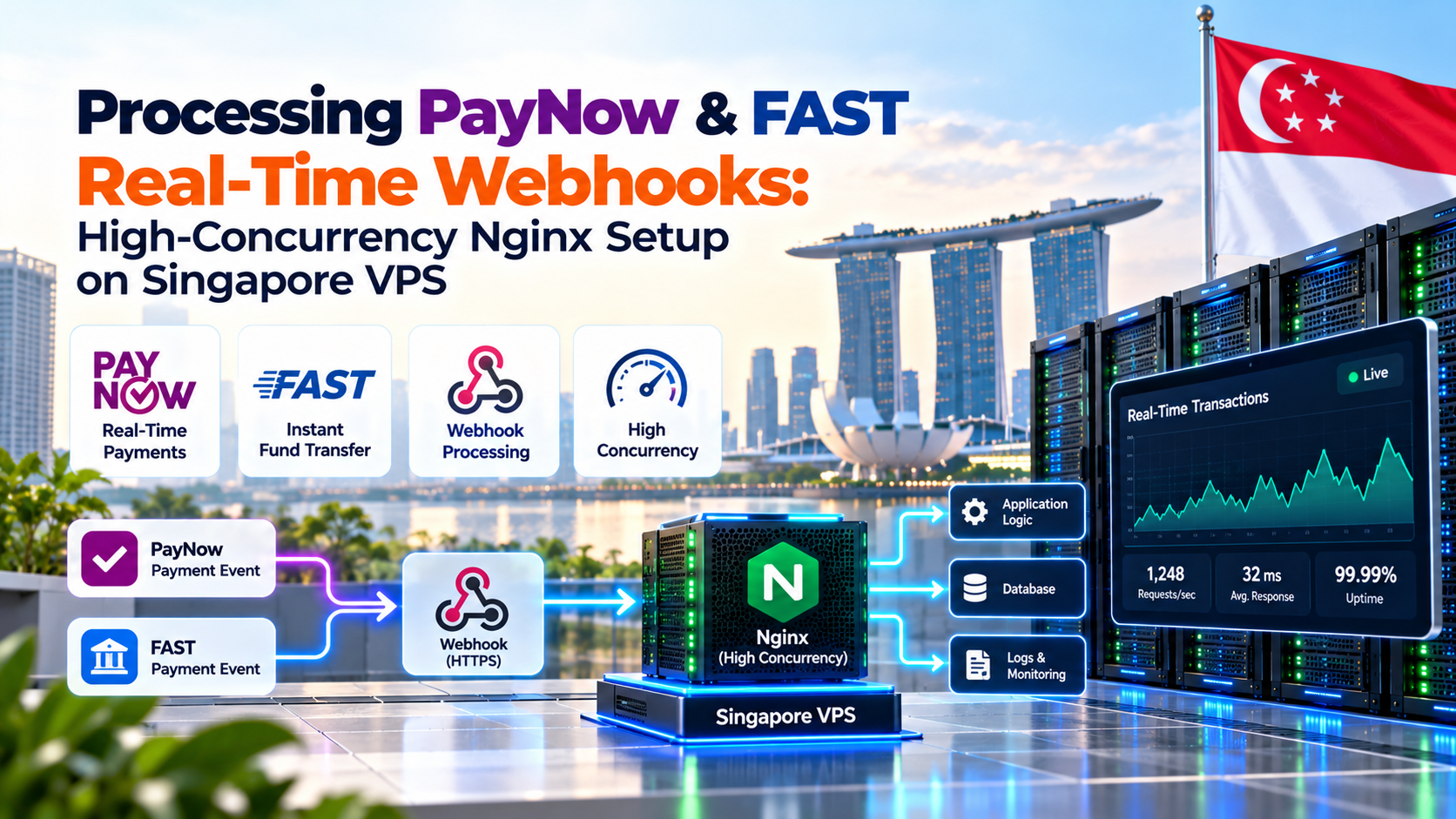
In fact, in Singapore’s digital payments ecosystem, PayNow and FAST represent the primary real-time transaction backbone.
Specifically, governed by The Association of Banks in Singapore, these rails process millions of instant transactions daily.
Specifically, e-commerce retailers, fintech payment gateways, and subscription platforms rely on instant webhook notifications for fulfillment.
However, high-concurrency payment surges create severe operational bottlenecks when servers run on default configurations.
In fact, if a webhook receiver fails to respond within 3,000 milliseconds, banking switches trigger aggressive retries.
Consequently, this retry storm overwhelms connection pools, causing catastrophic transaction backlog and reconciliation delays.
Furthermore, deploying a dedicated tuned Singapore VPS hosting platform provides optimized socket capacity and isolated KVM compute.
Therefore, engineering teams can ingest tens of thousands of real-time banking callbacks with zero dropped packets.
Key Webhook Architecture Takeaways
Evaluating high-concurrency payment webhook engines requires verified telemetry across network latency, socket limits, and queue buffering:
Anatomy of Singapore Real-Time Payment Webhook Deliveries
Furthermore, when a customer scans a PayNow QR code, bank clearing networks execute multi-step callback workflows.
Specifically, the issuing bank transmits clearing messages across the FAST interbank clearing switch.
In addition, the payment aggregator constructs an HTTP POST request containing payment details and an HMAC signature.
In addition, payment gateways enforce rigid connection timeout limits, typically between 3,000 and 5,000 milliseconds.
Furthermore, if your server fails to acknowledge within this window, the delivery is classified as unacknowledged.
Consequently, banking switches trigger automated retries at predefined exponential intervals.
Similarly, high-throughput teams can examine our architecture for food delivery real-time webhook pipelines.
Therefore, preventing cascading retry storms requires rapid HTTP 200 acknowledgments under 15 milliseconds.
Technical Comparison: High-Concurrency Singapore VPS vs Generic Cloud Server
Moreover, standard commodity cloud instances lack the network peering and kernel tuning necessary for banking webhooks.
In contrast, an optimized Singapore VPS eliminates noisy neighbor contention through dedicated KVM hardware virtualization.
| Technical Dimension | Optimized Singapore VPS Webhook Node | Standard Commodity Cloud | Payment Processing Impact |
|---|---|---|---|
| Socket Capacity (somaxconn) | 65,535 (Tuned Linux Kernel) | 128 – 1,024 (Default unoptimized) | Eliminates SYN drop errors during sudden concurrency bursts |
| Network Peering Latency | < 1.5ms via SGIX to Singapore Banks | 35ms – 85ms via overseas transit | Completes TLS handshakes in under 5ms, avoiding gateway timeouts |
| Ingestion Architecture | Asynchronous In-Memory Stream (Redis) | Synchronous Direct SQL Commit | Guarantees sub-15ms HTTP 200 acknowledgments to bank switches |
| Idempotency Handling | Atomic Distributed Locks via Redlock | Application-level unindexed SQL queries | Prevents double-credit exploits during duplicated retry delivery |
| Bandwidth & Port Speed | Unmetered 1Gbps Dedicated Uplink | Throttled / Metered Burstable Port | Ensures zero packet drops during high-frequency API ingestion |
| Virtualization Consistency | Dedicated KVM CPU Thread Pinning | Oversubscribed shared hypervisors | Eliminates noisy neighbor CPU stalls during cryptographic validation |
The Asynchronous Decoupled Ingestion Architecture: Nginx, Redis Streams, and Workers
Specifically, never perform synchronous database operations or third-party API calls inside the HTTP webhook receiving request handler.
A resilient PayNow webhook processing pipeline divides responsibilities across three decoupled infrastructure tiers.
In fact, the Edge Ingestion Receiver validates TLS handshakes and proxies requests to memory-based backends.
Furthermore, an in-memory Redis Streams queue captures the raw payload with sub-millisecond write latency.
In addition, background worker processes consume queued events independently to update databases and notify customers.
Consequently, unexpected relational database locks never delay incoming payment confirmations from the banking switch.
Linux Kernel Socket Tuning and Nginx Configuration for Webhook Ingestion
Additionally, default Linux distributions are tuned for conservative server workloads, causing socket exhaustion under heavy load.
Specifically, adjust Linux kernel parameters in PuTTY to support tens of thousands of concurrent TCP sockets.
Furthermore, configure Nginx to bypass disk request buffering and stream payloads directly to memory.
To illustrate, this configuration allows the server to sustain up to 50,000 active concurrent connections without packet loss.
In addition, review our technical blueprints for securing Singpass OIDC API gateways.
Consequently, payment ingestion nodes maintain reliable performance during massive flash sales and festival shopping peaks.
HMAC-SHA256 Signature Verification and Atomic Idempotency in Python
In particular, financial consistency requires validating that incoming webhooks originate legitimately from the bank clearing gateway.
In addition, using constant-time cryptographic verification eliminates timing attacks while atomic Redis locks prevent double-credit exploits.
As a result, using constant-time comparison blocks signature forging attempts by malicious third parties.
Furthermore, the atomic Redis lock prevents duplicate callbacks from accidentally crediting user balances twice.
Therefore, your financial records remain strictly balanced and tamper-proof under all network conditions.
Frequently Asked Questions
Core Technical Specifications
Deployment & Operational Inquiries
Deploy High-Concurrency PayNow Webhook VPS
Specifically, handle peak payment surges with dedicated KVM hardware, sub-1.5ms SGIX connectivity, and unmetered gigabit ports.
Furthermore, maintain zero dropped transactions during sudden flash sales and high-frequency settlement runs.