

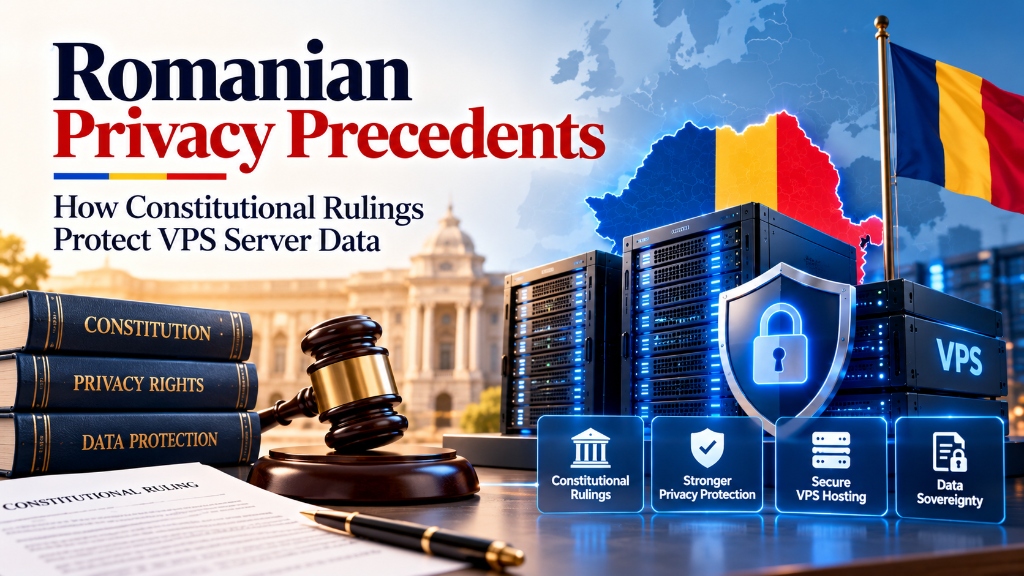
In an era of global data collection mandates, safeguarding proprietary business data is a critical operational priority.
Specifically, international enterprises and fintech startups must carefully evaluate the judicial stability of their hosting jurisdictions.
Consequently, selecting an independent Romanian privacy law VPS platform provides world-class constitutional safeguards.
Key Privacy & Constitutional Takeaways
Evaluating European hosting jurisdictions requires verified telemetry across statutory protections, warrant rules, and encryption integrity:
1. The Constitutional Shield: Romania’s History of Defending Digital Privacy
To understand Romania’s uncompromising privacy stance, one must appreciate its modern constitutional history.
In fact, following the fall of the authoritarian regime in December 1989, Romanian jurisprudence prioritized civil liberties.
Specifically, legal scholars drafted the Romanian Constitution to safeguard personal privacy and the inviolability of private communications.
The Tripartite Constitutional Guarantees: Articles 26, 27 & 28
Rather than treating digital data as disposable corporate property, Romanian law establishes three complementary legal barriers.
Furthermore, these statutory principles defend cloud tenants against arbitrary interference from foreign or domestic surveillance bodies.
Constitutional Mandates: Prohibiting Bulk Surveillance & Secret Backdoors
This constitutional foundation means that cloud hosting facilities operate under a strict judicial framework.
In contrast to jurisdictions with secret surveillance letters, Romanian statutory law makes indiscriminate wiretapping unconstitutional.
Specifically, data at rest and data in transit cannot be legally monitored through automated mass filtering.
Furthermore, cloud providers are constitutionally prohibited from installing passive eavesdropping taps on network uplinks.
Therefore, lawful inspection requires an individualized, judicially approved search warrant based on demonstrable criminal probable cause.
2. The 2009 & 2014 CCR Rulings: Striking Down Blanket Data Retention Directives
The resilience of Romanian privacy was tested when the European Union issued Directive 2006/24/EC.
Specifically, this directive mandated that internet providers indiscriminately log communications metadata of all citizens for two years.
While most European nations accepted the mandate, Romania became the epicentre of constitutional resistance.
Landmark Constitutional Court Decisions 1258/2009 & 440/2014
In fact, in Decision No. 1258/2009, the CCR struck down Romania’s initial data retention law.
Furthermore, the court ruled that continuous, indiscriminate surveillance violated the constitutional presumption of innocence.
In addition, in Decision No. 440/2014, the Constitutional Court struck down the revised retention statute.
Specifically, records on the CCR Decision 440/2014 Portal confirm that accessing retained data without prior judicial approval is invalid.
Additionally, in Decision No. 17/2015, the CCR struck down the draft Romanian Cyber Security Law.
Consequently, the court reaffirmed that private virtual machines are inviolable private spaces requiring strict judicial warrants.
3. Pioneering European Law: How Romanian Precedents Shaped CJEU Jurisprudence
The courageous rulings of the Romanian Constitutional Court reverberated across the European continent.
Furthermore, when privacy advocates challenged the Data Retention Directive before the CJEU, they cited Romanian jurisprudence.
In April 2014, the CJEU invalidated EU Directive 2006/24/EC in the landmark Digital Rights Ireland case.
Key CJEU Principles Derived from Romanian Precedents
Consequently, organizations deploying a Romanian privacy law VPS benefit from standards recognized across Europe.
In addition, review our detailed guide on ANSPDCP and GDPR compliance on Romania VPS platforms.
Therefore, your infrastructure operates within a jurisdiction committed to upholding digital sovereignty.
4. What This Means for VPS Hosting: Warrant Requirements vs. Bulk Surveillance
From an engineering perspective, Romanian constitutional rulings directly govern how datacenter operators handle government inquiries.
Specifically, hosting a virtual private server in Bucharest delivers measurable operational protections for enterprise workloads.
Operational Protections for Bucharest VPS Deployments
Furthermore, this legal certainty provides confidence for fintech platforms holding proprietary algorithms or customer databases.
Therefore, organizations avoid the risks of warrantless data confiscation present in less regulated hosting regions.
5. Comparative Legal Framework: Warrant-Based Access vs. Surveillance Mandates
Evaluating global hosting jurisdictions requires comparing how legal systems balance state surveillance against personal privacy.
In contrast to offshore havens or cloud giants, Romania combines strict privacy with full EU market legality.
| Legal Dimension | Romania (Constitutional Shield) | United States (CLOUD Act / FISA) | Offshore Havens (Panama / Island) |
|---|---|---|---|
| Mass Data Retention | Struck Down (Unconstitutional) | Upheld under carrier agreements | Unregulated / Subject to ISP whim |
| Judicial Warrant Rule | Mandatory prior judicial warrant | Administrative subpoenas & NSLs allowed | Varies / Lack of judicial oversight |
| Extraterritorial Seizure | Blocked without formal MLAT / Court | Permitted via CLOUD Act worldwide | Vulnerable to diplomatic coercion |
| GDPR Sovereignty | Full 100% EU Single Market Status | Non-EU (Subject to Schrems risks) | Non-EU (Requires standard clauses) |
| Datacenter Standards | Tier III Bucharest Datacenters (NXDATA) | Tier III/IV Hyperscale Facilities | Aging, high-latency island facilities |
Consequently, hosting in Romania eliminates the threat of extraterritorial subpoenas under the US CLOUD Act.
Furthermore, your organization maintains full GDPR compliance without relying on fragile cross-border standard contractual clauses.
6. Technical Implementation: Hardening Linux VPS Storage with Full-Disk Cryptography
While Romanian constitutional law stops mass surveillance, defense-in-depth requires rigorous cryptographic safeguards.
Specifically, system administrators should pair legal protections with Linux Unified Key Setup (LUKS-2) volume encryption.
LUKS-2 Storage Encryption & Dropbear Configuration
To illustrate, configuring LUKS-2 volume encryption keeps your application database completely ciphertext at rest.
Furthermore, Dropbear initramfs enables remote SSH decryption during server reboots without exposing unencrypted keys.
Consequently, unauthorized third parties cannot access server records even in theoretical hardware seizure scenarios.
7. The Lawful Balance: Legitimate Law Enforcement Cooperation vs. User Rights
It is essential to distinguish between legitimate constitutional digital privacy and unlawful criminal immunity.
In fact, Romania actively participates in international law enforcement cooperation, Europol, Interpol, and European MLAT frameworks.
Therefore, the Romanian judicial system strictly prosecutes cybercrime, financial fraud, malware distribution, and botnet operations.
Due Process Protections During Lawful Investigations
Specifically, this balanced judicial framework provides optimal stability for legitimate enterprise digital platforms.
Furthermore, it protects against arbitrary surveillance while maintaining international commercial and legal respectability.
Frequently Asked Questions (FAQ)
Constitutional Case Law & Jurisdictional Safeguards
Storage Encryption & Compliance Standards
Safeguard Corporate Data Under Romania’s Strong Privacy Protections
Specifically, leverage Romania’s constitutional court precedents defending digital data sovereignty against overreaching surveillance directives.
Furthermore, host mission-critical enterprise databases on private, isolated KVM cloud virtualization with dedicated resources.
