

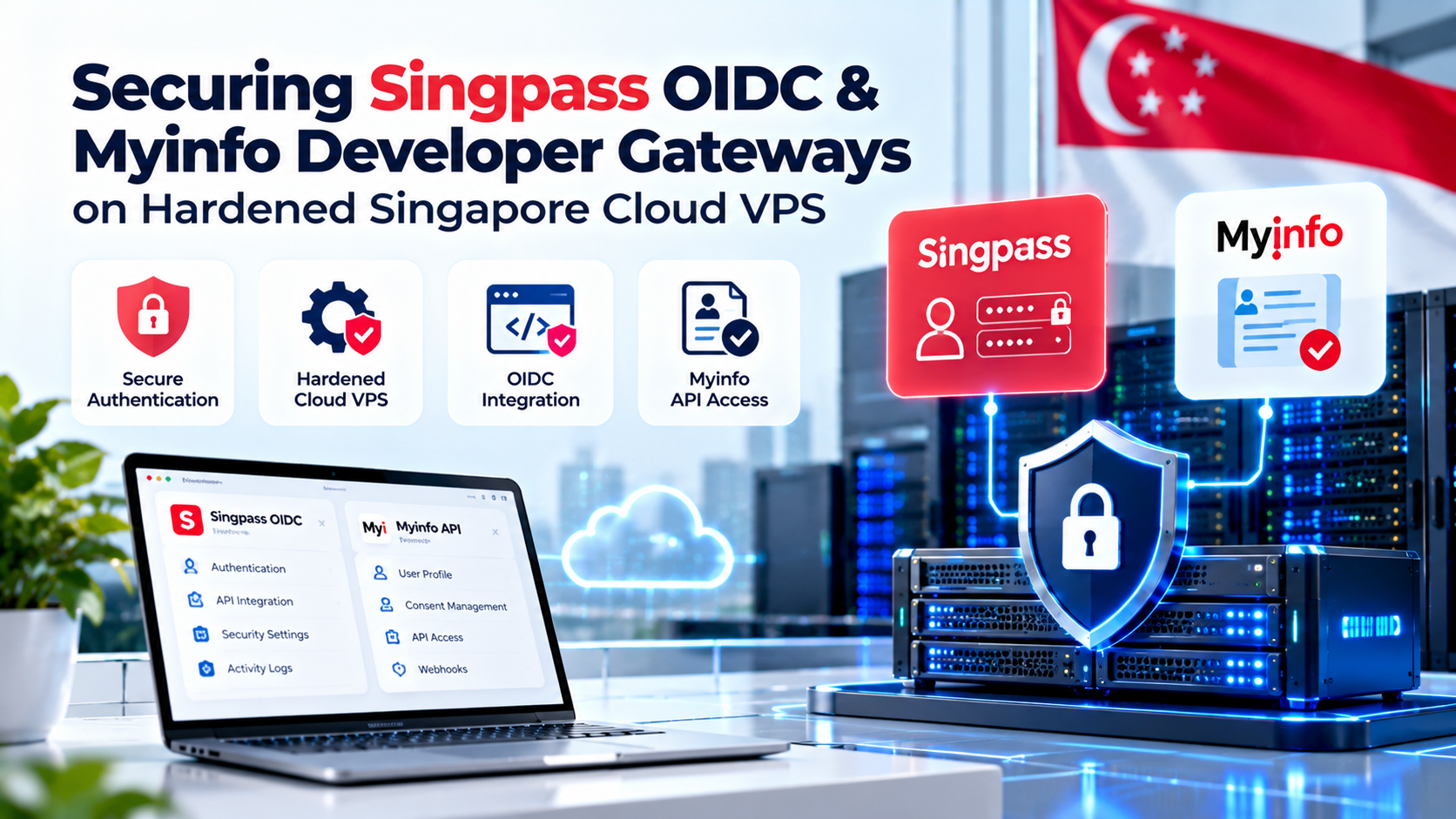
When architecting a Singpass OIDC Singapore VPS solution, securing Singpass OIDC and Myinfo developer gateways on a Singapore VPS requires sub-millisecond local network peering to GovTech endpoints, dedicated TLS 1.3 reverse proxies, and strict public-key infrastructure. Cryptographic verification of JWE (JSON Web Encryption) payloads and ECDSA P-256 signed JWT tokens requires dedicating at least 4 vCPUs and 8 GB RAM to prevent token validation bottlenecks during morning peak Singpass authentications.
Singpass OIDC Singapore VPS Infrastructure & Technical Guide
Specifically, in Singapore’s hyper-connected digital economy, Singpass (Singapore Personal Access) and Myinfo represent the technological bedrock of consumer identity verification across your Singpass OIDC Singapore VPS environment. In fact, managed by the Government Technology Agency (GovTech), Singpass serves over 4.5 million residents, enabling seamless citizen-to-business transactions across banking, insurance, healthcare, telecommunications, and fintech. Similarly, by leveraging OpenID Connect (OIDC) protocols and Myinfo developer APIs, businesses can onboard customers instantly with government-verified KYC (Know Your Customer) data, eliminating paperwork, reducing fraud, and achieving instant digital verification.
However, integrating with GovTech’s National Digital Identity (NDI) infrastructure is subject to extraordinarily stringent security and network requirements across your Singpass OIDC Singapore VPS environment. Importantly, govTech strictly requires partner applications to communicate via mutual Transport Layer Security (mTLS), authenticate requests from pre-registered static IP addresses, validate complex JSON Web Signatures (JWS) and JSON Web Encryption (JWE) tokens, and maintain rigid data localization within Singapore territory. Specifically, attempting to run Singpass authentication gateways on multi-tenant serverless platforms or overseas shared clouds frequently causes dropped handshakes, IP whitelisting rejections, and compliance audit failures.
Deploying your identity gateway on an enterprise-grade hardened Singapore VPS hosting solution provides the dedicated static network routing, hardware-accelerated cryptographic processing, and sovereign data isolation required to maintain flawless Singpass and Myinfo integration.
GovTech NDI Architecture: OpenID Connect & PKCE
Furthermore, govTech’s National Digital Identity platform implements a customized extension of the OpenID Connect (OIDC) Core 1.0 protocol, incorporating Proof Key for Code Exchange (PKCE) and strict cryptographic assertions:
In addition, 1. Authorization Code Flow with PKCE: When a user initiates a login via Singpass (either through the mobile app QR code or biometric authentication), the client application generates a cryptographically random code_verifier and hashes it using SHA-256 to create the code_challenge. This parameter is submitted to GovTech’s authorization endpoint, eliminating authorization code interception attacks.
2. Dual-Layer Token Security (JWS and JWE): The identity token returned by GovTech is signed using JSON Web Signature (JWS) with ECDSA using the P-256 curve (ES256). Furthermore, sensitive Myinfo citizen data payloads (such as residential address, income tax assessments, and employment records) are additionally encrypted using JSON Web Encryption (JWE) with RSA-OAEP-256 and A256GCM. The application gateway must execute nested decryption and signature verification in real time.
Singpass OIDC Singapore VPS Infrastructure & Technical Guide
Consequently, 3. Dynamic JWKS Caching: GovTech rotates its public cryptographic signing keys dynamically. Authentication gateways must query and cache GovTech’s JSON Web Key Set (JWKS) endpoint, refreshing cached keys without introducing latency to live user authentications.
📌 Table of Contents
- GovTech NDI Architecture: OpenID Connect & PKCE
- Singapore VPS vs Generic Cloud: Architecture Comparison
- Static IP Whitelisting & GovTech Peering
- Reverse Proxy: Terminating GovTech mTLS with Nginx
- Token Replay Prevention & Redis Caching
- Automating Token Decryption & JWKS Rotation
- Frequently Asked Questions (FAQ)
Singapore VPS vs Generic Cloud: Architecture Comparison
Therefore, architecting an identity gateway on purpose-built infrastructure versus commodity cloud environments reveals stark operational advantages:
| Technical Requirement | Hardened Singapore VPS Gateway | Generic Cloud / Serverless | GovTech Compliance Impact |
|---|---|---|---|
| Static IPv4 Egress | Dedicated Clean Static Singapore IPv4 | Dynamic / Shared NAT Gateway IPs | Mandatory for GovTech firewall egress whitelisting |
| Network Peering Latency | < 1.8ms via Direct SGIX Peering | 35ms – 90ms via regional routing | Eliminates user timeout drops during QR code scanning |
| Mutual TLS (mTLS) Handling | Native Nginx/Envoy kernel-level offload | Complex load balancer pass-through | Required for bidirectional client certificate authentication |
| Data Residency & PDPA | 100% Onshore Singapore (Equinix SG1/SG3) | Dynamic cross-border data replication | Fulfills Singapore sovereign data protection rules |
| Cryptographic Processing | Dedicated AES-NI & AVX-512 hardware acceleration | Shared CPU slices with cold start latency | Maintains sub-10ms token decryption under peak load |
| Private Key Security | Hardware-encrypted LUKS2 volume storage | Plaintext environment variables | Protects GovTech-issued PKI signing keys from extraction |
Static IP Whitelisting & GovTech Peering
Engineers integrating enterprise digital identity verification can access the official PDPA data protection isolation policies for OpenID Connect token specifications.
Notably, govTech’s production API gateway enforces rigid network-level ingress firewalls. When an enterprise registers an application in the Singpass Developer Portal, the applicant must formally submit the static public IPv4 addresses from which outbound token exchange and Myinfo data retrieval requests will originate. Requests arriving from non-whitelisted IP addresses are dropped immediately at the firewall perimeter without an HTTP response code.
In contrast, in serverless or elastic container architectures, outbound egress IP addresses fluctuate dynamically across vast CIDR blocks, forcing companies to deploy expensive NAT Gateways and elastic IP pools. By contrast, an Onlive Server Singapore VPS provides dedicated, permanently assigned static IPv4 addresses registered under clean Singapore autonomous systems (ASNs).
Singpass OIDC Singapore VPS Infrastructure & Technical Guide
Furthermore, Onlive Server maintains direct peering at the Singapore Internet Exchange (SGIX), interconnecting directly with the Government Commercial Cloud (GCC) backbone hosted in local Singapore datacenters. Outbound mTLS handshakes and token exchanges complete in less than 1.8 milliseconds round-trip, guaranteeing that citizen identity verification workflows execute instantly without UI loading spinners.
Reverse Proxy: Terminating GovTech mTLS with Nginx
Additionally, to establish communication with GovTech Myinfo endpoints, the application gateway must present a valid client certificate issued and signed by GovTech’s partner PKI. Terminating mTLS at the Nginx reverse proxy layer isolates cryptographic overhead from application microservices:
# /etc/nginx/conf.d/singpass_gateway.conf

upstream identity_backend {
    server 127.0.0.1:8000;
    keepalive 32;
}

server {
    listen 443 ssl http2;
    server_name auth.yourcompany.com.sg;

    # Inbound SSL configuration (client facing)
    ssl_certificate /etc/ssl/certs/auth_gateway.crt;
    ssl_certificate_key /etc/ssl/private/auth_gateway.key;
    ssl_protocols TLSv1.3 TLSv1.2;
    ssl_ciphers ECDHE-ECDSA-AES256-GCM-SHA384:ECDHE-RSA-AES256-GCM-SHA384;
    ssl_prefer_server_ciphers on;

    # Strict transport security and security headers
    add_header Strict-Transport-Security "max-age=63072000; includeSubDomains; preload" always;
    add_header X-Frame-Options "DENY" always;
    add_header X-Content-Type-Options "nosniff" always;

    # Singpass redirect callback endpoint
    location /auth/singpass/callback {
        # Strict rate limiting to prevent authorization code brute forcing
        limit_req zone=auth_limit burst=10 nodelay;

        proxy_pass http://identity_backend;
        proxy_http_version 1.1;
        proxy_set_header Connection "";
        proxy_set_header Host $host;
        proxy_set_header X-Real-IP $remote_addr;
        proxy_set_header X-Forwarded-For $proxy_add_x_forwarded_for;
        proxy_set_header X-Forwarded-Proto $scheme;

        # Outbound GovTech client certificate authentication (configured in backend microservice)
        proxy_connect_timeout 3s;
        proxy_read_timeout 5s;
    }
}
For example, this hardened proxy topology buffers high-frequency redirect bursts during peak business hours, shielding backend authentication microservices from connection exhaustion and enforcing strict TLS parameter verification before payloads reach business logic layers.
Token Replay Prevention & Redis Caching
To illustrate, govTech security guidelines mandate stringent safeguards against token replay attacks and state manipulation. When a user authenticates through Singpass, the client initiates the OIDC handshake by embedding a cryptographically random, single-use nonce and state parameter into the authorization request. Upon callback processing, the application must verify that the decrypted ID token contains an identical nonce value that has never been consumed previously.
To achieve sub-millisecond nonce validation without database disk I/O bottlenecks, administrators deploy a localized, in-memory Redis key-value cache on the Singapore VPS instance. Each generated nonce is stored with a rigid 300-second Time-To-Live (TTL). When the callback executes, an atomic Redis GETDEL command retrieves and purges the key in a single transaction. If a malicious actor attempts to resubmit a previously intercepted callback URL, the secondary lookup fails instantly, terminating the session and preventing fraudulent account takeovers.
In enterprise multi-VPS deployments, pairing this setup with Redis Sentinel ensures sub-second failover across isolated availability zones. This architecture preserves active authorization states even during scheduled maintenance or hypervisor host migrations, guaranteeing uninterrupted compliance with GovTech NDI session availability benchmarks.
Singpass OIDC Singapore VPS Infrastructure & Technical Guide
Digital identity gateways frequently interface with payment processing APIs, making synchronization with PayNow and FAST real-time webhook infrastructure critical for automated account onboarding.
Automating Token Decryption & JWKS Rotation
In particular, once the authorization code is exchanged with GovTech, the application receives an encrypted identity token containing the resident’s verified identity. The following script demonstrates verifying and decrypting the payload using high-speed native cryptographic bindings:
import json
from jwcrypto import jwk, jwe, jws

# 1. Load your application private decryption key (stored in secure volume)
with open('/var/secrets/singpass_private_enc.key', 'rb') as f:
    app_private_key = jwk.JWK.from_pem(f.read())

# 2. Fetch GovTech public JWKS keys for signature verification
with open('/var/cache/govtech_ndi_jwks.json', 'r') as f:
    govtech_keyset = jwk.JWKSet.from_json(f.read())

def process_myinfo_payload(encrypted_jwe_token):
    # Step A: Decrypt the inbound JWE using application private key
    jwe_token = jwe.JWE()
    jwe_token.deserialize(encrypted_jwe_token, key=app_private_key)
    decrypted_jws_payload = jwe_token.payload

    # Step B: Verify the nested JWS signature against GovTech public JWKS
    jws_token = jws.JWS()
    jws_token.deserialize(decrypted_jws_payload)
    jws_token.verify(govtech_keyset)

    # Step C: Parse verified citizen identity JSON attributes
    verified_identity = json.loads(jws_token.payload.decode('utf-8'))
    return verified_identity
As a result, executing cryptographic operations on dedicated KVM CPU cores ensures that complex RSA-OAEP-256 decryption cycles execute in under 4 milliseconds, delivering instant onboarding response times for mobile banking and digital registration portals.