

Direct Technical Answer
Singapore PDPA Compliant VPS Architecture
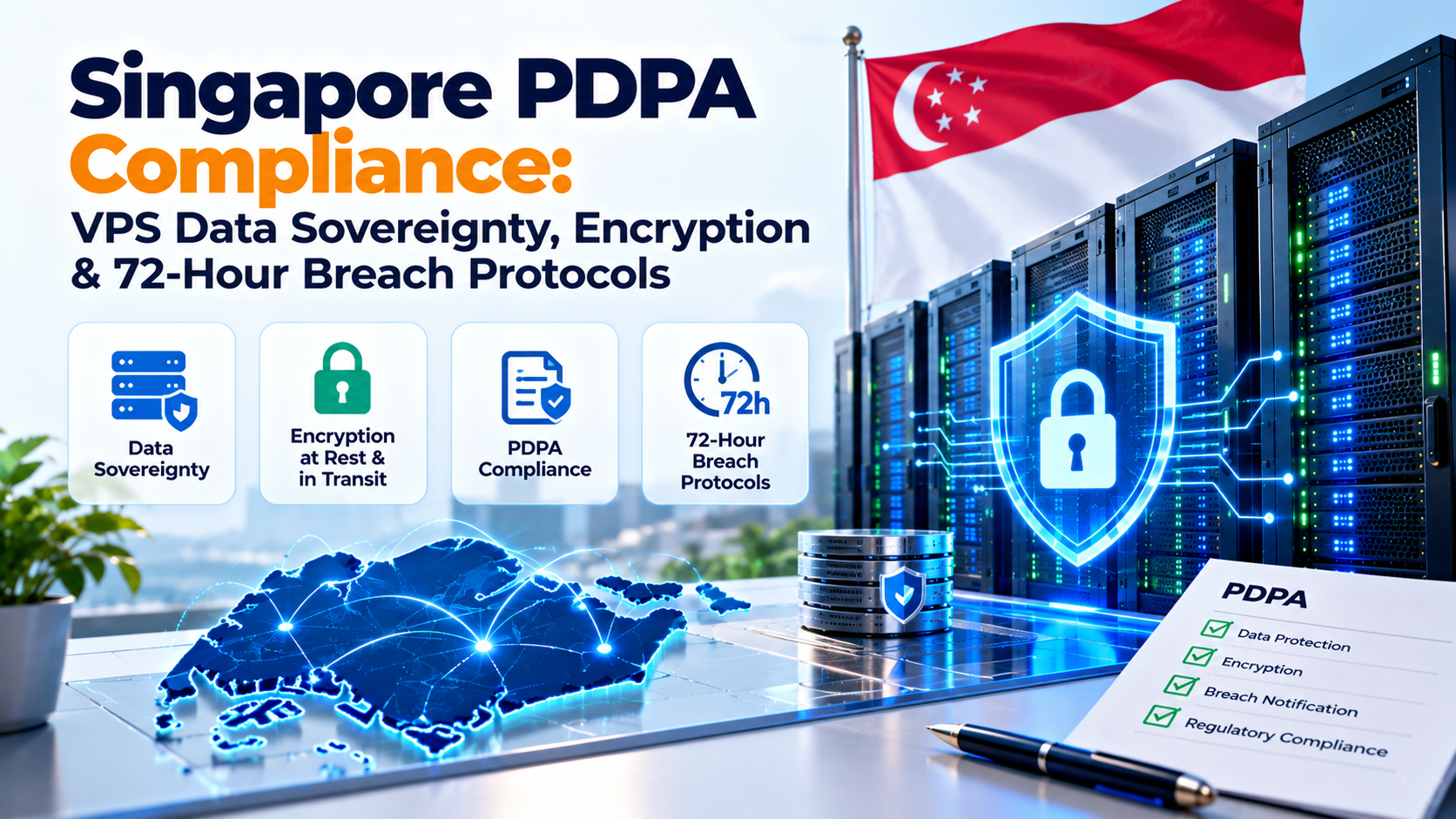
Quick Answer: VPS Data Sovereignty & 72-Hour Breach Protocols under Singapore PDPA
When architecting a Singapore PDPA Compliant VPS solution, hosting on a PDPA-compliant Singapore VPS ensures that personal data collected from Singapore residents remains protected under local sovereign jurisdiction. It satisfies statutory transfer limitations (Section 26), enforces AES-256 encryption at rest and in transit via TLS 1.3, restricts administrative root access via audited SSH keys, and supports automated intrusion detection to fulfill mandatory 72-hour Personal Data Protection Commission (PDPC) breach notifications.
Singapore PDPA Compliant VPS Infrastructure & Technical Guide
Specifically, the Personal Data Protection Act 2012 (PDPA), significantly strengthened by the Personal Data Protection (Amendment) Act 2020, establishes Singapore’s comprehensive statutory baseline for data governance across your Singapore PDPA Compliant VPS environment. In fact, administered and enforced by the Personal Data Protection Commission (PDPC), the law governs how private organizations collect, process, store, and transfer personal data. Similarly, with maximum financial penalties reaching up to 10% of an organization’s annual Singapore turnover (or SGD 1,000,000), compliance is a top-tier operational priority for every business operating digital services in the country.
Furthermore, under the statutory Protection Obligation (Section 24 of the PDPA), an organization must make reasonable security arrangements to protect personal data in its possession or under its control against unauthorized access, collection, use, disclosure, copying, modification, or disposal across your Singapore PDPA Compliant VPS environment. Importantly, when an enterprise provisions cloud hosting infrastructure, the underlying server architecture, physical datacenter location, storage encryption standards, and operating system hardening directly dictate whether the organization satisfies these legal duties.
Hosting customer records, transactional ledgers, and authentication databases on an enterprise PDPA-compliant Singapore VPS hosting platform provides the physical data sovereignty, cryptographic volume isolation, and verifiable forensic audit trails required to satisfy both the PDPC and corporate risk auditors.
📌 Master Chapter Index
- Singapore PDPA Compliant VPS: Data Sovereignty and the Transfer Limitation Obligation Under Section 26
- Technical Safeguards: PDPA Compliant VPS Architecture vs Commodity Cloud Hosting
- The 72-Hour Mandatory Breach Notification Protocol and Incident Timelines
- Cryptographic Storage Architecture: LUKS2 Full Volume Encryption and Key Management
- Data Protection Officer Access Audits and Cryptographic Key Rotation Cycles
- Configuring Linux Storage Encryption and Auditd Telemetry for PDPA Forensics
- Frequently Asked Questions About KVM Hypervisor and Resource Isolation
Singapore PDPA Compliant VPS: Data Sovereignty and the Transfer Limitation Obligation Under Section 26
In addition, one of the most complex compliance challenges under the Singapore PDPA is the Transfer Limitation Obligation codified in Section 26. Specifically, under this rule, an organization must not transfer any personal data to a country or territory outside Singapore, except in accordance with prescribed requirements ensuring that the overseas recipient provides a standard of protection comparable to the PDPA.
When enterprises host data on generic global cloud hyperscalers whose infrastructure dynamically replicates data objects across multi-region availability clusters (such as migrating database backups between Singapore, Tokyo, and Frankfurt without granular administrative control), the organization inadvertently violates Section 26. To legally justify cross-border transfers, companies must execute complex legally binding Standard Contractual Clauses (SCCs), audit third-party overseas data centers, or secure explicit, fully informed consent from every individual user.
Singapore PDPA Compliant VPS Infrastructure & Technical Guide
By anchoring production workloads and primary databases on Onlive Server Singapore VPS instances located exclusively within Singapore’s sovereign jurisdiction (in carrier-grade facilities like Equinix SG1 or SG3), data sovereignty is preserved by design. Customer records never transit external international borders or subsea cables, eliminating cross-border compliance overhead and insulating the enterprise from foreign jurisdictional surveillance laws (such as the US CLOUD Act or EU GDPR third-country transfer scrutiny).
Technical Safeguards: PDPA Compliant VPS Architecture vs Commodity Cloud Hosting
Satisfying the PDPC’s reasonable security arrangements requirement demands robust infrastructure-level controls across compute, storage, and networking:
| Technical Safeguard | PDPA-Compliant Singapore VPS | Standard Commodity Cloud | PDPC Regulatory Significance |
|---|---|---|---|
| Geographic Data Residency | 100% Onshore Singapore (Equinix DC) | Opaque Multi-Region Dynamic Failover | Guarantees full compliance with Section 26 Transfer Limitations |
| Storage Encryption at Rest | LUKS2 / AES-XTS-256 with TPM 2.0 | Shared platform-managed keys or unencrypted | Prevents raw block extraction during disk decommissioning |
| Virtualization Boundary | Dedicated Hardware KVM Isolation | Shared Kernel Containers (LXC/Docker) | Eliminates container breakout and cross-tenant memory snooping |
| Breach Forensic Telemetry | Kernel auditd with cryptographically signed streams | Standard local rotating log files | Enables exact incident timeline reconstruction within 72 hours |
| Transit Cryptography | Enforced TLS 1.3 + PFS ECDHE Ciphers | Legacy TLS 1.0/1.1 or weak ciphers permitted | Protects API payloads and webhooks from man-in-the-middle sniffing |
| Data Disposal Standards | NIST SP 800-88 Cryptographic NVMe Erase | Standard sector re-allocation | Fulfills the Retention Limitation Obligation (Section 25) |
The 72-Hour Mandatory Breach Notification Protocol and Incident Timelines
Compliance officers auditing cloud storage and customer data processing can verify standards in the IMDA Data Protection Trustmark audit standards for enterprise cloud services.
Consequently, the 2020 amendments to the PDPA introduced a mandatory data breach notification regime. Under Section 26D of the Act, an organization must notify the PDPC of a “notifiable data breach.” A breach is statutorily notifiable if it meets either of two criteria:
Therefore, 1. Significant Harm Threshold: The breach results in, or is likely to result in, significant harm to any individual whose personal data was compromised (such as financial information, account credentials, medical records, or national identification numbers like NRIC/FIN).
Notably, 2. Significant Scale Threshold: The breach relates to personal data of 500 or more individuals, regardless of whether significant harm has occurred.
Singapore PDPA Compliant VPS Infrastructure & Technical Guide
In contrast, the critical timeline begins the moment an organization has credible grounds to believe that a data breach may have occurred. The organization must carry out a reasonable and expeditious assessment (which must not exceed 30 calendar days). Once the breach is assessed to be notifiable, the organization must notify the PDPC as soon as practicable, and in any event no later than 72 hours. Affected individuals must also be notified as soon as practicable if significant harm is likely.
Cryptographic Storage Architecture: LUKS2 Full Volume Encryption and Key Management
Additionally, to satisfy the PDPC’s Protection Obligation, personal data must never reside as plaintext on physical or virtual storage volumes. While application-level database encryption is valuable, volume-level encryption ensures that swap files, temporary tables (/tmp), query cache buffers, and automated dump files cannot be inspected by unauthorized parties.
Implementing LUKS2 (Linux Unified Key Setup version 2) using the aes-xts-plain64 cipher suite with Argon2id password-hashing key derivation provides mathematically unbreakable defense against offline volume mounting. Furthermore, binding volume unlock keys to a virtual Trusted Platform Module (vTPM 2.0) using Clevis and Tang network-bound disk encryption (NBDE) allows secure automated rebooting inside trusted Singapore data center networks while preventing volume decryption if disk images are copied out of the hypervisor.
Data Protection Officer Access Audits and Cryptographic Key Rotation Cycles
For example, under Section 11 of the PDPA, every business operating in Singapore must formally designate at least one individual as a Data Protection Officer (DPO) responsible for overseeing statutory data protection compliance. In cloud-native and VPS environments, the DPO must maintain direct administrative visibility into who accesses personal data, when access occurs, and the technical justification for privileged system logins.
To illustrate, to satisfy both the DPO oversight requirements and the Retention Limitation Obligation (Section 25), organizations must implement automated cryptographic key rotation schedules. Volume encryption master keys should be re-wrapped annually using hardware-backed key derivation functions, and old database partitions containing expired user records must be scrubbed using cryptographically verified zero-fill patterns (blkdiscard --secure or shred -u -z -n 3) to prevent forensic magnetic or NAND remnant recovery.
Data protection officers operating in regulated sectors must verify that cloud hosts meet MAS TRM Notice FSM-N21 security requirements alongside personal data handling safeguards.
Configuring Linux Storage Encryption and Auditd Telemetry for PDPA Forensics
In particular, administrators can implement volume-level encryption and configure high-fidelity forensic auditing to satisfy PDPC incident reporting mandates using standard Linux utilities:
Linux System Shell
# 1. Format dedicated database partition with LUKS2 encryption
cryptsetup luksFormat --type luks2 --cipher aes-xts-plain64 --key-size 512 --hash sha512 --pbkdf argon2id /dev/vdb1

# 2. Open encrypted volume and map to logical device
cryptsetup open /dev/vdb1 secured_db_data

# 3. Create high-performance Ext4 filesystem with data journal flags
mkfs.ext4 -L db_data -m 1 /dev/mapper/secured_db_data

# 4. Mount partition with secure mount flags (noexec, nosuid, nodev)
mkdir -p /var/lib/postgresql/data
mount -o noexec,nosuid,nodev,noatime /dev/mapper/secured_db_data /var/lib/postgresql/data

# 5. Configure auditd rules to detect unauthorized access to personal data directories
cat << 'EOF' > /etc/audit/rules.d/pdpa-protection.rules
# Track read/write attempts to the customer database tablespace
-w /var/lib/postgresql/data -p rwa -k customer-data-access
# Track unauthorized access to application secrets and SSL private keys
-w /etc/ssl/private -p rwa -k cryptographic-keys
-w /etc/nginx/ssl -p rwa -k tls-certificates
# Track changes to administrative access configuration
-w /etc/ssh/sshd_config -p wa -k ssh-tampering
-w /etc/pam.d/ -p wa -k auth-module-tampering
EOF
service auditd restart

# 6. Verify active forensic audit watchpoints
auditctl -l | grep "customer-data-access"
As a result, in the event of an attempted data exfiltration incident, these audit rules immediately generate timestamped entries detailing the exact user ID (UID), process ID (PID), command binary, and affected inode. This evidence allows legal counsel and incident response teams to rapidly ascertain breach scope within hours, satisfying the PDPC’s stringent 72-hour reporting deadline.