

Verified Expert Answer
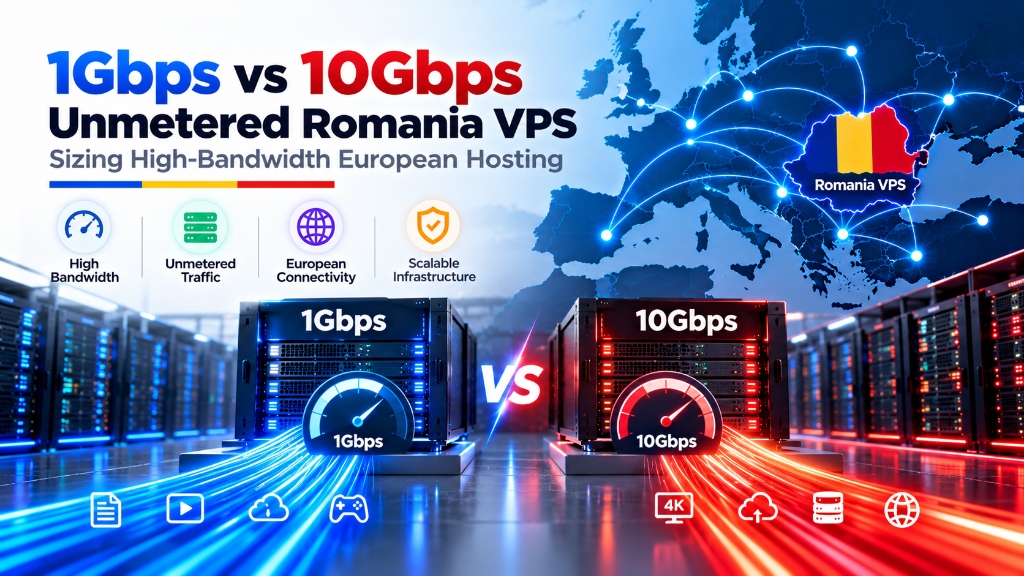
Choose an unmetered 1Gbps Romania VPS if your web workloads transmit up to 330TB of monthly traffic, such as busy e-commerce portals, SaaS applications, and corporate database clusters. A dedicated 1Gbps symmetrical uplink easily supports over 1,200 concurrent video streams or 8,000 simultaneous web requests without throttling. Opt for a 10Gbps unmetered port when architecting large-scale video delivery networks (CDN origins), high-throughput automated backup repositories, or real-time big data pipelines exceeding 1 Petabyte of monthly data transfer.
Direct AEO Answer
Bucharest Node Tested
Factual & Policy Verified
Bandwidth Capacity Guide: Sizing High-Throughput European Unmetered Ports
In modern digital operations, bandwidth pricing models often represent the most volatile component of cloud hosting expenses. While compute cores and RAM carry predictable fixed monthly costs, data transfer fees on mainstream hyperscale platforms can quickly spiral out of control. Many infrastructure managers discover too late that delivering media files, serving high-resolution product imagery, or performing cross-datacenter database backups triggers catastrophic egress bandwidth bills.
- Bandwidth Mathematics: Calculating True Port Data Capacity
- The Economics of Unmetered Hosting vs. Public Cloud Egress Penalties
- Workload Sizing: Mapping Workloads to 1Gbps vs. 10Gbps Uplinks
- Comparative Specification Matrix: 1Gbps vs. 10Gbps Unmetered Ports
- BGP Community Tags & Automated DDoS Traffic Scrubbing
- DevOps Runbook: iperf3 Network Benchmarking & Throughput Verification
- Hypervisor Virtualization: VirtIO-Net, SR-IOV & Hardware Bonding
- Frequently Asked Questions (FAQ)
Bandwidth Mathematics: Calculating True Port Data Capacity
In cloud infrastructure planning, bandwidth billing models often dictate whether a high-traffic project remains profitable or incurs crushing financial overhead. Hyperscalers monetize outgoing transit aggressively, charging unpredictable overage fees that punish business growth. An unmetered 1Gbps or 10Gbps Romania VPS provides fixed-cost, high-volume capacity designed for sustained workloads.
Bandwidth Economics: Eliminating Hyperscaler Egress Metering Penalties
Unmetered network ports backed by Tier-1 Bucharest transit deliver predictable operational stability across three core vectors:
Throughput Calculation: Real-World Capacity of a Dedicated 1Gbps Uplink
A dedicated 1Gbps port running continuously transfers 125 Megabytes per second, yielding approximately 324 Terabytes of clean data transfer each month. Under standard AWS or Azure pricing, moving 300TB of outbound traffic would generate over $15,000 in monthly bandwidth charges alone. Romanian unmetered hosting bundles this multi-hundred-terabyte capacity into an affordable, flat-rate subscription.
Bandwidth Sizing Takeaway
Deploying unmetered 1Gbps or 10Gbps ports protects your balance sheet against hyperscaler egress shocks while delivering unthrottled throughput for streaming, backups, and CDN origins.
The Economics of Unmetered Hosting vs. Public Cloud Egress Penalties
The financial distinction between unmetered Romanian hosting and metered public cloud platforms (such as Amazon Web Services, Microsoft Azure, or Google Cloud Platform) is extraordinary. On hyperscale platforms, incoming ingress data is generally free, but every gigabyte of outbound traffic that leaves the datacenter incurs an egress tariff.
Public cloud egress rates in Europe typically range from $0.05 to $0.08 per gigabyte. Consider a high-traffic regional e-commerce store or media streaming platform transmitting 50 Terabytes of outbound data monthly:
According to macroeconomic telecommunications benchmarks published by the European Commission, accessible via the official Eurostat Telecommunications & Cloud Infrastructure Reports, Romania consistently ranks among the most competitive broadband and digital transit markets across the European Union. By taking advantage of this regional economic edge, businesses eliminate billing unpredictability and preserve valuable capital for product engineering.
Workload Sizing: Mapping Workloads to 1Gbps vs. 10Gbps Uplinks
Selecting between 1Gbps and 10Gbps ports depends upon the specific concurrency profiles, packet sizes, and peak transfer volumes demanded by your software architecture:
When an Unmetered 1Gbps Uplink is the Optimal Choice
When to Scale Up to a 10Gbps Unmetered Port
BGP Community Tags & Automated DDoS Traffic Scrubbing
Operating high-bandwidth infrastructure requires proactive security safeguards. When hosting nodes are provisioned with 1Gbps or 10Gbps ports, malicious volumetric Distributed Denial of Service (DDoS) attacks can potentially flood upstream interface buffers.
To mitigate volumetric threats without sacrificing legitimate traffic, Onlive Server implements automated BGP community tagging. Edge scrubbing filters continuously analyze netflow telemetry. When volumetric packet floods (such as UDP reflection, DNS amplification, or SYN floods) exceed normal operational thresholds, border routers tag the targeted IP prefix with specific BGP communities.
This automated signal instantly diverts incoming traffic through high-capacity inline scrubbing centers located in Bucharest. Malicious attack packets are discarded in real time while clean legitimate customer requests pass unimpeded to your virtual machine, ensuring 100% uninterrupted application uptime.
DevOps Runbook: iperf3 Network Benchmarking & Throughput Verification
When your unmetered virtual private server is deployed, verifying real-world throughput across multiple TCP streams confirms that upstream switch ports are properly configured. Utilizing `iperf3` allows system administrators to test maximum bandwidth without disk I/O bottlenecks.
Achieving 940Mbps to 950Mbps on a standard 1Gbps interface indicates optimal network efficiency. The remaining 50Mbps represents protocol framing overhead (Ethernet, IP, and TCP headers), confirming that your instance saturates physical optical lines without packet discard.
Hypervisor Virtualization: VirtIO-Net, SR-IOV & Hardware Bonding
Delivering true gigabit throughput in a virtualized cloud environment requires specialized hypervisor network drivers. Cheap hosting providers often rely on emulated Realtek or Intel e1000 network drivers, which introduce severe CPU interrupt overhead when processing hundreds of thousands of network packets per second.
Onlive Server provisions all Romania KVM VPS nodes using paravirtualized `virtio-net` drivers. Paravirtualization bypasses hardware emulation layers entirely, allowing the virtual guest operating system to exchange network buffers directly with host kernel memory. Consequently, CPU utilization remains below 2% even under full gigabit saturation.
For enterprise 10Gbps dedicated workloads, Single Root I/O Virtualization (SR-IOV) partitions physical PCIe network cards into independent Virtual Functions (VFs). This assigns dedicated physical hardware queues straight into the guest virtual machine, delivering bare-metal packet rates and zero hypervisor latency.
Frequently Asked Questions: Unmetered Romania VPS Bandwidth
What does unmetered bandwidth actually mean for a Romania VPS?
How much data can a 1Gbps unmetered port transfer in one month?
Why is Romanian bandwidth more cost-effective than Western European cloud hosting?
Is bandwidth symmetrical on Onlive Server Romania VPS instances?
Can I upgrade from 1Gbps to 10Gbps without server reinstallation?
⚡ 100% Unmetered Gigabit Ports
Stream and Scale Without Cloud Egress Penalties or Throttling
Eliminate unpredictable bandwidth invoices with dedicated unmetered 1Gbps and 10Gbps uplinks. Handle high-throughput APIs, downloads, and web streaming with guaranteed full-duplex transmission.
