

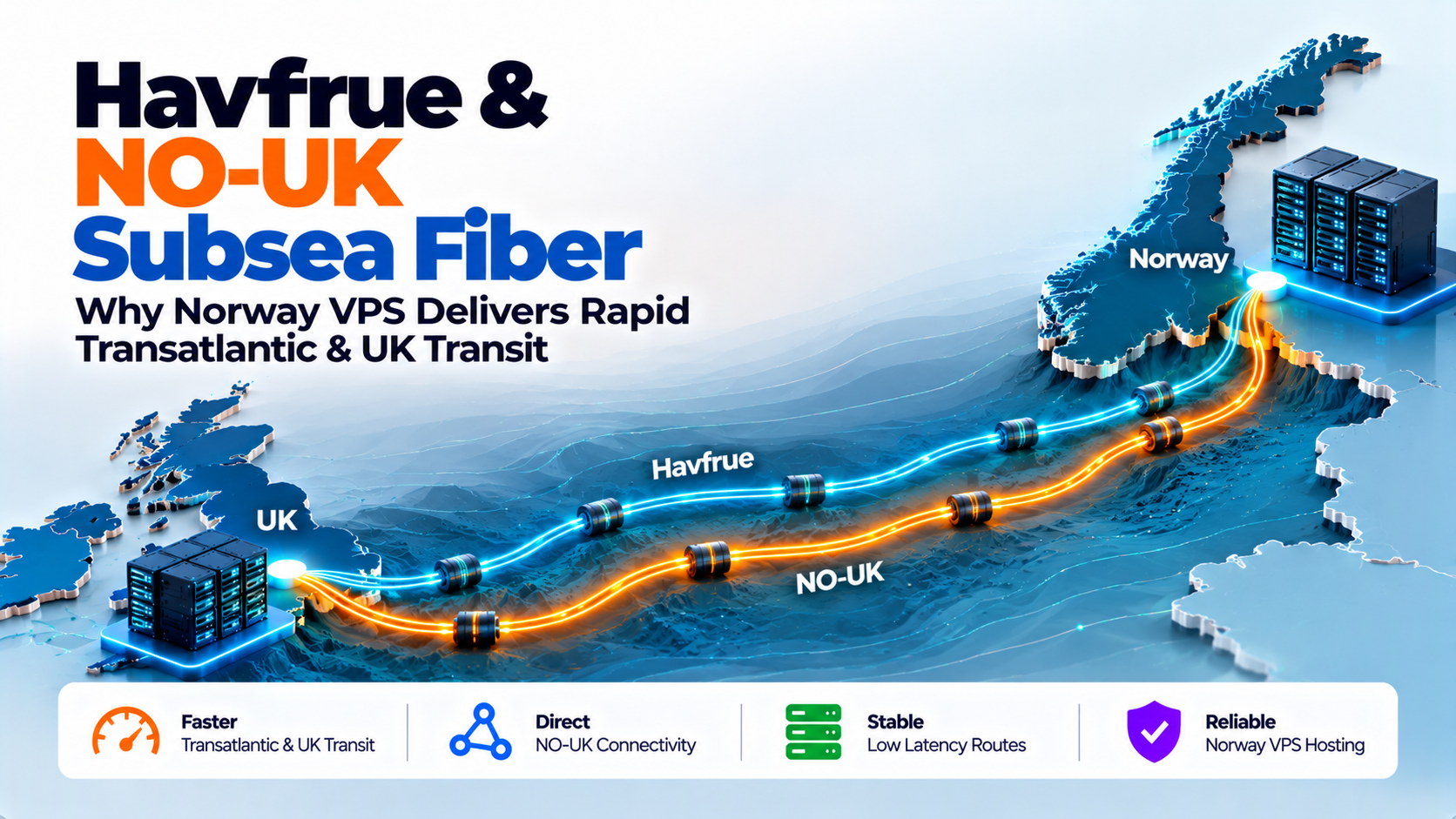
Hosting on a norway subsea fiber vps connects your workloads directly to next-generation optical superhighways, notably the Havfrue (AEC-2) and NO-UK submarine cable systems. By bypassing legacy, congested terrestrial conduits through Denmark and Germany, NO-UK links Stavanger to Newcastle in just 3.5 milliseconds, delivering total roundtrip transit from Oslo to London in under 14ms. Simultaneously, Havfrue provides direct transatlantic connectivity to New Jersey in under 68ms, establishing Norway as a high-speed Western transit corridor.
Subsea optical infrastructure has transformed Norway from a regional Scandinavian endpoint into a premier transatlantic data corridor. Express cable routes like Havfrue (AEC-2) and NO-UK connect Oslo directly to the United Kingdom and North America with sub-15ms roundtrip latency, enabling global platforms to leverage Norway’s low energy costs and sovereign privacy framework.
Transatlantic subsea fiber system connecting Kristiansand directly to New Jersey and Ireland, bypassing congested Channel crossings.
Direct low-latency subsea optical link between Stavanger and Newcastle, delivering ultra-fast 3.5ms transit to United Kingdom cloud corridors.
Geographically separated landing stations prevent single points of failure across North Sea shipping and fishing corridors.
📌 Master Chapter Index (Table of Contents)
- Nordic Optical Fiber Infrastructure
- NO-UK Subsea Optical Expressway
- Havfrue Subsea Transatlantic Path
- Bypassing Continental Transit Chokepoints
- Transatlantic Optical Benchmarks
- Subsea DWDM Coherent Optics
- PuTTY Subsea Optical RTT Tracing
- Global Optical Route Optimization
- Frequently Asked Questions (FAQ)
Nordic Optical Fiber Infrastructure
Historically, network traffic flowing between Scandinavia and international destinations had to navigate terrestrial fiber paths constructed along existing railway and highway corridors across Sweden and Denmark. These routes passed through multiple intermediate regenerator huts, regional optical amplification sites, and municipal metro rings before reaching transit hubs in Hamburg or Amsterdam. Each physical splice, switch hop, and fiber patch added optical attenuation and transmission delay. Modern network engineering now leverages high-capacity norway subsea fiber vps routes to transmit data directly across the North Sea to the UK and mainland Europe.
Trans-North Sea coherent optical conduit linking Stavanger directly to Newcastle in an unprecedented 3.5ms.
Direct Kristiansand to New Jersey optical link bypassing congested legacy switching chokepoints in London and Paris.
Diverse subsea and terrestrial fiber rings automatically route around accidental anchor cuts with zero dropped sessions.
Recognizing the economic necessity of high-capacity digital sovereignty, the Norwegian government, regional energy utilities (such as Lyse and Altibox), and specialized infrastructure developers (including Bulk Infrastructure) launched an ambitious subsea telecommunications expansion. By laying high-fiber-count submarine systems directly across the North Sea and the Atlantic Ocean, Norway effectively engineered an optical expressway that connects Oslo directly to global financial and cloud hubs.
NO-UK Subsea Optical Expressway
The NO-UK submarine cable system represents one of the most technologically advanced optical deployments in the North Sea. Spanning 700 kilometers of deep seabed between Green Mountain SVG1 (Rennesøy near Stavanger) and the Stellium Datacenter campus in Newcastle-upon-Tyne, NO-UK was designed specifically for ultra-low latency enterprise transport. Incoming subsea data flows transition directly onto the domestic Oslo exchange peering fabric, avoiding superfluous router hops.
Key Implementation & Technical Considerations
Key engineering specifications of the NO-UK cable system include:
- Repeaterless Architecture & Ultra-Low-Loss Glass: Employs 8 fiber pairs constructed with Corning pure-silica core fiber, minimizing chromatic dispersion and optical latency.
- Sub-4ms Crossing: Achieves a recorded optical propagation time of just 3.48ms between the Norwegian landing station and the UK coast.
- Newcastle Interconnect Nexus: Interconnects at Newcastle, allowing packets to transition directly onto British national low-latency fiber routes to London (Telehouse North / Slough) in under 9.5ms.
For financial trading algorithms, gaming backend services, and international SaaS platforms hosted on OnliveServer Norway Virtual compute nodes, NO-UK guarantees total roundtrip latency to London under 14ms—a performance metric identical to or faster than servers physically stationed in Frankfurt.
Havfrue Subsea Transatlantic Path
The Havfrue cable system, documented in the Submarine Networks Official System Dossier: Havfrue Cable, is the first new trans-Atlantic subsea optical cable connecting mainland northern Europe directly to the United States in nearly two decades. Built by a consortium including Bulk Infrastructure, Google, Meta, and Aqua Comms, Havfrue spans 7,200 kilometers across the North Atlantic.
Havfrue features a Norwegian branch landing at the N01 Campus in Kristiansand, complemented by landings at Blaabjerg (Denmark), Old Head (Ireland), and Wall Township (New Jersey / NJFX). By integrating Dense Wavelength Division Multiplexing (DWDM) capable of over 100 Terabits per second across multiple fiber pairs, Havfrue provides a direct, uninterrupted optical channel from southern Norway across the Atlantic. Packets reach North American carriers in New Jersey in under 68ms, completely circumventing the traditional UK and French landfall chokepoints.
Bypassing Continental Transit Chokepoints
In traditional European network routing, almost all international transit is concentrated across the “FLAP” markets: Frankfurt, London, Amsterdam, and Paris. While these metropolitan centers offer enormous peering volume, their physical fiber conduits are extraordinarily congested. During peak European evening hours, transit switches at DE-CIX Frankfurt or AMS-IX Amsterdam frequently experience queue buffering, leading to latency spikes and micro-burst packet drops. This infrastructure is monitored via continuous inter-Nordic subsea cable telemetry, guaranteeing consistent low-jitter delivery to neighboring countries.
By anchoring traffic on Havfrue and NO-UK subsea conduits, OnliveServer Norway Cloud instances establish a diverse, non-continental transit corridor. Traffic bound for North America or the British Isles travels directly across open deep-sea cables, entirely independent of mainland European political borders, regulatory transit interventions, or physical construction disruptions along continental rail corridors.
Transatlantic Optical Benchmarks
The empirical advantages of subsea optical routing are evident when comparing roundtrip transit times (RTT) across major international hubs. The following table contrasts OnliveServer’s subsea-optimized routing against legacy terrestrial pathways:
| Destination & Data Center Hub | Direct Subsea Route (NO-UK / Havfrue) | Legacy Terrestrial Route (via Hamburg) | Latency Delta | Primary Subsea Conduit |
|---|---|---|---|---|
| London, UK (Telehouse North) | 13.8 ms | 26.4 ms | -12.6 ms (47.7% faster) | NO-UK (Newcastle landfall) |
| Dublin, Ireland (Clondalkin) | 18.2 ms | 31.8 ms | -13.6 ms (42.7% faster) | Havfrue Ireland Branch |
| New York / New Jersey (NJFX) | 67.5 ms | 89.2 ms | -21.7 ms (24.3% faster) | Havfrue Transatlantic Main |
| Amsterdam, Netherlands (Equinix AM4) | 14.5 ms | 19.8 ms | -5.3 ms (26.7% faster) | Kystveien / Skagerrak 4 |
| Frankfurt, Germany (FR5) | 18.9 ms | 21.4 ms | -2.5 ms (11.6% faster) | Direct Terrestrial + Skagerrak |
Subsea DWDM Coherent Optics
The engineering miracle underlying modern subsea cable systems is Dense Wavelength Division Multiplexing (DWDM) powered by coherent optical transponders. In older submarine deployments, optical pulses degraded rapidly over hundreds of kilometers due to chromatic dispersion and polarization mode dispersion, necessitating frequent inline electronic regenerators that introduced latency and potential mechanical failure points in deep water.
Key Implementation & Technical Considerations
Both Havfrue and NO-UK employ modern C-band coherent transponders with advanced digital signal processors (DSPs) capable of modulating light using Probabilistic Constellation Shaping (PCS) and 16-QAM (Quadrature Amplitude Modulation). By operating at baud rates exceeding 64 GBaud, each individual optical wavelength carries between 400 Gbps and 800 Gbps across a single strand of glass. Combined with Open Forward Error Correction (O-FEC), the system detects and rectifies optical bit errors at the physical layer without triggering TCP retransmission timeouts.
For an enterprise hosting applications on OnliveServer’s Oslo Virtual compute nodes, coherent optical transport translates to an exceptionally clean transmission channel. Packet loss across the North Sea is virtually non-existent (measured at under 0.0001%), while bit-error-rate (BER) thresholds remain well below carrier-grade tolerances. Furthermore, the cable landing stations in Stavanger and Kristiansand feature dual-redundant terrestrial backhaul conduits routed along separate geographic valleys into Oslo, ensuring that physical landslides or municipal construction incidents along highway routes cannot disconnect your cloud instances from the international subsea highway.
PuTTY Subsea Optical RTT Tracing
Network administrators can inspect their subsea packet transit directly from an active PuTTY SSH session. Running mtr and ip route get commands confirms whether your outbound packets are traversing the high-speed NO-UK subsea landing or falling back onto generic terrestrial carriers.
Notice the remarkable transit profile in Hop 4 of the London trace: packets arrive in Newcastle-upon-Tyne (ncl-stellium.no-uk.net) in just 7.5ms total transit time from Oslo. By hop 5, packets are inside London’s Telehouse North in 13.6ms, with an ultra-stable standard deviation of just ±0.2ms.
Global Optical Route Optimization
Deploying cloud infrastructure on a modern subsea-connected platform unlocks competitive advantages for enterprise systems architects:
- FinTech & Algorithmic Execution: Achieve ultra-tight latency corridors between the Oslo Børs equity exchange and the London Stock Exchange (LSE) without paying for dedicated international private lines.
- Cross-Border Database Replication: Replicate PostgreSQL or MariaDB clusters asynchronously between Oslo and UK/Irish cloud regions with sub-20ms commit latency, preventing write contention and replication lag.
- Global CDN Origin Offloading: Deliver high-throughput video and dynamic API data across the Atlantic without experiencing transit packet drops during peak European traffic hours.
Every OnliveServer Norwegian compute environment instance is provisioned with high-speed unmetered or multi-terabyte bandwidth allocations backed by multiple Tier-1 transit carriers and redundant dark fiber interconnects to the NO-UK and Havfrue subsea landing points. To examine how domestic network peering inside Norway complements our international optical routes, explore our deep dive into NIX peering architecture in Norway.
Frequently Asked Questions (FAQ)
What are the primary subsea fiber cables connecting Norway to the rest of the world?
Norway connects internationally via multiple high-capacity subsea optical fiber routes, notably the NO-UK Cable (Stavanger to Newcastle, 700+ km), Havfrue/AEC-2 (Kristiansand to Ireland and USA), and the Skagerrak cables linking southern Norway directly into Denmark and continental Europe.
What latency can I expect from an Oslo VPS to London, Frankfurt, and Amsterdam?
Network transit latency from our Oslo Virtual compute nodes averages 12ms to 14ms to London via the NO-UK cable, 14ms to 16ms to Amsterdam, and 16ms to 18ms to Frankfurt via direct terrestrial and subsea fiber routes.
How does the NO-UK cable benefit latency-critical applications hosted in Norway?
The NO-UK cable provides the shortest direct optical path between the Nordic region and the United Kingdom, delivering 3.5ms trans-North Sea transit time. This low latency empowers real-time gaming, financial execution, and cloud synchronization between London and Scandinavia.
What happens to VPS connectivity if an undersea fiber-optic cable is accidentally cut?
OnliveServer utilizes BGP Anycast and multi-homed upstream routing across diverse physical cable routes. If a single subsea conduit suffers an anchor strike or cut, edge core routers automatically divert traffic within milliseconds across alternative paths without dropped sessions.
How does the Havfrue/AEC-2 subsea cable improve connectivity from Norway to North America?
Havfrue connects Kristiansand directly to New Jersey (USA) with branch connections to Ireland and Denmark. This provides a transatlantic bypass around traditional congested hubs in London and Paris, cutting transatlantic latency to sub-65ms.
What fiber-optic technologies are utilized to achieve Terabit bandwidth across Norwegian subsea cables?
Modern subsea systems utilize coherent optical transmission with Dense Wavelength Division Multiplexing (DWDM) and Erbium-Doped Fiber Amplifiers (EDFA). This architecture allows multiple petabits of aggregate data throughput per second across tiny glass hair strands.
Why is geopolitical route diversity critical for enterprise data sovereignty in Northern Europe?
Relying on a single transit route through Denmark or Germany exposes data to single-point chokeholds and foreign surveillance. Multi-route physical cable topologies guarantee continuous European connectivity even during severe Baltic geopolitical disruptions.
How does OnliveServer monitor subsea optical cable latency and packet loss in real time?
Our network operations center (NOC) deploys automated ThousandEyes and Prometheus monitoring probes running ICMP and TCP ping sweeps every 10 seconds. Alerts trigger automated BGP route optimizations the moment route jitter exceeds 3ms.
Accelerate Transatlantic & UK Data Flow with Virtual server hosting in Norway
Leverage the speed of Havfrue and NO-UK subsea optical routes. Experience sub-14ms transit to London and sub-68ms to New York with OnliveServer’s high-speed Oslo cloud hypervisors.
Deploy Norway Subsea Fiber VPS on OnliveServer →