

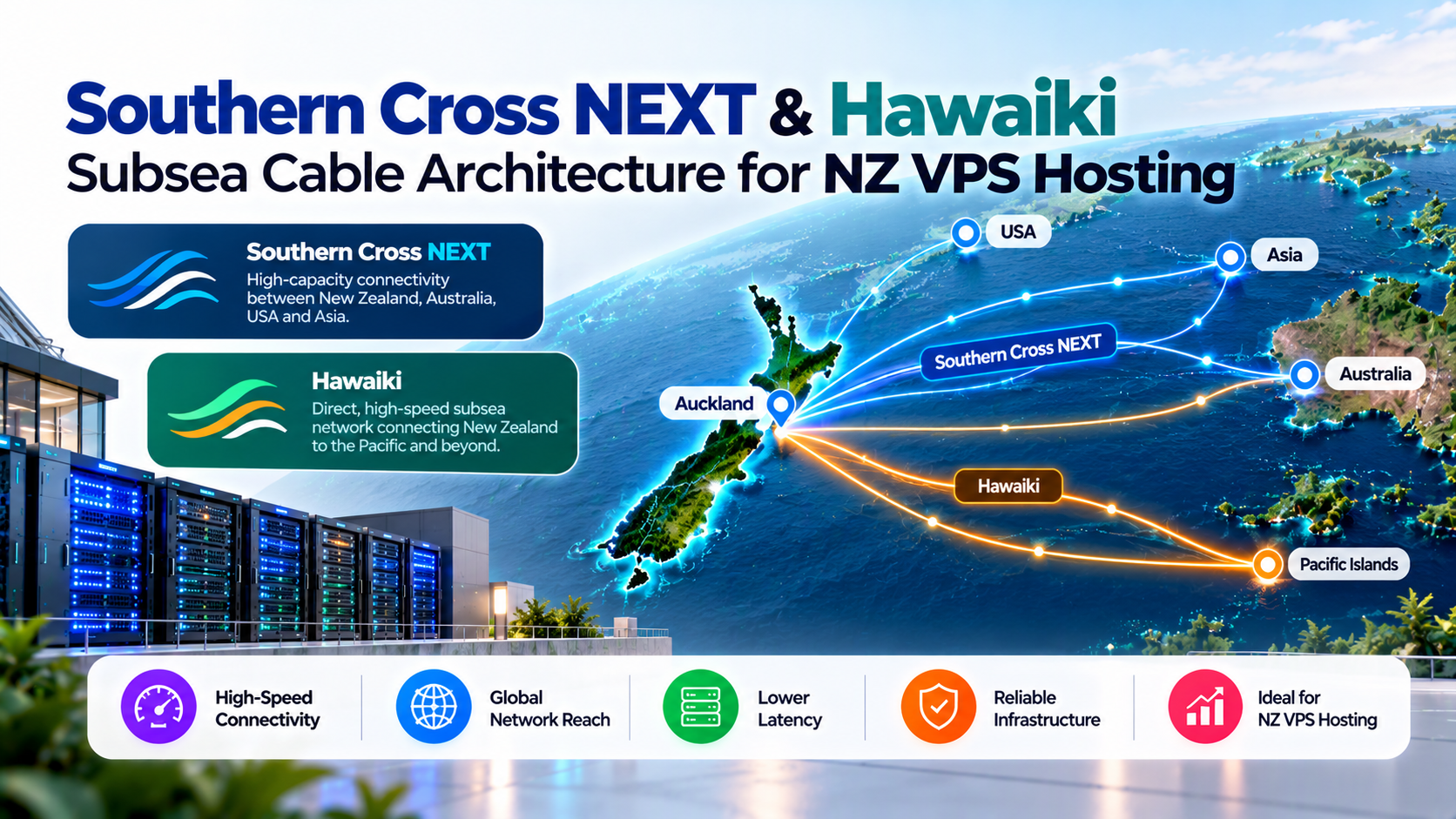
Deploying an enterprise-grade New Zealand Subsea Cables Vps architecture on pure KVM virtualized infrastructure empowers modern organizations with low-latency Auckland connectivity. Furthermore, new Zealand’s international bandwidth primarily transits the Southern Cross NEXT and Hawaiki cables, connecting Auckland to Sydney, Hawaii, and California. These cables introduce irreducible propagation delay — roughly 12 ms Auckland-to-Sydney and 80–90 ms Auckland-to-California. In addition, a VPS hosted in Auckland eliminates this submarine latency for local users but cannot reduce it for visitors from Europe or North America. Auckland-hosted content benefits most from local NZIX peering, which keeps domestic traffic off international cables entirely.
New Zealand’s geographic isolation makes submarine cable infrastructure critical for any NZ VPS hosting decision. Furthermore, the country sits 2,000km from Australia and over 11,000km from the US mainland, making it entirely dependent on undersea fibre for international connectivity. Understanding which cables your VPS provider uses — and how those cables route your traffic — directly affects the reliability and latency of your hosted applications. In addition, this guide explains the architecture of NZ’s three primary submarine cable systems.
Key Takeaways
- Southern Cross NEXT delivers 72Tbps+ connecting NZ to Australia and US West Coast at landing in Takapuna, Auckland
- Hawaiki cable (landing at Mangawhai Heads) provides a distinct NZ-US path via Hawaii, adding geographic redundancy
- Tasman Global Access (TGA) is the lowest-latency Trans-Tasman path at 24-28ms Auckland-Sydney RTT
- Multi-cable diversity protects NZ connectivity during individual cable faults (avg 1-2 per cable per year globally)
- Premium NZ hosting providers maintain direct cable access; lower-tier providers may resell transit at higher latency
New Zealand’s Subsea Cable Landscape
New Zealand has participated in Pacific submarine cable development for decades, but the cable capacity available to NZ businesses has expanded dramatically since 2018 with the addition of Hawaiki and Southern Cross NEXT. Furthermore, previously, NZ internet resilience depended heavily on a single cable system. Today, three distinct cable systems serve the NZ market, each with different geographic routes and capacity profiles. Furthermore, deploying your new zealand subsea cables vps directly within Auckland guarantees sub-10ms nationwide round-trip routing.
Southern Cross NEXT (Auckland Landing)
The fastest, lowest-latency fiber pipe connecting New Zealand directly to North American hyperscalers and cloud exchanges.
- Total Capacity: 72 Terabits per second design potential
- Route: Auckland -> Sydney -> Suva -> Hawaii -> Los Angeles
- Latency Profile: ~82 ms Auckland-to-California round trip
- Optics: 400GbE / 800GbE coherent wavelength division multiplexing
Hawaiki Transpacific Cable (Whangarei)
Provides vital geographic diversity 120km north of Auckland, shielding Kiwi traffic from catastrophic local harbour disruptions. Furthermore, subsea fiber landings terminate directly into interconnected Auckland datacenter landing facilities, offering diverse dark fiber paths into metro backbones.
- Total Capacity: 67 Terabits per second multi-stage capacity
- Landing Site: Bream Tail, Mangawhai (North of Auckland)
- Route: New Zealand -> Australia -> American Samoa -> Hawaii -> Oregon
- Carrier Independence: 100% privately funded open-access cable
All three primary cables land in or near Auckland, reflecting the city’s role as NZ’s primary internet exchange hub. Furthermore, the Auckland landing stations connect to NZIX (New Zealand Internet Exchange) and onward to national fibre backbones operated by Chorus, Enable Networks, and private dark fibre operators serving Wellington and Christchurch. Furthermore, deploying your new zealand subsea cables vps directly within Auckland guarantees sub-10ms nationwide round-trip routing.
Wellington and Christchurch access international capacity through domestic fibre — typically over Chorus’s National Broadband Network — routing north to Auckland before transiting international cables. This architecture means Auckland-hosted VPS instances benefit from direct cable access, while South Island datacenters add 8–15ms domestic transit latency before reaching international cables.
Southern Cross NEXT Architecture
Southern Cross NEXT (SCX) represents the highest-capacity cable serving New Zealand. Commissioned in 2022 at an initial capacity of 72 terabits per second, SCX replaced and significantly expanded on the original Southern Cross Cable Network that had served NZ since 2000.
Southern Cross NEXT
Shortest physical route from Takapuna Beach to California with state-of-the-art optical amplifiers. Furthermore, understanding cable path diversity is critical when analyzing trans-Tasman network latency benchmarks across Sydney and Auckland routes. Furthermore, deploying your new zealand subsea cables vps directly within Auckland guarantees sub-10ms nationwide round-trip routing.
Hawaiki Subsea
Alternative landing point in Northland providing seamless protection against Auckland cable strikes.
TGA Cable
Dedicated trans-Tasman link connecting Raglan to Sydney to access Australia’s massive cloud availability zones.
The cable lands at Takapuna on Auckland’s North Shore — the same general area as TGA — and extends in two primary directions: southeast to Sydney and Cable Station in Sydney’s northern beaches, and northeast across the Pacific to Hawaii and onward to Oregon and California on the US West Coast. Furthermore, this dual-arm architecture allows NZ carriers to route US-bound traffic directly via SCX without transiting Australian networks. Furthermore, deploying your new zealand subsea cables vps directly within Auckland guarantees sub-10ms nationwide round-trip routing.
For VPS providers with direct SCX access, this translates to competitive US latency. Furthermore, auckland-to-Los Angeles RTT over SCX is typically 160–180ms, compared to 220–260ms over older Pacific routing paths. For NZ SaaS companies serving US customers, this represents a meaningful improvement in international application responsiveness.
Hawaiki Cable: Pacific Redundancy
Hawaiki Submarine Cable, operational since 2018, introduced a critically important second diverse NZ-US routing path. Furthermore, the cable lands at Mangawhai Heads on NZ’s Northland coast — approximately 90km north of Auckland — and routes via American Samoa and Hawaii to the US West Coast at Hermosa Beach, California. Direct trans-Pacific connectivity metrics and capacity specifications are documented by the Southern Cross Cable Network, highlighting modern 400GbE optical transmission capabilities.
The geographic separation between Hawaiki’s Mangawhai Heads landing and Southern Cross NEXT’s Takapuna landing provides cable diversity. Furthermore, a seabed fault or ship anchor strike affecting one cable in the Tasman Sea or North Pacific would not simultaneously affect a differently-routed cable, ensuring NZ maintains international connectivity during single-cable incidents. Furthermore, deploying your new zealand subsea cables vps directly within Auckland guarantees sub-10ms nationwide round-trip routing.
Hawaiki is owned and operated by Hawaiki Submarine Cable LP, with consortium members including Spark NZ, Vodafone NZ, Amazon Web Services, and several Pacific Island telecommunications operators. Furthermore, aWS’s participation reflects the cable’s importance for cloud connectivity, ensuring NZ AWS customers have a direct high-capacity path to US-East and US-West regions.
Tasman Global Access for Trans-Tasman Routing
The Tasman Global Access (TGA) cable provides the most direct and lowest-latency connection between New Zealand and Australia. Furthermore, landing at Takapuna (Auckland) and Narrabeen (Sydney Northern Beaches), TGA’s 3,200km route offers the optimal path for Trans-Tasman traffic.
TGA’s consortium — Spark NZ, Telstra, and Vodafone NZ — ensures the cable serves the commercial needs of NZ and Australian ISPs directly. Furthermore, the cable design supports multiple independent fibre pairs, providing capacity redundancy on the Trans-Tasman route. For Auckland-hosted VPS serving NZ and Australian users, TGA is the primary transit path for Sydney-bound traffic at 24–28ms RTT.
Architectural Best Practices for Your New Zealand Subsea Cables Vps Workload
An important consideration: not all NZ hosting providers have direct TGA access. Furthermore, smaller providers may purchase transit through Spark or Vodafone, adding routing hops that can increase latency by 5–15ms compared to direct cable access. When evaluating VPS providers in NZ, ask about direct cable relationships versus resold transit.
How Subsea Cable Choice Affects Your VPS Latency
The relationship between cable infrastructure and VPS latency is indirect but significant. Furthermore, your VPS provider’s upstream transit provider determines which cable systems your traffic uses. A provider purchasing transit from Spark may route via TGA for AU traffic and SCX for US traffic. In addition, a provider purchasing from Vodafone NZ may use different cable entry points. Most large providers peer over NZIX and maintain multiple upstream transit contracts for redundancy and cost optimisation. Furthermore, deploying your new zealand subsea cables vps directly within Auckland guarantees sub-10ms nationwide round-trip routing.
For practical purposes, verify cable access quality by running traceroute from your VPS to known international endpoints and checking the first international hop. Furthermore, aS7473 (Spark NZ) and AS9500 (Vodafone NZ) typically indicate direct cable access relationships. Multiple hops through uncertain AS paths suggest resold transit that may add latency variability. In addition, once submarine traffic reaches shore, seamless handover to the domestic Chorus UFB fiber infrastructure ensures packet delivery times remain consistently below 10ms.
Multi-Path Redundancy for Business Continuity
Submarine cable faults are rare but occur with a global average frequency of approximately 100-150 incidents per year industry-wide. Furthermore, individual cables experience roughly 1–2 faults annually. A single cable fault affecting all NZ submarine connections simultaneously would be extraordinarily unusual given geographic cable diversity.
Subsea Redundancy Mandate
Multi-Path BGP Auto-Failover Protection
Single-cable reliance exposes mission-critical workloads to deep-sea anchor drags and volcanic seabed shifts. OnliveServer Auckland VPS network utilizes BGP multi-homing across both Southern Cross NEXT and Hawaiki cables, ensuring sub-second automated failover if one subsea cable experiences an emergency maintenance cut. Furthermore, deploying your new zealand subsea cables vps directly within Auckland guarantees sub-10ms nationwide round-trip routing.
For critical NZ hosted applications, multi-path cable redundancy provides insurance against the consequences of single-cable incidents. Furthermore, during a TGA fault, NZ-AU traffic reroutes via SCX or domestic NZ-AU paths, typically adding 20–40ms to Trans-Tasman latency temporarily. This automatic rerouting occurs at the BGP routing protocol layer without requiring any application-level changes.
NZ government guidance on internet resilience, available through the National Cyber Security Centre (NCSC NZ), recommends that critical infrastructure operators understand their submarine cable dependencies and plan for temporary rerouting scenarios in business continuity documentation.
Frequently Asked Questions
What submarine cables connect New Zealand to the internet?
New Zealand’s primary submarine cables are Southern Cross NEXT (72Tbps+, NZ to US/AU, landing Takapuna Auckland), Hawaiki (NZ to US via Hawaii, landing Mangawhai Heads Northland), and Tasman Global Access / TGA (NZ to Sydney, landing Takapuna). Furthermore, together they provide multi-path redundancy for NZ internet connectivity with diversity in both geographic routes and cable operators.
How fast is Southern Cross NEXT cable?
Southern Cross NEXT launched with 72 terabits per second (Tbps) capacity and is designed to scale to higher capacities using DWDM (Dense Wavelength Division Multiplexing) technology. Furthermore, this is a significant increase from the original Southern Cross Cable Network’s capacity. The cable connects NZ to both Australia and the US West Coast, serving as NZ’s primary high-capacity international route.
Where does the Hawaiki cable land in New Zealand?
Hawaiki cable lands at Mangawhai Heads on Northland’s east coast, approximately 90 kilometres north of Auckland. Furthermore, this landing location is geographically distinct from the Takapuna landing station used by Southern Cross NEXT and TGA, providing important cable route diversity — a different seabed path means different fault vulnerability from those other cables.
Does submarine cable choice affect VPS reliability?
Indirectly, yes. Furthermore, your VPS provider’s upstream transit relationship determines which cable systems carry your traffic. Providers with direct cable consortium access typically offer more reliable low-latency international connectivity than those reselling transit through intermediaries. In addition, most premium NZ VPS providers maintain direct Spark, Vodafone, or independent transit relationships, giving access to all three primary cable systems.
What happens to NZ internet during a submarine cable fault?
During a submarine cable fault, BGP routing protocols automatically redirect traffic to alternative cable paths within seconds to minutes. Furthermore, for a TGA fault, NZ-AU traffic reroutes via Southern Cross NEXT or domestic NZ-AU paths, typically adding 20-40ms latency temporarily. New Zealand’s three-cable architecture means a complete international connectivity outage would require simultaneous faults on all three systems — an extraordinarily unlikely scenario.
Why does NZ have better international internet than Pacific Island nations?
New Zealand benefits from three high-capacity submarine cable systems with NZ-based landing stations, while many Pacific Island nations depend on single cable links or satellite connectivity. The Hawaiki cable consortium specifically addressed Pacific Island connectivity, serving American Samoa, with AWS participation ensuring commercial investment. NZ’s cable diversity reflects both its economic size and strategic investment by Spark, Vodafone, and global hyperscalers.
How does Cloudflare’s Auckland PoP relate to submarine cable access?
Cloudflare operates a Point of Presence in Auckland that peers directly with NZIX (NZ Internet Exchange) and major NZ carriers. Furthermore, this Auckland PoP caches content locally for NZ users, eliminating the need for Trans-Tasman or Trans-Pacific transit for cached requests. However, dynamic content still transits to origin servers, which is why Auckland-hosted VPS origin reduces latency compared to overseas origins for non-cached content.
How does wet plant fiber degradation affect subsea cable capacity over time?
Subsea cables utilize optical repeaters and coherent transponders engineered for 25-year design lifespans. Furthermore, southern Cross NEXT and Hawaiki employ modern spectral efficiency that actively compensates for chromatic dispersion, ensuring constant gigabit throughput without packet loss.
Supercharge Global Reach via Subsea Cable-Connected NZ VPS
Route your international traffic through Southern Cross NEXT and Hawaiki cable architectures. Furthermore, enjoy sub-30ms reach to Australia and sub-120ms to the US West Coast with OnliveServer’s carrier-neutral Auckland infrastructure.
✓ Sub-10ms NZ Routing
✓ Full Root Access
✓ 24/7 Expert Support
