

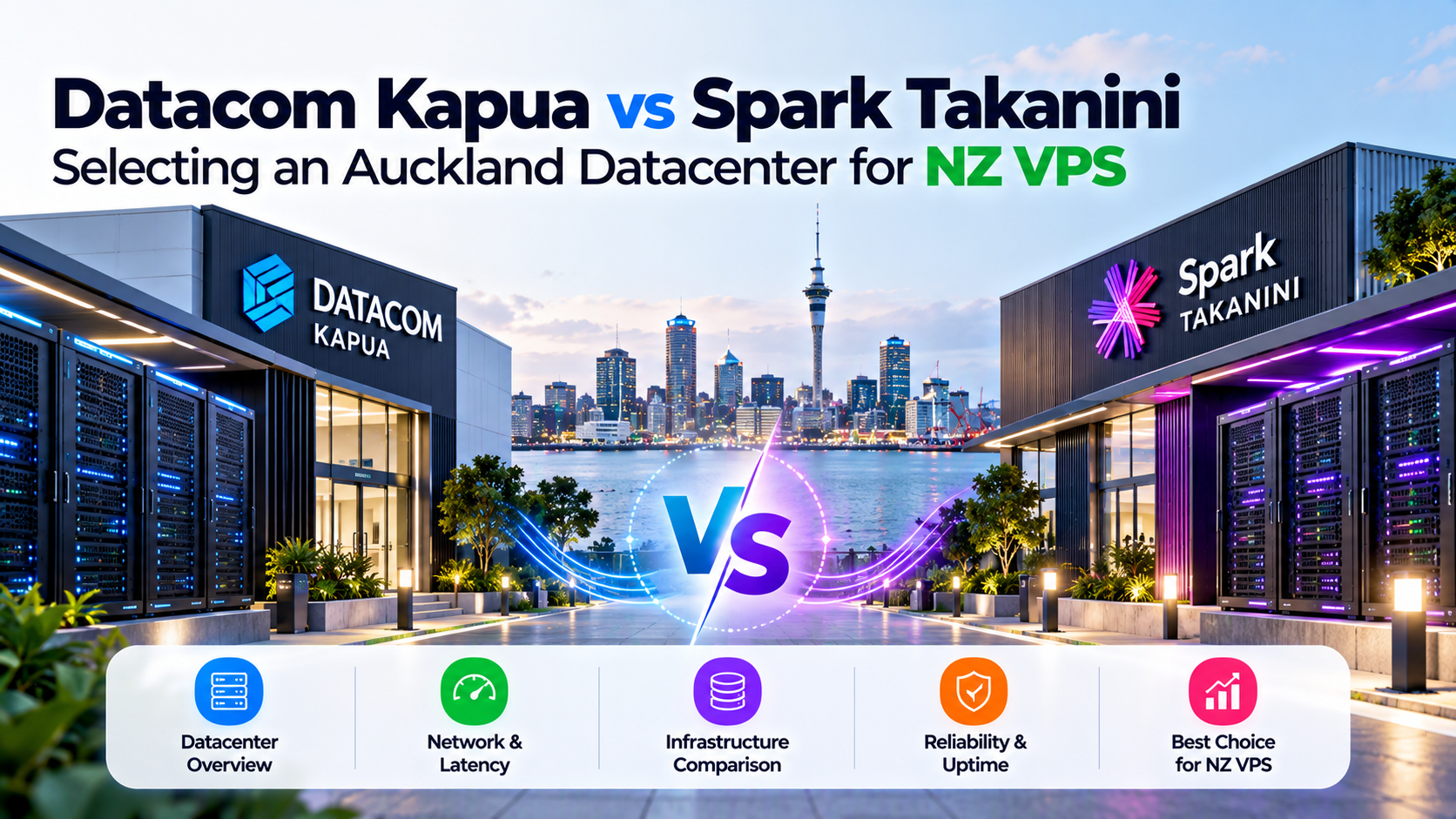
Deploying an enterprise-grade Auckland Datacenter Vps architecture on pure KVM virtualized infrastructure empowers modern organizations with low-latency Auckland connectivity. Furthermore, Auckland’s primary co-location facilities — Datacom Kapua in Albany and Spark Takanini south of the CBD — differ significantly in redundancy tier, power feed topology, and interconnection options. Datacom Kapua offers Tier III-design infrastructure with direct NZIX peering, making it better suited for latency-sensitive or compliance-driven workloads. Spark Takanini, by contrast, provides higher raw floor density and superior carrier neutrality. Consequently, for most Auckland VPS workloads, the right facility depends on whether your priority is low-latency local exchange routing or raw compute density.
When businesses evaluate New Zealand VPS hosting, the physical datacenter location within Auckland matters more than many realise. A virtual private server is only as reliable as the facility housing its hypervisor. Auckland’s two premier cloud corridors — the North Shore Albany precinct anchored by Datacom Kapua, and the South Auckland logistics hub at Spark’s Takanini facility — offer meaningfully different infrastructure profiles. Therefore, this guide provides a technical comparison to help Kiwi CTOs, infrastructure architects, and DevOps engineers make an informed decision.
Key Takeaways
- Datacom Kapua (Albany) offers 4.5MW IT load capacity with PUE ~1.3 and dual substation power feeds
- Spark Takanini provides carrier-neutral dark fiber and diverse dual-path connectivity to Auckland CBD
- Both facilities comply with NZ Building Code seismic Zone B requirements, though structural approaches differ
- Latency between Albany and Takanini is under 2ms — the performance difference is minimal for most workloads
- Your carrier preference, compliance requirements, and power topology needs should drive the decision
Auckland’s Datacenter Corridor: North Shore vs South Auckland
North Shore: Albany & Technology Sector Proximity
Auckland’s commercial datacenter market is geographically split into two distinct corridors. The North Shore cluster — centred on Albany near State Highway 1 — benefits from proximity to Auckland’s technology sector, the University of Auckland’s Tamaki campus, and direct motorway access for on-site engineering teams. Albany sits approximately 18 kilometres north of the CBD, connected via the Northern Motorway. As a result, organizations requiring frequent physical access to their hosted infrastructure benefit from reduced travel time and lower operational overhead.
Datacom Kapua (Albany, North Shore)
Optimized for latency-critical fintech, public-sector compliance, and high-security enterprise workloads requiring sovereign New Zealand governance.
- Design Tier: Tier III+ equivalent with 4.5 MW critical capacity
- Power Path: Dual independent 33kV substation feeds with N+1 UPS
- Cooling Efficiency: Target PUE ~1.3 with cold-aisle containment
- Connectivity: Direct dark-fiber cross-connects to Auckland CBD & NZIX
Spark Data Centre (Takanini, South Auckland)
Ideal for large-scale container clusters, high-bandwidth streaming, and disaster recovery replication separate from North Shore infrastructure.
- Design Tier: Tier III modular topology with multi-megawatt scalability
- Carrier Density: True neutral meet-me room with Spark, Chorus & Vocus
- Disaster Isolation: Located 35km south of CBD outside primary flood zones
- Power Redundancy: 2N UPS battery reserves and 48-hour on-site diesel fuel
South Auckland: Industrial Heartland & Logistics Affinity
The South Auckland corridor, anchored near Takanini and Manukau, serves the city’s industrial heartland. This location provides proximity to Auckland Airport (15 km), the Port of Auckland logistics spine, and the city’s highest concentration of manufacturing and distribution businesses. For businesses operating supply-chain or logistics platforms, a South Auckland datacenter offers natural geographic affinity with their operational footprint. In addition, when evaluating cross-border response times, pairing your facility selection with verified trans-Tasman latency benchmarks between Auckland and Sydney provides measurable network routing telemetry.
Neither location is definitively superior. The right choice depends on carrier relationships, existing office locations, and the nature of workloads being hosted. Both corridors connect to the same national fibre backbone via Chorus, Enable, and private dark fibre routes. Consequently, organizations can achieve comparable uptime SLAs from either precinct when paired with the right carrier configuration.
Facility Deep-Dive: Datacom Kapua (Albany)
Datacom Kapua is New Zealand’s largest domestically-owned hyperscale facility. Situated in Albany on Auckland’s North Shore, the facility offers enterprise-grade colocation and underpins cloud infrastructure for numerous government agencies and large Kiwi enterprises. In addition, its 100% New Zealand ownership structure ensures compliance with the Privacy Act 2020 and all government cloud procurement frameworks.
Substation Power Diversity
Dual 33kV feeds routed from separate Vector substations eliminate single-point grid failure risks during winter storm peaks.
Eco-Friendly PUE 1.3
Auckland’s temperate maritime climate enables extensive free-cooling cycles, slashing thermal overhead and environmental footprint.
Sovereign NZ Ownership
100% New Zealand-owned facility compliant with all Privacy Act 2020 and government cloud procurement frameworks. Moreover, local transit redundancy inside Auckland facilities is further reinforced through direct NZIX peering at Auckland exchange points, bypassing congested transit backbones.
Direct NZIX Port Access
Sub-millisecond access to Auckland Internet Exchange peering fabric for Spark, 2degrees, and One NZ traffic.
Power Topology, Dual Substation Feeds & Generators
Datacom Kapua is designed around an N+1 power architecture with dual grid feeds sourced from separate Auckland City substations. This separation is critical: a fault on one transmission line or transformer does not create a single point of failure. The facility supports a total IT load capacity of approximately 4.5 megawatts across its operational halls. In addition, both A-side and B-side power distribution ensures dual-corded servers receive truly independent power paths — a requirement for any infrastructure claiming Tier III equivalency.
Diesel generators provide extended backup runtime — typically 48 hours at full load with on-site fuel — supplemented by UPS systems to bridge the generator start time (typically 10–30 seconds). Therefore, even during extended grid outages, critical workloads continue operating without interruption.
Cooling & PUE Energy Efficiency
Datacom Kapua achieves a Power Usage Effectiveness (PUE) of approximately 1.3, which places it well ahead of the global average of 1.58. The facility uses an airside economiser approach compatible with Auckland’s temperate maritime climate, reducing mechanical cooling requirements for much of the year. For VPS hypervisors running compute-intensive workloads, consistent low-PUE operation translates directly to lower per-megawatt costs and a smaller carbon footprint.
Facility Deep-Dive: Spark Data Centre (Takanini)
Spark’s Takanini facility in South Auckland serves as the primary cloud and colocation anchor for Spark’s enterprise infrastructure business. As New Zealand’s largest telecommunications company, Spark brings an inherent network advantage through its national fibre backbone and international submarine cable access. Consequently, evaluating datacenter resilience here means aligning facility specifications with Onlive Server’s New Zealand VPS hosting standards for redundant capacity components and concurrent maintainability.
Carrier-Neutral MMR
Over a dozen telco providers cross-connected directly inside the Meet-Me-Room.
Multi-Megawatt Scale
Built for high-density rack configurations supporting modern GPU and high-IOPS NVMe workloads.
Seismic & Flood Safe
Constructed on stable volcanic bedrock elevated safely above Auckland coastal tsunami hazard zones.
Network Carrier Neutrality & Fiber Feeds
Takanini is positioned as a carrier-neutral facility, meaning multiple network operators — including Spark, Vodafone, 2degrees, and several ISPs — maintain points of presence within the building. This carrier diversity allows tenants to establish direct cross-connects to multiple providers without depending solely on Spark’s own network. Specifically, this multi-carrier approach is invaluable for organizations requiring redundant uplink paths at competitive transit rates.
The facility connects to Auckland’s CBD fibre ring via diverse dual-path routes, ensuring no single cable trench failure can isolate the building. Moreover, connectivity to the Southern Cross NEXT cable landing station at Takapuna provides low-latency international transit for workloads requiring US and Pacific Island connectivity. For national organizations requiring geodiverse resilience beyond the Auckland region, deploying an active-passive setup with cross-island disaster recovery between Auckland and Wellington fulfills tier-1 compliance requirements.
Physical Security & Biometric Access Controls
Enterprise colocation requires multi-layer physical security. Takanini implements mantraps at primary entry points — double-door airlocks requiring badge authentication before the inner door unlocks. Biometric verification (typically palm vein or fingerprint) supplements badge readers in high-security zones. In addition, CCTV with 90-day retention covers all aisles, cage boundaries, and external perimeters.
For regulated industries — financial services, healthcare, government — this physical security posture satisfies the NZISM physical security controls and supports Privacy Act 2020 data protection obligations. Therefore, organizations subject to strict audit requirements can demonstrate compliance without additional capital expenditure on physical security infrastructure.
Seismic Resilience & Building Code Compliance in NZ
New Zealand’s seismic environment requires datacenter designers to think beyond standard international building codes. The Auckland region sits in the moderate seismic hazard zone (NZS 1170.5 Zone Factor Z = 0.13), lower than Wellington but significant enough to require engineered structural systems. As a result, both major Auckland facilities have invested substantially in seismic mitigation beyond standard commercial building requirements.
NZBC Structural Compliance
Importance Level 4 (IL4) Seismic Building Standard
New Zealand Building Code (NZBC) mandates that critical infrastructure operating as disaster-response or essential public services meet Importance Level 4 (IL4) criteria. Both Datacom Kapua and Spark Takanini incorporate base isolation, seismic bracing on all server racks, and flexible utility couplings to maintain uncompromised continuous operation during major alpine fault shaking.
Architectural Best Practices for Your Auckland Datacenter Vps Workload
| Seismic Factor | Datacom Kapua (Albany) | Spark Takanini |
|---|---|---|
| NZ Seismic Zone | Auckland Zone B (Z=0.13) | Auckland Zone B (Z=0.13) |
| Building Importance Level | Level 3 (Critical) | Level 3 (Critical) |
| Structural System | Reinforced concrete tilt-panel | Steel moment frame |
| Floor Loading | 12 kPa (raised floor) | 10–15 kPa (zone-dependent) |
Auckland’s volcanic geology also introduces considerations absent in most international markets. The Auckland Volcanic Field contains over 50 cones; while no eruption has occurred in recorded history, both facilities are sited away from identified volcanic hazard zones as defined by GNS Science’s volcanic impact assessment for Auckland. Moreover, combining local datacenter proximity with optimized Chorus UFB fiber routing for optimal TTFB ensures ultra-responsive delivery for New Zealand domestic web applications.
Both Kapua and Takanini are constructed to or above the New Zealand Building Code (NZBC) structural performance requirements for importance level 3 buildings — the category covering critical infrastructure. This means they are designed to remain operational through a 1-in-500-year seismic event with only minor structural damage. Consequently, enterprise organizations can deploy mission-critical workloads with confidence in the physical resilience of Auckland’s hosted infrastructure.
Latency & Transit Routing Comparison
For most enterprise and cloud workloads, the latency difference between Albany and Takanini is negligible. A round-trip between the two Auckland precincts over commercial fibre is typically under 2 milliseconds — far below the threshold that affects application performance. However, the routing path to end-users matters significantly more than inter-facility latency. Therefore, businesses targeting New Zealand audiences should explore the full range of New Zealand VPS hosting plans to match their specific performance requirements.