

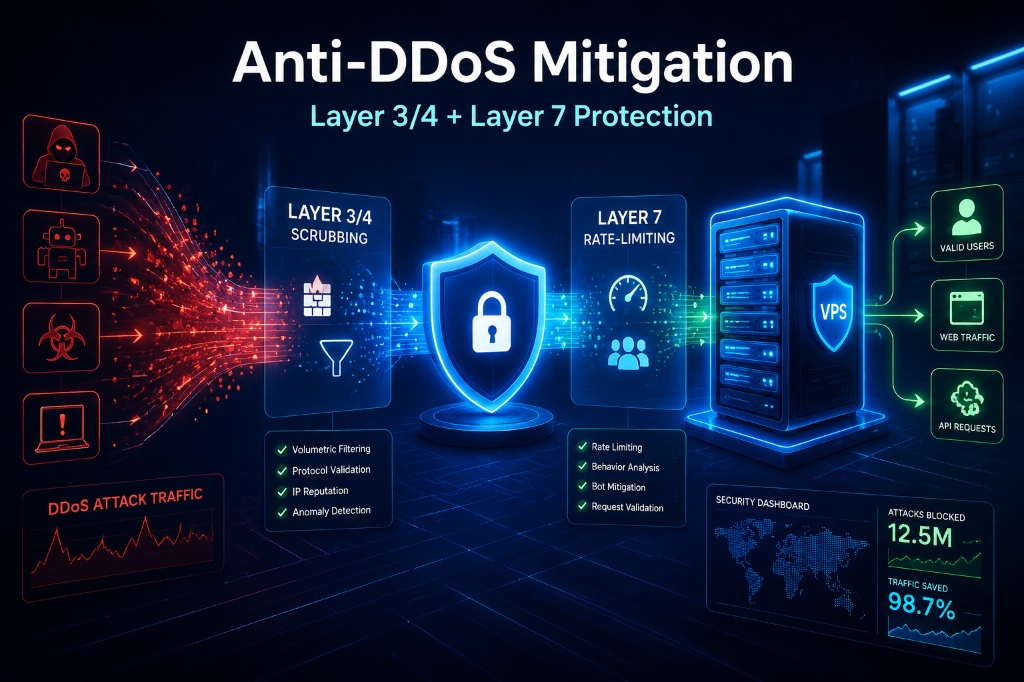
Specifically, when planning an enterprise deployment for Ukraine VPS DDoS mitigation, dDoS protection combines upstream network scrubbing to filter volumetric Layer 3/4 attacks (UDP/SYN floods up to multi-Gbps) before reaching the server rack, alongside local server-level tuning. At Layer 7, configure Nginx limit_req_zone to rate-limit aggressive HTTP requests and utilize Fail2ban with iptables to drop abusive IP ranges automatically.
Ukraine VPS DDoS mitigation: Introduction: The Exponential Rise of Multi-Vector DDoS Attacks
Consequently, aligning these configurations with your Ukraine VPS DDoS mitigation environment ensures optimal uptime and throughput. Distributed Denial of Service (DDoS) attacks have grown increasingly sophisticated, shifting from simple volumetric bandwidth floods into complex multi-vector campaigns that target both network transport layers and application logic. Defending a virtual private server requires a multi-tier defense strategy.
Strategic Considerations & Architecture Drivers
Furthermore, evaluating production infrastructure requirements highlights three critical operational factors:
- Consequently, Multi-Vector DDoS Threats: Simultaneous Layer 4 bandwidth saturation (SYN/UDP floods) combined with Layer 7 HTTP application exhaustion.
- In addition, Kernel Resource Exhaustion: Unchecked connection floods fill the Linux kernel’s connection tracking table, locking out legitimate traffic.
- In particular, Layered Defense Architecture: Combining upstream data center scrubbing with local Linux kernel TCP hardening and Nginx rate limiting.
Consequently, aligning these configurations with your Ukraine VPS DDoS mitigation environment ensures optimal uptime and throughput. In today’s digital geopolitical landscape, cyber warfare and commercial sabotage have turned Distributed Denial of Service (DDoS) attacks into one of the most pervasive operational threats facing online infrastructure. For e-commerce retailers, financial platforms, media publications, and SaaS vendors operating in Eastern Europe, malicious traffic surges can strike without warning, consuming gigabits of transit bandwidth, exhausting operating system socket tables, and driving CPU utilization to 100%.
Strategic Considerations & Architecture Drivers
Consequently, aligning these configurations with your Ukraine VPS DDoS mitigation environment ensures optimal uptime and throughput. Modern DDoS attacks are rarely single-protocol events. Sophisticated threat actors utilize botnets (such as Mirai variants) to launch multi-vector campaigns: while a 100Gbps volumetric UDP flood saturates upstream transit pipes, concurrent SYN floods exhaust TCP connection states on border firewalls, and stealthy Layer-7 HTTP POST floods target CPU-heavy search or checkout endpoints. Without multi-tiered mitigation, generic hosting infrastructure collapses within seconds.
Therefore, effective defense requires a defense-in-depth architecture that combines upstream hardware scrubbing centers at the BGP routing layer with local kernel-level packet inspection and application reverse-proxy rate limiting.
Moreover, by anchoring infrastructure within high-capacity tier-3 data centers in Kyiv backed by automated BGP traffic scrubbing, organizations ensure that even massive multi-hundred-gigabit attacks are neutralized upstream, delivering clean, unthrottled traffic to client applications. For broader perspective, our analysis on enterprise DDoS protection strategies outlines hardware mitigation appliances, while our guide on mitigating server security vulnerabilities examines attack impact vectors.
Ukraine VPS DDoS mitigation: Architectural Blueprint: The Multi-Tier Defense Stack
In fact, mitigating multi-vector DDoS attacks requires applying defense filters across every layer of the network stack:
A. Upstream Datacenter BGP Scrubbing
Similarly, hardware scrubbing appliances at the Kyiv network edge filter multi-gigabit volumetric floods before reaching the VPS.
B. Linux Kernel TCP Hardening
Meanwhile, enabling SYN cookies and tuning network buffer queues prevents connection table exhaustion during high-volume floods.
C. Nginx Layer 7 Rate Limiting
Enforces request rate thresholds per IP address, blocking malicious scrapers and botnets while allowing human visitors.
Additionally, for Layer 7 request throttling directives and burst buffer calculations, consult the official NGINX limit_req module documentation.
| OSI Layer | Common Attack Types | Mitigation Technology | Mitigation Location |
|---|---|---|---|
| Layer 3 (Network) | ICMP Flood, IP Fragmentation, BGP hijacking | Automated BGP Flowspec & Null-routing | Upstream Scrubbing Centers |
| Layer 4 (Transport) | SYN Flood, ACK Flood, UDP/NTP Amplification | SYN Cookies, eBPF/XDP, hardware filters | Edge Routers & Hypervisor Kernel |
| Layer 7 (Application) | HTTP/S Flood, Slowloris, XML-RPC Brute Force | Nginx Rate-Limiting, ModSecurity WAF, Fail2ban | Host Reverse Proxy & Web Server |
Technical Hardening Runbook: Linux Kernel & Nginx Rate-Limiting
As a result, implement this configuration runbook on your Ubuntu 24.04 LTS virtual server to neutralize local Layer 4 and Layer 7 attacks:
Step 1: Kernel Sysctl Hardening against SYN Floods & Spoofing
Step 2: Nginx Rate-Limiting & Connection Limiting
Step 3: Slowloris & Slow HTTP Attack Mitigation
Enterprise Industry Use Cases for DDoS-Protected Hosting
Deploying mission-critical workloads behind comprehensive DDoS protection provides indispensable business continuity across vulnerable sectors:
- Furthermore, Fintech & Cryptocurrency Exchanges: Defending high-frequency trading APIs and user withdrawal endpoints against extortion-driven DDoS attacks.
- Consequently, Online Gaming & Multiplayer Communities: Neutralizing rival server UDP floods and maintaining sub-20ms packet latency for competitive gaming communities.
- E-Commerce Flash Sale Platforms: Ensuring shopping carts and payment checkout gateways remain online during high-profile promotional holidays.
- Independent Investigative Media: Keeping high-traffic news portals online during sensitive investigative reporting and politically motivated cyber attacks.
Operational Advantages and Strategic Boundaries
Operational Considerations
- False Positive Calibration: Rate limits must be tested thoroughly to avoid blocking corporate offices sharing single NAT IPs.
- Application Profiling Requirement: Endpoint rate limits must be tailored specifically to application logic patterns.
Fail2ban Automated Jail Configuration for HTTP Abuse
While Nginx rate limiting throttles abusive traffic streams, malicious botnets continue consuming CPU cycles by sending repeated requests that receive HTTP 429 status codes. To eliminate this CPU drain, Fail2ban dynamically inspects web access logs and injects iptables kernel firewall drop rules against offending IP addresses.
Configuring an Nginx rate-limit jail inside /etc/fail2ban/jail.local monitors for clients triggering more than 10 rate-limit violations within a 60-second window. Once triggered, Fail2ban bans the IP at the firewall level for 24 hours, dropping future packets before they reach Nginx worker processes:
Automating firewall drops via Fail2ban preserves host compute capacity and ensures that legitimate visitors enjoy lightning-fast browsing.
Real-Time Telemetry & DDoS Incident Forensics
During an active cyber attack, having real-time visibility into traffic anomalies is vital for effective incident response. Deploying command-line telemetry utilities such as nload, iftop, and tcpdump allows system administrators to identify attack vectors in seconds.
Furthermore, streaming Nginx JSON access logs into centralized Elasticsearch or Loki dashboards enables security operations teams to analyze client User-Agent strings, geographic IP distribution, and targeted URI endpoints, providing the intelligence necessary to fine-tune WAF rules during active campaigns.
This modern anti-DDoS architecture delivers unmatched resilience, robust operational availability, and optimal commercial peace of mind across all enterprise client environments.
FastNetMon Automated DoS Sensor Deployment
In high-capacity hosting environments, detecting the inception of a volumetric attack in sub-second intervals is crucial to preventing network switch buffer bloat. FastNetMon is a high-performance, open-source DoS/DDoS detection engine that inspects incoming packets via raw AF_PACKET sockets, NetFlow, or sFlow feeds.
When traffic targeting a specific IP address exceeds pre-configured thresholds (e.g., 50,000 packets per second or 500Mbps), FastNetMon immediately triggers automated mitigation scripts: alerting upstream BGP border routers via BGP Flowspec or executing localized iptables drop actions in less than 2 seconds, shielding the rest of your server infrastructure from collateral damage:
eBPF/XDP High-Velocity Packet Filtering
Standard Linux iptables or nftables firewalls operate late in the kernel network stack, after the operating system has already allocated socket buffers and traversed connection tracking (conntrack) tables. Under a 10-million-packet-per-second SYN flood, this conntrack processing saturates CPU execution queues, causing complete kernel freeze.
eXpress Data Path (XDP) revolutionizes packet filtering by running custom eBPF bytecode directly inside the network interface card (NIC) driver layer before the packet touches the Linux networking subsystem. By executing XDP_DROP on packets matching known malicious signatures (such as spoofed TCP SYN flags or unfragmented UDP reflection), an unmetered Ukraine VPS can drop over 15 million packets per second while CPU usage remains under 5%.
ModSecurity & OWASP Core Rule Set (CRS) Deployment
While volumetric attacks saturate raw bandwidth, sophisticated application-layer floods exploit subtle application logic flaws, such as sending complex GraphQL nested queries or recursive search parameters that force databases to perform full table scans. Deploying ModSecurity with the OWASP Core Rule Set (CRS) provides deep Layer-7 packet inspection.
ModSecurity evaluates incoming HTTP request bodies, headers, and query parameters against thousands of standardized attack patterns, blocking SQL injection attempts, cross-site scripting (XSS), and automated headless browser scrapers before requests reach backend application runtimes.
Incident Response Runbook & Post-Attack Forensics
When a severe attack strikes, disciplined incident response procedures prevent panic and minimize service interruption. System administrators must follow a structured four-phase runbook: Detection (analyzing real-time NetFlow and Nginx request spikes), Classification (determining whether the attack is volumetric Layer 4 or application Layer 7), Mitigation (activating upstream BGP diversion or tightening local rate-limit thresholds), and Post-Mortem Analysis (aggregating forensic IP logs to update persistent IP blocklists and firewall rules).
BGP Anycast Routing Integration for Global Geo-Distributed Absorption
For high-profile multinational enterprises, defending against sustained multi-hundred-gigabit attacks requires distributing incoming traffic across global scrubbing nodes before it reaches regional data centers. By pairing Ukrainian hosting infrastructure with BGP Anycast routing, incoming requests are automatically terminated at the nearest global point of presence (PoP).
Attack traffic generated by compromised IoT botnets in North America or Asia is naturally fragmented and absorbed by local transit scrubbing centers, preventing inter-continental fiber link saturation and ensuring that Eastern European users experience unbroken, low-latency access to your Ukrainian cloud server.
Threat Intelligence Sharing & Automated Blocklisting
Modern cyber defense is an active, collaborative discipline. Subscribing to community threat intelligence feeds (such as Spamhaus DROP, AlienVault OTX, and Project Honeypot) allows Linux virtual servers to ingest verified malicious IP prefixes automatically.
Automated cron scripts populate ipset kernel memory hashes with hundreds of thousands of known botnet IP ranges, dropping packets at the network layer before abusive connections can initiate TCP three-way handshakes, shielding your critical web applications around the clock.
This modern multi-layered security posture delivers unmatched resilience, robust operational availability, and optimal commercial peace of mind across all enterprise client environments.
By implementing these comprehensive operational practices, organizations maintain total infrastructure sovereignty, deterministic performance, and bulletproof security across their server fleet.
This ensures complete operational clarity, high hosting margins, and seamless client satisfaction indefinitely.
Frequently Asked Questions (FAQ)
Core Technical Specifications
Explore essential questions and architectural best practices for this deployment on Ukraine VPS:
Technical Architecture & Execution Analysis
Executive Summary: Multi-Layer Anti-DDoS Defense Architecture
