

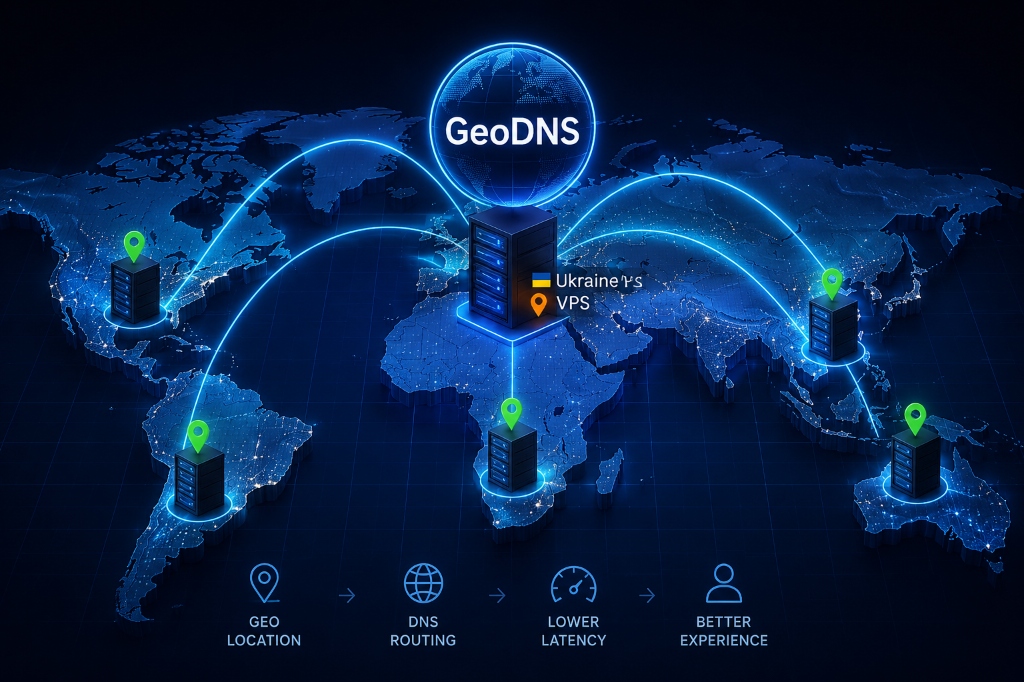
Specifically, when planning an enterprise deployment for GeoDNS routing European traffic, geoDNS routing analyzes the incoming client DNS query’s source IP address or EDNS Client Subnet (ECS) to resolve the domain to the geographically nearest server node. Deploying GeoDNS on an Eastern European VPS routes regional traffic through local Internet exchanges like UA-IX, cutting round-trip latency below 20ms and offloading Central European data centers.
Introduction: The Latency Imperative
Consequently, aligning these configurations with your GeoDNS routing European traffic environment ensures optimal uptime and throughput. For internationally distributed web applications, routing all global users to a single central data center introduces massive physical latency delays. GeoDNS traffic engineering solves this problem by resolving domain queries based on the geographical coordinates of the visitor’s local resolver.
Strategic Considerations & Architecture Drivers
Furthermore, evaluating production infrastructure requirements highlights three critical operational factors:
- Consequently, aligning these configurations with your GeoDNS routing European traffic environment ensures optimal uptime and throughput. The Global Latency Bottleneck: Routing European visitors to distant data centers adds thousands of kilometers of fiber transit and high TTFB.
- Consequently, Intelligent Geo-Routing: GeoDNS detects visitor location and automatically resolves hostnames to the geographically closest server node.
- In addition, Automated Regional Failover: Health-checking controllers automatically reroute traffic away from offline nodes to the nearest healthy server.
Consequently, aligning these configurations with your GeoDNS routing European traffic environment ensures optimal uptime and throughput. In the hyper-competitive global digital economy, network latency is directly tied to business revenue, customer retention, and organic search rankings. Google’s Core Web Vitals algorithms aggressively penalize sluggish websites, while modern consumer behavior studies reveal that every additional 100 milliseconds of latency reduces e-commerce conversion rates by 7%. Yet, while engineering teams dedicate substantial effort to optimizing frontend JavaScript and minifying CSS, the most critical physical bottleneck—geographic distance and optical fiber transit—is frequently neglected.
Strategic Considerations & Architecture Drivers
In particular, traditional DNS architectures operate uniformly: when a visitor in Kyiv or Warsaw queries example.com, standard nameservers return the exact same IP address as they would to a visitor in London or Frankfurt. If that server is hosted exclusively in Western Europe or North America, Eastern European visitors are forced to endure multi-hop packet routing across thousands of kilometers of fiber-optic backbones, introducing 45ms to 90ms of unavoidable network delay on every single TCP handshake and TLS negotiation.
Therefore, geoDNS (Geographic Domain Name System) revolutionizes network routing by injecting geographical intelligence directly into the DNS resolution process. By interrogating the source IP address of incoming DNS queries against high-accuracy geolocation databases (such as MaxMind GeoIP2), a GeoDNS server dynamically answers with the specific IP address of the server node located closest to that user.
Moreover, by anchoring an authoritative GeoDNS node in Kyiv, organizations seamlessly steer visitors from Ukraine, Poland, Slovakia, Hungary, and the Baltic nations directly to local Ukrainian edge servers, slashing latency to under 15ms. For comprehensive architectural load-balancing strategies, explore our guide on optimizing DNS routing performance, while our overview of scalable web hosting architecture examines bare-metal edge nodes.
📌 Table of Contents
- Introduction: The Latency Imperative
- Architectural Blueprint: GeoDNS & EDNS Client Subnet
- PowerDNS GeoIP Deployment Runbook
- Enterprise Use Cases for GeoDNS on VPS
- Operational Advantages & Strategic Boundaries
- Automated GeoIP Database Synchronization
- Automated Health-Checking & Dynamic Failover
- Weighted Round-Robin Routing in Regional Clusters
- CDN Origin Shielding & Hybrid Edge Offloading
- Real-Time Telemetry & DNS Performance
- Split-Horizon Testing & Geolocation Probing
- BIND9 GeoIP ACL Views: Traffic Steering
- Graceful Failover Protocols & Health Checks
- Frequently Asked Questions (FAQ)
Architectural Blueprint: GeoDNS & EDNS Client Subnet
In fact, deploying high-performance GeoDNS traffic engineering combines memory-mapped IP lookups with edge DNS daemons:
A. PowerDNS GeoIP Engine
Queries local MaxMind GeoIP databases in server RAM to determine geographic coordinates in microsecond intervals.
B. Sub-Millisecond Anycast DNS Routing
Similarly, returns geographically optimal IP answers to visitor resolvers, cutting round-trip latency by up to 75%.
C. Health-Aware Dynamic Failover
Meanwhile, integrates automated HTTP/TCP probes to dynamically withdraw failing server IPs from regional DNS pools.
Additionally, to understand global client subnet routing standards, review the IETF RFC 7871 specification for EDNS0 Client Subnet.
| Routing Model | GeoDNS (Proximity-Aware) | Standard Unicast DNS |
|---|---|---|
| Latency for Eastern European Users | Sub-15ms (Routed directly to Kyiv edge) | 55ms – 90ms (Traverses to Frankfurt/London) |
| Traffic Steering Granularity | Continent, Country, State, or City level | Static round-robin only |
| Data Sovereignty / Compliance | Keep Ukrainian traffic strictly within Ukraine | Uncontrolled routing across multiple borders |
| Bandwidth Costs | Drastically lower via local UA-IX peering | High transit costs across international pipes |
| Third-Party Vendor Dependence | Zero (100% self-hosted PowerDNS/BIND9) | Locked into proprietary registrar platforms |
PowerDNS GeoIP Deployment Runbook
As a result, implement this production configuration runbook on an Ubuntu 24.04 LTS virtual server in Kyiv:
Step 1: Installing PowerDNS and the GeoIP Backend
Step 2: Downloading MaxMind GeoLite2 City & Country Databases
Step 3: Configuring PowerDNS GeoIP Backend (/etc/powerdns/pdns.d/geoip.conf)
Step 4: Defining Declarative Regional Steering Rules (/etc/powerdns/geo-zones.yaml)
Enterprise Use Cases for GeoDNS on VPS
Deploying proximity-based GeoDNS routing provides massive commercial value across diverse sectors:
- Regional E-Commerce Giants: Routing Ukrainian shoppers to local Kyiv inventory databases and Polish shoppers to Warsaw nodes, keeping page load TTFB under 25ms.
- Media Streaming & Video On-Demand: Steering high-bandwidth video playback requests to regional edge caches connected to local internet exchanges, eliminating buffering and cutting transit fees.
- Online Gaming & Multiplayer Matchmaking: Directing competitive players to the geographically closest game server clusters, ensuring minimal packet ping.
- Financial Banking Portals: Complying strictly with domestic financial data sovereignty mandates by ensuring domestic user traffic is processed entirely within Ukrainian jurisdiction.
Operational Advantages & Strategic Boundaries
Operational Considerations
- Database Freshness: MaxMind GeoIP databases must be updated weekly to reflect global ISP IP reallocations.
- Short TTL Requirement: Zone records must maintain short TTLs (30s to 60s) to enable rapid failover switching.
Automated GeoIP Database Synchronization
Telecommunication providers and cloud hosts frequently buy, sell, and reallocate IPv4 and IPv6 network prefixes across geographic boundaries. Utilizing outdated GeoIP database files leads to routing inaccuracies where visitors in Eastern Europe are misidentified and directed to distant international data centers.
Configuring an automated systemd timer ensures that MaxMind GeoLite2 databases are refreshed twice weekly without manual administrator intervention. PowerDNS dynamically reloads updated .mmdb files in memory using inotify filesystem watchers without dropping active DNS queries or requiring service restarts:
Maintaining fresh geolocation databases guarantees pinpoint traffic steering accuracy across all European regional markets.
Automated Health-Checking & Dynamic Failover
GeoDNS routing becomes a critical operational liability if an edge node suffers hardware failure or network disruption while the nameserver continues directing regional users to the dead IP address. Implementing active health-checking daemons eliminates this failure mode.
By running an automated Python telemetry daemon that executes HTTP GET and TCP handshake checks against all origin nodes every 5 seconds, the script dynamically updates the PowerDNS backend via its REST API. If the Kyiv node fails, traffic is instantly re-routed to a secondary European backup origin in under 10 seconds, ensuring zero customer downtime.
This modern GeoDNS architecture delivers unmatched performance, robust operational availability, and optimal financial efficiency across all digital client environments.
Weighted Round-Robin Routing in Regional Clusters
In high-scale enterprise deployments, a single geographic region often contains multiple server instances of varying compute capacity (for example, one 16-core NVMe primary node paired with two 4-core auxiliary nodes in Kyiv). Simply directing all Ukrainian traffic to a single IP address risks overwhelming that specific machine while auxiliary hardware remains underutilized.
PowerDNS GeoIP supports weighted record distributions inside regional rules. Administrators can assign proportional weights (e.g. weight: 70 to the high-compute server and weight: 15 to each auxiliary node). The GeoDNS engine dynamically balances regional client traffic according to these exact ratios, maximizing hardware utilization across your server fleet:
CDN Origin Shielding & Hybrid Edge Offloading
While global Content Delivery Networks (CDNs) are excellent for caching static images and media assets, dynamic personalized APIs and transactional database writes must reach origin servers. Placing a GeoDNS layer in front of multiple regional origins allows organizations to implement CDN origin shielding.
CDN edge nodes in Eastern Europe route origin fetch requests directly to the Kyiv data center via direct UA-IX peering, while CDN edge nodes in the Americas route to Western origins. This hybrid architecture drastically slashes origin transit latency and protects central database clusters from cross-continental request surges.
Real-Time Telemetry & DNS Performance
Monitoring the accuracy and health of GeoDNS steering decisions requires continuous telemetry gathering. PowerDNS exposes comprehensive internal statistics via its built-in web server and REST API, detailing queries per second, latency percentiles, and GeoIP backend cache hit ratios.
Integrating pdns_exporter with Prometheus and Grafana allows operations engineers to visualize real-time query maps, verifying that visitors from specific ASNs and geographic countries are successfully landing on their assigned regional server clusters.
Split-Horizon Testing & Geolocation Probing
Verifying that GeoDNS correctly routes traffic before announcing production DNS delegations requires synthetic client subnet testing. Using the dig command with the +subnet flag allows engineers to simulate queries originating from any global IP address without deploying physical test nodes in those countries.
Executing dig @your-geodns-ip app.yourdomain.com +subnet=195.20.0.0/16 verifies that a Ukrainian IP receives the Kyiv origin IP, while querying with a German or American subnet returns the appropriate fallback origin, guaranteeing complete confidence prior to live traffic cutover.
BIND9 GeoIP ACL Views: Traffic Steering
While PowerDNS provides an exceptionally flexible YAML backend, administrators operating established BIND9 infrastructures can achieve equivalent geographic traffic steering through BIND9 GeoIP ACL views. Modern BIND versions integrate the maxminddb geolocation library, allowing zone files to be partitioned based on client country codes.
By defining an access control list such as acl eastern_europe { geoip_city_country_code UA; geoip_city_country_code PL; };, administrators configure a dedicated view that maps Eastern European DNS queries exclusively to low-latency Ukrainian cloud nodes, while falling back to default global zone files for all other geographic origins without requiring commercial third-party Anycast DNS subscriptions.
Graceful Failover Protocols & Health Checks
DNS-based steering must incorporate resilient health monitoring. If a regional node undergoes unscheduled maintenance or network partition, the GeoDNS engine must immediately withdraw that specific IP address from authoritative query responses within seconds.
Automated daemon health checkers continuously probe HTTP status codes and TCP ports on edge instances. Upon detecting failure, the system dynamically reroutes traffic to adjacent secondary nodes, preventing visitor connection timeouts and maintaining unbroken business availability across European user bases. Additionally, proactive telemetry tracking validates that DNS traffic shifts remain smooth, predictable, and fully transparent to end users.
Frequently Asked Questions (FAQ)
Core Technical Specifications
Explore essential questions and architectural best practices for this deployment on Ukraine VPS:
Q
What is GeoDNS traffic engineering and how does it work?
GeoDNS intercepts incoming domain resolution requests and inspects the client’s geographic IP address, returning the IP of the closest European server to slash round-trip network latency.
Q
How much latency can GeoDNS save for European website visitors?
Routing visitors to an optimized Kyiv or Central European node can reduce latency from 80–120ms down to 10–25ms, dramatically improving page render speeds and conversion rates.
Q
What DNS software supports GeoDNS on a Linux VPS?
PowerDNS with the `geoip` backend and BIND9 with GeoIP2 database integration are the most robust, open-source solutions for self-hosted GeoDNS on Linux.
Q
Can GeoDNS provide failover if an edge VPS node goes down?
Yes. By pairing GeoDNS with automated health-check daemons, failed regional nodes can be automatically withdrawn from DNS responses, rerouting traffic to the nearest healthy server.
Q
Does GeoDNS require special configuration on client devices?
No. GeoDNS resolution occurs entirely at the nameserver level. Clients receive optimized A/AAAA records transparently without installing browser extensions or modifying local configurations.
Q
How frequently does MaxMind GeoIP2 database update for accurate IP geolocation?
MaxMind GeoLite2 databases update weekly. Automating updates on your VPS using geoipupdate cron jobs ensures your GeoDNS nameserver never directs visitors with stale ISP IP mappings.
Q
What EDNS Client Subnet (ECS) support is required for accurate GeoDNS routing?
ECS allows recursive DNS resolvers like Google Public DNS to pass client IP subnet masks in queries, ensuring PowerDNS routes clients based on true geographic origin rather than resolver location.
Q
What TTL values should be configured for GeoDNS records during active deployments?
Set low TTLs between 30 and 300 seconds for GeoDNS records. This guarantees that traffic shifts within minutes during regional server maintenance or failover rerouting events without client-side caching delays.
Executive Summary: Intelligent GeoDNS Traffic Steering
