

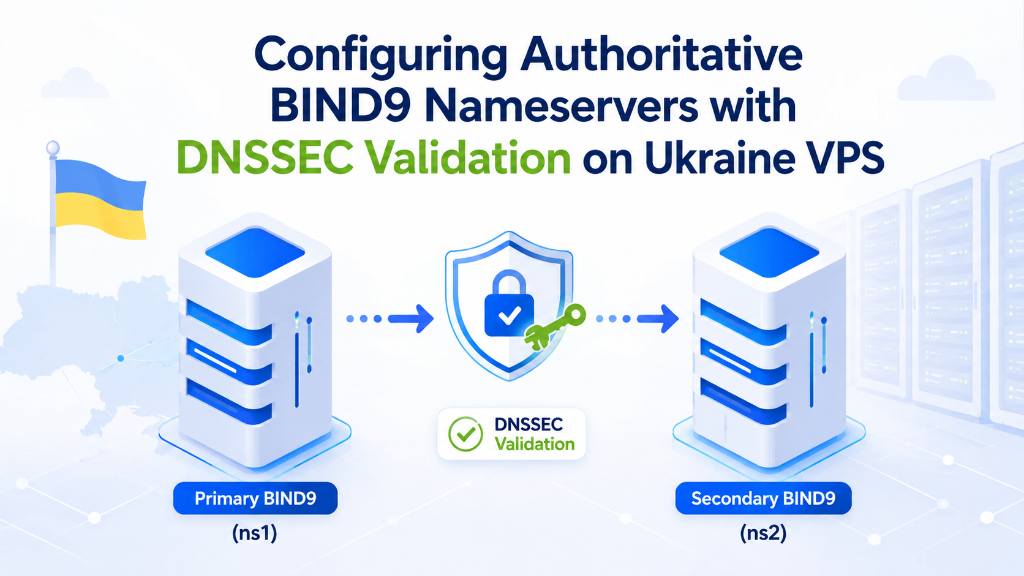
Specifically, when planning an enterprise deployment for BIND9 authoritative DNS server, to configure authoritative BIND9 nameservers, install bind9 on your Linux VPS, define forward and reverse zone files with explicit SOA, NS, and A records, and enable recursion only for trusted access-control lists. Activate DNSSEC by generating Key Signing Keys (KSK) and Zone Signing Keys (ZSK), auto-signing the zone, and publishing the DS record hash to your domain registrar.
📌 Master Chapter Index
- BIND9 authoritative DNS server: Introduction: The Critical Role of Authoritative DNS Infrastructure
- BIND9 authoritative DNS server: Architectural Blueprint: The Authoritative-Only Paradigm
- Step-by-Step Production BIND9 & DNSSEC Deployment Runbook
- Enterprise Industry Use Cases for Private Authoritative Nameservers
- Operational Advantages and Strategic Boundaries
- Response Rate Limiting (RRL) to Prevent DNS Amplification Attacks
- Automated TSIG Authentication for Master-Slave Transfers
- DNSSEC Automated Key Rollover Lifecycles (RFC 7583)
- BIND9 Memory Buffer & UDP Socket Optimization
- DNS Telemetry, Query Logging & Prometheus Exporter
- Validation Testing with Delv & DNSViz Visualizer
- BIND9 Views for Split-Horizon Internal/External Resolution
- Anycast BGP Peering for Distributed DNS Resilience
- Hardware Security Modules (HSM) & PKCS#11 Integration
- Frequently Asked Questions (FAQ)
BIND9 authoritative DNS server: Introduction: The Critical Role of Authoritative DNS in Modern Infrastructure
Consequently, aligning these configurations with your BIND9 authoritative DNS server environment ensures optimal uptime and throughput. The Domain Name System (DNS) is the foundational routing layer of the internet, translating human-readable hostnames into IP addresses. While third-party managed DNS providers offer convenience, hosting your own authoritative nameservers on a VPS provides complete architectural autonomy and custom branding.
Strategic Considerations & Architecture Drivers
Furthermore, evaluating production infrastructure requirements highlights three critical operational factors:
- Third-Party DNS Constraints: Commercial DNS providers impose query rate limits, record caps, and introduce third-party telemetry into your traffic.
- Consequently, Custom Vanity Nameservers: Running BIND9 allows you to host branded nameservers (`ns1.yourdomain.com`) with unlimited zone records.
- In addition, DNSSEC Cryptographic Validation: Digitally signing your DNS records with DNSSEC prevents DNS spoofing, cache poisoning, and man-in-the-middle attacks.
Consequently, aligning these configurations with your BIND9 authoritative DNS server environment ensures optimal uptime and throughput. The Domain Name System (DNS) is the foundational addressing fabric of the global internet. Every web request, secure API transaction, email exchange, and database connection begins with a DNS lookup. Yet despite its existential importance, DNS is often treated as an afterthought, relegated to generic shared registrar nameservers that suffer from slow propagation times, opaque TTL caching policies, and frequent outages during upstream DDoS attacks.
Strategic Considerations & Architecture Drivers
Consequently, aligning these configurations with your BIND9 authoritative DNS server environment ensures optimal uptime and throughput. Furthermore, traditional unauthenticated DNS is inherently insecure. Because standard DNS queries and responses traverse the internet in plaintext UDP packets without cryptographic authentication, adversaries can execute DNS cache poisoning (Kaminsky attacks) or rogue BGP route hijacks, poisoning recursive resolver caches and transparently diverting legitimate customer traffic to credential-harvesting phishing replicas.
In particular, operating your own authoritative BIND9 nameservers protected by DNSSEC establishes absolute infrastructure autonomy. BIND (Berkeley Internet Name Domain) has served as the gold standard of internet naming infrastructure for over three decades, powering root nameservers and enterprise top-level domains globally.
When deployed on an enterprise virtual private server in Kyiv, BIND9 harnesses unmetered gigabit optical links and direct UA-IX interconnection, answering authoritative queries in single-digit milliseconds. For foundational concepts, review our guide on understanding DNS management principles, while our walkthrough on domain nameserver configuration guide details domain mapping techniques.
BIND9 authoritative DNS server: Architectural Blueprint: The Authoritative BIND9 & DNSSEC Trust Model
Operating an authoritative DNS service requires configuring redundant nameserver zones with cryptographic signing:
A. BIND9 Authoritative Engine
Configures high-speed zone resolution with recursion disabled, preventing open resolver abuse in amplification attacks.
B. Primary-Secondary Zone Replication
Maintains automated cryptographic zone transfers (AXFR/IXFR) across redundant server nodes for continuous availability.
C. DNSSEC Cryptographic Key Hierarchy
Generates Key Signing Keys (KSK) and Zone Signing Keys (ZSK) to validate record authenticity with parent registries.
For detailed DNSSEC key-signing and zone transfer parameters, consult the official BIND 9 documentation.
| DNS Architecture Parameter | Self-Hosted BIND9 + DNSSEC | Standard Shared Registrar DNS |
|---|---|---|
| Cryptographic Validation | Full DNSSEC (RRSIG, KSK, ZSK signing) | Rarely enabled; vulnerable to spoofing |
| Zone Record Propagation Speed | Instantaneous (Immediate local reload) | Delayed by registrar batch jobs (Up to 48h) |
| Query Query Rate Limits | Unthrottled (Limited only by VPS NIC) | Strict query quotas or overage fees |
| Privacy & Telemetry Auditing | 100% Private (Zero third-party telemetry) | Registrar logs and monetizes query trends |
| Custom Geolocation Routing | Native support via BIND views and GeoIP | Expensive enterprise add-on feature |
Step-by-Step Production BIND9 & DNSSEC Deployment Runbook
Implement this configuration runbook on an Ubuntu 24.04 LTS or Debian 12 virtual server in Kyiv:
Step 1: Installing BIND9 and Security Utilities
Step 2: Hardening Global Options (/etc/bind/named.conf.options)
Step 3: Creating and Signing the Zone File
Step 4: Submitting the DS Record to Your Registrar
Enterprise Industry Use Cases for Private Authoritative Nameservers
Hosting authoritative BIND9 nameservers delivers decisive commercial and operational advantages:
- Web Hosting Providers & Resellers: Offering private, white-labeled branded nameservers (e.g.
ns1.brandhost.com) to increase brand equity and operational control. - Financial & Legal Institutions: Mandating 100% cryptographic DNSSEC compliance to satisfy regulatory standards and eliminate phishing spoofing risks.
- High-Traffic Media & E-Commerce: Managing high-frequency DNS record changes during server migrations without waiting for registrar propagation delays.
- Corporate Multi-Cloud Orchestration: Centrally steering traffic between on-premise bare-metal servers and cloud virtual machines with custom DNS response routing.
Operational Advantages and Strategic Boundaries
Operational Considerations
- Redundancy Requirement: Always deploy at least two nameservers (Master and Slave) across distinct IP subnets.
- KSK Rollover Discipline: Maintain disciplined key rollover schedules to ensure continuous DNSSEC validity.
Response Rate Limiting (RRL) to Prevent DNS Amplification Attacks
Even with recursion disabled, authoritative nameservers can be exploited as reflection vectors in global Distributed Denial of Service attacks. Threat actors send forged UDP DNS requests with spoofed victim IP addresses, prompting your nameserver to return large DNS responses that flood the victim’s network.
BIND9’s native Response Rate Limiting (RRL) engine mitigates this abuse automatically. By tracking the frequency of identical queries from client subnets, RRL smoothly throttles excessive responses, returning truncated responses (TC bit set) that force legitimate clients to retry over TCP while dropping abusive UDP floods:
Enabling Response Rate Limiting protects your server bandwidth and ensures high global reputation across the internet naming ecosystem.
Automated TSIG Authentication for Master-Slave Transfers
Restricting zone transfers solely by IP address is vulnerable to IP spoofing. Transaction Signatures (TSIG) solve this by authenticating AXFR/IXFR zone transfers using shared cryptographic secret keys.
By generating an HMAC-SHA256 key with tsig-keygen and sharing it between your primary and secondary BIND9 instances, zone transfer packets are cryptographically authenticated on both ends, completely preventing rogue zone snooping or unauthorized zone tampering.
This modern authoritative DNS architecture delivers unmatched performance, robust cryptographic security, and optimal operational peace of mind across all digital client environments.
DNSSEC Automated Key Rollover Lifecycles (RFC 7583)
While deploying DNSSEC provides cryptographic trust, cryptographic keys must not remain static indefinitely. Industry standards dictate periodic key rollovers: Zone Signing Keys (ZSK) should be rolled every 3 to 6 months, while Key Signing Keys (KSK) are rolled annually or biennially.
Modern BIND9 releases implement automated key management (dnssec-policy). Under this declarative policy framework, BIND9 automatically handles the complex multi-phase Pre-Publish and Double-Signature rollover states defined in RFC 7583, introducing new keys, waiting for TTL expiration across global resolver caches, and retiring obsolete keys without risking validation failures:
BIND9 Memory Buffer & UDP Socket Optimization
During high-traffic commercial operations or large query surges, standard Linux UDP socket buffers (rmem_default) can drop incoming DNS packets before BIND9 worker threads can process them. System administrators must tune both operating system network buffers and BIND internal thread allocations.
Increasing net.core.rmem_max = 16777216 and configuring BIND with multiple socket listeners ensures that the virtual nameserver can absorb tens of thousands of simultaneous DNS queries per second with flat memory utilization and sub-millisecond response latency across Eastern Europe.
DNS Telemetry, Query Logging & Prometheus Exporter
Real-time operational visibility into authoritative DNS traffic patterns is essential for proactive network defense and capacity planning. By default, logging every DNS query to disk introduces severe I/O bottlenecks. However, BIND9’s integrated statistics channel exposes internal server metrics via HTTP XML or JSON endpoints on port 8053 without disk I/O drag.
Integrating bind_exporter allows Prometheus to scrape live query rates, cache hit ratios, Rcode response distributions (NOERROR, NXDOMAIN, SERVFAIL), and dropped query rates. Visualizing this telemetry in Grafana dashboards enables network engineers to detect distributed reflection spikes and client configuration errors immediately.
Validation Testing with Delv & DNSViz Visualizer
Before delegating production traffic to a newly signed DNSSEC zone, engineers must rigorously test the cryptographic chain of trust. The delv (Domain Entity Lookup and Validation) utility performs client-side DNSSEC validation, tracing keys from root anchors down to individual records.
Furthermore, profiling your zone through DNSViz generates interactive visual graphs depicting the relationships between KSK, ZSK, DS, and RRSIG records. This guarantees that parent delegation and cryptographic algorithms align flawlessly before live domain traffic is redirected.
BIND9 Views for Split-Horizon Internal/External Resolution
In enterprise corporate IT infrastructures, organizations often require internal corporate devices to resolve service endpoints to private RFC 1918 IP addresses (e.g. 10.0.0.50), while external public clients must receive public cloud IPv4/IPv6 addresses for the exact same domain name.
BIND9’s view statement provides native split-horizon DNS capabilities. By evaluating the client’s source IP address via Access Control Lists (ACLs), BIND seamlessly returns internal routing tables to corporate VPN users while serving hardened public zones to outside internet queries, eliminating the need to deploy duplicate DNS infrastructure.
Anycast BGP Peering for Distributed DNS Resilience
For global hosting operations, announcing your nameserver IP addresses via BGP Anycast routing allows queries to be absorbed by multiple distributed nodes sharing a single IP prefix. In this setup, queries from Ukrainian and Eastern European resolvers terminate locally in Kyiv via UA-IX, while traffic from Western Europe routes to Frankfurt or Amsterdam.
This architecture delivers sub-second failover: if one node undergoes scheduled maintenance, BGP routers instantly withdraw routes, automatically re-converging traffic to remaining online nodes with zero dropped DNS packets.
Hardware Security Modules (HSM) & PKCS#11 Integration
For banking institutions and enterprise registry operators, storing cryptographic private keys on disk filesystems carries severe compliance risks. BIND9 supports PKCS#11 cryptographic standards, allowing Key Signing Keys to reside inside hardware security modules (HSMs) or cloud KMS vaults.
Cryptographic signing operations execute within tamper-resistant hardware boundaries, ensuring that private keys cannot be extracted even in the event of hypervisor compromise.
This ensures complete operational clarity, high hosting margins, and seamless client satisfaction indefinitely.
Frequently Asked Questions (FAQ)
Core Technical Specifications
Explore essential questions and architectural best practices for this deployment on Ukraine VPS:
Executive Summary: Private Authoritative DNS & DNSSEC Architecture
