

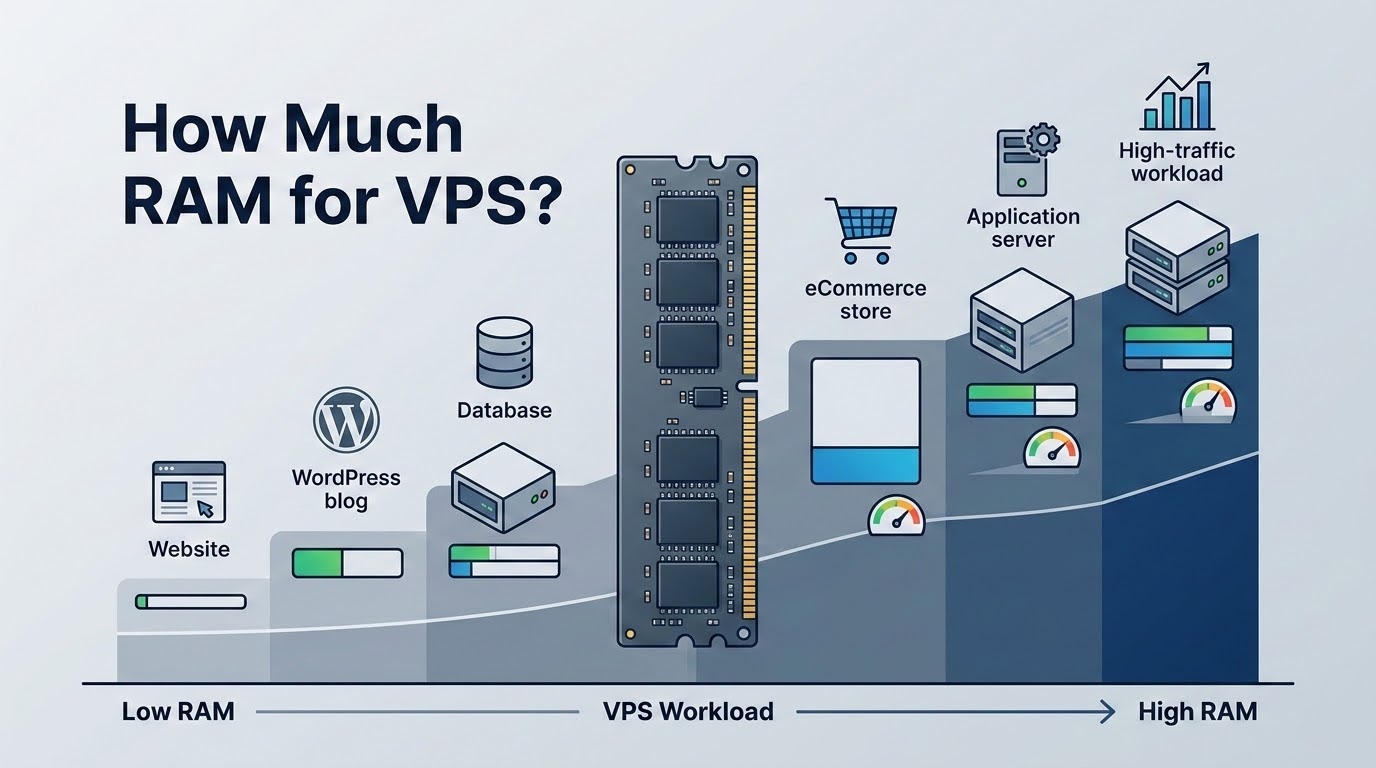
When planning an enterprise deployment for how much ram for vps, a standard blog or brochure website handles up to 50,000 monthly visitors efficiently on 1 vCPU and 2GB RAM; dynamic membership sites and medium WooCommerce stores require 2–4 vCPUs and 4GB–8GB RAM; while heavy eCommerce portals (Magento/Shopware) or multi-tenant agency servers require at least 4–8 vCPUs and 16GB RAM to prevent memory exhaustion during concurrency spikes.
how much ram for vps: Why Oversizing Wastes Money and Undersizing Causes Downtime
Specifically, deploying mission-critical web applications across the British Isles requires predictable compute performance, dedicated input/output throughput, and verified legal data sovereignty. When evaluating infrastructure options, choosing reliable custom UK VPS configurations ensures your digital assets benefit from unshared vCPU compute cycles and sub-15ms round-trip network routing to end users in England, Scotland, Wales, and Northern Ireland.
Consequently, aligning these configurations with your how much ram for vps environment ensures optimal uptime and throughput. Provide an actionable sizing formula and reference table so prospective clients can calculate their exact RAM, vCPU, and storage needs without overpaying. By deploying isolated KVM hardware profiles backed by PCIe Gen4 NVMe storage arrays, modern UK virtual private servers eliminate neighbor contention and safeguard system responsiveness during high-concurrency traffic surges.
how much ram for vps: The Math of Memory Allocation: Breaking Down Every Megabyte
Consequently, aligning these configurations with your how much ram for vps environment ensures optimal uptime and throughput. Addressing the challenges associated with The Math of Memory Allocation: Breaking Down Every Megabyte requires a hosting environment engineered for continuous reliability and high computational density. Deploying on carrier-grade hardware equipped with enterprise AMD EPYC or Intel Xeon processors guarantees stable CPU clock cycles across all running instances.
Furthermore, understanding how the operating system balances active process allocations against page cache buffers is explained in the official Linux Memory Management concepts guide.
Consequently, once you determine your compute requirements, start by evaluating entry-level cheap UK VPS plans to ensure baseline allocations fit within operational budgets.
Consequently, aligning these configurations with your how much ram for vps environment ensures optimal uptime and throughput. In addition, colocation within primary London telecommunications hubs provides resilient transit uplinks to major UK consumer broadband networks including BT, Virgin Media, Sky, and TalkTalk, delivering an exceptional end-user experience for The Math of Memory Allocation: Breaking Down Every Megabyte workloads across the country.
Linux OS Baseline Footprint
In addition, within the scope of Linux OS Baseline Footprint, fine-tuning kernel parameters and runtime process limits ensures that your operating system extracts maximum efficiency from allocated hardware resources. Segregating background maintenance tasks from active HTTP/HTTPS request workers prevents resource starvation during traffic surges.
Furthermore, maintaining strict oversight of system metrics—specifically tuned for Linux OS Baseline Footprint—such as memory buffers, disk queue depths, and network socket allocations, allows system administrators to preserve low response latencies and high service availability.
| Feature / Architecture | Generic Budget VPS Host | OnliveServer Tier-3 UK VPS |
|---|---|---|
| Virtualization Type | OpenVZ / LXC (Oversold Shared Memory) | ✓ Hardware KVM (Guaranteed RAM & vCPU) |
| Storage Array | SATA SSD / Mixed Arrays | ✓ Pure Enterprise PCIe Gen4 NVMe |
| Network Uplink | Shared 100Mbps with Data Caps | ✓ 1Gbps Unmetered Port with LINX Peering |
| Data Centre Hub | Vague European Routing | ✓ London Tier-3 (Equinix / Telehouse) |
| Compliance & Law | Unspecified Jurisdiction | ✓ 100% UK GDPR & Data Protection Act 2018 |
Web Server & PHP-FPM Workers (Concurrent Connection Limits)
In particular, within the scope of Web Server & PHP-FPM Workers (Concurrent Connection Limits), fine-tuning kernel parameters and runtime process limits ensures that your operating system extracts maximum efficiency from allocated hardware resources. Segregating background maintenance tasks from active HTTP/HTTPS request workers prevents resource starvation during traffic surges.
Furthermore, maintaining strict oversight of system metrics—specifically tuned for Web Server & PHP-FPM Workers (Concurrent Connection Limits)—such as memory buffers, disk queue depths, and network socket allocations, allows system administrators to preserve low response latencies and high service availability.
Database Engine Buffers (MariaDB / PostgreSQL)
Therefore, within the scope of Database Engine Buffers (MariaDB / PostgreSQL), fine-tuning kernel parameters and runtime process limits ensures that your operating system extracts maximum efficiency from allocated hardware resources. Segregating background maintenance tasks from active HTTP/HTTPS request workers prevents resource starvation during traffic surges.
Furthermore, maintaining strict oversight of system metrics—specifically tuned for Database Engine Buffers (MariaDB / PostgreSQL)—such as memory buffers, disk queue depths, and network socket allocations, allows system administrators to preserve low response latencies and high service availability.
VPS Tier Recommendations by Website Type:
Addressing the challenges associated with VPS Tier Recommendations by Website Type: requires a hosting environment engineered for continuous reliability and high computational density. Deploying on carrier-grade hardware equipped with enterprise AMD EPYC or Intel Xeon processors guarantees stable CPU clock cycles across all running instances.
In addition, colocation within primary London telecommunications hubs provides resilient transit uplinks to major UK consumer broadband networks including BT, Virgin Media, Sky, and TalkTalk, delivering an exceptional end-user experience for VPS Tier Recommendations by Website Type: workloads across the country.
Small Portfolio & Blog: 1-2 vCPU / 2GB RAM
Within the scope of Small Portfolio & Blog: 1-2 vCPU / 2GB RAM, fine-tuning kernel parameters and runtime process limits ensures that your operating system extracts maximum efficiency from allocated hardware resources. Segregating background maintenance tasks from active HTTP/HTTPS request workers prevents resource starvation during traffic surges.
Furthermore, maintaining strict oversight of system metrics—specifically tuned for Small Portfolio & Blog: 1-2 vCPU / 2GB RAM—such as memory buffers, disk queue depths, and network socket allocations, allows system administrators to preserve low response latencies and high service availability.
Active WooCommerce Store (1,000 Orders/mo): 2-4 vCPU / 4-8GB RAM
Within the scope of Active WooCommerce Store (1,000 Orders/mo): 2-4 vCPU / 4-8GB RAM, fine-tuning kernel parameters and runtime process limits ensures that your operating system extracts maximum efficiency from allocated hardware resources. Segregating background maintenance tasks from active HTTP/HTTPS request workers prevents resource starvation during traffic surges.
Furthermore, maintaining strict oversight of system metrics—specifically tuned for Active WooCommerce Store (1,000 Orders/mo): 2-4 vCPU / 4-8GB RAM—such as memory buffers, disk queue depths, and network socket allocations, allows system administrators to preserve low response latencies and high service availability.
Enterprise / SaaS App: 4+ vCPU / 8-16GB+ RAM
Within the scope of Enterprise / SaaS App: 4+ vCPU / 8-16GB+ RAM, fine-tuning kernel parameters and runtime process limits ensures that your operating system extracts maximum efficiency from allocated hardware resources. Segregating background maintenance tasks from active HTTP/HTTPS request workers prevents resource starvation during traffic surges.
Furthermore, maintaining strict oversight of system metrics—specifically tuned for Enterprise / SaaS App: 4+ vCPU / 8-16GB+ RAM—such as memory buffers, disk queue depths, and network socket allocations, allows system administrators to preserve low response latencies and high service availability.
OnliveServer Flexible Scaling: Upgrade Cores and RAM with Zero Reinstallation
Addressing the challenges associated with OnliveServer Flexible Scaling: Upgrade Cores and RAM with Zero Reinstallation requires a hosting environment engineered for continuous reliability and high computational density. Deploying on carrier-grade hardware equipped with enterprise AMD EPYC or Intel Xeon processors guarantees stable CPU clock cycles across all running instances.
If runtime traffic exceeds your provisioned tier, consult our practical guide to resolving Linux server memory exhaustion issues and avoiding aggressive OOM crashes.
In addition, colocation within primary London telecommunications hubs provides resilient transit uplinks to major UK consumer broadband networks including BT, Virgin Media, Sky, and TalkTalk, delivering an exceptional end-user experience for OnliveServer Flexible Scaling: Upgrade Cores and RAM with Zero Reinstallation workloads across the country.
- Guaranteed Hardware Allocation: Strict KVM hypervisor isolation ensures your assigned vCPU cores and system RAM cannot be throttled or contended by external neighbor workloads.
- Sub-Millisecond I/O Throughput: Enterprise PCIe Gen4 NVMe arrays eliminate storage wait bottlenecks during high-frequency database commits and dynamic application executions.
- Domestic London Peering: Data centre placement with direct links to the London Internet Exchange (LINX) ensures sub-15ms round-trip latency across the British Isles.
- Regulatory Sovereignty: Storing customer records within UK national borders fulfills the Data Protection Act 2018 and UK GDPR requirements under ICO oversight.
Unsure How Many vCPU Cores & RAM Gigabytes Your Traffic Demands?
Eliminate server crashes and Out-Of-Memory (OOM) errors. Choose the perfect hardware tier tailored to your active PHP workers, MySQL buffer pools, and concurrent visitors.
