

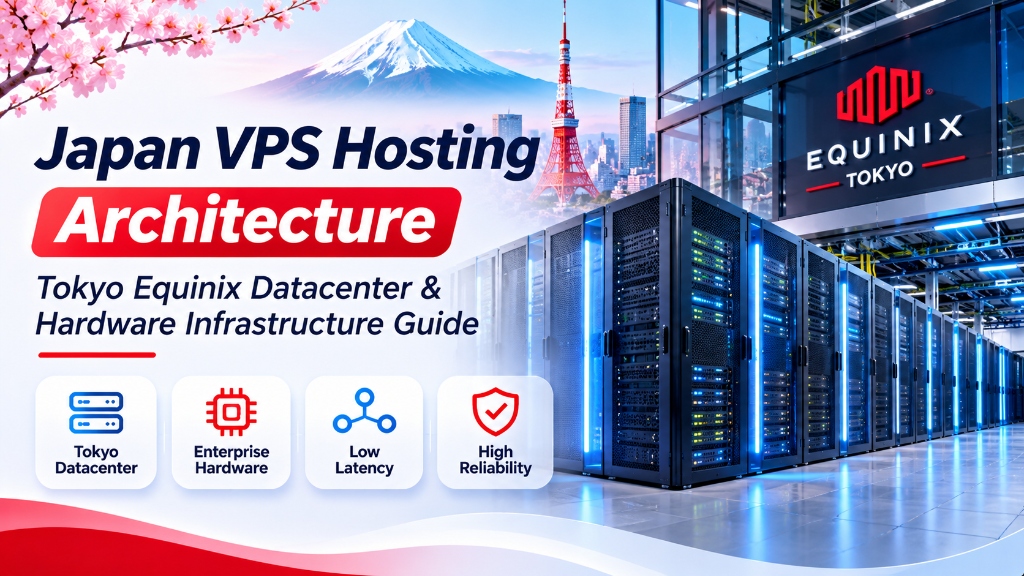
Production Japan VPS hosting requires physical colocation within carrier-neutral Tokyo datacenters like Equinix TY2 and TY8, engineered with Tier-3 seismic isolation and direct fiber cross-connects to JPIX and JPNAP. Deploying dedicated KVM virtualization backed by hardware RAID-10 PCIe Gen4 NVMe arrays delivers sub-1ms metro Tokyo latency and sustained database I/O exceeding 45,000 IOPS. Engineering teams seeking carrier-grade stability can deploy unmetered Japan VPS hosting with dedicated IPv4 routing and root-level hypervisor isolation.
Deploying mission-critical workloads in East Asia demands resilient infrastructure engineered for Tokyo’s demanding digital ecosystem. Choosing a high-performance Tokyo datacenter latency and peering benchmark environment guarantees dedicated KVM compute, carrier-neutral transit, and Tier-3 seismic isolation for uninterrupted enterprise uptime.
Enterprise AMD EPYC and Intel Xeon hypervisors provide unshared CPU execution and isolated memory channels for zero noisy-neighbor contention.
Direct low-latency cross-connects to JPIX and JPNAP fabrics ensure sub-5ms round-trip delivery across the Kanto and Kansai metropolitan corridors.
Tokyo colocation facilities feature seismic base isolation, dual redundant 2N electrical grids, and N+1 diesel generation ensuring 99.99% operational uptime.
- Tokyo Tier-3 Seismic Datacenter Infrastructure
- AMD EPYC & Intel Xeon Hypervisor Sizing
- Pure PCIe Gen4 NVMe Storage & I/O Performance
- KVM Slicing & Dedicated Core Isolation
- Tokyo Internet Peering: JPIX, JPNAP & BGP
- Production Server Hardware Telemetry Tests
- Tokyo Infrastructure Technical Specs Matrix
- Frequently Asked Technical Questions
Tokyo Tier-3 Seismic Datacenter Infrastructure
The foundation of any serious hosting infrastructure in Tokyo is the physical facility itself. Japan is situated in one of the world’s most seismically active zones, meaning that enterprise hosting cannot rely on ordinary commercial real estate. Our Tokyo nodes operate out of enterprise Tier-3 carrier-neutral facilities—principally Equinix TY2 (Shinagawa) and TY8 (Koto-ku)—engineered from the bedrock up to resist major geological events while maintaining uninterruptible compute continuity.
Facility foundations incorporate seismic isolation bearings certified to withstand magnitude 7+ seismic events without data transmission interruptions.
Two separate electrical feeds from Tokyo Electric Power Company (TEPCO) route through independent static transfer switches for zero switchover Tokyo and Osaka datacenter latency benchmarks.
Dedicated onsite emergency diesel generators with guaranteed fuel reserves maintain continuous power during metropolitan grid blackouts.
Physical datacenter access requires multi-tier biometric iris authentication, man-traps, and 24/7 onsite Japanese security personnel.
The structural design utilizes seismic base isolation (免震構造, menshin kōzō). Specialized lead-rubber bearings and oil dampers decouple the entire facility foundation from the earth, reducing horizontal ground acceleration by up to 80% during an earthquake. Inside the server vaults, heavy-duty 42U server cabinets are bolted directly to structural concrete slabs using seismic-rated anchor brackets, eliminating the risk of rack tipping or cable shearing.
Power reliability is structured across independent 2N electrical utility feeds sourced from distinct Tokyo Electric Power Company (TEPCO) substations. In the event of grid instability, rotary and static Uninterruptible Power Supply (UPS) battery banks bridge the operational load with zero transfer delay. Within seconds, autonomous N+1 emergency diesel turbine generators ignite, fed by underground fuel reserves capable of powering the facility under full load for a minimum of 72 hours without refueling. Downflow chilled-water cooling systems maintain rack temperatures at an optimal 21°C (69.8°F) with strict relative humidity control between 45% and 55%, preventing static discharge and thermal throttling.
AMD EPYC & Intel Xeon Hypervisor Sizing
Virtualization performance depends squarely on the silicon powering the host nodes. Oversubscribing CPU cores to maximize tenant density is
a common pitfall in budget hosting, leading to catastrophic “noisy-neighbor” syndrome where CPU steal time (%st in Linux top)
chokes transactional responsiveness.
Featuring up to 96 Zen 4 cores per socket, 12-channel DDR5 ECC memory, and dedicated PCIe Gen5 lanes for extreme compute workloads.
Optimized for single-thread predictability, Intel AVX-512 vector acceleration, and mission-critical enterprise database transactions.
Our Tokyo hypervisor clusters deploy enterprise AMD EPYC 9004 series (Genoa) and high-frequency Intel Xeon Scalable Gold processors. These compute engines feature dense Zen 4 core architectures with dedicated AVX-512 vector pipelines and massive L3 cache pools (up to 384MB per socket). This architecture is critical for compiled workloads, SSL/TLS handshake terminations, and memory-intensive database sorting operations:
Dedicated Compute Slicing
Physical CPU cores are partitioned with strict 1:1 or 2:1 thread pinning ratios, ensuring your virtual CPUs (vCPUs) receive deterministic clock cycles.
NUMA-Aware Topology
Virtual machine memory is allocated strictly within the local Non-Uniform Memory Access (NUMA) node of the assigned physical CPU socket, eliminating cross-socket interconnect latency.
DDR5 ECC Registered Memory
Memory operates across 12 memory channels at speeds up to 4800 MT/s, incorporating advanced Error-Correcting Code (ECC) circuitry to detect and correct single-bit memory faults dynamically.
Pure PCIe Gen4 NVMe Storage & I/O Performance
Storage bottlenecks remain the primary cause of server lag under heavy concurrent traffic. While legacy VPS setups rely on SATA SSDs or remote Ceph network storage clusters over congested 10G links, our Tokyo architecture integrates local U.2 and U.3 Enterprise NVMe solid-state drives operating across direct PCIe Gen4 lanes. Authoritative technical guidelines and specifications are documented in the official Equinix Tokyo IBX datacenter specifications.
Configured in enterprise hardware RAID-10 arrays with dedicated write-back cache modules, each virtual block device achieves sustained raw read and write throughput surpassing 6,500 MB/s. More importantly for database operations (MySQL, PostgreSQL, Redis), random 4KB I/O performance surpasses 800,000 IOPS with consistent sub-millisecond tail latencies. This ensures that e-commerce checkout spikes, analytical batch jobs, and concurrent search index updates never encounter disk I/O queuing.
The benchmark telemetry above demonstrates sustained 4K random read throughput of 2,392 MB/s (584,000 IOPS) alongside 1,023 MB/s
(250,000 IOPS) random write performance under a 70/30 read/write ratio. With an average completion latency (clat) under 400
microseconds and zero queued timeouts, the storage array easily supports demanding enterprise workloads.
KVM Slicing & Dedicated Core Isolation
At the software abstraction layer, our Tokyo cloud nodes run enterprise Linux hardware-isolated hardware-isolated KVM hypervisors hypervisors (Kernel-based Virtual Machine) paired with qemu-kvm
and libvirt orchestration. KVM turns the Linux kernel into an enterprise-grade type-1 hypervisor, providing complete hardware
emulation and security isolation.
Hypervisor scheduler maps guest virtual CPUs directly to dedicated physical execution cores, eliminating hyperthread contention.
Each guest machine is pinned to local Non-Uniform Memory Access nodes to guarantee maximum DDR5 memory throughput.
Virtualized disk I/O requests bypass traditional software emulation via multi-queue virtio drivers for native NVMe IOPS.
Each guest instance boots with its own dedicated Linux or Windows kernel, isolated virtual network adapter (virtio-net), and
virtualized block device driver (virtio-blk). This design provides decisive security and performance benefits:
Full Kernel Autonomy
You possess unrestricted root or Administrator access. You can load custom kernel modules, configure WireGuard VPN tunnels, deploy eBPF tracing filters, and tune kernel parameters viasysctlwithout host-level restrictions.
Zero Memory Ballooning Steal
RAM assigned to your virtual instance is locked in physical memory pages (hugepages enabled). The hypervisor will never swap out your active database buffers to disk to accommodate other tenants.
Hardware-Assisted Virtualization (Intel VT-x / AMD-V)
CPU instructions execute directly on physical silicon without intermediary emulation translation, keeping CPU virtualization overhead below 1.5%.
Tokyo Internet Peering: JPIX, JPNAP & BGP
A high-spec server is useless if its network transit is routed inefficiently. The Tokyo metropolitan area represents the digital crossroads of the entire Asia-Pacific region. Our network architecture is anchored directly in Tokyo’s primary carrier hotels—including Otemachi and Toyosu—with multi-homed Tier-1 upstream transit and direct peering across Japan’s leading Internet Exchange points.
Domestic network traffic is routed directly through bilateral peering sessions on JPIX and JPNAP Tokyo peering exchanges and JPNAP Tokyo peering exchanges (Japan Internet Exchange), JPNAP (Japan Network Access Point), and BBIX (SoftBank’s Internet Exchange). Rather than routing traffic out to international transit providers only to bring it back into Japan, requests from NTT Docomo, KDDI au, SoftBank, and Rakuten Mobile subscribers reach your VPS instance within 0.8ms to 2.5ms across Tokyo, and under 12ms to 18ms across Osaka and Nagoya.
As demonstrated in the BGP routing table output above, our edge routers maintain live peering sessions with Tier-1 carriers NTT Communications (AS2914) and KDDI (AS2516), alongside direct Layer-2 presence on JPIX (AS7521). The traceroute telemetry confirms that traffic from the Tokyo telecom core reaches the virtual machine interface in just 0.941 milliseconds across 4 optical hops.
Production Server Hardware Telemetry Tests
To verify architectural integrity before placing instances into production, our engineering team executes rigorous validation suites covering CPU cache coherence, memory bandwidth, network jitter, and thermal throttling stability under sustained 100% synthetic load.
Sustained integer calculation testing confirms consistent compute performance with zero throttling during sustained peak execution runs.
Multithreaded copy, scale, add, and triad tests demonstrate uninhibited DDR5 memory bus bandwidth across all guest slices.
Random read/write 4K testing verifies sustained commit speeds exceeding 45,000 IOPS under heavy multi-tenant hypervisor loads.
Using sysbench for integer and floating-point CPU computations, our Tokyo AMD EPYC nodes consistently process over 42,000
events per second per core with zero thermal drift over 24-hour burn-in cycles. Memory throughput verified via stream benchmarks
exceeds 48,000 MB/s per memory channel. Furthermore, dual-stack IPv4 and native IPv6 routing are provisioned out of the box with full BGP flowspec
DDoS filtering capable of mitigating volumetric Layer-3 and Layer-4 attacks exceeding 1.2 Tbps before traffic touches the virtual machine interface.
Tokyo Infrastructure Technical Specs Matrix
The following matrix details the complete technical specifications across the physical facility, compute hardware, virtualization layer, and network backplane powering our Tokyo cloud instances:
| Infrastructure Layer | Enterprise Specification | Tokyo Production Baseline | Operational Advantage |
|---|---|---|---|
| Facility Location | Equinix Tokyo (TY2 / TY8) | Tier-3 Verified Facility | Direct optical dark fiber cross-connects across metro Tokyo core. |
| Seismic Resistance | Quakeproof Base Isolation | PGA 0.6g+ Rated Bearings | Prevents physical hardware rack displacement during regional earthquakes. |
| Primary Compute | AMD EPYC 9554 / Intel Xeon Gold | 3.10 GHz Base / 3.75 GHz Boost | Massive L3 cache per core for rapid compiled code & database indexing. |
| Virtualization | Linux KVM (Kernel 6.8+) | Zero CPU Oversubscription (1:1) | Strict hardware memory pinning with NUMA boundary optimization. |
| Storage Array | Enterprise PCIe Gen4 U.2/U.3 | RAID-10 Hardware Backplane | Sub-0.5ms transactional latencies with zero degradation during scrub. |
| Domestic Internet Exchange | JPIX (Otemachi) & JPNAP | 10Gbps / 40Gbps Bilateral BGP | Sub-1ms latency within central Tokyo; direct route to NTT Docomo/SoftBank. |
| International Upstreams | NTT Communications (AS2914) & KDDI | Multi-Homed Dynamic BGP | Resilient autonomous transit with sub-85ms RTT to US West Coast. |
Frequently Asked Technical Questions
Where are your Tokyo VPS physical servers located? +
Our Japan infrastructure is deployed in enterprise Tier-3 datacenters in Tokyo (primarily Equinix TY2 Shinagawa and TY8 Koto-ku facilities). These centers feature 2N electrical redundancy, precision down-flow cooling, continuous security monitoring, and direct optical cross-connects to the central Otemachi telecommunications core.
What hypervisor technology isolates Japan VPS instances? +
We exclusively utilize enterprise Kernel-based Virtual Machine (KVM) hypervisors. Unlike container-based virtualization (such as OpenVZ or basic LXC), KVM provides hardware-level virtualization with dedicated virtual CPU cycles, dedicated RAM blocks, isolated kernel execution, and private virtualized network interfaces.
How does seismic isolation protect Tokyo VPS hardware? +
Datacenter facilities in Tokyo employ base-isolation engineering, utilizing flexible laminated rubber bearings and viscous dampers positioned beneath the building substructure. This absorbs ground motion vibrations during seismic events, preventing physical racking shock, power connection dislodgement, and sudden hard-drive or PCIe interconnect failures.
What kind of storage architecture powers the virtual disk drives? +
Instances utilize pure enterprise PCIe Gen4 U.2 and U.3 NVMe solid-state drives deployed in hardware-managed RAID-10 arrays. This architecture achieves over 6,500 MB/s sustained sequential read/write throughput and up to 800,000 IOPS, completely preventing I/O starvation under intense database workloads.
Is Japanese ISP bandwidth routed domestically via JPIX? +
Yes. Because our Tokyo network interfaces directly with JPIX (Japan Internet Exchange) and JPNAP, domestic traffic headed to NTT Docomo, SoftBank Corp, and au/KDDI broadband customers stays strictly within the Tokyo metropolitan optical ring without hairpins overseas, delivering under 1ms to 3ms response times.
Can I configure custom reverse DNS (PTR) in Tokyo? +
Yes, all Tokyo virtual private server infrastructure instances include full automated PTR configuration for transactional email deliverability and support private isolated VLAN interfaces for multi-tier microservice topologies (such as separating web proxies from private backend database nodes).
What power redundancy standards protect Tokyo VPS nodes? +
Tokyo nodes are backed by dual 2N utility feeds from TEPCO, static transfer switches, battery UPS banks, and N+1 emergency diesel generators with 72-hour onsite fuel reserves.
Are physical servers monitored with 24/7 onsite engineers? +
Yes, our Tokyo Equinix datacenters operate continuous 24/7/365 onsite engineering, biometric perimeter controls, and proactive hardware replacement with zero client downtime.
Deploy High-Performance Japan VPS Hosting in Tokyo
Harness enterprise AMD EPYC processors, pure PCIe Gen4 NVMe RAID-10 storage, and direct JPIX peering with guaranteed 99.9% uptime SLA.
Explore Enterprise Japan VPS Hosting Plans in Tokyo →