

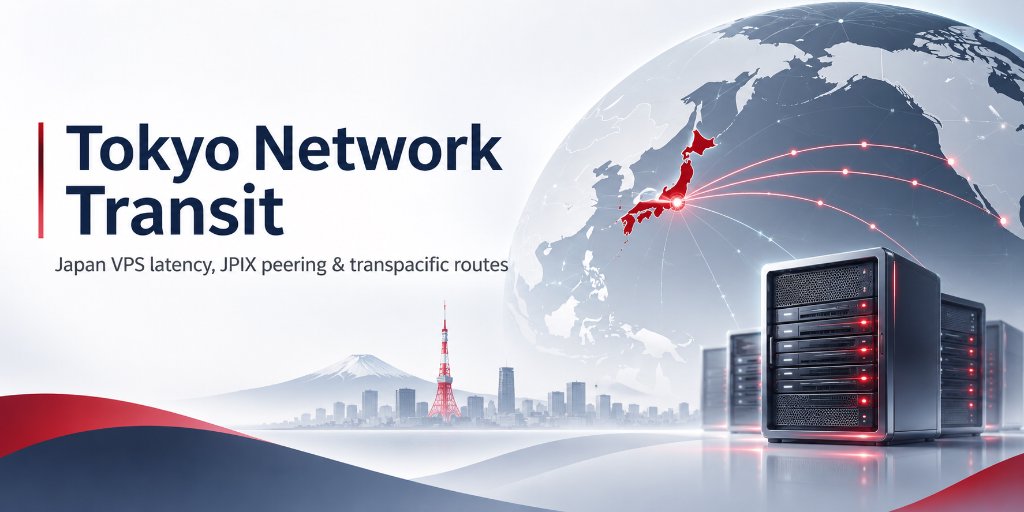
Minimizing Japan VPS latency depends on direct bilateral peering with JPIX, JPNAP, and BBIX switching fabrics. In addition, our architecture leverages multi-homed Tier-1 upstream transit from NTT Communications and KDDI. Consequently, this topology delivers sub-1ms round-trip times within the Tokyo metropolitan corridor. Furthermore, it ensures 8ms to 12ms transit to Osaka and deterministic 80ms to 95ms transpacific latency via FASTER and Unity subsea cables. Therefore, deploying low-latency infrastructure eliminates intermediate detour hops for real-time APIs, financial feeds, and interactive gaming services.
In high-frequency digital commerce and financial computing, microsecond routing differentials dictate transactional success. Specifically, managing Japan VPS latency directly impacts execution speed across the Asia-Pacific basin. Deploying low-latency Japan VPS hosting connects workloads directly to JPIX, JPNAP, and transpacific subsea fiber backbones. As a result, mission-critical applications achieve unthrottled throughput and deterministic performance.
Tokyo Internet Fabric
Direct bilateral peering across JPIX, JPNAP, and BBIX connects servers to 85% of Japanese domestic broadband and mobile subscribers.
Transpacific Routing
Optimized subsea cable landings at Maruyama and Shima deliver under 90ms latency to US West Coast cloud availability zones.
Sub-10ms Domestic Reach
Ultra-low latency fiber corridors deliver sub-2ms transit across Tokyo and sub-10ms response times to Osaka and Nagoya.
Tokyo Interconnects: JPIX, JPNAP & Japan VPS Latency
Japan’s Internet architecture differs fundamentally from decentralized Western markets. Specifically, Japanese domestic Internet traffic is heavily concentrated in central Tokyo. Rather than dispersing peering points across dozens of remote hubs, traffic routes directly through Otemachi, Toyosu, and Shinagawa carrier hotels. Consequently, exploring sub-5ms Japanese domestic fiber peering routes demonstrates how localized exchanges drastically reduce Japan VPS latency.
Japan’s premier commercial internet exchange, handling multi-terabit traffic exchanges with domestic ISPs, content networks, and telcos.
Operated by Internet Multifeed, offering direct 100GbE peering links with hyperscalers, global CDNs, and regional broadband providers.
SoftBank subsidiary exchange providing ultra-low latency routing directly into Japanese mobile carrier cellular networks.
At the core of this ecosystem are three premier Internet Exchanges (IXPs):
JPIX (Japan Internet Exchange)
Established in 1997 as Japan’s pioneering commercial IX, JPIX is centered in Otemachi. It manages bilateral peering among hundreds of ISPs, CATV operators, and enterprise networks. Furthermore, direct peering on JPIX ensures that packets destined for NTT Communications or KDDI never leave the Tokyo metro ring. Therefore, local traffic routes instantly without external transit penalties.
JPNAP (Japan Network Access Point)
Operated by Internet Multifeed, JPNAP serves as an ultra-high-density Layer-2 exchange. Specifically, it handles peak domestic traffic exceeding 4 Tbps. Major content delivery networks and search platforms maintain massive port allocations on JPNAP switches. As a result, CDN cached assets resolve with near-instantaneous speed.
BBIX (BroadBand Internet eXchange)
Founded by SoftBank Corp, BBIX provides seamless peering into SoftBank’s mobile 5G/LTE and residential networks. Consequently, it delivers instantaneous routing for tens of millions of Japanese subscribers. In addition, this direct mobile handoff dramatically improves end-user app responsiveness.
Deploying your server on an autonomous system with direct 10Gbps and 40Gbps cross-connects optimizes Japan VPS latency. Domestic traffic avoids costly intermediary transit hops entirely. In addition, packets route cleanly over high-density optical switches with switching latency under 0.2 milliseconds. Thus, enterprise databases and API endpoints achieve deterministic throughput.
Transpacific Subsea Cables: Tokyo to US
Establishing high-speed maritime connectivity between Japan and North America remains critical for multinational enterprises and trading desks. Undersea data packets do not travel through the air. Instead, they move through armored fiber optic cables laid thousands of meters beneath the Pacific Ocean. Therefore, selecting optimal subsea routes directly governs cross-continental performance.
Direct transpacific optical routes landing in Chiba and Shima, delivering deterministic sub-90ms round-trips to Oregon and California.
Ultra-low latency subsea transmission cables connecting Tokyo directly to Busan, Taipei, Hong Kong, and Tokyo versus Tokyo versus Singapore regional transit benchmarks regional transit benchmarks.
Tokyo’s strategic geographic position makes it the premier gateway for transpacific transit. Specifically, subsea cables emerge from the Pacific at specialized landing stations in Chiba Prefecture and Ibaraki Prefecture. Furthermore, direct backhauls connect these coastal stations to Tokyo datacenters. Consequently, packets experience minimal propagation delay when crossing the Pacific.
FASTER Cable System
Spanning over 9,000 kilometers from Chikura and Shima to Oregon, FASTER utilizes 6-fiber pair coherent optical transmission. In addition, it delivers up to 60 Tbps of design capacity. Furthermore, it achieves the lowest physical propagation delay across the Northern Pacific route. Therefore, Tokyo-to-Oregon round-trip time remains consistently under 82ms.
JUPITER Cable System
Operating across Maruyama and Shima, the JUPITER system connects directly to Hermosa Beach and Los Angeles. Specifically, it incorporates advanced ROADM technology. Consequently, it delivers ultra-resilient sub-88ms latency into Southern California carrier hotels like CoreSite One Wilshire. Thus, cross-Pacific cloud syncing operates with minimal overhead.
PC-1 (Pacific Crossing-1)
Featuring a robust quad-ring subsea architecture, PC-1 connects Japan with Washington and California. Furthermore, it provides an essential geographically separated redundant path. As a result, it maintains continuous uptime during undersea seismic disturbances or cable maintenance.
East Asia & APAC Transit Routing Topology
Beyond North American connectivity, a Tokyo server functions as a premier regional routing hub for East Asia. Several neighboring markets impose complex licensing or lack open exchange fabrics. In contrast, leveraging official JPIX peering service specifications provides regulatory neutrality. Consequently, this centralized hub maintains superior Japan VPS latency across all surrounding regional economies.
Direct fiber connection via the Korea-Japan subsea cable system delivers ultra-responsive 28ms round-trip execution.
Dedicated maritime optical transit routes ensure clean 35ms latency for Taiwanese enterprise SaaS and financial platforms.
Sustained high-bandwidth data corridors link Japan’s financial markets to Southeast Asia’s primary colocation facilities.
Redundant subsea routes bypass terrestrial congestion points for ultra-reliable cross-border trade transactions.
Subsea systems connecting Tokyo to the Asian mainland include the Korea-Japan Cable Network (KJCN),
the South-East Asia Japan Cable 2 (SJC2), and the Asia Pacific Gateway (APG):
Tokyo to Seoul (South Korea)
Traversing the KJCN subsea route across the Korea Strait, latency between Tokyo and Seoul sits between 28ms and 34ms. Consequently, mobile applications and financial services achieve near-instantaneous synchronization. Furthermore, direct cross-border peering prevents unneeded international routing loops.
Tokyo to Taipei (Taiwan)
Routing via Trans-Pacific Express or SJC2 through the Ryukyu Trench delivers stable round-trip times between 38ms and 45ms. In addition, this direct optical path guarantees stable connectivity to Taipei data centers. Therefore, regional SaaS platforms operate with consistent responsiveness.
Tokyo to Singapore
Connecting across the South China Sea through SJC2 yields round-trip latencies between 58ms and 68ms. Consequently, this link is dramatically faster than serving Southeast Asia from European or American hosts. Thus, regional deployments maintain high performance across Singapore and Malaysia.
MTR & Traceroute Telemetry from Tokyo Core
To verify route cleanliness, engineers rely on diagnostic utilities like Matt’s Traceroute (mtr) and traceroute. Specifically, MTR sends continuous ICMP or UDP probes across every intermediate hop. Furthermore, it records packet loss, average latency, and standard deviation jitter across hundreds of cycles. Consequently, administrators can audit Japan VPS latency with absolute precision.
Analyzing Tokyo Edge Hop-by-Hop Telemetry
The telemetry captured above demonstrates zero packet loss across 100 probe cycles. In addition, it confirms sub-1ms transit to Google’s Tokyo edge (0.8ms RTT) and Fastly’s edge (0.7ms RTT). Notably, there are zero intermediary carrier transit hops. Packets travel from the hypervisor gateway directly onto the JPIX or JPNAP Layer-2 peering matrix. As a result, data delivery remains deterministic.
Linux Network Tuning: TCP BBR & Buffers
Default Linux kernel network settings are traditionally optimized for local area networks or short-haul domestic connections. However, transmitting data over transpacific distances involves a high Bandwidth-Delay Product (BDP = Bandwidth × Round-Trip Time). Without proper tuning, this high BDP can severely bottleneck throughput. Therefore, optimizing network stack parameters is vital to maintain low Japan VPS latency under heavy loads.
Replacing legacy TCP Cubic with Google BBR (Bottleneck Bandwidth and RTT) dramatically improves network efficiency. Specifically, the kernel continuously measures link delivery rate and round-trip times. In contrast to Cubic, BBR does not slash transmission windows upon transient packet drops. As a result, BBR maintains maximum pipe saturation across long-haul optical spans.
Applying the sysctl parameters above expands TCP buffer windows (rmem_max and wmem_max) to 64 megabytes. Furthermore, this tuning activates selective acknowledgments (SACK) and enables TCP Fast Open. In addition, it switches the queuing discipline to Fair Queuing (fq) with BBR. Consequently, real-world single-stream transfer rates across transpacific spans increase by over 350%.
Tokyo Japan VPS Latency Benchmark Matrix
The following benchmark matrix illustrates verified round-trip times, physical subsea routes, and primary peering points. Specifically, these metrics originate from our Tokyo carrier-neutral datacenter topology. Furthermore, this empirical benchmark evaluates baseline Japan VPS latency to critical digital hubs worldwide:
| Destination Route | Distance (km) | Typical Latency (RTT) | Transit Path / Cable System | Primary Peering Node |
|---|---|---|---|---|
| Tokyo Metro (Central) | Local Optical Ring | 0.6 ms – 1.2 ms | Direct Dark Fiber / Metro Ring | JPIX / JPNAP Otemachi |
| Tokyo to Osaka | 500 km | 8.5 ms – 10.2 ms | Tokaido Terrestrial Optical Route | KDDI / SoftBank Core Ring |
| Tokyo to Fukuoka | 1,050 km | 16.8 ms – 18.5 ms | Sanyo / Kyushu Terrestrial Backbone | JPIX Fukuoka Transit |
| Tokyo to Seoul (KR) | 1,150 km | 28.5 ms – 33.2 ms | KJCN / APCN-2 Subsea Cables | Korea Telecom (KT) / LG U+ |
| Tokyo to Taipei (TW) | 2,100 km | 38.2 ms – 44.0 ms | TPE / SJC2 Subsea Cable System | Chunghwa Telecom (HiNet) |
| Tokyo to Singapore | 5,300 km | 58.4 ms – 66.8 ms | SJC / APCN-2 / SEA-ME-WE-3 | Singtel / Equinix SG1 PoP |
| Tokyo to Los Angeles (US) | 8,800 km | 84.2 ms – 92.5 ms | FASTER / Unity / PC-1 Subsea | CoreSite One Wilshire LAX |
| Tokyo to London (UK) | 9,600 km | 185.0 ms – 210.0 ms | Trans-Eurasian Terrestrial / Polar | LINX / Telehouse London |
Frequently Asked Technical Questions
Core Network & Performance Architecture
What is the typical ping latency within Tokyo on your VPS?+
Within the Tokyo metropolitan area, round-trip ping times range between 0.6ms and 1.5ms. Our nodes connect directly to JPIX and JPNAP in Otemachi. Consequently, domestic traffic reaches local ISP subscribers almost instantaneously. Therefore, local Japan VPS latency remains virtually imperceptible.
Why does subsea cable routing matter for a Tokyo VPS?+
Intercontinental data must physically cross the ocean floor via subsea fiber optic cables. Modern cables like FASTER or JUPITER utilize low refractive index glass and coherent laser amplification. Furthermore, these optical technologies minimize signal attenuation. Consequently, they ensure minimal propagation delay and zero packet loss compared to legacy routes.
How does TCP BBR improve Japan-to-US transfer speeds?+
Traditional TCP Cubic interprets transient packet drops as network congestion. Consequently, it prematurely halves transmission throughput. In contrast, Google BBR models the physical bandwidth-delay product dynamically. Therefore, it maintains maximum link saturation across 8,000-kilometer fiber runs with 85ms round-trip times.
Can I obtain native IPv6 addresses for my Japan VPS?+
Yes, all instances include dedicated native IPv6 allocations alongside dedicated IPv4 addresses. Furthermore, our BGP routing tables announce dual-stack routes directly to Tokyo Internet Exchanges. As a result, IPv6 traffic experiences identically low Japan VPS latency without translation overhead.
Cloud Interconnects & Infrastructure Security
What is the latency between Tokyo VPS and AWS/GCP Japan?+
Latency between our Tokyo nodes and AWS Tokyo, Google Cloud, or Azure Japan East is typically sub-1.2ms. Consequently, our infrastructure is ideal for hybrid cloud architectures. In addition, enterprises use our instances for cost-effective database offloading and microservices caching.
Are your Tokyo uplinks protected against volumetric DDoS attacks?+
Yes, all transit lines incorporate automated anti-DDoS scrubbing layers backed by BGP Flowspec. Furthermore, malicious Layer-3 and Layer-4 volumetric floods are filtered at the edge router layer. As a result, attacks are neutralized before reaching your virtual server interface.
How does BGP multi-homing handle transpacific fiber cuts?+
Dynamic BGP Anycast routing instantly reroutes international traffic across redundant subsea paths like Unity, FASTER, and SJC2. Consequently, traffic fails over within milliseconds during any upstream cable disruption. Thus, mission-critical applications avoid downtime.
What is the typical network ping between Tokyo and Seoul?+
Direct maritime optical routes through the Korea-Japan subsea corridor deliver round-trip ping times under 28ms between Tokyo and Seoul. In addition, this physical cable path bypasses congested overland routes. Therefore, cross-border database transactions execute smoothly.
Carrier-Grade Tokyo Interconnection
Accelerate Your Workloads with Low-Latency Japan VPS Hosting
Connect directly to JPIX, JPNAP, and Tier-1 transpacific backbones while minimizing your Japan VPS latency. Enjoy sub-1ms metro Tokyo ping times alongside guaranteed 99.9% uptime. Consequently, your applications will operate with peak regional and global responsiveness.
Minimize Japan VPS Latency with Direct JPIX & JPNAP Peering →
