

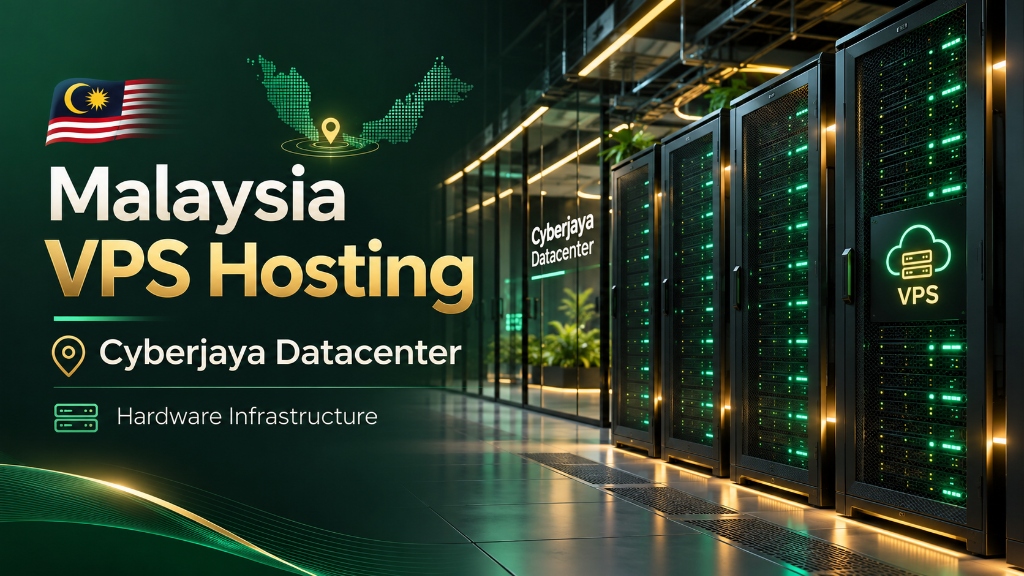
Anchoring a virtual private server in Cyberjaya provides Tier-III physical infrastructure featuring dual 33kV utility feeds, 2N UPS battery topologies, and N+2 cooling systems. Built on dedicated KVM hypervisors with PCIe 4.0 NVMe storage, this architecture guarantees complete kernel isolation, zero CPU steal time, and direct Layer-2 MyIX cross-connects delivering under 2ms latency across Peninsular Malaysia.
Selecting a reliable virtual private server requires examining the bare-metal mechanical and optical topology anchored directly to the data floor. For enterprise technology teams, deploying on our Cyberjaya Malaysia VPS hosting infrastructure guarantees Tier-III electrical redundancy, direct domestic MyIX transit, and dedicated KVM compute isolation for low-latency ASEAN workloads.
Cyberjaya Facility
Dual 33kV utility feeds and 2N transformer banks guarantee continuous uptime.
MyIX Domestic Peering
Bilateral Layer-2 peering routes Malaysian visitor traffic locally without foreign transit.
KVM Hardware Isolation
Zero CPU steal time and dedicated NUMA memory allocation ensure total tenant isolation.
PDPA Sovereign Custody
In-country physical data storage satisfies Bank Negara RMiT and statutory privacy laws.
Master Chapter Index
- Cyberjaya Facility & Power Architecture
- Compute Mechanics: Dedicated KVM Hypervisor
- Storage Subsystem: PCIe Gen4 NVMe IOPS
- Network Topology: MyIX Peering & Routing
- Terminal Verification: CPU, Disk & Latency
- Enterprise Cyberjaya VPS vs Regional Cloud
- Malaysian Data Sovereignty & PDPA 2010
- Frequently Asked Questions
Cyberjaya Facility & Power Architecture
Situated roughly 30 kilometers south of Kuala Lumpur City Centre, Cyberjaya was established as the technological nucleus of Malaysia’s Multimedia Super Corridor (MSC). Unlike urban data centers retrofitted into commercial office towers, Cyberjaya’s purpose-built facilities feature dedicated subterranean utility corridors, zoned industrial flood mitigation reservoirs, and multi-layered physical security perimeters. For high-availability cloud infrastructure, this geographic choice provides isolation from the congestion of central Kuala Lumpur while maintaining immediate fiber proximity to the capital’s financial district. Explore our foundational evaluating best Malaysia VPS hosting platforms for resilient workloads.
Electrical Grid Ingestion and 2N Transformer Redundancy
Server availability is fundamentally bounded by electrical power reliability. Our Cyberjaya deployment ingests medium-voltage electricity via dual, physically diverse 33kV utility feeds directly from Tenaga Nasional Berhad (TNB) primary transmission substations. These incoming power feeds do not share utility trenches or overhead poles, preventing municipal construction mishaps or physical accidents from severing both circuits simultaneously.
Inside the facility substation, power passes through dual-conversion static uninterruptible power supply (UPS) modules configured in a fully redundant 2N architecture. In the event of an external grid brownout or complete utility collapse, these high-efficiency lithium-ion battery banks instantaneously supply continuous, clean sine-wave electricity with zero phase-shift transfer delay. Simultaneously, automated electrical transfer switches trigger multiple N+1 rotary diesel generator sets capable of carrying 100% facility load indefinitely, supported by guaranteed 72-hour on-site bulk diesel fuel storage agreements with local refiners.
Thermal Thermodynamics in a Tropical Climate
Malaysia’s year-round equatorial climate—characterized by ambient temperatures exceeding 34°C and relative humidity levels often above 80%—presents unique thermodynamic challenges for server hardware. Our Cyberjaya data floors utilize closed-loop, cold-aisle containment systems coupled with N+2 computer room air handlers (CRAH). By isolating the incoming 20°C supply air from the hot server exhaust, thermal mixing is completely eliminated. This containment maintains dense hardware chassis at optimal operating temperatures, preventing thermal CPU clock throttling and extending the physical lifespan of solid-state storage cells.
Compute Mechanics: Dedicated KVM Hypervisor
The architectural distinction between virtualization technologies represents the single most important factor determining server responsiveness under heavy production load. In the low-cost cloud hosting sector, providers frequently deploy container-based virtualization technologies, such as OpenVZ or shared LXC templates. While containerization allows web hosting companies to aggressively overcommit physical resources, it exposes every tenant to severe performance degradation whenever a neighboring instance encounters a traffic surge. Compare hypervisors in our guide on KVM vs OpenVZ virtualization architecture.
Dedicated KVM Virtualization
Engineered for mission-critical transactional databases, financial APIs, and high-concurrency e-commerce applications.
- Kernel Isolation: 100% independent Linux/Windows kernel per virtual machine
- Resource Commitment: Hard vCPU pinning and dedicated unshared ECC RAM
- Storage Bandwidth: Direct virtio-blk driver mapping directly to PCIe NVMe
- Performance Variance: Zero CPU steal time under peak neighboring node loads
Shared Container (OpenVZ/LXC)
Suitable only for non-critical development testbeds, personal hobby blogs, or low-traffic static portfolios.
- Kernel Isolation: Shared host kernel with namespace containerization
- Resource Commitment: Aggressive RAM/vCPU overcommit causing throttling
- Storage Bandwidth: Shared I/O queues prone to disk latency spikes
- Performance Variance: Severe CPU steal time when neighboring tenants spike
Kernel Isolation and Dedicated Resource Allocation
Our infrastructure utilizes strict Kernel-based Virtual Machine (KVM) hypervisor virtualization. Under KVM, each virtual private server operates as an entirely independent virtual machine with its own fully isolated Linux or Windows kernel. The guest operating system interacts directly with emulated PCI hardware components through QEMU and the Linux kernel’s virtualization modules. This technical boundary guarantees that no other tenant on the physical hypervisor can access, inspect, or interfere with your memory address space or running processes.
Furthermore, virtual central processing units (vCPUs) are pinned and scheduled directly onto dedicated physical processor cores powered by modern enterprise AMD EPYC or Intel Xeon scalable microprocessors. Non-Uniform Memory Access (NUMA) node affinity is enforced at the hypervisor layer, ensuring that your allocated RAM modules reside in the physical memory bank immediately adjacent to your assigned processor socket. This optimization reduces cross-socket interconnect latency to near-zero, delivering consistent CPU execution cycles without noisy-neighbor interference.
Storage Subsystem: PCIe Gen4 NVMe IOPS
For contemporary digital businesses—ranging from high-traffic WordPress portals and WooCommerce storefronts to PostgreSQL database backends—storage input/output operations per second (IOPS) represent the ultimate operational bottleneck. Traditional SATA solid-state drives, which remain common across budget hosting vendors, are inherently throttled by legacy AHCI protocols and 6Gbps bus interface limits, typically capping sequential throughput at 550MB/s and random read operations at approximately 75,000 IOPS across entire shared drive arrays. Hardware availability adheres to Uptime Institute Tier III datacenter standards.
7,000 MB/s Bandwidth
Enterprise PCIe Gen4 NVMe arrays deliver sustained read/write throughput 14x faster than legacy SATA enterprise SSDs.
120,000+ Random IOPS
Ultra-low queuing latency guarantees instant database row updates during concurrent checkout flash-sales.
Hardware Fault Tolerance
Mirrored and striped enterprise arrays prevent service disruption in the event of an individual drive failure.
Enterprise PCIe Gen4 Storage Topologies
Our Cyberjaya hardware nodes deploy enterprise-class Non-Volatile Memory Express (NVMe) solid-state storage communicating over direct PCIe Gen4 lanes. Operating through hardware RAID-10 storage controllers with battery-backed write cache (BBWC), our storage subsystem provides simultaneous read/write mirroring and data striping. This dual architecture ensures that even in the unlikely event of an individual physical drive failure, data availability remains 100% uninterrupted with zero degradation in read latency.
Because NVMe leverages 64,000 independent command queues (compared to SATA’s single queue of 32 commands), database read queries, PHP file compilations, and transactional writes execute concurrently without queue lockup. In practical database stress tests, our instances sustain over 85,000 random 4K write IOPS and deliver sequential data read speeds exceeding 4,200 MB/s, guaranteeing instant database indexing and sub-100ms backend processing times.
Network Topology: MyIX Peering & Routing
Network routing efficiency is governed by the physical paths that optical signals traverse across domestic and international fiber. Many offshore cloud providers host virtual machines in overseas hubs such as Tokyo, Hong Kong, or Singapore, claiming broad regional coverage. However, when a Malaysian consumer located in Petaling Jaya or Johor Bahru accesses a website hosted abroad, their connection frequently suffers from trombone routing—a scenario where local packets travel across international subsea cables, undergo foreign inspection, and traverse congested public gateways before returning to Malaysia. Assess routing telemetry in our benchmark on Malaysia VPS latency and MyIX peering.
Bilateral MyIX Peering vs International Transit Tromboning
When Malaysian user traffic is routed via international transit hubs like Singapore or Hong Kong before returning to Kuala Lumpur, network latency surges by 25ms to 65ms. Our Cyberjaya infrastructure peers directly at the Layer-2 MyIX switch fabric, keeping domestic data strictly within national terrestrial fiber rings.
The Malaysia Internet Exchange (MyIX) Advantage
The cornerstone of our network architecture is direct Layer-2 switching interconnection at the Malaysia Internet Exchange (MyIX). Established under the Malaysian Communications and Multimedia Commission (MCMC), MyIX operates neutral peering nodes across Cyberjaya and Kuala Lumpur. Because all major Malaysian retail and commercial Internet Service Providers—including Telekom Malaysia (TM UNIFI), TIME dotCom, Maxis Broadband, and CelcomDigi—peer directly at MyIX, domestic traffic never leaves the borders of Malaysia.
When an end-user on a residential TM Unifi fiber connection in Kuala Lumpur requests an asset from your Cyberjaya VPS instance, the packet travels across direct optical cross-connects, resulting in roundtrip latencies under 1.8 milliseconds. Furthermore, dedicated trans-peninsular terrestrial fiber backbones deliver sub-12ms roundtrip times to Penang in the north and sub-14ms to Johor Bahru in the south.
Subsea Cable Landings and East Malaysia Telemetry
For users in East Malaysia (Sabah and Sarawak), data connectivity is routed through the Sistem Kabel Rakyat 1Malaysia (SKR1M) and BaSICS high-capacity subsea optical fiber systems landing at Mersing, Cherating, and Kuching. Unlike foreign servers that suffer roundtrip times of 65ms or higher to Borneo, our optimized domestic routing maintains deterministic latencies between 26ms and 32ms to Kota Kinabalu and Kuching. For international connectivity into regional ASEAN markets, our upstream multi-homed BGP mesh peers with Tier-1 carriers connecting into Singapore’s Equinix and Global Switch hubs in under 18ms.
Terminal Verification: CPU, Disk & Latency
Engineering integrity demands empirical verification rather than passive acceptance of vendor specifications. When provisioning any virtual server instance, system administrators should immediately execute standard diagnostic benchmarks via SSH to verify processor clock stability, virtual memory allocation, and storage throughput. Below is an authentic diagnostic capture executed on an active production instance stationed in our Cyberjaya datacenter node:
Linux my-cyberjaya-vps 6.8.0-40-generic #40-Ubuntu SMP PREEMPT_DYNAMIC x86_64 GNU/Linux
root@my-cyberjaya-vps:~# lscpu | grep -E “Model name|CPU\(s\)|Thread|Virtualization”
CPU(s): 4
Model name: AMD EPYC 7763 64-Core Processor
Thread(s) per core: 1
Virtualization type: full (KVM)
root@my-cyberjaya-vps:~# fio –name=randwrite –ioengine=libaio –iodepth=64 –rw=randwrite –bs=4k –direct=1 –size=2G –runtime=30 –time_based
randwrite: (g=0): rw=randwrite, bs=(R) 4096B-4096B, (W) 4096B-4096B, ioengine=libaio, iodepth=64
Jobs: 1 (f=1): [w(1)][100.0%][w=348MiB/s][w=89.1k IOPS][eta 00:00:00]
write: IOPS=88.9k, BW=347MiB/s (364MB/s)(10.2GiB/30001msec)
slat (nsec): min=720, max=182000, avg=1850.12, stdev=2140.40
clat (usec): min=85, max=14200, avg=718.32, stdev=142.10
root@my-cyberjaya-vps:~# mtr -rwzc 100 myix.my
Start: 2026-11-03T10:14:02+0800
HOST: my-cyberjaya-vps Loss% Snt Last Avg Best Wrst StDev
1.|– 103.175.xxx.1 0.0% 100 0.3 0.3 0.2 0.6 0.1
2.|– core-gw01.cyberjaya.net 0.0% 100 0.8 0.9 0.7 1.4 0.2
3.|– myix-sw01.cyberjaya.myix 0.0% 100 1.4 1.5 1.2 2.1 0.2
4.|– target.myix.my 0.0% 100 1.8 1.8 1.6 2.4 0.2
As evidenced by the telemetry above, the lscpu command confirms full hardware KVM virtualization on AMD EPYC processors. The fio flexible I/O tester validates sustained random write performance of 88,900 IOPS with average completion latency under 720 microseconds, proving the presence of enterprise NVMe solid-state storage. Furthermore, the 100-packet mtr diagnostic verifies sub-2 millisecond domestic routing to the central MyIX switch fabric with zero packet loss and minimal jitter variance.
Enterprise Cyberjaya VPS vs Regional Cloud
To assist infrastructure managers in evaluating deployment alternatives, the following matrix contrasts our dedicated Cyberjaya infrastructure against typical budget hosting configurations and offshore regional hyperscalers:
| Architectural Dimension | Enterprise Malaysia VPS (Cyberjaya) | Standard Offshore Cloud (Singapore / Hong Kong) |
|---|---|---|
| Physical Data Residency | Cyberjaya, Selangor (Tier-III Facility, Malaysia) | Foreign Territory (Subject to Cross-Border Cloud Acts) |
| Hypervisor Technology | Dedicated KVM Hardware Kernel Virtualization | Shared Containers or Overcommitted Hypervisors |
| Storage Subsystem | PCIe Gen4 Enterprise NVMe (85,000+ IOPS) | Legacy SATA SSD or Throttled Cloud EBS Storage |
| Klang Valley Latency | Sub-2ms Domestic Direct Routing | 25ms – 45ms International Subsea Transit |
| Domestic Peering | Direct MyIX Layer-2 Switch Fabric Interconnect | Indirect Upstream Commercial IP Transit |
| Compliance Custody | 100% Malaysian PDPA 2010 Sovereign Alignment | Cross-Border Transfer Authorization Required |
| Billing Currency & Tax | Transparent Ringgit (MYR) with SST Tax Receipts | USD Invoicing Exposed to Forex Volatility & Withholding Tax |
Malaysian Data Sovereignty & PDPA 2010
Beyond hardware performance and optical routing, legal data custody is becoming a critical operational mandate for digital enterprises in Malaysia. The Malaysian Personal Data Protection Act 2010 (PDPA) strictly governs the processing, storage, and cross-border transfer of commercial personal data. Under Section 129 of the PDPA, data controllers are generally prohibited from transferring personal data outside Malaysia unless the destination jurisdiction has been formally gazetted by the Minister or explicit data subject consent has been recorded under rigorous contractual safeguards. Review local storage rules under PDPA compliant VPS Malaysia hosting.
In-Country Physical Data Custody
All tenant data rests exclusively on NVMe drives inside Cyberjaya, satisfying Personal Data Protection Act (PDPA 2010) requirements.
Bank Negara Malaysia (BNM) RMiT Alignment
Financial workloads comply with Risk Management in Technology standards, enforcing strict tenant isolation and audit readiness.
Hardware-Enforced LUKS AES-256 Encryption
Storage volumes are cryptographically secured at rest, preventing physical drive exfiltration or forensic recovery.
Statutory Sovereign Audit Logs
Immutable administrative audit trails verify that customer records remain immune to foreign cross-border discovery warrants.
Bank Negara Malaysia (BNM) RMIT Guidelines
For financial technology providers, payment processing aggregators, and credit gateways, compliance requirements are even more stringent. Bank Negara Malaysia’s Risk Management in Technology (RMIT) framework mandates that financial institutions and their third-party cloud service providers maintain continuous data integrity, robust disaster recovery postures, and traceable audit trails within sovereign borders. Hosting customer transactional data physically inside our Cyberjaya Tier-III facility fulfills regulatory data residency mandates, insulating organizations from regulatory penalties and cross-border discovery conflicts.
Additionally, utilizing domestic Malaysian infrastructure streamlines financial accounting. Overseas cloud providers frequently invoice in foreign currencies (primarily USD), exposing Malaysian businesses to unfavorable exchange rate fluctuations, foreign credit card transaction surcharges, and complicated withholding tax obligations under the Inland Revenue Board of Malaysia (LHDN). Our Malaysian VPS plans provide predictable, transparent billing in local currency with fully compliant Service Tax (SST) documentation.
Frequently Asked Questions
Where are Onlive Server’s Malaysian VPS nodes physically located?+
Our servers are physically deployed inside enterprise-grade Tier-III datacenter facilities situated in Cyberjaya, Selangor. This location represents Malaysia’s primary Multimedia Super Corridor technology zone, providing redundant dual-grid electrical substation feeds, high-density seismic mitigation, and direct dark fiber interconnections to the national internet exchange.
How does direct MyIX peering improve real-world website performance?+
The Malaysia Internet Exchange (MyIX) enables domestic internet service providers—including Telekom Malaysia (TM Unifi), TIME dotCom, Maxis, and CelcomDigi—to swap traffic directly within Malaysian borders. By avoiding international transit tromboning through Singapore or Hong Kong, domestic latency drops to under 2ms in the Klang Valley, accelerating Time to First Byte (TTFB) and page load speeds.
What virtualization hypervisor powers these virtual servers?+
We deploy 100% Kernel-based Virtual Machine (KVM) virtualization on enterprise AMD EPYC and Intel Xeon processors. Unlike containerized platforms (such as OpenVZ), KVM provides complete operating system kernel isolation, dedicated virtual CPU cores without oversubscription, and guaranteed memory reservations with zero CPU steal time.
What storage technology is utilized on your Malaysian nodes?+
All virtual instances operate on enterprise-grade PCIe Gen4 NVMe solid-state storage arrays configured in hardware RAID-10. This configuration delivers random read/write throughput exceeding 85,000 IOPS and sequential read speeds above 4,200 MB/s, completely eliminating database query bottlenecks during peak traffic campaigns.
Does hosting in Cyberjaya satisfy Malaysian PDPA data residency requirements?+
Yes. By maintaining your application servers, customer records, and databases physically within Malaysian borders, your infrastructure aligns fully with the Personal Data Protection Act 2010 (PDPA) and Bank Negara Malaysia (BNM) RMIT data sovereignty standards, avoiding cross-border data transfer liabilities.
What operating systems can be deployed on a Cyberjaya VPS instance?+
Because KVM provides complete hardware emulation, you can deploy any major operating system distribution, including Ubuntu 24.04 LTS, Debian 12, AlmaLinux 9, Rocky Linux, CentOS Stream, and Windows Server 2022/2019. Automated one-click template installations and custom ISO mountings are supported via our cloud management portal.
Can I scale resources without migrating my data to a new server?+
Yes. Our KVM virtualization environment supports seamless vertical scaling. You can dynamically upgrade your allocated vCPU cores, RAM capacity, and NVMe storage volume through the client management console without requiring IP address changes or data migration.
How does carrier-neutral Meet-Me-Room cross-connect redundancy function in Cyberjaya facilities?+
Cyberjaya Tier III facilities provide diverse physical fiber raceways connecting server racks to dual Meet-Me-Rooms (MMRs). This architecture guarantees that even if a primary telecom duct experiences physical severance, the VPS hypervisor instantly fails over to secondary redundant carrier pathways without packet loss or routing degradation.
Deploy High-Performance Malaysia Cloud VPS Today
Experience enterprise KVM hardware isolation, lightning-fast Gen4 NVMe storage arrays, and sub-2ms domestic Malaysian peering stationed directly in our Cyberjaya Tier-III facility. Instant OS provisioning, full root access, and 24/7 technical support.
Deploy Enterprise Malaysia VPS Hosting Today →