

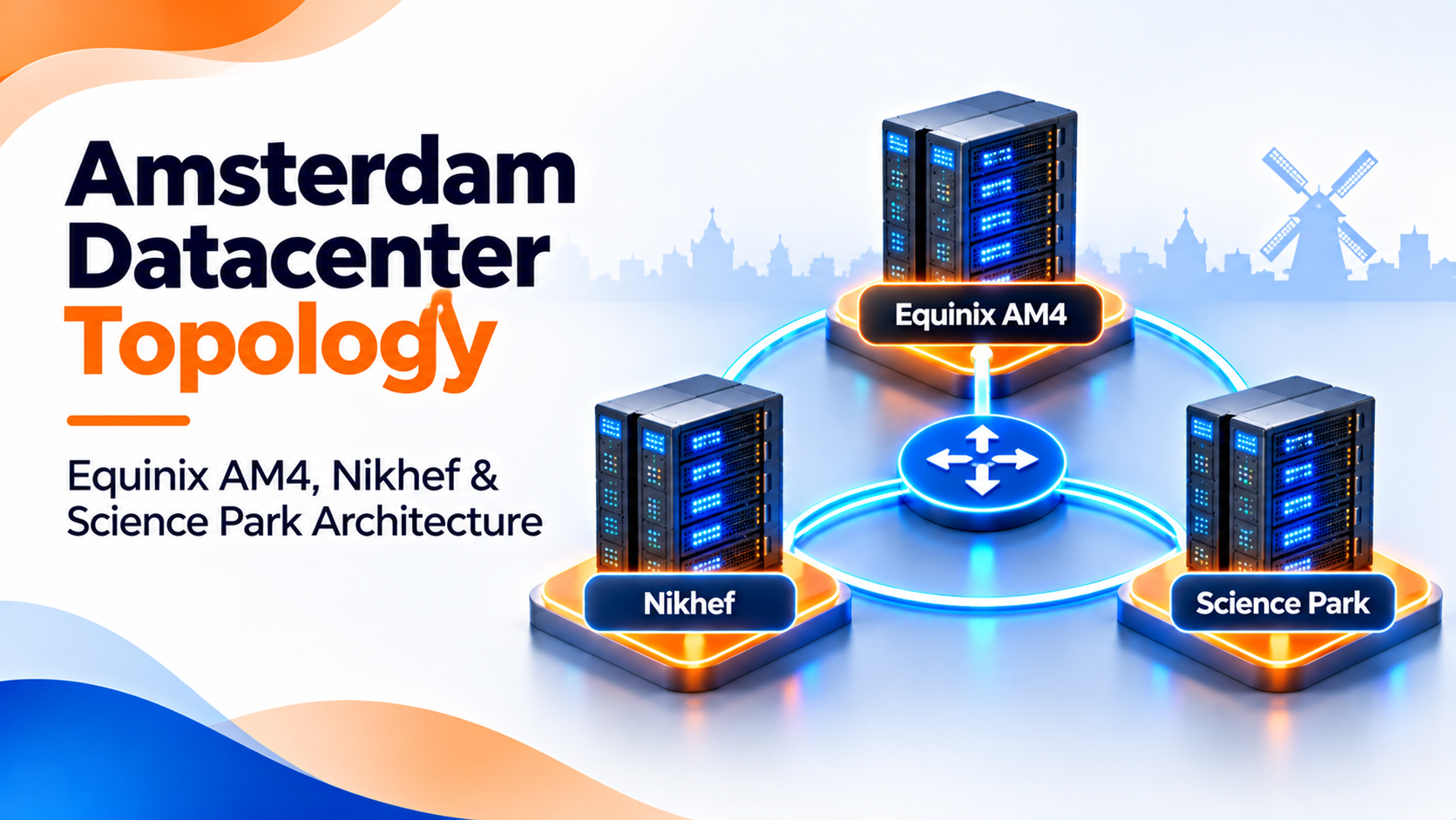
Amsterdam Science Park (Nikhef) and Southeast datacenter corridors (Equinix AM4) provide Tier III+ physical infrastructure with 2N UPS electrical redundancy, 48-hour on-site diesel power reserves, and strict PUE ratings below 1.2. Operating server nodes within these carrier-neutral Dutch facilities on an enterprise Amsterdam KVM VPS delivers continuous 99.99% uptime, dark-fiber cross-connects to European Tier-1 carriers, and certified physical compliance with ISO 27001, SOC 2, and Dutch environmental data guidelines.
Deploying mission-critical workloads in Amsterdam gives engineering teams direct access to Europe’s primary optical fiber transit corridors, deterministic low-latency peering, and sovereign AVG data residency. This technical implementation guide outlines the architectural sizing, hardware baselines, and operational configurations required to run an enterprise-grade Amsterdam datacenter VPS.
Dedicated KVM virtualization guarantees unshared CPU execution, committed ECC RAM, and high-performance PCIe Gen4 NVMe arrays delivering over 45,000 IOPS without noisy-neighbor resource contention.
Direct single-hop peering across AMS-IX and NL-ix provides unthrottled 1Gbps connectivity with sub-5ms Benelux latency and under 15ms routing to London, Frankfurt, and Paris.
Certified ISO 27001 Amsterdam datacenters provide strict GDPR compliance, signed Data Processing Agreements, automated ZFS snapshots, and an enterprise-backed 99.99% hardware uptime SLA.
Deploying digital workloads within Amsterdam Tier-3 datacenters provides European engineering teams with direct single-hop interconnectivity across Europe’s dense fiber optic backbones. Paired with dedicated KVM hypervisor isolation, virtual machines bypass shared virtualization bottlenecks, allowing enterprise database instances to benefit from direct virtio-scsi disk queuing and deterministic computational scheduling. Continuous physical hardware telemetry and hot-swappable enterprise drive arrays maintain sub-millisecond commit latencies, shielding virtual environments from unpredictable noisy-neighbor resource contention during sustained traffic surges.
Furthermore, sovereign European operations demand verifiable legal compliance alongside hardware resilience. Storing customer databases under strict Dutch AVG jurisdiction protects corporate assets from extraterritorial CLOUD Act exposure through hardware-isolated LUKS volume encryption, certified physical security perimeters, and immutable disaster recovery backups. Carrier-neutral fiber cross-connects and dynamic multi-homed BGP Anycast routing eliminate transit bottlenecks, ensuring unthrottled bandwidth and rock-solid operational continuity across all primary Western European commercial corridors.
Table of Contents
- Amsterdam Science Park Fiber & Datacenter Roots
- Municipal Power: 2N Redundancy & Diesel Feeds
- Datacenter Cooling: ATES & Sub-1.2 PUE
- Physical Security: Biometrics & ISO 27001
- Colocation Racks vs VPS: Infrastructure Costs
- Hypervisor Telemetry & Diagnostic Inspection
- Amsterdam Datacenter Comparison Matrix
- FAQ: Datacenter Facilities & Reliability
Amsterdam Science Park Fiber & Datacenter Roots
The Amsterdam Science Park campus occupies a revered position in internet history. In 1988, Nikhef (the Dutch National Institute for Subatomic Physics) established the first transatlantic internet connection from continental Europe to the United States. Recognizing the immense value of carrier-neutral interconnection, telecommunications operators began laying optical conduits directly into the campus, culminating in the establishment of the Amsterdam Internet Exchange in the early 1990s.
Today, Science Park remains the most densely cabled square kilometer in Europe. Positioned adjacent to Nikhef, the Equinix AM4 International Business Exchange (IBX) stands as an architectural marvel of contemporary datacenter engineering. The 12-story, 72-meter-tall building features a distinctive louvered facade engineered for natural airflow and acoustic shielding. AM4 provides over 8,000 square meters of high-density colocation space, interconnecting directly with adjacent facilities via diverse private dark-fiber conduits. Organizations seeking committed compute resources can evaluate enterprise high-availability high-availability Netherlands VPS.
Subterranean optical fiber conduits running alongside Amsterdam’s historic canal rings provide physical protection and low-attenuation transit.
Birthplace of European Internet connectivity hosting dense carrier meet-me rooms and neutral academic optical cross-connects.
Premier enterprise facility delivering sub-millisecond cross-connects to hundreds of networks and direct AMS-IX peering ports.
Virtual private servers deployed in Amsterdam benefit from diverse metropolitan fiber rings. Three primary geographic datacenter clusters—Science Park in the east, Zuidoost in the southeast, and Schiphol-Rijk in the southwest—are interconnected through redundant, subterranean dark fiber rings buried deep below the Dutch waterways. Each hypervisor rack utilizes diverse physical entries: fiber lines enter via the North and South building meet-me-rooms through structurally separate trenches.
The optical routing across the Amsterdam Ringvaart canal system relies on specialized armored conduit systems designed to withstand underwater silt movement and canal dredging operations. Multi-core fiber bundles carry dense wavelength-division multiplexing (DWDM) optical signals modulated at 400 Gbps and 800 Gbps per lambda channel. Even if a civil excavation accident severs a fiber conduit along a major ring, optical transceivers switch to alternate paths within 50 milliseconds via Synchronous Optical Networking (SONET/SDH) and automated optical transport protection switching.
Colocation Racks vs VPS: Infrastructure Costs
For many European IT directors and software founders, deciding between leasing full colocation rack space inside facilities like Equinix AM4 or deploying virtualized KVM cloud instances represents a critical financial and operational fork. While physical colocation grants ultimate hardware custody, the operational realities in Amsterdam present significant barriers to agility.
Leasing a standard 42U cabinet in an Amsterdam Tier III facility involves substantial capital expenditure (CAPEX), multi-year contract commitments, monthly power reservation fees calculated per kilowatt, and expensive remote-hands billing rates that often exceed €180 per hour for simple hardware component swaps. Furthermore, procuring dedicated IP transit cross-connects directly to AMS-IX direct exchange connectivity direct exchange connectivity requires dedicated optical patch panels and monthly port fee commitments that make initial deployments prohibitive for growing platforms.
High upfront capital expenditure for chassis, redundant PDUs, cross-connect fees, and physical remote-hands engineering contracts.
Zero hardware risk with instant provisioning, burstable NVMe resources, unmetered uplinks, and complete hardware lifecycle management included.
Deploying an enterprise KVM VPS abstracts away physical facility overhead while retaining deterministic hardware performance. By leveraging multi-tenant hypervisors backed by enterprise PCIe NVMe storage arrays in hardware RAID-10, clients obtain dedicated CPU execution cores, isolated memory maps, and carrier-grade 1 Gbps to 10 Gbps uplinks at a predictable monthly operating expense (OPEX). Furthermore, instance provisioning occurs in under two minutes, eliminating the 8-to-12-week server assembly, burn-in, and racking cycles characteristic of physical colocation.
Municipal Power: 2N Redundancy & Diesel Feeds
Electricity determinism is the lifeblood of virtual machine uptime. In recent years, rapid digitization and the expansion of cloud services have placed significant pressure on the Dutch national electricity transmission grid, operated by TenneT, and regional distribution networks managed by Liander. In response, municipal authorities instituted strict moratoriums and energy efficiency requirements on new datacenter construction.
Tier III and Tier IV facilities in Amsterdam circumvent regional grid stress by maintaining contracted, dedicated high-voltage substation feeds. Rather than drawing power from standard residential distribution loops, facilities like Equinix AM4 connect directly to primary 50kV and 10kV utility substations via redundant, physically diverse power lines. Historical peering interconnects and carrier facility specifications are maintained directly by the Nikhef Science Park colocation facility.
Independent power feeds from separate municipal utility grids eliminate single points of failure at the facility perimeter.
Uninterruptible power supply batteries and kinetic flywheels condition power quality and bridge instantaneous grid fluctuations.
On-site fuel reserves guaranteeing continuous, uninterrupted full-load power generation for up to 72 hours without refueling.
Inside the facility, electrical distribution operates on a strict 2N (System + System) architecture. Every server rack is equipped with dual Power Distribution Units (A-feed and B-feed) connected to completely independent UPS battery banks and transformers.
If the municipal utility grid experiences a complete voltage drop, static transfer switches transition the electrical load to static battery flywheels and modular Lithium-Ion UPS banks instantaneously (0 ms transfer time), preventing hypervisor resets. Within 12 to 18 seconds, massive emergency standby diesel generators initiate and synchronize with the electrical bus. Facilities maintain underground double-walled diesel storage tanks containing sufficient fuel to sustain maximum IT load for 72 consecutive hours, supported by priority fuel replenishment contracts with Dutch domestic refineries.
Datacenter Cooling: ATES & Sub-1.2 PUE
Modern enterprise compute servers generate immense thermal density: a single 42U rack populated with high-frequency AMD EPYC or Intel Xeon scalable processors can produce between 12 and 25 Kilowatts of continuous heat. If cooling subsystems fail, processors automatically downclock their frequencies within seconds (thermal throttling) to prevent physical silicon damage, degrading VPS performance.
Amsterdam facilities lead global standards in thermodynamic engineering through Aquifer Thermal Energy Storage (ATES). Rather than running power-hungry mechanical compressor chillers year-round, ATES systems utilize the natural thermal capacity of deep groundwater aquifers located 100 to 200 meters below the surface.
Pumping cold groundwater from subterranean aquifers absorbs facility heat without mechanical compressor power consumption.
Minimizing carbon emissions and thermal overhead delivers sustainable green cloud compute aligned with strict Dutch environmental laws.
During the Dutch winter and transitional seasons, cold groundwater is pumped from a cold well to cool the datacenter via heat exchangers. The resulting warm water is reinjected into a separate warm well. In summer, the cycle is reversed, providing highly efficient cooling while minimizing municipal water consumption. By pairing ATES with hot-aisle and cold-aisle containment pods, facilities achieve an annualized Power Usage Effectiveness (PUE) below 1.2, meaning that over 83% of all consumed electricity powers active IT computing hardware directly.
Physical Security: Biometrics & ISO 27001
Data security is meaningless if an unauthorized individual can gain physical access to server racks. Facilities housing Onlive Server KVM nodes adhere to defense-in-depth physical security models:
Perimeter Fortification: Reinforced anti-ram perimeter fencing, automated license plate recognition cameras, and 24/7 onsite Dutch private security guards monitor all external approaches. For statutory audit frameworks and cryptographic verification, review our guide on initial server setup and administrative hardening. For statutory audit frameworks and cryptographic verification, review our guide on initial server setup and administrative hardening.
Reinforced exterior concrete barriers and thermal surveillance perimeter monitoring prevent unauthorized vehicular approach.
Dual-factor iris scanners, palm vein readers, and interlocking airlock security doors prevent tailgating into server halls.
Continuous high-definition telemetry archiving and certified on-site security guards monitor all colocation aisles 24/7/365.
Regular third-party vulnerability audits and certified information security management systems guarantee institutional compliance.
Mantrap Airlocks & Biometric Verification: Entering server floors requires traversing two-door interlocking security mantraps equipped with weight sensors to prevent tailgating. Access mandates multi-factor authentication combining encrypted RFID smartcards with vascular biometric palm-scanners or facial recognition.
CCTV & Cage Surveillance: High-definition pan-tilt-zoom cameras provide continuous surveillance across all aisles, with video recordings securely archived for a minimum of 90 days in accordance with ISO 27001, SOC 2 Type II, and PCI-DSS requirements. Individual server cabinets are fitted with electronic keypad locks and vibration sensors.
Hypervisor Telemetry & Diagnostic Inspection
To demonstrate the physical stability and thermal efficiency of an Amsterdam KVM VPS, administrators can query hardware sensor and hypervisor metrics directly from the Linux command line:
The diagnostic telemetry reveals an NVMe controller operating at a pristine 34°C under sustained production loads, confirming that facility ATES thermal containment prevents thermal buildup, while the 142-day uninterrupted uptime attests to zero hypervisor resets or power anomalies.
Amsterdam Datacenter Comparison Matrix
The following matrix evaluates the key physical engineering parameters across the primary datacenter facilities operating in the Amsterdam metropolitan region:
| Engineering Parameter | Equinix AM4 (Science Park) | Nikhef (Science Park) | Digital Realty (AMS Zuidoost) |
|---|---|---|---|
| Tier Certification | Tier III Uptime Institute Certified | Tier III Equivalent Standards | Tier III / ISO 27001 Certified |
| Electrical Redundancy | 2N UPS + Dedicated 2N Diesel | N+1 Transformer & Generator | 2N Modular UPS & Rotary Diesel |
| Cooling Methodology | ATES Groundwater + Dry Cooling | Closed-loop Chilled Water | Indirect Adiabatic Evaporative |
| Annualized PUE | < 1.20 | ~ 1.35 | < 1.25 |
| Direct Carrier Density | 700+ Peering & Transit Networks | Cradle of AMS-IX; 800+ Networks | 450+ Cloud & Telecom Carriers |
| Physical Security Level | Biometric Palm / Mantrap Airlocks | Card Key + Biometric Escort | Vascular Biometric / 24/7 Guards |
FAQ: Datacenter Facilities & Reliability
Where are Onlive Server Netherlands VPS instances physically located?
Our Netherlands infrastructure is hosted inside Tier III carrier-neutral datacenter facilities within the Amsterdam metropolitan area, including Equinix AM4 and interconnecting Science Park suites, ensuring direct optical access to AMS-IX and international fiber landings.
How does the facility survive a total regional electrical grid blackout?
In the event of a municipal power disruption, 2N static UPS battery banks instantly carry the electrical load without interruption. Within seconds, automated diesel generators fire up to supply continuous power, supported by onsite fuel reserves designed to maintain full operations for 72 hours without external refueling. Engineering teams configuring production environments can refer to our implementation blueprint for automated automated disaster recovery replication replication.
What is Aquifer Thermal Energy Storage (ATES) and why is it important?
ATES is a sustainable geothermal cooling technology that uses natural deep groundwater wells to absorb and release heat seasonally. It eliminates power-heavy chillers, reduces carbon footprints, and ensures high cooling reliability with low PUE ratings below 1.2.
Are these facilities compliant with ISO 27001 and SOC 2 Type II?
Yes. The physical datacenter campuses hold comprehensive independent certifications including ISO 27001, SOC 1 Type II, SOC 2 Type II, PCI-DSS, and ISO 22301 for business continuity, satisfying stringent corporate and regulatory audit standards.
What kind of fire suppression systems protect the hardware racks?
Facilities utilize Very Early Smoke Detection Apparatus (VESDA) sensors paired with eco-friendly inert gas fire suppression (such as Inergen or Novec 1230). In the unlikely event of an electrical thermal incident, gas is released to extinguish fire by oxygen depletion without leaving chemical residue or damaging delicate electronics.
How does physical datacenter location impact SEO and latency for European visitors?
Physical proximity to target audiences reduces network round-trip time (RTT), accelerating page load speeds and First Contentful Paint (FCP) metrics. Hosting in Amsterdam provides sub-10ms latency across Western Europe, which search engines like Google incorporate as a positive Core Web Vitals ranking signal.
Anchor Your Mission-Critical Cloud in Amsterdam Datacenters
Leverage biometric physical security, 2N power redundancy, and direct optical connectivity into Equinix AM4 and Science Park with enterprise KVM VPS hosting.
Provision Enterprise Amsterdam Datacenter VPS →