

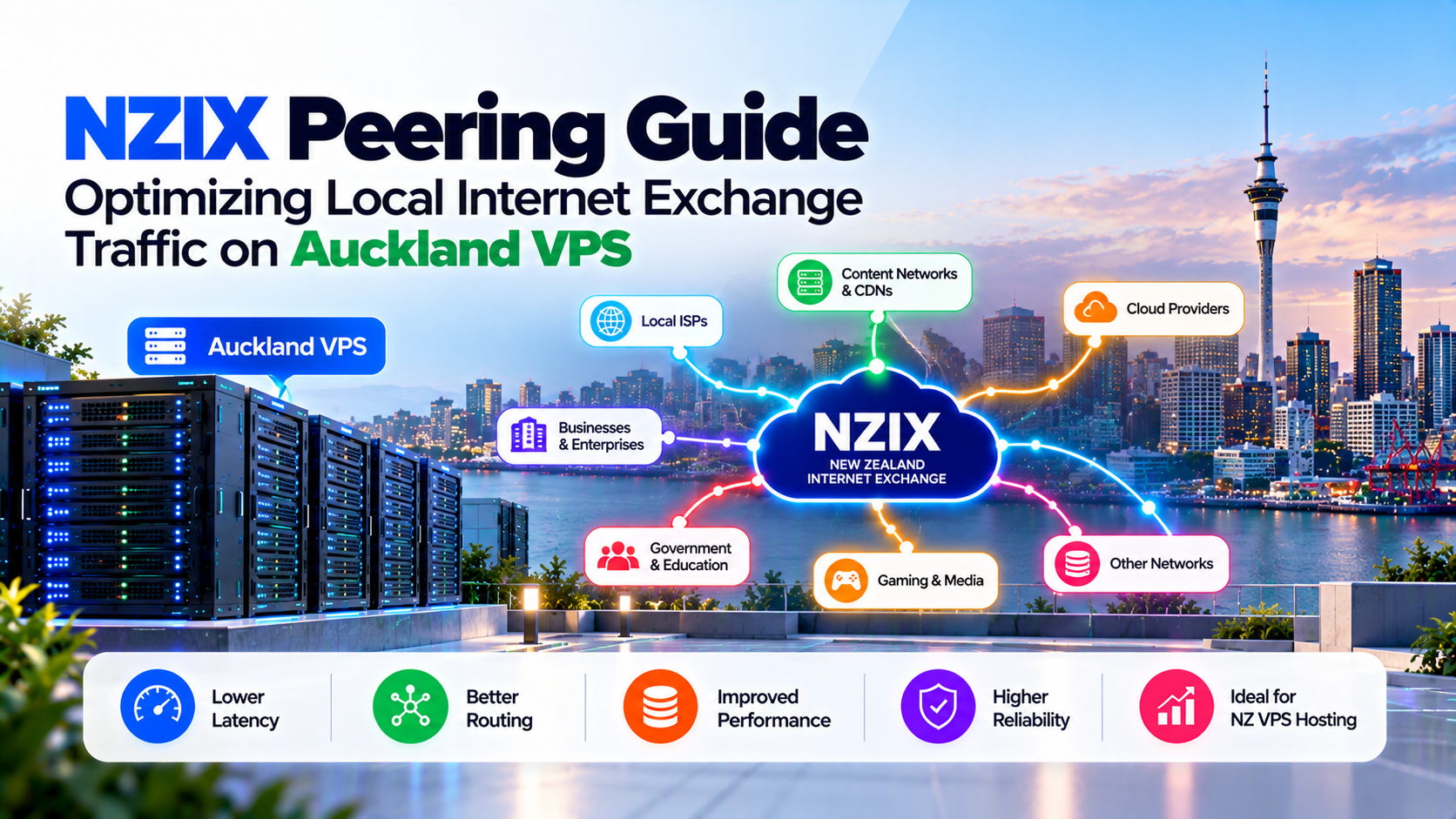
Deploying an enterprise-grade Nzix Peering Vps architecture on pure KVM virtualized infrastructure empowers modern organizations with low-latency Auckland connectivity. Furthermore, nZIX (New Zealand Internet Exchange) in Auckland enables participating ISPs and hosting providers to exchange local traffic directly, bypassing international cable paths. When your Auckland VPS is hosted on an NZIX-connected network, requests from Spark, Vodafone, and 2degrees customers typically resolve without leaving New Zealand. In addition, this can reduce round-trip times for domestic users by 15–30 ms compared to routing via Sydney. Peering does not affect international traffic — those requests still traverse Southern Cross or Hawaiki.
When a NZ residential user on Chorus broadband loads your website hosted in Auckland, where does that traffic travel? Furthermore, ideally, it stays entirely within New Zealand — crossing the NZIX fabric in Auckland and never touching an international submarine cable. In practice, poorly-configured routing can send Auckland-to-Auckland traffic via Sydney or beyond, adding unnecessary latency and cost. In addition, understanding NZIX and its impact on NZ VPS hosting is essential for network architects optimising local performance.
Key Takeaways
- NZIX operates three IXP nodes: Auckland (primary), Wellington, and Christchurch
- Direct peering at NZIX keeps NZ-to-NZ traffic domestic, avoiding international transit costs
- NZIX members include Spark, Vodafone, 2degrees, Chorus, and major content networks
- IXP-connected VPS providers deliver lower intra-NZ latency vs providers relying on international transit
- BGP peering at NZIX allows preferential routing for domestic prefixes without capacity charges
What is NZIX and Why It Matters for VPS
An Internet Exchange Point (IXP) is a physical network facility where multiple internet service providers, cloud companies, and content networks connect to exchange traffic directly — without routing through third-party transit providers. Furthermore, nZIX (New Zealand Internet Exchange) is NZ’s primary IXP operator, established in 1995 and serving as the central fabric for domestic internet traffic exchange. Furthermore, deploying your nzix peering vps directly within Auckland guarantees sub-10ms nationwide round-trip routing.
Direct NZIX Peering Port
Optimized for New Zealand SaaS, local media streaming, and enterprise APIs where traffic stays within Aotearoa.
- Domestic Hop Count: Direct single-hop transit to local ISPs
- Latency Profile: Sub-3 ms RTT to Spark, 2degrees & One NZ customers
- Transit Cost: Bypasses expensive international IP transit bandwidth charges
- Throughput: Uncapped line-rate switching through Auckland exchange fabric
Standard Upstream IP Transit
Necessary for global visitors, but highly inefficient and expensive for purely domestic New Zealand traffic.
- Domestic Hop Count: Traverses 4-8 autonomous system router hops
- Latency Profile: 12 – 35 ms often tromboning via Sydney or Melbourne
- Transit Cost: Subject to metered international transit gigabyte pricing
- Congestion Risk: Vulnerable to peak-hour international subsea bottlenecks
The practical impact of NZIX for VPS users is routing quality. Furthermore, when your VPS provider peers at NZIX alongside major NZ ISPs (Spark, Vodafone, 2degrees, Chorus), traffic between your server and NZ end users takes the most direct possible path. Without NZIX peering, two Auckland servers on different providers might route traffic via Sydney or even Los Angeles — a routing inefficiency that adds 50-200ms of unnecessary latency. In addition, peering traffic flows seamlessly across Datacom Kapua and Spark Takanini datacenter interconnects, maximizing local bandwidth efficiency.
NZIX Auckland Peering Ecosystem
NZIX’s Auckland node — its largest and most connected facility — operates with multiple route servers allowing members to establish peering relationships with many participants simultaneously. Furthermore, the Auckland IXP connects at speeds from 1Gbps to 100Gbps, with major participants including all three mobile carriers, Chorus (the national fixed-line network wholesale provider), and numerous cloud service providers. Furthermore, deploying your nzix peering vps directly within Auckland guarantees sub-10ms nationwide round-trip routing.
Content networks including Cloudflare, Akamai, and Google have NZIX presence, meaning cached content served by these networks to NZ users transits NZIX rather than international submarine cables. Furthermore, for VPS operators running applications that integrate with these CDN and cloud platforms, NZIX peering can reduce API call latency and webhook delivery times significantly.
NZIX also operates Wellington and Christchurch nodes, extending IXP benefits to NZ’s capital and South Island. Furthermore, these regional nodes enable South Island traffic to exchange locally without routing north to Auckland — relevant for VPS operators serving Canterbury or Otago audiences.
Benefits of IXP-Connected VPS Hosting
Hosting your application on a VPS with NZIX connectivity delivers four primary benefits over providers relying on international transit for domestic routing.
Spark & Chorus Peering
Reaches over 60% of New Zealand residential and commercial fiber lines directly within Auckland. Furthermore, by settling local traffic at the exchange, servers conserve upstream transit bandwidth on international subsea fiber links for foreign visitors. Furthermore, deploying your nzix peering vps directly within Auckland guarantees sub-10ms nationwide round-trip routing.
2degrees & One NZ Fabric
Zero-hop interconnection with NZ’s major mobile and fixed-wireless broadband subscribers.
Direct Cache Ingress
High-speed interchange with Akamai, Cloudflare, Google and Microsoft edge nodes in Auckland.
Architectural Best Practices for Your Nzix Peering Vps Workload
Sovereign Domestic Path
Packets never cross international borders, satisfying strict local data sovereignty mandates.
Lower intra-NZ latency: NZ-to-NZ traffic over NZIX typically achieves 2–15ms RTT depending on geographic distance within NZ. Furthermore, the same traffic routed via Sydney would add 50–80ms even for Auckland-to-Wellington transfers. For real-time applications — interactive APIs, WebSockets, database-heavy applications — this difference is perceptible to end users. Furthermore, deploying your nzix peering vps directly within Auckland guarantees sub-10ms nationwide round-trip routing.
Resilience from international cable faults: Traffic exchanged at NZIX never touches submarine cables. Furthermore, a Southern Cross NEXT cable fault that disrupts NZ-US traffic has no effect on domestic NZ traffic routed over NZIX. Your Auckland VPS serving NZ users remains fully accessible during international cable incidents. In addition, participating networks and multilateral peering switch fabrics are managed directly by the New Zealand Internet Exchange IX.NZ across Auckland, Wellington, and Christchurch points of presence.
Reduced transit costs for providers: NZIX peering is typically charged on a port-speed basis rather than per-gigabyte, making domestic traffic exchange cheaper than purchasing international transit bandwidth. Furthermore, providers that pass these savings on to customers may offer more competitive pricing for NZ-primary workloads.
Content network proximity: CDN providers peering at NZIX can serve cached content to NZ users without transiting international cables. Furthermore, your VPS origin server benefits indirectly: when CDN pulls miss and content is fetched from origin, the CDN-to-origin path stays domestic for Auckland-hosted VPS.
Reducing International Transit Costs
Internet transit — paying a network provider to route your traffic to arbitrary destinations — is the fallback for traffic that cannot be exchanged directly over IXP or private peering. Furthermore, transit costs for NZ providers routing international traffic have decreased substantially with the addition of Southern Cross NEXT and Hawaiki cable capacity, but they remain meaningfully higher per-megabit than IXP peering costs. Furthermore, deploying your nzix peering vps directly within Auckland guarantees sub-10ms nationwide round-trip routing.
For VPS operators running high-traffic applications serving primarily NZ audiences, choosing a provider with strong NZIX peering can reduce the proportion of traffic that incurs international transit costs — even when traffic nominally stays within NZ, some providers route it internationally due to routing policy decisions.
For mixed NZ/AU traffic patterns, providers with both NZIX peering and direct TGA cable access offer the best combination: domestic NZ traffic via NZIX at near-zero marginal cost, Trans-Tasman traffic via TGA at competitive submarine cable rates, and US/Pacific traffic via SCX or Hawaiki. Furthermore, real-time UDP applications and low-jitter game server hosting benefit immediately from zero-hop peering across Spark, One NZ, and 2degrees.
Technical BGP Peering Concepts for VPS Users
The Border Gateway Protocol (BGP) underpins internet routing globally. When your VPS provider announces your server’s IP address range (prefix) via BGP at NZIX, other NZIX members can receive this route and direct traffic to your server without going through third-party transit networks.
For VPS users, BGP visibility at NZIX is transparent and automatic — you don’t configure BGP on your VPS. Your provider’s network team manages these relationships. However, understanding BGP helps you evaluate provider claims about peering and routing quality.
Route visibility tools — such as BGP.tools, RIPE RIS, or NZIX’s own looking glass — allow you to verify whether your provider’s IP prefixes are visible to NZIX route servers. Furthermore, a well-peered provider will appear in NZIX routing tables reachable by all major NZ carriers. An under-peered provider may not appear, meaning domestic NZ traffic routes via international transit even for NZ-to-NZ communication.
Choosing an NZIX-Connected Hosting Provider
When evaluating VPS providers for NZ-primary workloads, confirm NZIX membership directly. Furthermore, nZIX publishes a current member list at nzix.net. Members connecting at 10Gbps or above to NZIX’s Auckland node are well-positioned for high-traffic workloads. In addition, members at 1Gbps are suitable for typical VPS traffic volumes.
Verify Direct Port Connected to NZIX Auckland Exchange
Confirm your hosting provider maintains active 10GbE or 100GbE ports on the InternetNZ exchange fabric. Furthermore, web applications routing through NZIX observe measurable gains in Core Web Vitals and TTFB optimization, lowering server response thresholds below 50ms. Furthermore, deploying your nzix peering vps directly within Auckland guarantees sub-10ms nationwide round-trip routing.
Inspect BGP Route Table & Looking Glass
Check that domestic prefixes are exchanged directly without tromboning through Australian transit providers.
Audit MTU Configuration (Jumbo Frames Support)
Ensure network interface supports 9000 MTU on peering VLANs to maximize bulk transfer throughput.
Configure Dual-Stack IPv4 and IPv6 Peering
Enable native IPv6 routing to support modern Kiwi mobile networks and government agencies.
Additionally verify that the provider connects to NZIX Wellington and Christchurch nodes if your audience includes South Island users. Furthermore, not all Auckland-based providers participate in regional nodes, relying instead on domestic transit for non-Auckland NZ traffic. Furthermore, deploying your nzix peering vps directly within Auckland guarantees sub-10ms nationwide round-trip routing.
As a practical verification step, use a VPS to run mtr from your server to a known Chorus or Vodafone NZ address (e.g., a public DNS resolver). If the first hop outside your provider’s network shows AS132203 (NZIX) or direct NZ carrier ASNs without international hops, your provider has effective NZIX peering for NZ-domestic traffic.
Frequently Asked Questions
What is NZIX and how does it work?
NZIX (New Zealand Internet Exchange) is NZ’s primary IXP operator, running exchange points in Auckland, Wellington, and Christchurch. ISPs, cloud providers, and content networks connect to NZIX’s switching fabric and exchange internet traffic directly — without routing through third-party transit providers. This keeps NZ domestic traffic within NZ borders, reducing latency and transit costs for all participants.
Does NZIX peering improve my VPS performance?
Yes, indirectly. Furthermore, your VPS provider’s NZIX membership means NZ-to-NZ traffic exchanges directly at the IXP rather than routing via international submarine cables. For applications serving NZ users, this can reduce intra-NZ latency by 50-200ms in worst-case routing scenarios. In addition, the improvement is most significant for real-time applications, WebSocket connections, and database-heavy interactive sites with NZ user bases.
Which companies peer at NZIX Auckland?
NZIX Auckland members include Spark NZ, Vodafone NZ, 2degrees, Chorus, Enable Networks, Cloudflare, Akamai, Google, and numerous NZ ISPs and hosting companies. Furthermore, the full current member list is published at nzix.net. A well-connected provider will appear in this list and typically advertise their NZIX connection capacity as a technical differentiator.
Can I peer at NZIX directly as a VPS customer?
No. Furthermore, individual VPS customers do not connect directly to NZIX — only network operators and organisations with their own IP address allocations and Autonomous System Numbers (ASNs) can become NZIX members. As a VPS customer, you benefit from NZIX indirectly through your hosting provider’s membership and the IXP connectivity of major NZ carriers who serve your end users.
What’s the difference between NZIX peering and international transit?
NZIX peering exchanges traffic directly between participants over the IXP fabric at a fixed port-based cost — typically very cheap per gigabyte for high-volume domestic routes. Furthermore, international transit means paying a provider to route your traffic to any destination globally, including NZ addresses when domestic peering isn’t available. Transit is more expensive per megabit and adds routing hops compared to direct IXP exchange.
Is NZIX relevant for Australian or international VPS users?
NZIX is specifically relevant for traffic between NZ participants. Furthermore, if your VPS serves primarily Australian users from an Auckland datacenter, Trans-Tasman routing via TGA cable matters more than NZIX peering. However, if your application has NZ users alongside AU users, NZIX peering ensures the NZ portion of your traffic is handled optimally while TGA handles AU traffic.
How do I verify my VPS provider’s NZIX connectivity?
Use BGP.tools or RIPE RIS to look up your provider’s Autonomous System Number (ASN). Furthermore, check if that ASN peers at NZIX by searching the nzix.net member list. You can also run mtr from your VPS to a NZ residential IP or major NZ carrier address and check whether the path includes NZIX route server IPs (AS132203) or shows direct NZ carrier hops without international routing.
How does bilateral BGP peering differ from route server peering at NZIX?
Multilateral route servers allow a VPS host to exchange prefixes with dozens of NZIX members via a single BGP session. Furthermore, bilateral peering establishes direct private peer-to-peer sessions, reserved for high-traffic networks like Spark and Google for dedicated throughput.
Maximize Throughput with Direct NZIX-Peered Virtual Servers
Bypass expensive transit hops and keep your domestic traffic local with direct New Zealand Internet Exchange peering. Furthermore, experience ultra-low round-trip times, zero congestion, and unmetered local routing for your critical workloads.
✓ Sub-10ms NZ Routing
✓ Full Root Access
✓ 24/7 Expert Support
