

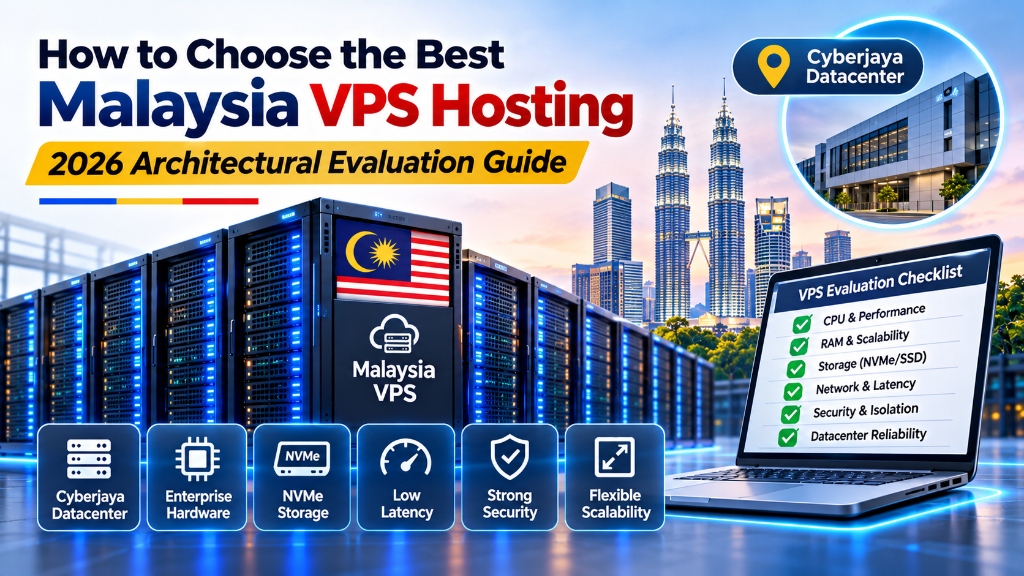
When deciding how to choose VPS Malaysia hosting, prioritize physical Tier-III datacenters in Cyberjaya, true KVM kernel virtualization over containerized OpenVZ setups, and direct MyIX peering. Furthermore, dedicated NUMA memory allocations, enterprise PCIe Gen4 NVMe arrays exceeding 80,000 IOPS, and transparent Ringgit pricing guarantee deterministic performance for ASEAN production workloads.
Core Architectural Pillars for Hosting in Malaysia
Choosing the right virtual server across Southeast Asia requires evaluating hardware architectures. Specifically, assess upstream transit networks, and datacenter infrastructure standards. Our production-grade Malaysia VPS hosting platform delivers dedicated KVM resources, pure PCIe 4.0 NVMe storage, and transparent Ringgit billing to keep your cloud operations scalable and cost-predictable.
Hardware Sovereignty
Physical servers housed directly in Cyberjaya ensure sub-5ms local round-trip times.
Pure KVM Compute
Dedicated CPU cores and unshared RAM eliminate noisy-neighbor cloud degradation.
Transparent MYR Billing
Invoicing in local Malaysian Ringgit eliminates foreign exchange volatility and cross-border bank fees.
When assessing virtual server infrastructure, prospective buyers often focus on core counts and RAM. However, underlying hardware architecture matters significantly more. Substandard providers routinely mask overcommitted processors and slow storage arrays behind attractive price tags.
Domestic Edge
Datacenter Location
Verify physical server placement inside Cyberjaya or Kuala Lumpur to avoid cross-border latency degradation.
Dedicated KVM
Kernel Isolation
Ensure dedicated hypervisor resource allocation with zero vCPU oversubscription or memory ballooning.
PCIe NVMe
Enterprise Storage IOPS
Deploy pure enterprise NVMe storage capable of delivering 80,000+ random IOPS for heavy database queries.
Direct Peering
MyIX Fiber Integration
Confirm direct Layer-2 interconnects to Telekom Malaysia, CelcomDigi, TIME, and Maxis networks.
A robust evaluation strategy examines five interlinked layers. Specifically, evaluate electrical redundancy, CPU oversubscription ratios, storage throughput, peering density, and support responsiveness. Methodical evaluation prevents the painful cycle of underperforming hosts, production downtime, and emergency migrations.
- ✔ Core Architectural Pillars for Hosting in Malaysia
- ✔ Datacenter Geography: Cyberjaya vs Regional
- ✔ Network Telemetry & MyIX Peering Verification
- ✔ Workload Sizing: vCPU, RAM & NVMe IOPS
- ✔ Hypervisor Integrity: KVM Isolation Auditing
- ✔ Total Cost of Ownership: Currency Risk & Egress
- ✔ Technical Comparison: Infrastructure Tiers
- ✔ Engineering Checklist: Pre-Provisioning Verification
- ✔ Frequently Asked Questions (FAQ)
Datacenter Geography: Cyberjaya vs Regional
Physical location is the primary determinant of network latency. Furthermore, it governs data residency compliance for Malaysian enterprise workloads.
Cyberjaya Datacenter Hub
The premier hosting zone for Malaysian enterprises, e-commerce brands, government agencies, and fintech platforms.
- Domestic Latency: 1ms – 4ms across Klang Valley, Selangor & Putrajaya
- Exchange Interconnect: Direct dark-fiber links to primary MyIX switches
- Power Infrastructure: Dedicated high-voltage TNB transmission substations
- Regulatory Compliance: 100% sovereign Malaysian jurisdiction (PDPA & BNM)
Offshore Singapore Hosting
Effective for multi-country regional apps, but incurs noticeable latency penalties for domestic Malaysian end-users.
- Domestic Latency: 18ms – 35ms from Kuala Lumpur via subsea/terrestrial links
- Exchange Interconnect: Routes via SGIX and international carrier transit
- Cost Vulnerability: Invoiced in USD or SGD subject to foreign exchange swings
- Regulatory Exposure: Cross-border data transfer subject to Section 129 review
In contrast, Cyberjaya was comprehensively planned as Malaysia’s Silicon Valley. It features purpose-built campuses equipped with diverse medium-voltage grid feeds from TNB. Furthermore, dedicated fiber conduits and environmental flood controls ensure maximum facility reliability. Housing infrastructure in Cyberjaya ensures that servers operate in high-density facilities with verified Tier-III uptime standards.
When compared to regional offshore hosting in Singapore, hosting directly in Cyberjaya provides an unbeatable domestic latency advantage. Singapore delivers respectable speeds into southern Johor. However, packets traveling to northern Peninsular states or East Malaysia must traverse subsea gateways. Consequently, this adds 20ms to 40ms of unnecessary network latency. Hosting within Cyberjaya ensures domestic traffic remains entirely within national borders.
Network Telemetry & MyIX Peering Verification
The quality of a hosting provider’s network depends on BGP routing topology. In particular, presence on local internet exchanges like MyIX ensures minimal latency and line-rate domestic throughput.
Unifi & TM One
Telekom Malaysia (AS4788)
Direct domestic routing ensures residential broadband users experience sub-5ms round-trip times.
Fiber Backbone
TIME dotCom (AS9930)
Ultra-low latency metro dark fiber guarantees sub-2ms connectivity across Kuala Lumpur commercial towers.
Mobile Subscribers
CelcomDigi & Maxis
Direct mobile peering delivers lag-free experiences for smartphone shoppers and mobile app users.
Without MyIX peering, server traffic routes through commercial transit providers. Consequently, packets often backhaul through regional hubs before returning to Malaysia. This routing anomaly—known as tromboning—degrades user experience and introduces unnecessary points of failure.
Before purchasing a virtual server, request a test IP address. Specifically, use their looking glass utility to verify routing paths. Execute diagnostic traceroute and mtr tests from domestic Malaysian ISPs like TM Unifi, TIME dotCom, and Maxis. If the route reveals intermediate hops outside Malaysia, proper domestic peering is absent. Therefore, domestic visitors will experience higher latency. Direct MyIX routes should resolve within 2 to 4 hops with roundtrip times under 2ms in the Klang Valley.
Workload Sizing: vCPU, RAM & NVMe IOPS
Accurately provisioning server resources prevents wasteful expenditure. Moreover, it prevents severe performance degradation under peak business load.
For dynamic e-commerce platforms like WooCommerce and Magento, memory is critical. In fact, RAM capacity directly governs database performance and concurrent user handling.
Consider the following baseline sizing recommendations for Malaysian production deployments:
- Entry-Level Production (Blogs, Corporate Portals): 2 vCPU cores, 4GB RAM, 50GB NVMe storage. Adequately supports up to 25,000 monthly visitors with server-level caching enabled.
- Mid-Tier Commercial (WooCommerce, SaaS Webhooks, APIs): 4 vCPU cores, 8GB RAM, 100GB NVMe storage. Supports dynamic checkout flows, Redis object caching, and concurrent payment gateway webhooks.
- High-Concurrency Enterprise (Multi-Store E-Commerce, Database Clusters): 8 vCPU cores, 16GB–32GB RAM, 200GB+ NVMe storage. Capable of handling massive marketing traffic surges like 11.11 shopping campaigns with zero performance throttling.
Hypervisor Integrity: KVM Isolation Auditing
The hypervisor architecture establishes the boundary between server tenants. Therefore, hypervisor isolation is paramount for security. In budget hosting markets, container technologies like OpenVZ or shared LXD are frequently used. Specifically, they share a single operating system kernel across dozens of tenants. Under this model, rogue processes on a neighboring container can exhaust shared system buffers or lock CPU schedulers.
For managing administrative dashboards efficiently, assess cPanel and Plesk control panel options.
In fact, true enterprise hosting relies exclusively on Kernel-based Virtual Machine (KVM) technology. KVM provides true hardware-assisted virtualization. Thus, each guest runs an independent kernel, custom modules like WireGuard or BBR, and dedicated swap space.
Hardware virtualization parameters are documented in the official Linux Kernel KVM documentation.
You can audit hypervisor isolation immediately after provisioning by connecting via SSH and inspecting CPU steal time using the top or vmstat utility:
procs ———–memory———- —swap– —–io—- -system– ——cpu—–
r b swpd free buff cache si so bi bo in cs us sy id wa st
1 0 0 6124500 45210 1284500 0 0 2 14 124 245 1 1 98 0 0
0 0 0 6124480 45210 1284520 0 0 0 0 88 190 0 0 100 0 0
0 0 0 6124480 45210 1284520 0 0 0 0 92 195 0 0 100 0 0
Under the cpu section, observe the st (steal time) column. On an uncrowded, properly managed KVM hypervisor, steal time should consistently register 0. If steal times consistently exceed 3% to 5%, physical processor cores are overcommitted. Consequently, your applications wait idle while noisy neighbors consume CPU cycles.
Total Cost of Ownership: Currency Risk & Egress
A comprehensive evaluation must account for total cost of ownership. Specifically, calculate bandwidth overages and currency fluctuations beyond the headline monthly hosting fee.
Financial Risk Advisory
USD Currency Exposure & Hyperscaler Bandwidth Traps
Global public clouds invoice in US Dollars, exposing Malaysian companies to 10%–15% annual currency swings. Additionally, international hyperscalers charge up to $0.09 per gigabyte in egress bandwidth fees, whereas OnliveServer provides transparent Ringgit billing and unmetered domestic bandwidth.
For Malaysian businesses whose revenue is denominated in Ringgit (MYR), USD billing introduces substantial foreign exchange exposure. Currency fluctuations can inflate hosting expenditures by 10% to 15% without any increase in resource consumption. Furthermore, international credit card payments incur foreign transaction processing fees from local financial institutions.
Another hidden cost vector across global cloud providers is bandwidth egress taxation. While inbound data transfer is typically free, outbound data transfer exceeding baseline tiers can incur exorbitant per-gigabyte surcharges. In contrast, premium Malaysian VPS providers like Onlive Server provide generous bandwidth allocations or unmetered port limits on dedicated 1Gbps ports, delivering complete budget predictability. Local billing in Ringgit also guarantees official tax invoices compliant with Malaysian Sales and Service Tax (SST) regulations.
Technical Comparison: Infrastructure Tiers
The matrix below provides an architectural reference for comparing enterprise-tier Malaysian VPS hosting against budget commodity hosting and complex foreign public clouds:
For a comparative market overview, read our review of top Malaysian VPS provider benchmarks.
| Evaluation Parameter | Enterprise Malaysia VPS (Onlive Server) | Budget Commodity Host | Global Public Cloud Hyperscaler |
|---|---|---|---|
| Datacenter Certification | Cyberjaya Tier-III Facility | Uncertified Urban Server Room | Tier-III Hyperscale Campus (Offshore) |
| Virtualization Isolation | Hardware KVM (0% CPU Steal) | OpenVZ / Shared Container | Custom Hypervisor (Burstable Core Caps) |
| Storage Throughput | PCIe Gen4 Enterprise NVMe (85K+ IOPS) | SATA SSD or Mechanical HDD | Network Block Storage (IOPS Throttled by Tier) |
| Domestic Routing | Direct MyIX Peering (<2ms KL) | Single Upstream Transit | International Transit Trombone (25ms-45ms) |
| Billing Predictability | Fixed Flat Rate (MYR Available, No Egress Fees) | Low Intro Rate, Sharp Renewal Spikes | Variable Usage-Based (USD Egress Penalties) |
Engineering Checklist: Pre-Provisioning Verification
Before authorizing a server purchase, submit the following technical queries to the prospective hosting vendor’s engineering team. The specificity and depth of their responses will quickly separate authentic infrastructure operators from passive resellers:
Request Looking Glass & Latency Diagnostic IP
Execute ping and MTR tests from your office network to verify sub-5ms latency before ordering.
Confirm KVM vs OpenVZ Hypervisor Architecture
Ensure full kernel isolation to run custom sysctl flags and prevent neighbor throttling.
Audit Enterprise NVMe vs Consumer SSD Hardware
Require enterprise-grade NVMe drives with power loss protection (PLP) for data integrity.
Verify Local Invoicing & 8% SST Tax Invoices
Ensure your hosting provider issues official Malaysian e-invoices for legitimate tax deductions.
- 1. What is the physical address of the datacenter hosting this node? Confirm that the hardware resides in a recognized Cyberjaya or central KL facility with Tier-III certification.
- 2. Does your network maintain an active, direct peering port at MyIX? Request their Autonomous System Number (ASN) and verify their peering status on public PeeringDB records.
- 3. Do you guarantee hardware-isolated KVM virtualization with zero CPU overcommit? Ensure the agreement explicitly prohibits container-based shared kernels and CPU throttling.
- 4. What specific solid-state drive models and RAID configurations are deployed? Verify that the storage subsystem utilizes enterprise PCIe NVMe in RAID-10 rather than consumer SATA drives.
- 5. Are bandwidth allocations metered, and what are the overage fees? Ensure that your server port provides unthrottled burstable capacity without predatory per-GB bandwidth bills.
- 6. Is technical support staffed locally in the Malaysia (MYT / UTC+8) timezone? Verify that systems engineers are available 24/7/365 to handle emergency hardware replacements and network issues.
- 7. Does your hosting agreement fulfill Malaysian PDPA 2010 data residency requirements? Confirm that your data remains in-country under sovereign legal protections.
Frequently Asked Questions (FAQ)
Q
Why is a Cyberjaya VPS superior to a shared hosting plan for Malaysian businesses?
Why is a Cyberjaya VPS superior to a shared hosting plan for Malaysian businesses?
Shared hosting bundles hundreds of websites onto a single operating system. Consequently, your business suffers resource competition, security vulnerabilities, and execution timeouts. In contrast, a Cyberjaya VPS provides dedicated vCPU cores, isolated RAM, and root access on enterprise NVMe storage with 99.99% uptime.
Q
How can I test network latency to Malaysian visitors before committing?
How can I test network latency to Malaysian visitors before committing?
Request a test IP or looking glass address from the hosting provider. Then, execute diagnostic tools like ping, traceroute, and MTR across TM Unifi, TIME dotCom, and Maxis. Specifically, high-quality domestic infrastructure demonstrates roundtrip times under 2ms in Klang Valley and sub-15ms across Peninsular Malaysia.
Q
What is CPU steal time and why does it matter?
What is CPU steal time and why does it matter?
CPU steal time represents the percentage of time a virtual machine waits while the physical hypervisor services neighboring instances. If steal time exceeds 3%, severe processor oversubscription is occurring. In contrast, dedicated KVM virtualization guarantees dedicated vCPU scheduling with near-zero CPU steal.
Q
Is Windows Server supported on Malaysian VPS instances?
Is Windows Server supported on Malaysian VPS instances?
Yes. Because KVM provides full hardware emulation, you can run Windows Server 2022 or 2019 seamlessly. Furthermore, Windows VPS instances are ideal for ASP.NET applications, Remote Desktop (RDP) management, and low-latency Forex trading on MetaTrader platforms.
Q
Can I upgrade server resources dynamically as my traffic increases?
Can I upgrade server resources dynamically as my traffic increases?
Yes. Enterprise KVM hosting allows seamless vertical resource scaling. Specifically, you can increase vCPU counts, memory allocations, and NVMe disk capacity directly from the client console without IP address changes or data migration.
Q
How does local Malaysian hosting assist with PDPA compliance?
How does local Malaysian hosting assist with PDPA compliance?
Under Malaysia’s Personal Data Protection Act (PDPA 2010), transferring personal data across international borders is strictly regulated. Therefore, storing and processing customer records physically within Malaysian borders fulfills sovereign data custody requirements and eliminates compliance penalties.
Q
How do hardware-level IOPS guarantees prevent noisy neighbor interference?
How do hardware-level IOPS guarantees prevent noisy neighbor interference?
Dedicated KVM virtualization enforces strict storage cgroup rate-limiting and paravirtualized Virtio-SCSI drivers on enterprise PCIe Gen4 NVMe arrays. By isolating disk queues per virtual machine, no adjacent tenant can monopolize storage bandwidth or cause latency spikes.
Q
What bandwidth commit ratio should Malaysian enterprises expect?
What bandwidth commit ratio should Malaysian enterprises expect?
Enterprises should demand 1:1 unmetered or low-oversubscription 1Gbps burstable uplinks connected directly to domestic exchange fabrics like MyIX. Consequently, this guarantees consistent line-rate throughput during high-traffic business hours without carrier throttling.
Deploy Your Verified Cyberjaya Cloud VPS Today
Scale your Malaysian business with enterprise KVM hardware isolation, ultra-fast PCIe Gen4 NVMe arrays, and sub-2ms MyIX peering. In fact, all infrastructure is stationed directly in Cyberjaya. Full root access, instant provisioning, and 24/7 technical support.
