

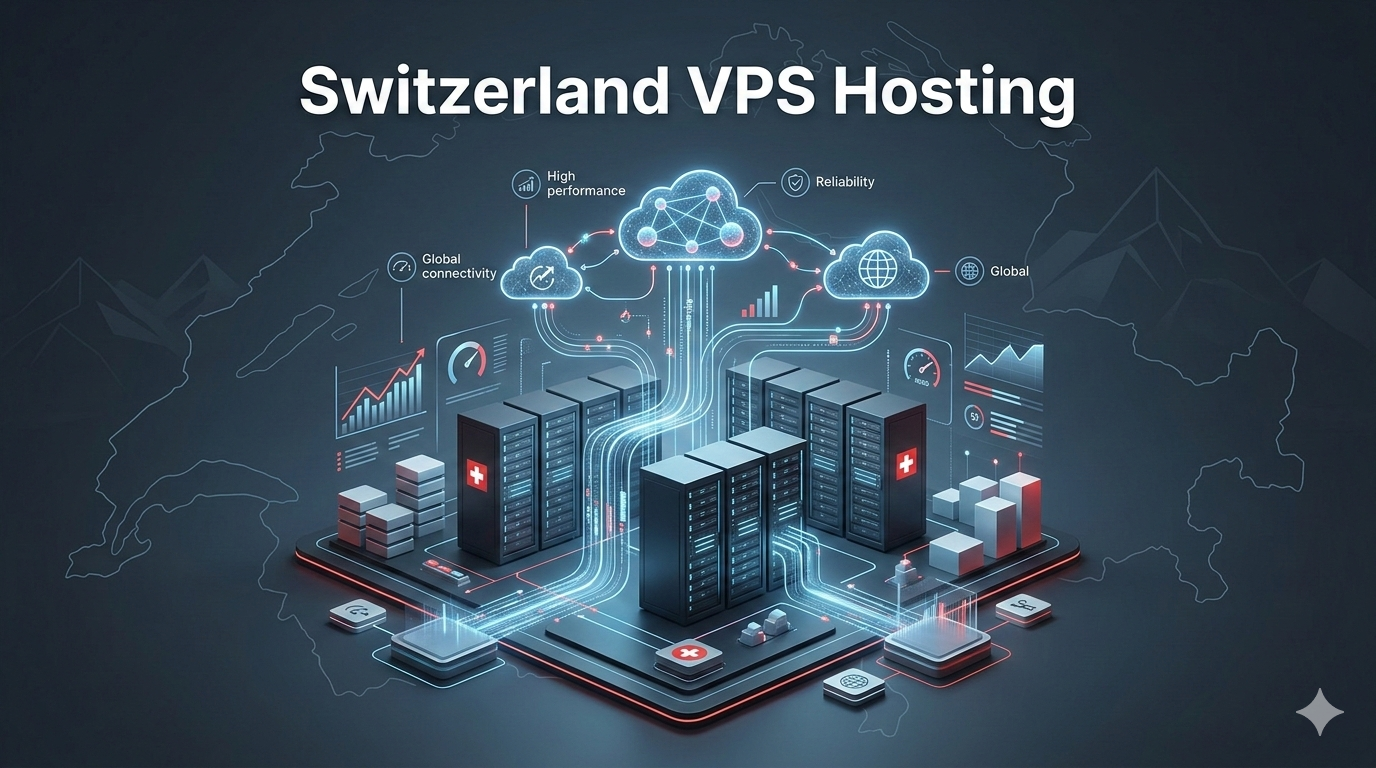
Specifically, a Swiss KVM VPS implements hardware-assisted Kernel-based Virtual Machine virtualization inside Zurich Tier III datacenters. Unlike shared-kernel containers (OpenVZ/LXC), KVM allocates dedicated vCPU threads, non-swappable physical ECC RAM, and an independent guest operating system kernel. This architectural boundary prevents noisy-neighbor resource theft, enables custom kernel encryption, and satisfies revDSG regulatory compliance.
Furthermore, in modern cloud computing, the hypervisor layer serves as the digital gatekeeper that divides physical silicon into functional virtual environments. However, not all virtualization technologies deliver equivalent security boundaries or compute predictability. Budget hosting providers frequently cut operational corners by utilizing shared-kernel containerization (such as OpenVZ, Virtuozzo, or basic LXC), where hundreds of tenants share a single monolithic Linux kernel. When deploying mission-critical databases, financial transactions, or confidential healthcare software, containerized hosting exposes organizations to severe security vulnerabilities and erratic resource throttling. Deploying on an authentic \1 provides true hardware-assisted virtualization. This architectural analysis examines how KVM virtualization inside our Zurich facilities ensures dedicated compute execution, unassailable memory isolation, virtio I/O acceleration, and comprehensive compliance with the Swiss Data Protection Act (revDSG).
Key Technical Takeaways
- Consequently, – \1 KVM leverages Intel VT-x and AMD-V hardware instructions, executing virtual CPUs with dedicated hardware registers and zero host kernel interference.
- In addition, – \1 Guest RAM addresses are mapped directly to physical registered ECC memory, eliminating page thrashing and memory leakage caused by neighboring tenants.
- In particular, – \1 Run customized Linux kernels, load proprietary kernel modules (WireGuard, eBPF), or deploy fully licensed Windows Server environments.
- – \1 Standardized virtio drivers communicate directly with host hardware rings, slashing storage and network packet latency to microseconds.
- Therefore, – \1 Complete kernel independence permits full-disk LUKS or BitLocker encryption without host administrator visibility, guaranteeing sovereign data privacy.
Introduction: The Hypervisor Foundation & KVM Standard
Kernel-based Virtual Machine (KVM) is an open-source, enterprise-grade virtualization technology integrated directly into the mainline Linux kernel since version 2.6.20. By turning the host Linux kernel into a Type-1 (bare-metal) hypervisor, KVM allows physical servers to run multiple isolated, virtualized guest operating systems at near-native execution speeds. When your virtual machine boots on an OnliveServer Zurich host node, KVM initializes hardware-assisted virtualization extensions—Intel VT-x or AMD-V. The guest virtual machine operates in a protected processor mode (Non-Root Operation), executing unprivileged CPU instructions directly on physical CPU cores without software translation. Privileged hardware instructions and memory accesses are trapped and validated by the KVM kernel module before execution. This hardware-enforced boundary ensures that even if a catastrophic exploit compromises a neighboring virtual machine on the physical chassis, the attacker cannot penetrate the hypervisor boundary or inspect your virtual machine’s memory registers.
📌 Table of Contents
- Introduction: The Hypervisor Foundation & KVM Standard
- KVM vs Container Virtualization (OpenVZ/LXC)
- Complete Security Isolation & Memory Sandboxing
- Storage & Networking with Virtio I/O Throughput
- Full OS Autonomy: Custom Linux & Windows via ISO
- Hypervisor Architecture Comparison Matrix
- Sizing & Pinning vCPU and Dedicated RAM
- NUMA Node Pinning & CPU Pinning for Low Latency
- Frequently Asked Questions (FAQ)
KVM vs Container Virtualization (OpenVZ/LXC)
In addition, to understand why KVM is mandatory for enterprise hosting, one must contrast it against OS-level containerization:
Container Virtualization (OpenVZ / LXC)
In particular, in an OpenVZ or LXC container environment, there is only one operating system kernel—the host node’s kernel. Containers are merely isolated namespaces sharing that single kernel:
The KVM Guarantee
Therefore, kVM creates an absolute virtual hardware platform including virtual CPU, virtual BIOS/UEFI, virtual network adapters, and dedicated memory. Each instance runs its own independent, unmodified operating system kernel with guaranteed compute boundaries.
Complete Security Isolation & Memory Sandboxing
Moreover, for organizations handling sensitive financial records, legal arbitrations, and healthcare patient data, memory isolation represents the ultimate security perimeter: – \1 When your Swiss KVM VPS is provisioned with 8GB of RAM, our hypervisor allocates and locks 8GB of physical registered ECC memory directly to your virtual machine’s process space. This memory cannot be swapped to disk or shared with other tenants. – \1 If a neighboring tenant experiences a memory leak or memory exhaustion, the Linux Out-Of-Memory (OOM) killer on the host terminates only the misbehaving process without affecting your KVM instance. – \1 Because KVM provides virtual hardware-level storage controllers, you can deploy full-disk encryption (such as LUKS on Linux or BitLocker on Windows Server) directly from the initial operating system setup. Even a host system administrator inspecting physical storage volumes sees only scrambled cryptographic ciphertext.
Storage & Networking with Virtio I/O Throughput
Historically, fully virtualized systems suffered from virtualization overhead when communicating with emulated hardware devices (such as emulating legacy IDE controllers or Realtek network cards).
In fact, modern Swiss KVM VPS deployments eliminate this overhead through paravirtualized \1 drivers:
Virtio-Block and Virtio-SCSI
Similarly, rather than emulating slow physical disk buses, \1 establishes direct shared-memory communication channels between the guest operating system and the host hypervisor. When paired with enterprise PCIe 4.0 NVMe storage arrays in hardware RAID 10, guest virtual machines achieve over 600,000 IOPS and sub-20 microsecond random read/write latency.
Virtio-Net Network Acceleration
Meanwhile, the \1 network driver bypasses legacy network emulation, transferring network packets across shared-memory ring buffers. When combined with direct \1, KVM instances process millions of packets per second with negligible CPU overhead.
Full OS Autonomy: Custom Linux & Windows via ISO
Because KVM emulates an authentic PC hardware motherboard, clients enjoy complete operating system autonomy: – \1 Instantly provision Ubuntu Server (22.04 / 24.04 LTS), Debian (11 / 12), AlmaLinux 9, Rocky Linux 9, or Alpine Linux from our pre-seeded cloud template library. – \1 Deploy official Windows Server 2022 or 2025 Standard editions with full Administrator Remote Desktop (RDP) connectivity. – \1 Upload your own specialized operating system ISO images (such as FreeBSD, pfSense, Proxmox Backup Server, or hardened corporate Linux spins) and execute standard operating system installation through an interactive HTML5 VNC console directly in your browser.
Hypervisor Architecture Comparison Matrix
Additionally, the table below compares the foundational architectural, security, and performance characteristics of KVM virtualization against shared-kernel container hosting:
As a result, this technical matrix establishes why enterprise organizations, fintech developers, and regulatory compliance officers strictly require KVM virtualization. For hardware sizing guidance, review our \1.
Sizing & Pinning vCPU and Dedicated RAM
OnliveServer configures its KVM host clusters to maintain generous resource headrooms. Virtual CPU cores are mapped to high-frequency AMD EPYC and Intel Xeon Scalable processor cores with strict scheduler quotas enforced by the Linux Completely Fair Scheduler (CFS). When your application experiences sudden traffic surges—such as a Black Friday e-commerce spike or breaking news coverage—KVM scheduler threads process concurrent requests smoothly without triggering CPU throttling. Furthermore, our cloud management control panel enables seamless, one-click vertical scaling. When your database outgrows its initial allocation, you can scale from 2 vCPU and 4GB RAM to 8 vCPU and 16GB RAM in seconds without reformatting drives or changing IP addresses. For cost breakdowns, review our analysis of \1.
NUMA Node Pinning & CPU Pinning for Low Latency
For latency-critical enterprise workloads—such as automated algorithmic trading engines, high-frequency database clusters, and telecommunication switches—KVM supports advanced processor pinning optimizations:
Non-Uniform Memory Access (NUMA) Alignment
High-density host servers feature dual-socket AMD EPYC or Intel Xeon Scalable processors, where each CPU socket manages its own dedicated memory channels. If a virtual machine’s vCPU executes on Socket 0 while accessing memory allocated on Socket 1, packets must cross the inter-socket interconnect (AMD Infinity Fabric or Intel UPI), adding latency penalties. OnliveServer configures enterprise KVM instances with NUMA-aware scheduling, ensuring that your virtual CPUs and physical ECC RAM are pinned to the same physical NUMA node for absolute lowest latency and maximum memory bandwidth.
Dedicated IRQ Affinity
Network card hardware interrupts (IRQs) can be assigned to dedicated CPU cores, preventing context switching overhead and allowing virtual network interfaces to process packet streams with zero jitter.
Frequently Asked Questions (FAQ)
Core Technical Specifications
Q1
What is KVM virtualization and why is it superior for Swiss VPS hosting?
Q2
Can I install custom Linux kernels or kernel modules on a Swiss KVM VPS?
Q3
How does KVM memory isolation protect against noisy neighbors?
Q4
Can I encrypt my entire disk using LUKS or BitLocker on a Swiss KVM VPS?
Deployment & Operational Inquiries
Q5
Does KVM support Windows Server hosting in Switzerland?
Q6
What storage subsystem is paired with Swiss KVM hypervisors?
Q7
How does KVM virtualization enhance compliance with the Swiss revDSG?
Q8
How quickly can a Swiss KVM VPS be deployed after completing checkout?
Deploy Dedicated Swiss KVM Virtualization Today
Experience the ultimate in cloud compute predictability, kernel autonomy, and hardware isolation inside Zurich’s premier Tier III datacenter. Benefit from pure KVM virtualization, PCIe 4.0 NVMe storage, and complete revDSG privacy.
Explore Swiss VPS Plans →