

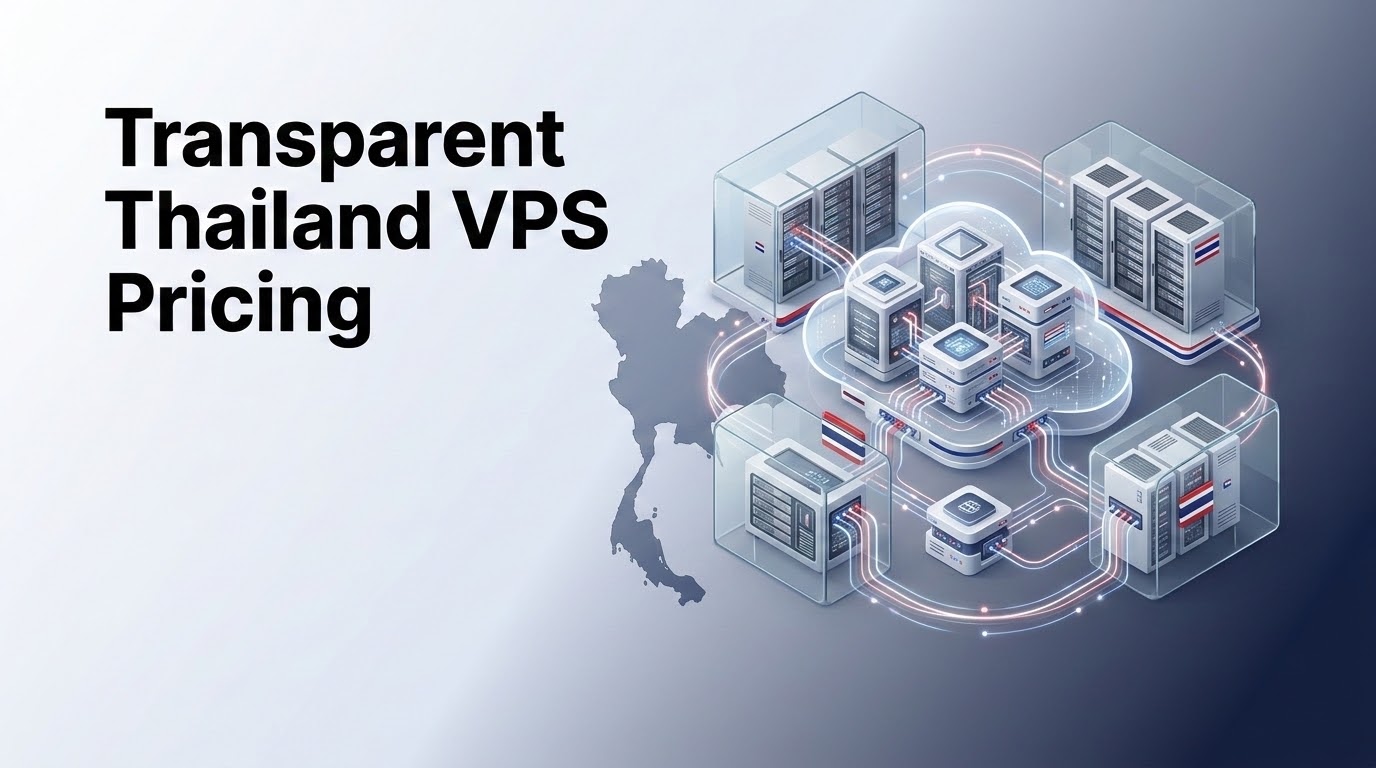
Specifically, when planning an enterprise deployment for Thailand VPS Pricing, a reliable production VPS in Bangkok costs between $12 and $45 per month, depending on vCPU count, RAM, and NVMe storage capacity. To avoid hidden fees, watch out for introductory teaser discounts that triple upon renewal, unbundled IPv4 address charges, and separate billing for domestic backup snapshots.
Furthermore, in the web hosting and cloud infrastructure sector, pricing opacity remains one of the greatest sources of customer frustration. Startups and small-to-medium businesses in Thailand frequently sign up for attractively priced virtual private servers, only to suffer severe “sticker shock” when the initial promotional term expires or when essential operational necessities—such as dedicated IP allocations, automated disaster recovery backups, and control panel licenses—are itemized on subsequent invoices. Budgeting effectively requires looking beyond headline teaser figures. Choosing transparent Thailand VPS hosting pricing and plans guarantees predictable recurring operating expenses, enterprise KVM reliability, and zero hidden licensing surcharges in Bangkok.
✔ Pricing & TCO Strategic Takeaways
- Consequently, The Renewal Multiple: Promotional introductory rates frequently jump by 200% to 400% at the end of the initial billing cycle.
- In addition, IPv4 Line-Item Surcharges: Due to global IPv4 address exhaustion, budget hosts often separate IP leasing fees ($3–$6/month) from the compute price.
- In particular, cPanel Licensing Inflation: Repeated price hikes by WebPros have turned cPanel into a major cost center ($17–$35+/month per server).
- Therefore, Disaster Recovery Budgeting: Automated offsite snapshot storage typically adds 15%–25% to base infrastructure expenses.
- Moreover, Tax & Foreign Exchange Overhead: Cross-border card payments and Thailand’s 7% Value Added Tax (VAT) alter real cash expenditures.
Introduction: Anatomy of a Transparent Hosting Bill
Consequently, when procuring cloud infrastructure, the single largest challenge is reconciling the advertised “headline price” with the actual total cost of ownership (TCO). A hosting invoice is composed of four distinct operational layers:
- In addition, Core Virtual Compute & Memory: The physical hypervisor slice (vCPUs and dedicated RAM) operating inside the Bangkok datacenter.
- In particular, Storage Fabric & I/O Allocations: The non-volatile media capacity (enterprise NVMe SSD arrays) and corresponding IOPS allowances.
- Therefore, Network Transit & Routing: The assigned static IPv4/IPv6 addresses, local BKNIX exchange peering, and international submarine transit pipe.
- Moreover, Software Licensing & Management Layer: Operating system licenses (e.g., Microsoft Windows Server core packs), control panels (cPanel, Plesk), and automated snapshot storage.
In fact, under a transparent pricing model, these core components are bundled into an all-inclusive, fixed recurring monthly fee that remains constant across renewals. Under an opaque pricing model, providers unbundle these requirements, using loss-leader pricing on compute to entice signups while charging exorbitant markups on essential storage, IP transit, and license add-ons.
📌 Table of Contents
- Introduction: Anatomy of a Transparent Hosting Bill
- The Introductory Discount Trap & Renewal Hikes
- IPv4 Scarcity & Dedicated IP Surcharges
- Control Panel Dilemma: cPanel Hikes vs Free Alternatives
- Backup Storage & Snapshot Costs
- Factoring in Thai VAT (7%) & Payment Fees
- 12-Month TCO Comparison: Budget vs Enterprise VPS
- Frequently Asked Questions (FAQ)
- Transparent Thailand VPS with Fixed Renewals
The Introductory Discount Trap & Renewal Hikes
Similarly, the “introductory teaser discount” is a classic retail hosting strategy. A provider displays a banner offering a virtual server for “only $4.99/mo.” However, buried in the checkout terms is a critical clause: “Price applies to initial 12-month billing cycle paid upfront; renews at regular rate of $19.99/mo.”
The Friction of Migration Lock-In
Meanwhile, budget hosts deliberately rely on customer inertia. Once an organization spends dozens of engineering hours deploying databases, configuring SSL certificates, integrating PromptPay payment gateways, and pointing DNS records to their Bangkok server, migrating to another provider at year’s end is painful. Unscrupulous providers exploit this lock-in, knowing that many IT managers will simply authorize the 300% renewal hike rather than undertake a complex database migration.
Additionally, always review the checkout confirmation page for the explicit “Renewal Price.” If a host does not publish their standard renewal rate openly on their pricing table, demand written clarification before entering credit card details. At OnliveServer, our published rates are the permanent renewal rates.
IPv4 Scarcity & Dedicated IP Surcharges
As a result, in November 2019, the Asia-Pacific Network Information Centre (APNIC) officially exhausted its final available /8 IPv4 address pool. Since that date, acquiring fresh blocks of routable IPv4 addresses requires purchasing them on secondary transfer markets, where wholesale prices currently range between $45 and $60 USD per IP address. Pair your cost auditing with our comprehensive buy VPS Thailand technical checklist to evaluate virtualization hypervisors, SLA terms, and network peering before finalizing your purchase. To protect digital asset ownership when bundling domains with hosting, review the ICANN Registrant Rights and Responsibilities educational guidelines.
Because physical IPv4 addresses are scarce capital assets, hosting providers in Thailand approach IP pricing in two ways:
- Specifically, Unbundled “BYO-IP” or Surcharge Billing: The host advertises a server for $6/mo, but the checkout cart reveals that a dedicated IP address costs an additional $3.50 to $5.00/mo. If you refuse the add-on, your server is placed behind a shared NAT proxy where outbound SMTP port 25 is blocked, and incoming HTTP requires complex port forwarding.
- Furthermore, Transparent Bundled Allocation: Quality enterprise providers bundle one dedicated, clean, APNIC-registered Bangkok IPv4 address (plus a /64 IPv6 subnet) into the base plan cost, ensuring complete data isolation and immediate email deliverability.
Control Panel Dilemma: cPanel Hikes vs Free Alternatives
Historically, cPanel was the ubiquitous choice for managing Linux servers. However, following its acquisition by private equity consortium WebPros, cPanel shifted from a flat, unlimited-account server license model to an aggressive per-account billing structure. Today, a basic “cPanel Admin” license for just 5 accounts costs approximately $17.49/month, while a 30-account “Pro” license exceeds $25.99/month. On a $15/month Bangkok VPS, the cPanel license costs more than the physical server itself!
Lightweight, Zero-Cost Control Panel Alternatives
Modern sysadmins in Thailand are increasingly adopting open-source and free enterprise control panels that deliver superior speed while consuming a fraction of server memory:
| Control Panel | Monthly License Fee | Idle RAM Overhead | Best Workload Use Case |
|---|---|---|---|
| cPanel / WHM (Pro) | $25.99 – $39.99/mo | 950 MB – 1,400 MB | Legacy shared hosting resellers unwilling to adapt. |
| FastPanel | $0.00 (Free) | ~90 MB | High-speed NGINX multi-site hosting, agency WordPress sites. |
| CyberPanel | $0.00 (Open-Source) | ~250 MB | WooCommerce e-commerce requiring OpenLiteSpeed and LSCache. |
| CloudPanel | $0.00 (Free) | ~120 MB | Modern PHP 8.x, Node.js, and Python microservices on NGINX. |
Backup Storage & Snapshot Costs
Consequently, never assume that automated disaster recovery backups are included in base hosting pricing unless explicitly stated in your service level agreement. Maintaining secondary storage clusters for automated snapshots requires separate enterprise storage capacity: Selecting a long-term infrastructure partner requires clear pricing schedules across transparently priced cloud VPS hosting with zero hidden recurring fees.
- In addition, Hypervisor Snapshot Add-ons: Most hyperscalers and cloud hosts charge between $0.05 and $0.08 per GB per month for block-level volume snapshots. For a 100GB server keeping 3 historical recovery points, snapshot charges add $15 to $24 per month to your bill.
- Self-Managed Automated Offsite Replication: Astute sysadmins avoid proprietary snapshot surcharges by deploying automated cron jobs using tools like BorgBackup, Restic, or Duplicity. These tools compress, deduplicate, and encrypt database dumps and media folders, replicating them directly to cost-effective S3-compatible object storage (e.g., Wasabi or Backblaze B2 at $0.006/GB).
Factoring in Thai VAT (7%) & Payment Fees
When operating a business in Thailand, legal corporate bookkeeping and payment processing mechanics have a tangible effect on net cash flow:
1. Thailand Value Added Tax (VAT 7%)
Under Thai tax law, legal corporate entities registered in Thailand must account for 7% VAT. If you lease from a local Thai entity, the 7% VAT is itemized on official tax invoices (ใบกำกับภาษี), allowing your accounting department to claim input tax credits. Overseas hyperscalers (AWS, Google Cloud) now also charge 7% Thai VAT on electronic service imports under Thailand’s e-Service Tax law.
2. Foreign Exchange (FX) & Cross-Border Card Surcharges
When paying an overseas cloud provider denominated in USD or EUR with a Thai corporate debit/credit card (e.g., from Kasikornbank, SCB, or Bangkok Bank), Thai banks levy an international conversion surcharge of 2.0% to 2.5%. Fluctuations in the USD/THB exchange rate can add another 5%–10% variance to your annual infrastructure spend.
12-Month TCO Comparison: Budget vs Enterprise VPS
To demonstrate how opaque pricing compounds over time, let us model the realistic 12-month expenditure for a mid-tier business platform (4 vCPU / 8GB RAM / 100GB Storage / 1 IPv4 / Automated Backups) between a typical “budget” host and OnliveServer’s transparent model:
| Expense Item | Budget Opaque Host (Headline $7.99/mo) | OnliveServer Enterprise Transparent VPS |
|---|---|---|
| Base Compute & RAM (Month 1-12) | $7.99/mo × 12 = $95.88 (Promotional) | $19.00/mo × 12 = $228.00 (Fixed Rate) |
| Dedicated Bangkok IPv4 Address | $4.50/mo × 12 = $54.00 | $0.00 (Included Standard) |
| Automated Snapshot Backups (100GB) | $8.00/mo × 12 = $96.00 | $4.00/mo × 12 = $48.00 |
| cPanel License (Admin 5 Accounts) | $17.49/mo × 12 = $209.88 | $0.00 (FastPanel/CyberPanel Pre-installed) |
| Year 1 Real Cash Outlay | $455.76 (~15,950 THB) | $276.00 (~9,660 THB) |
| Year 2 Projected Renewal (Loss-leader ends) | $671.76 (~23,500 THB) ↑ +47% jump | $276.00 (~9,660 THB) ↔ 0% increase |
The numbers reveal the reality: the “cheap $7.99/mo” budget host costs almost twice as much over 12 months once mandatory operational dependencies are factored in, and spikes even further in year two. Transparent pricing saves your business thousands of baht while ensuring higher enterprise reliability.
To verify domain DNS resolution, authoritative nameserver propagation, and registry records from your server shell, execute this PuTTY diagnostic runbook:
Frequently Asked Questions (FAQ)
Core Technical Specifications
Q1
I bought a VPS for $5/month, but at renewal was billed $18/month plus $4 for the IP. How do I prevent this?
Q2
Does OnliveServer charge extra for domestic Thailand bandwidth?
Q3
Can I pay for my Thailand VPS using local Thai payment methods like PromptPay?
Q4
Is it mandatory to purchase a paid cPanel license to run WordPress on a Thailand VPS?
Q5
Are there setup fees or hidden cancellation penalties on your Bangkok cloud servers?
Q6
Can our Thai company request an official withholding tax certificate (Withholding Tax 3%)?
Transparent Thailand VPS with Fixed Renewals
Protect your operating budget from unexpected renewal price spikes. Our transparent billing models guarantee clear monthly invoices, free setup, and predictable hosting expenses.
