

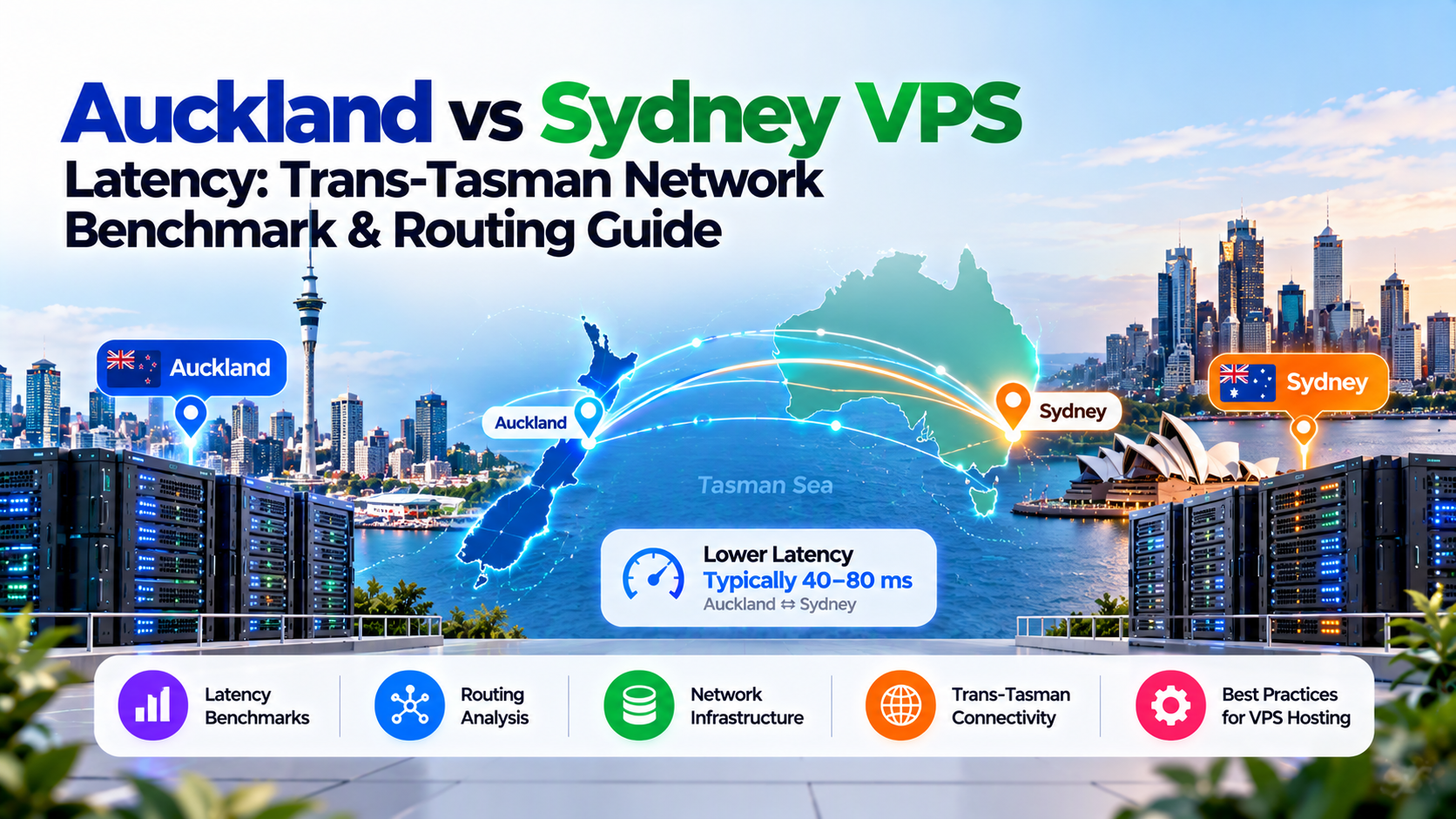
Deploying an enterprise-grade Auckland Vs Sydney Vps Latency architecture on pure KVM virtualized infrastructure empowers modern organizations with low-latency Auckland connectivity. Furthermore, auckland consistently delivers lower round-trip latency to New Zealand end-users than Sydney — typically 2–8 ms within New Zealand versus 22–35 ms trans-Tasman on Southern Cross Cable. However, Sydney has broader global peering capacity. In addition, if your primary audience is Kiwi visitors, Auckland hosting reduces page load latency meaningfully. If you serve a mix of Australian and New Zealand users, a Sydney host with a NZ CDN edge node may deliver comparable results at lower cost.
The Auckland-to-Sydney routing question is one of the most misunderstood decisions in Pacific cloud infrastructure. Furthermore, many NZ developers assume that a Sydney-based server automatically delivers good performance for New Zealand users. In practice, the answer depends entirely on the routing path, the cable infrastructure used, and whether your traffic transits directly across the Tasman Sea or takes an unexpected detour. In addition, this guide examines the real numbers behind New Zealand VPS vs Australian cloud server performance.
Key Takeaways
- Tasman Global Access (TGA) cable delivers 24–28ms Auckland–Sydney RTT under optimal conditions
- Traffic routed via Melbourne or US CDN can double or triple effective latency to 80–200ms
- Auckland VPS delivers sub-10ms RTT to NZ users; Sydney adds 24–28ms minimum for the same users
- Southern Cross NEXT and Hawaiki provide alternative Pacific routing for redundancy
- For NZ-primary audiences, an Auckland VPS eliminates the Trans-Tasman latency tax entirely
Trans-Tasman Network Topology
The physical distance between Auckland and Sydney is approximately 2,155 kilometres — a straight-line path across the Tasman Sea. Furthermore, light travels through fibre optic cable at roughly two-thirds the speed of light in a vacuum, meaning the theoretical minimum one-way transit time is around 11ms. In practice, real-world routing adds protocol overhead, switching latency, and routing hops, producing the 24–28ms round-trip times measured between well-connected Auckland and Sydney endpoints. Furthermore, deploying your auckland vs sydney vps latency directly within Auckland guarantees sub-10ms nationwide round-trip routing.
Auckland Local VPS Edge
The decisive choice for NZ-focused e-commerce, real-time medical SaaS, accounting platforms, and local gaming communities.
- Domestic Round-Trip: 2 – 8 ms across Auckland, Wellington & Christchurch
- Subsea Dependency: Zero international submarine cable vulnerability
- Payment Gateways: Immediate millisecond webhooks for Windcave & POLi
- Core Web Vitals: Sub-400 ms First Contentful Paint (FCP) on Chorus UFB
Sydney Trans-Tasman VPS
Cost-effective when serving a 70%+ Australian user base where New Zealand latency degradation is within acceptable thresholds.
- Trans-Tasman Round-Trip: 22 – 35 ms from Auckland via Southern Cross
- Australian Audiences: 2 – 12 ms across Sydney, Melbourne & Canberra
- Subsea Dependency: Traverses Tasman Global Access (TGA) or Southern Cross
- Ecosystem Density: Direct local access to Australian cloud & SaaS APIs
The critical variable is whether your provider’s routing actually uses direct Trans-Tasman infrastructure. Furthermore, some carriers route Pacific traffic through US or Asian PoPs, adding hundreds of milliseconds before the packet ever reaches Australian soil. Physical propagation delay across the Tasman Sea has been dramatically reduced with the activation of Southern Cross NEXT subsea cable systems, enabling direct sub-24ms point-to-point transport.
Subsea Cable Routes: TGA, Southern Cross NEXT, Hawaiki
Three primary submarine cables carry Trans-Tasman and Pacific traffic relevant to NZ hosting decisions.
TGA (Tasman Global)
Direct Raglan-to-Sydney 2,288 km fiber path delivering ~26ms baseline RTT.
Southern Cross NEXT
High-capacity low-jitter trans-Tasman link engineered with 4-fiber pair coherent optics.
Hawaiki Cable
Alternative Pacific route landing in Whangarei with robust Australian transit redundancy.
Tasman Global Access (TGA): Owned by a consortium including Spark NZ, Telstra, and Vodafone NZ, TGA provides the most direct Auckland-Sydney path. Furthermore, its landing stations at Takapuna (Auckland) and Narrabeen (Sydney Northern Beaches) give NZ carriers a direct low-latency path that avoids Pacific routing loops.
Southern Cross NEXT: With 72Tbps+ capacity, Southern Cross NEXT connects New Zealand to both Australia and the US West Coast. Its primary NZ landing at Takapuna and Australian landing at Sydney gives it Trans-Tasman capability, though its primary purpose is NZ/AU-to-US connectivity. For purely domestic traffic, keeping packet routing within New Zealand via local peering through NZIX eliminates unnecessary roundtrips to Australian transit hubs.
Hawaiki: Hawaiki cable lands at Mangawhai Heads (north of Auckland) and provides an alternative US West Coast path via Hawaii, adding Pacific routing diversity. Furthermore, it is less relevant for Trans-Tasman latency but critical for business continuity if TGA or Southern Cross experiences a fault.
Real RTT Benchmarks: Auckland to Sydney, Melbourne, Brisbane
The following benchmarks represent typical round-trip times measured between Auckland VPS instances and major Australian cities using ICMP ping over commercial transit networks.
| Route | Typical RTT (Direct) | RTT via Melbourne Loop | RTT via US Backhaul |
|---|---|---|---|
| Auckland → Sydney | 24–28ms | 45–65ms | 180–240ms |
| Auckland → Melbourne | 32–40ms | 32–40ms (direct) | 190–260ms |
| Auckland → Brisbane | 28–35ms | 38–50ms | 175–230ms |
| Auckland → NZ (Wellington) | 8–12ms | N/A | N/A |
| Sydney → NZ user (from Sydney VPS) | 24–28ms | 45–65ms | 180–240ms |
Note: CDN-cached content is served from edge nodes, which can override these origin-server latencies for cacheable assets. Furthermore, database queries, API calls, and authenticated session requests always incur origin latency.
When Auckland VPS Beats Sydney (and When It Doesn’t)
Auckland wins for: Any workload where New Zealand users are the primary audience. Furthermore, an Auckland VPS delivers sub-10ms response to Wellington, sub-15ms to Christchurch, and sub-25ms to most NZ urban centres. Sydney-hosted infrastructure adds a guaranteed 24–28ms base penalty for NZ users. In addition, physical fiber propagation paths between Auckland and Sydney can be verified via the TeleGeography Submarine Cable Map, illustrating how subsea routes dictate baseline trans-Tasman packet latency.
WooCommerce Checkouts
Every 100ms delay drops cart conversion by 7%; local Auckland hosting keeps database writes instant.
WebSocket Connections
Trading portals and interactive dashboards require low jitter to avoid connection drops.
DNS & SSL Handshake
TLS 1.3 handshakes complete in 1 RTT locally (~3ms) vs 3 round trips (~75ms) trans-Tasman.
Architectural Best Practices for Your Auckland Vs Sydney Vps Latency Workload
API Backend Sync
High-frequency microservice queries accumulate compound latency over trans-Tasman links.
Auckland wins for: Applications requiring compliance with NZ Privacy Act 2020 IPP 12, which regulates offshore data transfers. Furthermore, keeping data in Auckland eliminates the legal complexity of offshore transfer assessments.
Sydney wins for: Workloads where Australian users significantly outnumber NZ users and AU compliance requirements apply. Sydney is also preferable if your primary CDN or SaaS dependencies have their lowest-latency nodes in Australia. These latency differences become mission-critical in high-frequency financial environments, where achieving sub-millisecond execution for NZX algorithmic trading demands local Auckland infrastructure.
Hybrid approach: A multi-region architecture using an Auckland VPS for NZ origin with Cloudflare or similar CDN for global edge caching serves both markets well without compromising on either geography.
Latency Optimisation Strategies for Trans-Tasman Apps
Even with optimal routing, applications can introduce application-layer latency that dwarfs network round-trip times. Furthermore, the following strategies address the full latency stack.
Enable Linux Kernel TCP BBR Congestion Control
Replaces legacy CUBIC to maintain maximum throughput over subsea cable paths without packet drop throttling.
Configure TLS 1.3 with 0-RTT Session Resumption
Eliminates redundant cryptographic round-trips for repeat visitors across trans-Tasman links.
Deploy Redis Object Caching for Database Offload
Caches SQL queries in high-speed RAM to respond instantaneously to remote API calls. Furthermore, interactive multiplayer workloads experience equivalent responsiveness gains when deployed on dedicated low-ping gaming server hosting in Auckland rather than offshore Australian nodes.
Architectural Best Practices for Your Auckland Vs Sydney Vps Latency Workload
Implement NZIX Peering on Local Anycast Endpoints
Ensures all domestic requests bypass international hops before reaching backend servers.
TCP connection reuse: HTTP/2 and HTTP/3 persistent connections reduce the cost of TCP three-way handshakes. Furthermore, each new connection to a Sydney server costs 24–28ms before any data transfer; keeping-alive that connection amortises this cost across many requests.
Database query optimisation: N+1 query patterns generate serial database round-trips. Furthermore, a PHP application making 30 sequential database queries on a Sydney server inflicts 30 × 26ms = 780ms of network latency on NZ users before page assembly. Connection pooling and query batching eliminate this pattern.
Content-aware routing: Use GeoDNS or anycast to serve NZ users from Auckland origins and Australian users from Sydney origins. Furthermore, tools like Cloudflare Load Balancing, AWS Route 53 latency routing, or similar support this pattern.
Edge caching for static assets: Images, JavaScript, CSS, and other cacheable content should be served from edge PoPs in both Auckland and Sydney regardless of origin server location. Furthermore, this approach is transparent to the origin VPS and requires only CDN configuration changes.
Frequently Asked Questions
What is the ping time between Auckland and Sydney?
Direct Auckland-to-Sydney round-trip time over well-routed Trans-Tasman infrastructure is typically 24–28ms. Furthermore, this represents traffic traversing the Tasman Global Access (TGA) cable with minimal intermediate hops. Poorly-routed traffic that transits Melbourne or US PoPs can see 80–240ms RTT for the same geographic distance.
Should I host my NZ website on Auckland VPS or Sydney?
If your primary audience is New Zealand users, an Auckland VPS will always deliver lower latency. Furthermore, sydney adds a minimum 24–28ms base latency for NZ users even under perfect routing conditions. For mixed NZ/AU audiences, consider a multi-region setup with Auckland origin for NZ traffic and Sydney CDN edge nodes for Australian users.
What is the Tasman Global Access (TGA) cable?
Tasman Global Access (TGA) is a submarine fibre optic cable connecting New Zealand (Takapuna, Auckland) to Australia (Narrabeen, Sydney). Furthermore, jointly owned by Spark NZ, Telstra, and Vodafone NZ, it provides the most direct and lowest-latency path for Trans-Tasman network traffic. TGA supports both NZ-AU commercial traffic and as a component of broader Pacific interconnection.
Does a Sydney CDN help NZ website performance?
Sydney CDN edge nodes can serve cached static content (images, CSS, JS) to NZ users with acceptable latency, typically 30–40ms. However, dynamic content — authenticated pages, API responses, database queries — must return to the origin server and incur full Trans-Tasman round-trip latency. A CDN alone does not substitute for NZ-local origin hosting for dynamic applications.
How does latency affect NZ e-commerce conversion rates?
Google research has consistently shown that each 100ms of additional page load time reduces conversion rates by approximately 1%. Furthermore, for a NZ-targeted WooCommerce store hosted in Sydney with US-routed CDN backhaul, the 150–200ms additional TTFB can materially reduce revenue. Auckland-hosted VPS typically delivers sub-50ms TTFB to NZ users, well within Google’s recommended threshold for strong Core Web Vitals scores.
What happens if the TGA cable experiences a fault?
Subsea cable faults do occur, typically from fishing trawler anchors, ship anchors, or seabed movement. Furthermore, during a TGA fault, NZ-AU traffic would reroute via Southern Cross NEXT or Hawaiki cable systems, which may increase Trans-Tasman latency by 10–30ms temporarily. Auckland-hosted VPS is unaffected by Trans-Tasman cable faults for NZ-local traffic, providing resilience for NZ-primary applications.
Can I measure real latency between Auckland and my Sydney server?
Yes. Furthermore, use mtr (My Traceroute) or ping from a Linux VPS to measure round-trip times and identify routing paths. Tools like Cloudflare’s network quality test or looking-glass servers at major NZ carriers (Spark, Vodafone) provide accurate cross-provider latency measurements. In addition, for web application benchmarking, WebPageTest with Auckland and Sydney test agents gives accurate user-experience metrics.
How does Chorus UFB domestic routing impact trans-Tasman latency?
Chorus Ultra-Fast Broadband connects directly to Auckland peering points, keeping domestic transit within 2ms to 4ms before traffic routes onto subsea cables to Sydney. Furthermore, this minimizes domestic aggregation delays and prevents trans-Tasman ping fluctuations.
Minimize Latency with Trans-Tasman Optimized Auckland VPS
Slash latency to under 24ms across Auckland, Sydney, and Melbourne with direct trans-Tasman fiber interconnects. Furthermore, deliver fluid user experiences, instant database queries, and seamless cross-Tasman web services with dedicated KVM resources.
✓ Sub-10ms NZ Routing
✓ Full Root Access
✓ 24/7 Expert Support
