

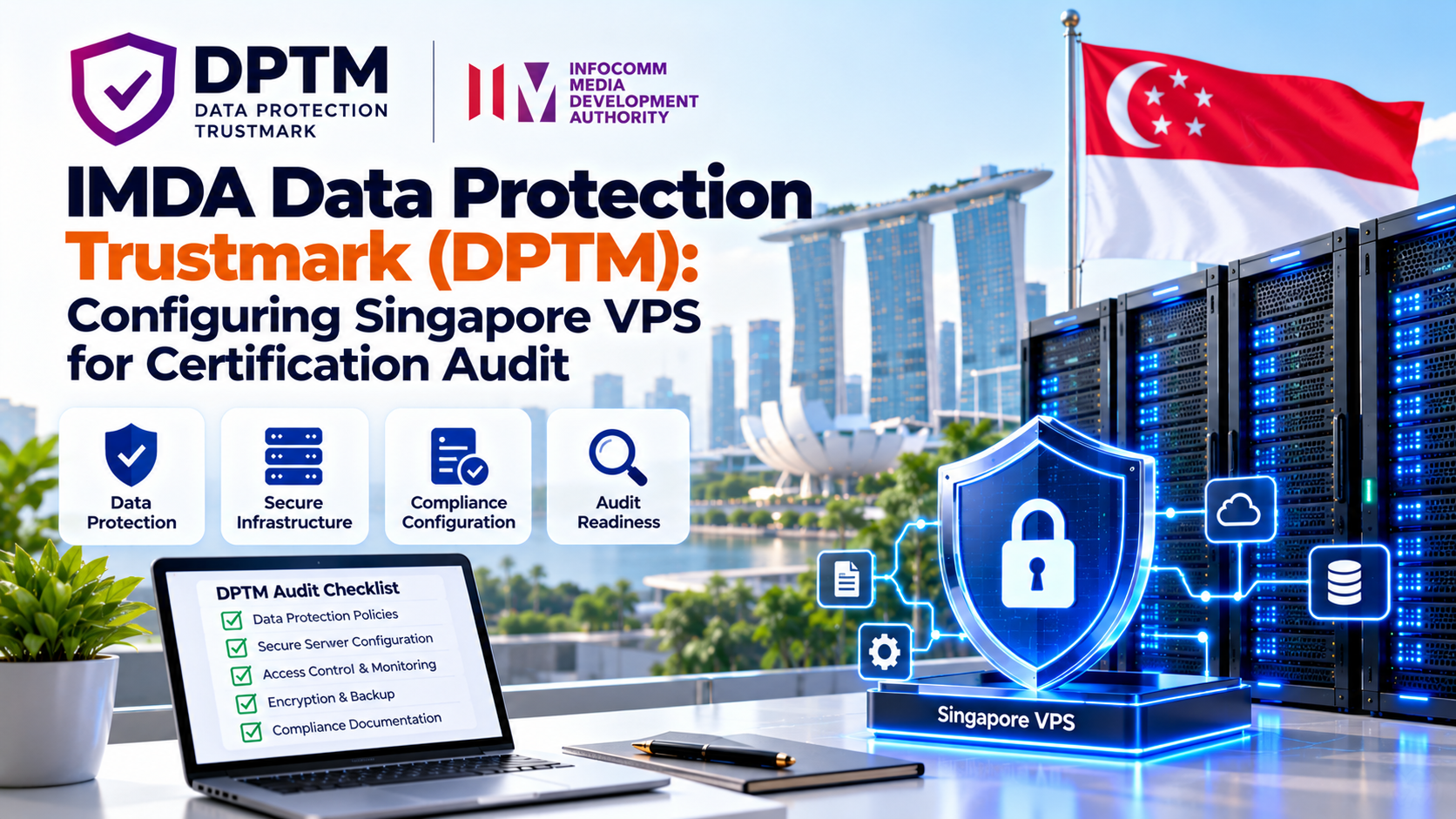
Direct Technical Answer
IMDA DPTM Singapore VPS Architecture
Quick Answer: Configuring Singapore VPS for IMDA DPTM Certification Audit
When architecting a IMDA DPTM Singapore VPS solution, configuring a Singapore VPS for IMDA Data Protection Trustmark (DPTM) certification requires implementing enterprise data governance across storage, networking, and identity access layers. Technical prerequisites include LUKS or ZFS AES-256 at-rest volume encryption, automated role-based access control (RBAC), multi-factor authentication (MFA) on all administrative SSH and bastion endpoints, automated vulnerability patch management, continuous intrusion detection monitoring, and immutable offsite snapshot retention to fulfill rigorous IMDA accredited third-party assessment criteria.
In an era of escalating cybersecurity threats and stringent consumer privacy expectations, establishing transparent data governance has become a decisive competitive advantage in Singapore across your IMDA DPTM Singapore VPS environment. To establish an objective benchmark of organizational data excellence, the Infocomm Media Development Authority (IMDA) and the Personal Data Protection Commission (PDPC) launched the Data Protection Trustmark (DPTM) certification. As Singapore’s premier institutional accreditation for data governance, the DPTM demonstrates to consumers, regulators, and enterprise clients that an organization possesses robust, third-party-audited systems to safeguard personal data.
Specifically, achieving DPTM certification is an exhaustive process across your IMDA DPTM Singapore VPS environment. Furthermore, independent assessment bodies—including BSI Group, TÜV SÜD, and ISOCert—conduct rigorous on-site and technical audits evaluating not only corporate legal policies, but also the underlying technical computing infrastructure where personal data resides. In addition, hosting infrastructure that exhibits loose access permissions, unencrypted storage volumes, unmonitored log rotations, or multi-tenant virtualization vulnerabilities will result in immediate non-conformity findings during the certification audit.
Architecting your digital workloads on a dedicated DPTM-ready Singapore VPS hosting platform provides the hardware isolation, sovereign local hosting, cryptographic storage safeguards, and automated audit tooling necessary to sail through the IMDA certification audit.
📌 Table of Contents
- 1. The Four Core Pillars of the IMDA DPTM Assessment Framework
- 2. Technical Comparison: DPTM-Ready Singapore VPS vs Generic Cloud VPS
- 3. Technical Controls for the Care of Personal Data Under Principle 3
- 4. APEC Cross-Border Privacy Rules and Privacy Recognition for Processors Interoperability
- 5. Third-Party Vendor Risk Audits and Cloud Infrastructure Supply Chain Safeguards
- 6. Linux System Hardening, AIDE Integrity Monitoring, and Log Retention Scripts
- 7. Frequently Asked Questions (FAQ)
The Four Core Pillars of the IMDA DPTM Assessment Framework
Furthermore, the IMDA DPTM certification framework is structured around four foundational principles that encompass the entire lifecycle of personal data management:
In addition, Principle 1: Governance and Transparency: Evaluates organizational leadership, the formal appointment of Data Protection Officers (DPOs), and the clarity of external privacy notices. Consequently, from a technical perspective, auditors examine whether technical system administrators receive formal access governance guidelines and whether user consent states are accurately tracked across backend databases.
Consequently, Principle 2: Management of Personal Data: Covers the lawful collection, processing, and retention limitation of consumer records. Therefore, systems must enforce automated data purge cycles, ensuring that obsolete customer records, expired session tokens, and inactive accounts are completely wiped according to published retention schedules.
Therefore, Principle 3: Care of Personal Data: Represents the primary technical hurdle in the audit. Auditors evaluate information security arrangements, encryption of data at rest and in transit, vulnerability management programs, backup isolation, disaster recovery resilience, and incident response runbooks.
Notably, Principle 4: Individuals’ Rights: Mandates reliable technical mechanisms allowing consumers to withdraw consent, access their historical data profiles, and request data corrections or account deletions within statutory timelines without technical friction.
Technical Comparison: DPTM-Ready Singapore VPS vs Generic Cloud VPS
Passing a DPTM certification audit requires technical infrastructure engineered to eliminate security gaps across every architectural layer:
| Audit Criterion | DPTM-Ready Singapore VPS | Standard Commodity Cloud | DPTM Certification Impact |
|---|---|---|---|
| Data Residency Assurance | 100% Onshore Singapore (Equinix SG1/SG3) | Unpredictable multi-region replication | Fulfills Principle 2 Data Transfer obligations without legal caveats |
| Filesystem Integrity Auditing | Daily automated AIDE cryptographic hashing | No baseline integrity monitoring | Proves detection of unauthorized root tampering during audits |
| Data at Rest Encryption | LUKS2 AES-256 with Argon2id Key Derivation | Unencrypted underlying hypervisor disks | Essential for satisfying Principle 3 Care of Personal Data |
| Audit Log Retention | Immutable auditd streams with SHA-256 hash checks | Standard circular logs (frequent overwrite) | Demonstrates forensic timeline capability for incident response |
| Disaster Recovery Verification | Automated cross-facility replica snapshots | Manual, untested cold backup archives | Verifies business continuity and minimal data loss (RPO ≤ 15 min) |
| Vulnerability Scanning | Automated weekly Trivy and OpenVAS scanning | Ad-hoc or absent vulnerability audits | Mandatory evidence submitted during DPTM documentary evaluation |
Technical Controls for the Care of Personal Data Under Principle 3
Organizations pursuing third-party privacy validation can examine the cross-border CBPR and ASEAN contractual clauses to prepare cloud infrastructure for assessment.
In contrast, principle 3 of the DPTM framework scrutinizes the practical security controls deployed to shield personal data against breach, exfiltration, or tampering. Independent assessment bodies conduct technical inspections across four distinct domains:
Additionally, 1. Network Segmentation & Perimeter Defense: Web servers facing the public internet must be isolated from backend database clusters hosting personal consumer records. Utilizing private internal networks (VLANs or WireGuard mesh tunnels) guarantees that database listening sockets (5432 or 3306) never bind to public IP interfaces.
For example, 2. Cryptographic Storage & Data Sanitization: Storage volumes containing customer information must utilize LUKS2 full-volume encryption. When test data or expired storage partitions are decommissioned, organizations must execute cryptographically certified erasure scripts complying with NIST SP 800-88 standards, generating auditable sanitization logs.
To illustrate, 3. Filesystem Integrity Monitoring (FIM): Assessment bodies require proof that unauthorized modifications to critical system binaries, web application code, and security configurations are detected immediately. Deploying Advanced Intrusion Detection Environment (AIDE) establishes a cryptographic database of SHA-256 file hashes, triggering automated security alerts if any unauthorized alteration occurs.
APEC Cross-Border Privacy Rules and Privacy Recognition for Processors Interoperability
In particular, a decisive strategic advantage of securing the IMDA DPTM is its direct interoperability with regional data protection frameworks. Under mutual recognition agreements, organizations certified under the DPTM can apply for fast-track certification under the APEC Cross-Border Privacy Rules (CBPR) system and the Privacy Recognition for Processors (PRP) system.
As a result, for multinational enterprises and cross-border digital platforms operating from Singapore, CBPR certification allows personal data to move seamlessly between participating APEC economies—including Japan, the United States, Australia, South Korea, and Canada—without requiring separate bespoke cross-border data transfer agreements. By deploying on a DPTM-ready Singapore VPS that already adheres to CBPR technical baselines, engineering teams eliminate jurisdictional friction and satisfy international institutional compliance mandates.
Third-Party Vendor Risk Audits and Cloud Infrastructure Supply Chain Safeguards
During the DPTM documentary evaluation stage, assessment bodies closely inspect an organization’s third-party cloud hosting vendors. Under Principle 3, applicants must prove that any outsourced data intermediary or infrastructure provider enforces data security measures equivalent to those of the certified organization.
Moreover, deploying on generic, uncertified budget servers exposes applicants to severe audit delays because unvetted hosting providers cannot provide compliant Data Processing Agreements (DPAs) or facility security attestations. Onlive Server solves this audit bottleneck by providing enterprise clients with verified compliance artifacts—including certified ISO/IEC 27001 certificates, SOC 2 Type II audit attestations, SS 564 green facility ratings, and binding DPAs guaranteeing 100% onshore Singapore data residency. Submitting these pre-validated vendor credentials directly resolves auditor inquiries, accelerating time-to-certification.
Enterprise legal teams preparing for DPTM auditing should review our baseline PDPA data sovereignty compliance frameworks to accelerate formal certification readiness.
Linux System Hardening, AIDE Integrity Monitoring, and Log Retention Scripts
In fact, system administrators can deploy automated filesystem integrity auditing and cryptographic log management on their Singapore VPS using standard Linux utilities:
Linux Shell Hardening
# 1. Install Advanced Intrusion Detection Environment (AIDE)
apt-get update && apt-get install -y aide aide-common

# 2. Configure AIDE watch rules for web applications and personal data directories
cat << 'EOF' >> /etc/aide/aide.conf
# Define custom monitoring macro for personal data folders
DataStore = p+i+n+u+g+s+b+m+c+md5+sha256

# Monitor web roots and database tablespaces
/var/www/html DataStore
/var/lib/postgresql/data DataStore
/etc/ssl/private DataStore
/etc/ssh/sshd_config DataStore
EOF

# 3. Initialize baseline cryptographic database
aideinit
mv /var/lib/aide/aide.db.new /var/lib/aide/aide.db

# 4. Schedule daily automated integrity check cron job
cat << 'EOF' > /etc/cron.daily/aide-dptm-audit
#!/bin/bash
aide --check > /var/log/aide/daily_report.log 2>&1
if [ $? -ne 0 ]; then
  # Alert DPO and security operations center immediately of integrity drift
  cat /var/log/aide/daily_report.log | mail -s "DPTM ALERT: Filesystem Integrity Drift Detected" [email protected]
fi
EOF
chmod +x /etc/cron.daily/aide-dptm-audit

# 5. Enforce 365-day immutable audit log rotation in /etc/logrotate.d/dptm-audit
cat << 'EOF' > /etc/logrotate.d/dptm-audit
/var/log/audit/audit.log {
    daily
    rotate 365
    compress
    delaycompress
    missingok
    notifempty
    create 0600 root root
    postrotate
        # Cryptographically sign rotated log file for evidentiary tamper-proofing
        sha256sum /var/log/audit/audit.log.1.gz > /var/log/audit/audit.log.1.gz.sha256
    endscript
}
EOF
Similarly, this automated hardening configuration generates the evidentiary documentation required by DPTM assessment bodies. During the audit interview, presenting cryptographic SHA-256 checksum histories and daily AIDE integrity verification reports conclusively demonstrates that your hosting environment enforces proactive, tamper-proof information security controls.