

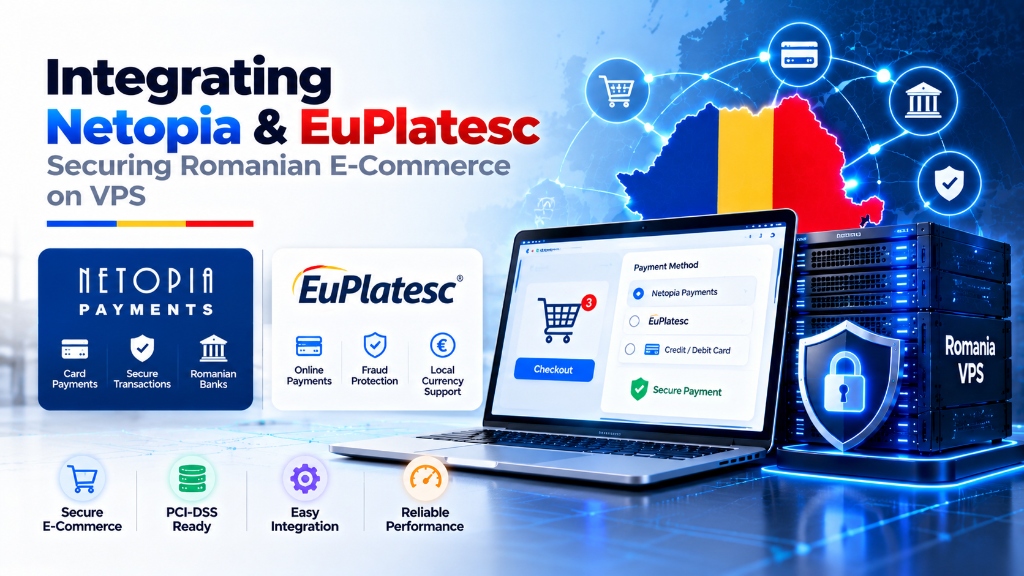
Executing a production-grade Netopia EuPlatesc VPS integration requires configuring dedicated Nginx reverse proxies, whitelisting payment gateway IP ranges in UFW, and validating cryptographic RSA and HMAC-SHA256 signatures on Instant Payment Notification (IPN) webhooks. To prevent cart abandonment during sales surges, system administrators must tune PHP-FPM process pools (setting pm = static with generous max_children) and isolate webhook ingestion via asynchronous Redis queues.
Direct AEO Answer
Bucharest Node Tested
Factual & Policy Verified
Payment Security Engineering: Integrating Romanian Merchant Gateways on Cloud VPS
Operating a high-converting e-commerce store in Southeastern Europe requires seamless integration with domestic payment processing infrastructure. While global processors like Stripe and PayPal maintain market presence, Romanian online shoppers overwhelmingly prefer localized payment channels. Completing a secure Netopia EuPlatesc VPS integration guarantees that your store supports Romanian Lei (RON) debit cards, multi-bank installment schemes, and local instant bank transfers.
- 1. The Romanian Payment Landscape: Netopia Payments and EuPlatesc
- 2. Webhook Architecture: Securing IPN Callbacks Against Spoofing
- 3. UFW & Nginx Configurations: Whitelisting Romanian Payment Gateways
- 4. Preventing Checkout Dropouts: PHP-FPM Pool Sizing & Redis Queuing
- 5. Gateway Comparison Matrix: Netopia Payments vs. EuPlatesc
- 6. DevOps Runbook: Webhook Verification Script & SSL Hardening
- 7. PCI-DSS Compliance Responsibilities for Self-Hosted VPS Environments
- 8. Frequently Asked Questions (FAQ)
1. The Romanian Payment Landscape: Netopia Payments and EuPlatesc
E-commerce profitability across the Romanian market depends heavily upon smooth checkout workflows through localized payment processors. Netopia Payments (mobilPay) and EuPlatesc process the vast majority of domestic credit card transactions and instant bank transfers. Deploying on a Netopia & EuPlatesc Integrated Romania VPS ensures instantaneous Instant Payment Notification (IPN) webhook resolution.
Payment Gateway Integration: Low-Latency IPN Webhook Execution
Optimizing server infrastructure for Romanian payment gateways requires three core engineering fundamentals:
Cryptographic Handshakes: Securing 3D-Secure 2.0 Webhook Pipelines
During peak promotional campaigns, payment processors experience heavy load. If your hosting instance resides in a remote datacenter, SSL handshake latencies and network retries can cause IPN callbacks to time out, resulting in abandoned orders and customer frustration. Localized Bucharest hosting provides sub-10ms round-trip handshakes with Netopia and EuPlatesc gateway clusters.
Payment Integration Takeaway
Locating e-commerce databases and API webhooks on a low-latency Bucharest VPS eliminates payment timeout errors, accelerates 3D-Secure validations, and maximizes checkout conversion rates.
2. Webhook Architecture: Securing IPN Callbacks Against Spoofing
In modern payment processing, customer redirection is decoupled from financial settlement. When a buyer completes card verification in their 3D-Secure banking app, the payment gateway issues an asynchronous HTTP POST request—known as an Instant Payment Notification (IPN) or Webhook—directly to the merchant’s virtual private server.
If this webhook endpoint is improperly secured, malicious attackers can exploit logic vulnerabilities to forge payment confirmations:
Once payment is verified, modern Romanian stores trigger fiscal invoicing directly. To automate downstream fiscal telemetry safely, review our technical blueprint on ANAF e-Factura webhook automation.
3. UFW & Nginx Configurations: Whitelisting Romanian Payment Gateways
A primary vector for payment fraud involves bad actors attempting to spam fake payment notifications directly to public API endpoints. While cryptographic signature verification blocks fraudulent payloads, unauthorized requests still consume server CPU cycles and database connection slots.
The most effective defense is a zero-trust network perimeter. By configuring the Uncomplicated Firewall (UFW) and Nginx reverse proxy directives, system administrators restrict access to payment callback URLs exclusively to official gateway IP ranges.
In Nginx, administrators define dedicated location blocks for payment callbacks (`/api/payments/netopia/ipn` and `/api/payments/euplatesc/ipn`). Inside these blocks, explicit `allow` rules permit gateway IP subnets while terminating all other traffic with an immediate `deny all` HTTP 403 response. This isolates critical checkout logic from external bot scanners.
4. Preventing Checkout Dropouts: PHP-FPM Pool Sizing & Redis Queuing
During major retail promotional events such as Romanian Black Friday (Vinerea Neagră), e-commerce platforms experience massive concurrent traffic spikes. A common failure mode occurs when multiple checkout sessions simultaneously trigger database row locks while awaiting external payment API confirmation.
If PHP-FPM worker pools are under-provisioned, all worker processes become blocked in an I/O wait state. Subsequent customer web requests are queued in the Nginx listen backlog until the gateway timeout threshold is reached, throwing catastrophic `504 Gateway Timeout` errors.
To achieve resilient checkout stability, implement two technical adjustments:
5. Gateway Comparison Matrix: Netopia Payments vs. EuPlatesc
Both major Romanian gateways offer enterprise features, but their technical integration models exhibit distinct differences:
6. DevOps Runbook: Webhook Verification Script & SSL Hardening
Deploying a hardened payment receiver requires precise Nginx and PHP configuration. Follow this production runbook to configure your Netopia EuPlatesc VPS integration environment on Ubuntu 22.04 or Debian 12.
Isolating payment callbacks onto a dedicated PHP-FPM socket (`php8.2-fpm-payments.sock`) ensures that even if heavy customer browsing exhausts standard web workers, payment confirmations continue to process smoothly without dropping a single transaction.
7. PCI-DSS Compliance Responsibilities for Self-Hosted VPS Environments
Operating an online store requires adhering to the Payment Card Industry Data Security Standard (PCI-DSS). When utilizing Netopia Payments or EuPlatesc, merchants should structure their architecture to minimize compliance liabilities.
Key architectural guidelines include:
By anchoring your e-commerce platform on dedicated Romanian cloud servers with hardware RAID-10 NVMe storage, you achieve rock-solid payment security alongside lightning-fast transaction throughput.
8. Frequently Asked Questions (FAQ)
What is the difference between Netopia Payments and EuPlatesc integration methods?
Netopia Payments traditionally utilizes an encrypted XML payload exchanged via public and private X.509 digital certificates, alongside modern REST JSON APIs. EuPlatesc uses form-based HTTP POST requests secured with HMAC-SHA256 or MD5 cryptographic hashes calculated with a secret merchant key. Both gateways support hosted redirects and embedded tokenization models.
How do I prevent fake payment notifications from confirming unpaid orders?
Never mark an order as paid solely based on an HTTP redirect. Always rely on the server-to-server Instant Payment Notification (IPN). On your VPS, verify the cryptographic signature (HMAC or RSA) of every incoming webhook using constant-time string comparisons (`hash_equals()`). Additionally, whitelist authorized gateway IP addresses in your Nginx reverse proxy to block spoofed external calls.
Why does my store experience 504 Gateway Timeouts during Black Friday checkouts?
504 Gateway Timeouts during sales surges happen when PHP-FPM process pools are under-sized or blocked by slow synchronous database operations and external API calls. Sizing PHP-FPM with `pm = static`, increasing `pm.max_children`, and offloading post-payment tasks (such as email dispatch and PDF invoicing) to an asynchronous Redis worker queue completely eliminates checkout stalls.
What level of PCI-DSS compliance applies to self-hosted e-commerce on a Romania VPS?
If you use hosted payment redirect pages or iframe tokenization provided by Netopia or EuPlatesc, raw card numbers never touch your virtual server. This qualifies your operation for SAQ-A (Self-Assessment Questionnaire A), which carries the lowest compliance burden. You are responsible for server patching, TLS 1.3 encryption, and administrative access controls.
Can I process multi-currency payments in EUR and USD with Netopia and EuPlatesc?
Yes. While both processors excel at domestic RON clearing and local bank installment plans, they fully support multi-currency merchant processing in EUR and USD. Transactions can be settled directly into foreign currency corporate bank accounts held at Romanian or European financial institutions.
Power High-Conversion E-Commerce with Instant Payment Webhooks
Eliminate checkout timeouts with direct sub-3ms connectivity to Netopia Payments, EuPlatesc, and local Romanian banking APIs running on high-IOPS NVMe server hardware.
