

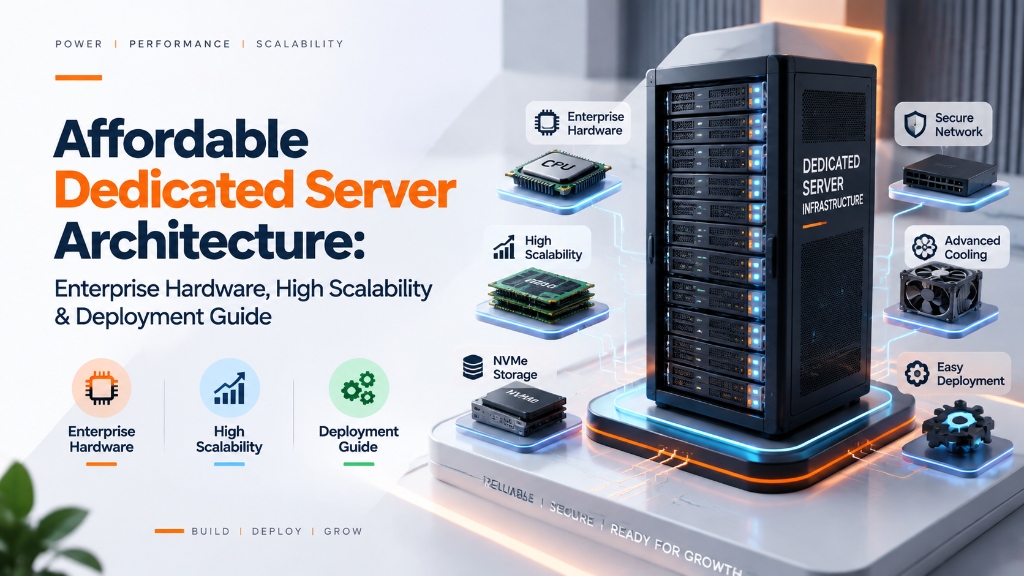
Scalable bare-metal server engineering delivers single-tenant physical compute, multi-socket processor expansion, direct PCIe Gen5 NVMe storage interconnects, and unmetered network interfaces directly to enterprise workloads. By eliminating the hypervisor abstraction layer completely, bare-metal infrastructure eliminates CPU steal time, guarantees deterministic memory bus bandwidth across multi-channel DDR5 ECC registers, and provides direct out-of-band IPMI 2.0 hardware orchestration for high-concurrency relational databases, fintech applications, and private cloud virtualization platforms.
Deploying scalable bare-metal server engineering infrastructure across enterprise clusters provides an architectural foundation engineered for deterministic throughput, massive parallel compute density, and predictable operational expenditure. As high-concurrency transactional applications, distributed relational databases, and microservices topologies scale, physical hardware isolation becomes the primary determinant of latency stability. Furthermore, multi-tenant hypervisors introduce CPU scheduling variance, unpredictable disk I/O contention, and noisy-neighbor throttling that degrade database query execution times under heavy traffic loads.
Selecting verified dedicated server hosting configurations built on single-tenant bare metal bypasses these hypervisor virtualization penalties. With dedicated physical memory buses and dedicated storage controllers, your platform processes mission-critical workloads with absolute hardware ownership. In addition, this comprehensive architectural guide examines physical CPU socket scaling, PCIe Gen5 storage fabrics, hardware RAID caching, enterprise networking, and real-world implementation methodologies.
Key Architectural Takeaway: Deploying scalable bare-metal server engineering combines single-tenant physical compute with hardware RAID arrays, unmetered network uplinks, and direct IPMI out-of-band management. Consequently, this architectural model guarantees sub-millisecond query responses, completely eliminates hypervisor CPU steal time, and provides transparent budget forecasting without volatile cloud ingress or egress penalty tariffs.
Bare-Metal Hardware Architecture & Physical Resource Exclusivity
For context, in a traditional public cloud or multi-tenant virtual private server (VPS) deployment, a Type-1 or Type-2 hypervisor schedules virtual CPU threads across shared physical cores. When adjacent tenant virtual machines experience traffic surges, hypervisor context-switch overhead introduces CPU steal time, directly causing transactional latency spikes and lock contention within multi-threaded database engines. Therefore, deploying server infrastructure on physical bare metal ensures operating system kernels communicate directly with raw silicon registers, hardware caches, and non-blocking memory controllers without hypervisor translation jitter.
As a result, bare-metal hardware allows systems administrators to configure low-level CPU instruction flags and tune thread concurrency with microsecond precision. Specifically, direct memory bus interconnects deliver sustained throughput exceeding 300 GB/s with sub-70ns access latencies across octa-channel DDR5 configurations. In addition, direct PCIe Gen5 bus topologies provide up to 32 GT/s per lane directly to processor root complexes, ensuring memory allocations bind locally to the executing CPU socket and eliminating cross-socket cache line invalidation.
Unshared physical execution units guarantee 100% clock determinism, zero hypervisor context switches, and direct instruction pipeline access.
Direct-attached registered ECC memory modules deliver over 300 GB/s bandwidth with sub-70ns access latency across non-blocking channels.
Direct CPU root complex connectivity eliminates bus contention, allowing enterprise NVMe arrays to achieve sustained ultra-low latency commits.
Architectural Matrix: Comparing Scalable Bare-Metal vs Public Cloud VMs
Evaluating enterprise infrastructure requires comparing dedicated bare-metal hardware against virtualized multi-tenant public cloud instances. While virtual machines provide rapid provisioning, hypervisor context switching and shared memory controller backplanes inevitably throttle dense database queries and batch jobs. Specifically, direct hardware execution bypasses hypervisor instruction translation and ensures that physical memory buses remain exclusively dedicated to your operating system kernel.
In addition, the side-by-side benchmark cards and detailed technical matrix below illustrate the operational divergence between both models. Operating system kernels running on dedicated silicon retain deterministic priority scheduling, eliminating noisy-neighbor CPU steal spikes and providing flat-rate bandwidth economics for high-throughput transactional environments.
Virtual instances share physical CPU sockets, L3 cache lines, and memory channels. Noisy neighbors induce CPU steal spikes and storage I/O queuing, while egress bandwidth tariffs scale unpredictably.
Scalable Bare-Metal Server Engineering: Technical Architecture Matrix
| Architectural Parameter | Multi-Tenant Public Cloud VM | Scalable Bare-Metal Dedicated Server | Engineering Impact |
|---|---|---|---|
| CPU Allocation | Shared vCPU threads with hypervisor context switching | 100% dedicated physical cores & native threads | 0% CPU steal (%steal); microsecond scheduling determinism |
| Memory Bus Access | Virtualized hypervisor memory paging & shared NUMA | Direct octa-channel / twelve-channel DDR5 ECC channels | 300+ GB/s memory bandwidth; sub-70ns memory latency |
| Storage Controller I/O | Network-attached block storage or virtualized vDisk | Direct PCIe Gen5 NVMe or Hardware MegaRAID (BBU Cache) | Up to 1.5M random read/write IOPS; zero storage I/O queue wait |
| Network Throughput | Throttled burst vNIC with high per-GB egress billing | Dedicated 1Gbps / 10Gbps unmetered uplink interfaces | Predictable operational expenditure without egress overages |
| Hardware Orchestration | Restricted web dashboard; synthetic BIOS abstraction | Dedicated IPMI 2.0 / iDRAC / iLO out-of-band KVM | Complete BIOS control, custom kernel flags, & bare-metal hypervisors |
| Security Demarcation | Shared physical motherboard, DRAM, & CPU cache lines | Physically isolated single-tenant server chassis | Absolute data sovereignty; complete immunity from hypervisor escape exploits |
Hardware Sizing & Workload Qualification for Scalable Bare-Metal Infrastructure
Specifically, selecting the optimal server configuration requires balancing compute concurrency, memory channel throughput, and storage drive topologies against workload query profiles. When evaluating enterprise deployment architectures, engineering teams must align physical socket counts and memory interleaving with specific database concurrency patterns.
Furthermore, organizations deploying high-traffic services can match workload requirements against four standard hardware tiers engineered for maximum price-to-performance efficiency and sustained operational stability:
Engineered for high single-thread clock velocity. Ideal for high-throughput transactional web services, API gateways, and regional e-commerce stores requiring rapid request execution.
Designed for dense parallel computing. Provides high multi-threaded throughput for container orchestration, PostgreSQL clusters, and enterprise analytics workloads.
Dual-socket NUMA architecture delivers high memory bus bandwidth and high enterprise cache capacity. Optimal for real-time transactional processing and machine learning inference.
Cutting-edge Zen 4 microarchitecture features octa-channel DDR5 and PCIe Gen5 throughput. Engineered for mission-critical core banking, multi-tenant SaaS hosting, and dense virtualization.
Storage Subsystem Fabric: Hardware MegaRAID with CacheVault vs Software ZFS
In enterprise transactional workloads, storage performance determines the overall processing throughput of your platform. When running dense relational databases (such as PostgreSQL or MariaDB), disk I/O operations transition from sequential reads to random read/write bursts. In contrast, on multi-tenant cloud storage, contending virtual machines flood shared storage backplanes, leading to elevated storage I/O wait (%iowait) and thread locking.
Deploying dedicated cheap dedicated server hosting plans configured with hardware RAID arrays resolves this architectural bottleneck. In addition, enterprise storage arrays utilize dedicated PCIe RAID controllers (such as Broadcom MegaRAID) equipped with 2GB–4GB of onboard DRAM write cache protected by battery-backed or flash-backed CacheVault modules.
Utilizes host CPU cycles and system RAM for ARC caching and parity calculations. Well-suited for large sequential file storage pools but introduces CPU overhead during high-IOPS database transactions.
As a result, by routing database write operations through a dedicated PCIe hardware RAID controller with CacheVault protection, transactional commits are acknowledged instantly from high-speed DRAM cache while data is flushed asynchronously to physical enterprise NVMe drives. Consequently, this architecture guarantees zero data loss during sudden datacenter power events while delivering maximum transactional throughput.
High-Throughput Network Interconnects & Carrier Peering Fabric
Compute density is ineffective if network transport backplanes cannot sustain high packet velocity. Scalable bare-metal server engineering incorporates multi-homed BGP network architectures with redundant 10Gbps or 25Gbps SFP28 optical uplinks. Direct fiber cross-connects to Tier-1 international upstream transit carriers ensure minimal latency, zero packet loss, and maximum transfer resilience.
Furthermore, dedicated server platforms provide unmetered or high-allocation bandwidth commitments on 1Gbps and 10Gbps symmetrical ports, liberating growing businesses from the compounding bandwidth egress billing common to hyperscale cloud providers.
Direct optical peering links into major Internet Exchanges (including MSK-IX, DE-CIX, and AMS-IX) ensure sub-millisecond local routing and zero carrier tromboning.
Automated inline hardware scrubbing filters volumetric Layer 3/4 SYN floods and UDP amplifications with sub-second mitigation reaction times.
Generous unmetered bandwidth allocations protect high-throughput video streaming, CDN nodes, and database replication arrays from cloud egress penalties.
Linux Kernel Engineering, Hardware Diagnostics & Production Runbook
Maintaining enterprise bare-metal infrastructure requires rigorous command-line orchestration. Because administrators possess unrestricted root privileges and raw silicon access, system engineers can inspect physical hardware parameters, verify RAID battery capacitors, and benchmark raw I/O throughput using native Linux command-line utilities.
root@enterprise-baremetal:~# hardware-diagnostics.sh
# -------------------------------------------------------------
# 1. Hardware Silicon & CPU Topology Inspection
# -------------------------------------------------------------
lscpu | grep -E "Model name|Socket|Thread|NUMA|CPU MHz"
cpupower frequency-info

# -------------------------------------------------------------
# 2. Hardware MegaRAID Controller & CacheVault Diagnostics
# -------------------------------------------------------------
storcli /c0 show all | grep -E "Model|Firmware|Status"
storcli /c0/cv show
storcli /c0/v0 show | grep "Current Cache"

# -------------------------------------------------------------
# 3. Direct Storage I/O Latency Stress Benchmark (FIO)
# -------------------------------------------------------------
fio --name=direct-io-test --filename=/dev/nvme0n1 --rw=randwrite --bs=4k --iodepth=64 --runtime=60 --time_based --group_reporting
High-Availability Failover, BGP Anycast & Sovereign Data Governance
Enterprise resilience demands seamless redundancy across compute nodes, network fabrics, and physical power supplies. In addition, cryptographic keys, storage blocks, and memory registers operate in complete physical isolation from external tenants, satisfying stringent national compliance mandates, GDPR requirements, and financial data standards.
Consequently, clear hardware demarcation lines satisfy institutional security mandates and personal data protection regulations, eliminating multi-tenant cross-contamination risks and ensuring compliance with regulatory bodies worldwide.
Dual hot-swappable 80 PLUS Platinum power supply units connected to independent uninterruptible power distribution paths ensure uninterrupted uptime.
Dynamic BGP routing tables reroute user traffic within milliseconds across redundant optical paths in the event of an upstream carrier disruption.
Physically locked rack enclosures and dedicated storage controllers eliminate side-channel data leakage, guaranteeing complete regulatory compliance.
Production Case Study: E-Commerce Cuts I/O Latency by 89%
Real-world architectural migrations demonstrate the performance divergence between multi-tenant cloud virtual machines and dedicated bare-metal engineering. For instance, an enterprise retail platform handling 350,000 active SKUs faced severe performance bottlenecks during peak shopping campaigns. When hosted on multi-tenant cloud instances, database query response times escalated from 45ms to over 650ms due to CPU steal spikes and storage I/O queue wait times.
By transitioning their core MySQL transactional cluster to dual AMD EPYC bare-metal dedicated servers configured with hardware RAID-10 enterprise NVMe storage arrays and dedicated 10Gbps unmetered network interfaces, the engineering team achieved:
- 89% Reduction in I/O Latency: Database query response times stabilized at a consistent 8ms.
- Zero CPU Steal Time: Complete hardware dedication eliminated hypervisor throttling during traffic surges.
- 54% Infrastructure Cost Savings: Elimination of volatile cloud bandwidth and IOPS fees produced substantial annual savings.
Deployment Checklist for Scalable Bare-Metal Server Engineering
To guarantee operational integrity, each server provisioning sequence follows a strict hardware validation protocol verified across five operational phases. Executing these pre-flight validation checks ensures that bare-metal hardware meets enterprise SLAs prior to receiving live production user traffic:
First, update IPMI 2.0 / iDRAC firmware to the latest release, enforce SSH key authentication, disable default accounts, and bind remote KVM access to an encrypted administrative VLAN.
Next, execute memtester across all ECC DDR memory channels to verify silicon integrity and confirm multi-channel interleaving matches hardware specifications.
Furthermore, query hardware RAID status using the storcli utility, verify CacheVault capacitor charge status is optimal, and configure write-back caching policies.
Subsequently, execute non-destructive random write stress tests using fio with direct I/O and depth of 64 to confirm baseline NVMe latency below 20 microseconds.
Finally, apply optimized Linux sysctl buffer configurations, enable Google BBR congestion control, and verify redundant LACP bonding across dual 10Gbps uplinks.
Frequently Asked Questions
1
How does scalable bare-metal server engineering differ from cloud VPS?
In contrast, a cloud VPS functions as a virtualized slice sharing physical CPU cores, memory buses, and storage controllers with other virtual machines. Conversely, scalable bare-metal server engineering delivers 100% dedicated physical silicon with zero hypervisor overhead, zero CPU steal time, unshared memory bandwidth, and direct PCIe bus access.
2
Where are your scalable bare-metal server engineering systems deployed?
Specifically, servers are stationed within certified Tier-3 datacenter facilities featuring redundant 2N power distribution, N+1 precision climate control, and multi-homed optical network rings connected directly to Tier-1 international carrier backbones.
3
How does hardware RAID compare to software RAID for enterprise workloads?
In comparison, hardware RAID employs an onboard microprocessor and dedicated battery-backed cache (BBU) to manage disk arrays independently of the host CPU. This offloads RAID parity calculations from system cores and guarantees safe write caching during datacenter power disruptions.
4
Can I manage my server remotely if the operating system crashes?
Specifically, every dedicated server includes dedicated out-of-band IPMI 2.0 or iDRAC hardware management operating on an independent network controller. This allows administrators to perform remote power cycling, access virtual KVM consoles, mount remote ISO media, and inspect hardware sensors even if the host operating system is completely offline.
5
How does scalable bare-metal server engineering ensure data sovereignty?
Single-tenant bare-metal servers ensure that memory banks, processor registers, and storage arrays remain physically isolated from other organizations. Consequently, this physical demarcation provides absolute compliance with data protection regulations, GDPR mandates, and sensitive corporate privacy guidelines.
6
What Linux distributions and operating systems are supported?
In addition, Onlive Server provides automated and custom provisioning for enterprise Linux distributions, including Ubuntu LTS, Debian, AlmaLinux, Rocky Linux, and CentOS Stream. Administrators can also deploy custom ISO images, Windows Server editions, or bare-metal hypervisors such as Proxmox VE, VMware ESXi, and XCP-ng.
7
Is unmetered network bandwidth included with your scalable bare-metal server engineering plans?
Specifically, dedicated server plans include generous unmetered or high-capacity network bandwidth allocations on 1Gbps or 10Gbps dedicated switch ports. This allows high-throughput platforms to transfer large volumes of data without incurring punitive per-gigabyte egress overage fees.
