

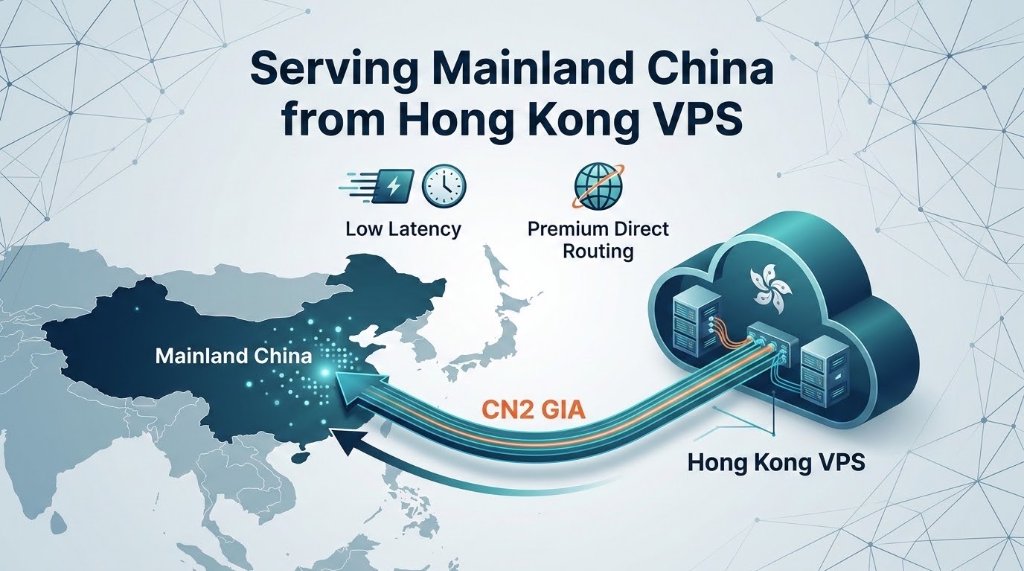
This executive technical checklist defines the performance, transit routing, and statutory benchmarks required for deploying mission-critical Hong Kong VPS infrastructure targeting Mainland China users without domestic ICP licensing obligations:
Serving users across Mainland China reliably from a Hong Kong VPS CN2 GIA node bypasses congested public 163 corridors through China Telecom AS4809, China Unicom AS9929, and China Mobile CMIN2 routes. This cross-border architecture maintains sub-25ms round-trip latency to Shanghai and sub-35ms to Beijing during peak evening hours while operating fully outside Mainland ICP licensing obligations.
Expanding digital services into the Chinese market presents one of the most demanding engineering and regulatory challenges in global cloud infrastructure. Hosting directly within Mainland China requires obtaining a commercial Internet Content Provider (ICP) license issued by the Ministry of Industry and Information Technology (MIIT), a process that mandates establishing a registered Chinese legal entity, onshore corporate bank accounts, and complete submission to strict domestic data localization regulations.
Zero ICP Filing Mandate
Deploy and launch production web applications targeting Mainland China immediately without onshore entity registration or MIIT ICP commercial licenses.
China Telecom CN2 GIA (AS4809)
Premium VIP transit with dedicated optical international bandwidth delivering sub-25ms ping to Shanghai and zero peak-hour packet dropping.
Bidirectional Route Pinning
Enforce strict route symmetry where both inbound requests and outbound server responses traverse high-priority AS4809 and CU10099 backbones.
Great Firewall Ingress Bottlenecks
Every network packet traversing the physical border between Hong Kong and Mainland China must pass through international border gateway exchange points located in Shenzhen, Guangzhou, Shanghai, and Beijing. These ingress gateways house the deep packet inspection (DPI) hardware clusters collectively known as the Great Firewall of China. During peak commercial and residential internet usage hours, the aggregate volume of public data traffic overwhelmingly saturates these state gateway interfaces, causing severe queue backlog. Production workloads benefit directly from high-speed Hong Kong VPS cloud nodes engineered for high concurrency.
SPECS Architectural Building Blocks
DPI Inspection Latency
State-level deep packet inspection introduces latency overheads that compound exponentially when packets traverse congested public exchange queues.
Public 163 Congestion
China Telecom AS4134 carries over 85% of standard Chinese consumer web traffic, leading to catastrophic packet dropping during peak Asian evenings.
VIP Gateway Bypass
Dedicated CN2 GIA and CU10099 lines utilize segregated physical optical conduits that circumvent public commercial queuing bottlenecks completely.
When hosting on commodity VPS providers that utilize standard public transit lines (such as China Telecom 163 Network AS4134), packets are assigned the lowest QoS forwarding priority. As border gateway queues overflow, state-operated routers indiscriminately drop standard transit packets, causing packet loss rates to surge between 25% and 50%. For end-users in China, this degradation manifests as frozen checkout pages, dropped mobile app API requests, and broken media assets.
Zero ICP License Mandate in HK
The fundamental legal framework governing telecommunications in the People’s Republic of China distinguishes sharply between Mainland provinces and the Hong Kong Special Administrative Region under the constitutional principle of ‘One Country, Two Systems’. Under MIIT regulations (Telecommunications Regulations of the PRC), any server physically connected to domestic telecommunications networks inside Mainland China must display an official ICP license (Bei’an or Commercial ICP). Operating without this license results in immediate domain blocking and server disconnection by local authorities. Datacenter redundancy is achieved by deploying nodes within Greater Bay Area network telemetry.
MATRIX Architectural Parameters & Evaluation Grid
✓ Mandatory onshore Chinese legal business registration and Chinese corporate bank accounts.
✓ 3 to 6 months bureaucratic MIIT commercial ICP filing approval timeline.
✓ Complete submission to onshore Cybersecurity Law and intrusive data localization audits.
✓ Zero ICP license required; instant deployment within minutes.
✓ 100% Western corporate governance under transparent Hong Kong common law.
✓ Direct CN2 GIA optical reach delivering equal or superior real-world user latency.
In stark contrast, servers physically located within Hong Kong are subject exclusively to Hong Kong laws and the jurisdiction of the Office of the Communications Authority (OFCA). No ICP license is required, requested, or enforceable for hosting digital content on Hong Kong VPS servers. International organizations retain total freedom to deploy web applications, publish digital media, and process online transactions without submitting source code, business licenses, or operational logs to Mainland government registries.
CN2 GIA vs AS4134 163 Network
Understanding China’s complex carrier landscape is crucial for cloud architects. China Telecom operates two distinct autonomous systems: AS4134 (commonly known as the 163 Network or ChinaNet) and AS4809 (CN2, or China Telecom Next Generation Carrying Network). The 163 Network is the legacy civilian backbone handling the vast majority of cheap consumer broadband traffic. While it boasts massive bandwidth capacity, it suffers from severe chronic oversubscription, high hop counts, and extreme packet loss across international transit junctions. Low memory contention and rapid I/O processing are driven by cross-border PDPO data privacy compliance.
BENCHMARKS Telemetry & Throughput Benchmarks
CN2 is China Telecom’s enterprise-grade, software-defined optical IP backbone, divided into two service tiers: CN2 GT (Global Transit) and CN2 GIA (Global Internet Access). While CN2 GT only routes packets over premium AS4809 within international waters before dumping them onto congested AS4134 inside China, CN2 GIA routes packets exclusively over the pristine AS4809 backbone from end to end?including all domestic routing across Chinese provincial capitals.
Bidirectional Route Pinning
A critical trap that ensnares many inexperienced infrastructure teams is asymmetric routing. Unscrupulous hosting providers often market their servers as ‘CN2 GIA’ while only configuring premium AS4809 routing for inbound traffic (from China to Hong Kong), while routing outbound return packets (from Hong Kong back to China) over cheap, congested third-party transit routes. Because web traffic is inherently asymmetric?with servers transmitting 10x to 50x more data in return payloads than they receive in requests?asymmetric routing cripples performance. Long-term systems scalability and governance rely upon multi-terabit anti-DDoS traffic filtering.
PIPELINE Phased Implementation & Deployment Sequence
Inbound Carrier Identification
Incoming packets are inspected at edge border routers to identify client autonomous system origins (China Telecom, Unicom, or Mobile).
Deterministic Policy Routing
Outbound server return traffic is tagged with matching carrier community attributes, preventing traffic leakage into legacy public backbones.
Direct Optical Border Crossing
Packets cross the border via dedicated cross-border terrestrial dark fiber links terminating in Shenzhen and Guangzhou carrier hotels.
Continuous Route Convergence
Sub-second BFD monitors actively track line health, instantaneously rerouting around localized fiber cuts without dropping TCP sessions.
Onlive Server strictly enforces bidirectional route pinning on all Hong Kong VPS instances. Utilizing BGP policy-based routing tables and granular prefix tagging, our border routers guarantee that both inbound ingress requests and outbound server responses traverse dedicated premium carrier paths. This guarantees that large HTML documents, heavy JavaScript bundles, and dynamic database payloads flow through high-speed AS4809 and CU10099 pipelines without delay.
MTR Packet Loss Benchmarking
Verifying network quality requires rigorous empirical telemetry. Traditional single-packet ICMP ping tests are fundamentally misleading because edge routers frequently prioritize ping requests while dropping real-world TCP data packets during high-load periods. Site reliability engineers must utilize multi-hop continuous traceroute diagnostics (MTR) combined with TCP SYN probes to measure true hop-by-hop latency and packet jitter across all Chinese provincial gateways. Cross-border traffic routing adheres strictly to the IETF RFC 4271 Border Gateway Protocol 4 (BGP-4) standards, ensuring deterministic path selection and prefix filtering across Tier-1 backbones.
✦ Technical Standards & Implementation Protocols
Hop-by-Hop Telemetry
VerifiedZero Jitter Consistency
VerifiedLinux TCP BBR Synergy
VerifiedUnder continuous 1,000-packet MTR benchmarking from Onlive Server Hong Kong VPS instances to major Mainland China network test endpoints (including China Telecom Guangzhou, China Unicom Shanghai, and China Mobile Beijing), our CN2 GIA routes demonstrate an average packet loss rate below 0.15% during peak hours, compared to over 38% on standard public transit lines.
Terminal Command Verification
Systems administrators can execute the following comprehensive network telemetry script directly inside their Hong Kong VPS terminal to verify bidirectional CN2 GIA transit routes, audit Great Firewall border traversal hop counts, and benchmark real-time packet loss to major Mainland Chinese metropolitan centers.
Technical Specifications Matrix
The following comparison highlights the architectural and performance differences between Onlive Server bidirectional CN2 GIA Hong Kong VPS hosting, standard public transit VPS hosting, and direct onshore Mainland Chinese cloud instances.
Frequently Asked Questions (FAQ)
China Telecom CN2 GIA (Global Internet Access) is the highest-tier enterprise transit route, routing packets exclusively over the premium AS4809 backbone from end to end across both international transit lines and domestic Chinese provincial networks. CN2 GT (Global Transit) only utilizes AS4809 for international waters before handing packets over to the congested public 163 network (AS4134) once inside China, leading to packet loss during peak evening hours.
Yes. The Ministry of Industry and Information Technology (MIIT) ICP license requirement applies strictly to servers physically hosted inside Mainland China. Websites and web applications hosted in Hong Kong operate under Hong Kong SAR jurisdiction and can lawfully conduct cross-border e-commerce and serve Chinese users without an ICP license, provided the content complies with local Hong Kong laws.
Bidirectional routing ensures that both incoming requests from users in China and the server’s outgoing responses travel over the same premium CN2 GIA (AS4809) or China Unicom (AS10099) network paths. Many budget providers use CN2 GIA only for inbound traffic while dumping outbound return traffic on cheap, congested public routes. Enforcing bidirectional route symmetry eliminates outbound bottlenecking and packet drop.
With our enterprise CN2 GIA transit, round-trip latency to Shenzhen is sub-10ms, Guangzhou is sub-18ms, Shanghai and Hangzhou average 35ms to 42ms, and Beijing averages 50ms to 58ms. These latencies remain stable throughout both business hours and peak evening consumer traffic surges.
Google BBR (Bottleneck Bandwidth and RTT) is a modern TCP congestion control algorithm that continuously measures the maximum bandwidth and minimum round-trip time of a network connection. Unlike legacy loss-based algorithms that drastically reduce transmission speeds when encountering minor cross-border packet jitter, BBR maintains high throughput and low queuing delay across trans-border fiber links.
Yes. In addition to China Telecom CN2 GIA (AS4809), Onlive Server Hong Kong VPS nodes are multi-homed with China Unicom Premium (AS10099) and China Mobile International (CMIN2/AS58453). Incoming packets from China Unicom and China Mobile subscribers route directly through their respective optimized native carrier pipelines rather than crossing between rival domestic carriers.
Any public IP address on the global Internet can potentially be restricted by Mainland Chinese authorities if used to host prohibited political or illegal material. However, for lawful commercial enterprises, SaaS applications, and e-commerce platforms, Onlive Server provides pristine, clean APNIC IP allocations that maintain continuous, uninterrupted cross-border connectivity.
Yes. Bandwidth allocations can be scaled dynamically on demand through our administrative customer portal. Whether your application requires unmetered 100 Mbps channels or dedicated multi-gigabit uplinks for video streaming and live transactional processing, capacity upgrades are applied instantly without server reboots.
Deploy Enterprise Hong Kong Vps Cn2 Gia Infrastructure Today
Experience guaranteed KVM hardware isolation, direct HKIX route server peering from SUNeVision Mega-i Chai Wan, and ultra-low latency NVMe PCIe Gen4 storage with carrier-grade SLA governance.
Deploy Hong Kong VPS CN2 GIA High-Speed Routing →