

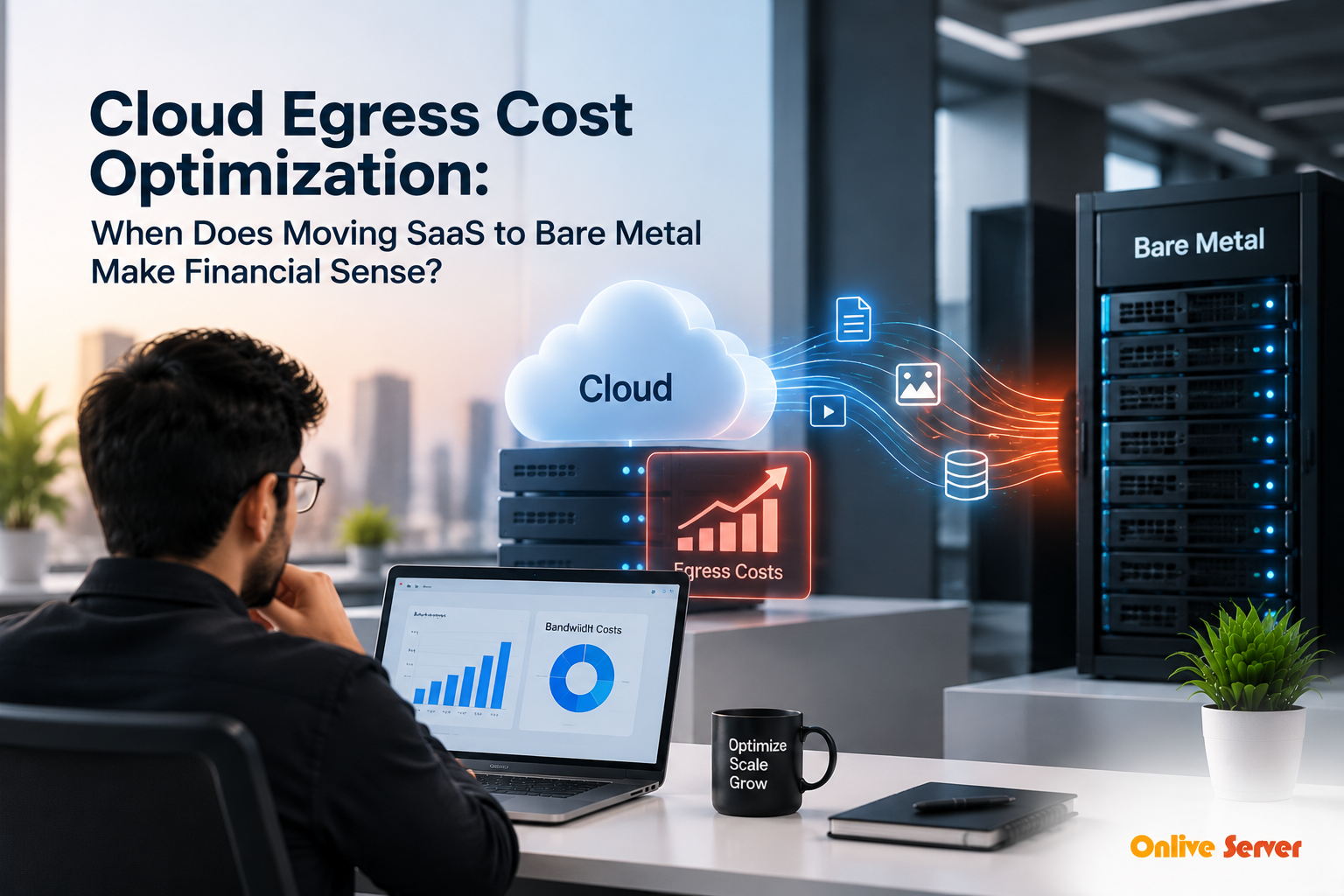
Moving a SaaS application from hyperscale public cloud to bare-metal servers makes compelling financial sense once outbound bandwidth exceeds 20 to 50 Terabytes per month. Hyperscalers charge punitive egress rates of $0.05 to $0.12 per Gigabyte, whereas bare-metal hosting provides flat-rate unmetered 1Gbps to 10Gbps uplinks, frequently cutting monthly infrastructure expenditures by 65% to 80%.
Public cloud providers have perfected the low-friction onboarding model. Free credits and instantaneous virtual machine spinning make hyperscalers attractive for early-stage SaaS development. For verified technical specifications and deployment parameters, consult the official Linux Kernel Documentation.
However, as digital platforms scale and user bases expand, cloud egress bandwidth pricing becomes a severe financial penalty. Every gigabyte of API JSON data, media streaming, or client file download is taxed at rates up to 100 times higher than wholesale transit.
For high-throughput applications, repatriating workloads to flat-rate unmetered dedicated servers transforms unpredictable monthly cloud invoices into predictable, cost-controlled line items.
The Public Cloud Egress Pricing Trap
Hyperscale cloud providers like AWS, Google Cloud, and Azure allow data to enter their networks for free (`ingress`). However, extracting data back out to the internet (`egress`) incurs steep tiered pricing.
A SaaS company transferring 100 Terabytes of outbound traffic per month pays roughly $8,000 to $9,000 exclusively for bandwidth in the public cloud. Over a single year, that represents more than $100,000 in egress penalties alone, excluding compute and storage costs.
In contrast, enterprise bare-metal hosting operates on unmetered or high-allocation port models. A dedicated 10Gbps unmetered server pipeline costs a tiny fraction of that amount, providing massive headroom without financial anxiety.
Monthly Outbound Egress Cost Comparison
| Monthly Outbound Data | Hyperscale Cloud (AWS / GCP) | Bare-Metal Dedicated Server | Annual Savings |
|---|---|---|---|
| 10 Terabytes | ~$850 / month | Included (Flat rate) | ~$8,000 / year |
| 50 Terabytes | ~$4,200 / month | Included (Flat rate) | ~$45,000 / year |
| 150 Terabytes | ~$12,500 / month | ~$400 – $600 / month | ~$140,000+ / year |
| 500 Terabytes | ~$38,000 / month | Unmetered 10Gbps Port | ~$420,000+ / year |
Three Indicators It Is Time to Migrate to Bare Metal
Assessing when to transition from public cloud requires evaluating bandwidth volume, workload predictability, and infrastructure margins:
1. Bandwidth Exceeds 25% of Total Cloud Bill: If network egress charges rival or surpass compute and database line items, your application architecture is subsidizing cloud provider profit margins.
2. Predictable, Sustained Network Baselines: Ephemeral cloud autoscaling is valuable for spiky, unpredictable consumer apps. But SaaS platforms with predictable 24/7 business workloads waste substantial money paying on-demand cloud premiums.
3. Large Storage and Backup Synchronization: Moving multi-terabyte data between regions or out to external backup repositories incurs heavy cloud penalties. Utilizing high-bandwidth storage server arrays ensures data syncs without metered billing.
The Hybrid Cloud Repatriation Architecture
Transitioning from public cloud does not require a disruptive, all-or-nothing forklift migration. Many leading SaaS companies adopt a hybrid repatriation model.
In this architecture, core compute, data storage, and outbound API streaming move to high-performance bare metal. The public cloud is retained selectively for edge CDN endpoints, AI training APIs, or specialized regional microservices.
For growing development teams wanting dedicated resources without managing bare-metal cabling, provisioning isolated cost-effective virtual private servers provides a flexible bridge toward full infrastructure independence.
To preserve low latency between systems, many engineering teams establish direct cross-connects or private interconnect links between colocation facilities and hyperscale clouds. This enables compute-heavy APIs and storage arrays to reside on dedicated hardware while retaining cloud-native frontends.
Financial payback periods for bare-metal repatriation are remarkably swift. The one-time engineering overhead of containerizing and shifting workloads is typically recouped within two to three months solely through eliminated cloud egress line items.
Infrastructure Repatriation Decision Matrix
| Application Archetype | Primary Bottleneck in Cloud | Bare-Metal Recommendation |
|---|---|---|
| High-Traffic API Gateways | Punitive per-GB egress charges on JSON responses | Migrate immediately to flat unmetered 10Gbps |
| Video & Media Streaming | Massive outbound terabytes bankrupt margins | Host origin streaming clusters on dedicated metal |
| Multi-Tenant B2B SaaS | Combined compute and steady-state egress overhead | Hybrid model (Bare metal core + Cloud CDN) |
| Early Prototype / MVP | Uncertain traffic; developer velocity priority | Retain cloud or deploy on entry-level VPS |
Network Determinism and Latency Advantages
Financial savings are the initial motivator for cloud repatriation, but performance gains often prove equally significant. Public cloud networking passes through complex software-defined networking (SDN) virtualization overlays.
These virtual network layers introduce packet jitter and latency spikes under heavy concurrency. On bare-metal servers, physical network interface cards (NICs) connect directly to top-of-rack datacenter switches with zero virtualization hops, providing consistent sub-millisecond round trips.
Summary and Financial Takeaways
Public cloud egress pricing functions as an artificial barrier designed to lock customers within proprietary ecosystems. For data-intensive SaaS companies, paying $0.08 per gigabyte for outbound traffic severely compresses gross profit margins.
Switching high-throughput workloads to bare-metal servers delivers predictable flat-rate billing, eliminates egress anxiety, and unlocks hundreds of thousands of dollars in annual savings that can be directly reinvested into product innovation.
The Economics of Cloud Egress Fees vs. Unmetered Dedicated Bandwidth
Public cloud hyperscalers operate on an asymmetric pricing model where data ingress (uploading data into the cloud) is free, but data egress (downloading data out to users or the Internet) incurs steep, recurring fees. Cloud providers assess egress surcharges ranging from $0.08 to $0.12 per gigabyte.
For data-intensive businesses—such as video streaming portals, SaaS platforms delivering automated customer backups, mobile app backends, and AI model weight distribution—monthly egress fees quickly surpass compute and storage costs combined. Transferring 100 terabytes of outbound data can cost between $8,000 and $12,000 monthly in pure bandwidth surcharges.
Dedicated bare-metal hosting transforms infrastructure economics by providing unmetered 1Gbps, 10Gbps, or 25Gbps network connections for a flat, predictable monthly fee. Transitioning high-volume outbound data streaming to dedicated bare metal slashes bandwidth expenses by 80% to 90% immediately.
Hybrid Cloud Egress Architecture: Compute in Cloud, Stream from Bare Metal
Organizations do not need to abandon their entire cloud ecosystem to capitalize on bare-metal egress cost savings. Adopting a hybrid cloud network architecture allows enterprises to retain specialized cloud managed services while routing high-volume outbound data through dedicated hardware.
In a hybrid topology, application logic or database engines in public cloud environments establish secure, high-speed private interconnects to dedicated bare-metal caching and streaming clusters:
- Cloud Compute / Storage Tier: Houses proprietary cloud databases or serverless microservices with minimal direct public user traffic.
- Dedicated Bare-Metal Edge Tier: Deploys high-performance NGINX or Varnish caching reverse proxies on unmetered bare-metal nodes.
- Public User Streaming: User requests for large video assets, file downloads, or API payloads are served directly from bare-metal edge caches, bypassing cloud egress fees entirely.
Direct Carrier Peering and Internet Exchange (IXP) Connectivity
Beyond cost savings, dedicated bare-metal hosting delivers superior network routing performance. Enterprise bare-metal providers maintain carrier-neutral datacenter presence with direct optical cross-connects to Tier-1 transit backbones and major Internet Exchange Points (IXPs) like DE-CIX, AMS-IX, and LINX.
Direct peering eliminates transit network hops, routing traffic to major consumer Internet Service Providers (ISPs) over optimized fiber paths. Users experience lower latency, reduced packet loss, and faster download speeds compared to congested public cloud transit gateways.
Dynamic Border Gateway Protocol (BGP) routing engines continuously monitor upstream network health, instantly redirecting traffic around fiber cuts to maintain continuous high-speed packet delivery.
Production Checklist for Cloud Egress Cost Optimization
Executing a successful egress optimization initiative requires disciplined traffic auditing and network engineering safeguards:
- Audit current public cloud billing statements to identify the top three egress-generating services, endpoints, and storage buckets.
- Deploy modern Brotli and Zstandard compression on edge proxies to reduce outbound text payload sizes by up to 30%.
- Provision dedicated bare-metal servers equipped with dual redundant 10Gbps network interfaces connected to independent network switches.
- Configure aggressive edge caching rules for static assets, media files, and public REST API endpoints to maximize cache hit ratios.
- Set up continuous network telemetry dashboards (such as Grafana with sFlow / NetFlow) to monitor real-time bandwidth consumption and peak transit trends.
Mitigating Cloud Lock-In and Enhancing Operational Freedom
High egress fees serve as a financial moat that public cloud hyperscalers use to discourage customers from moving data to competing providers. As enterprise datasets expand into petabytes, the cost of extracting data becomes an insurmountable financial barrier.
Migrating core data repositories and outbound delivery pipelines to dedicated bare-metal infrastructure restores complete architectural freedom. With unmetered bandwidth, organizations can replicate data across multiple datacenters and cloud providers without fearing punitive bandwidth invoices.
This operational sovereignty empowers engineering leaders to select the best infrastructure platforms for each workload, maximizing negotiating leverage and infrastructure flexibility.
Conclusion: Regaining Control Over Enterprise Infrastructure Costs
Cloud egress fees represent one of the most punitive and unpredictable operational expenses for growing digital enterprises. Transitioning outbound streaming and high-volume data pipelines to dedicated bare-metal servers eliminates budget volatility while dramatically improving download speeds.
By pairing unmetered dedicated bandwidth with hybrid edge caching and direct Tier-1 carrier peering, organizations achieve massive financial savings and superior network performance. Strategic infrastructure optimization turns network delivery from a costly budget drain into a highly efficient competitive advantage.
⚖️ Workload Decision Matrix: When to Use vs. When NOT to Use
✓ When Should You Use This?
- High-traffic enterprise platforms and database clusters processing over 1,000,000+ monthly requests without noisy-neighbor contention.
- Regulatory compliance demanding 100% single-tenant physical hardware isolation (HIPAA, PCI-DSS Level 1, GDPR financial tiers).
- Long-term compute workloads where sustained physical hardware usage eliminates variable public cloud egress bills.
✕ When Should You NOT Use This?
- Early-stage MVPs or short-lived dev/test environments requiring hourly spin-up and teardown (Deploy Cloud VPS instances instead).
- Budget-constrained projects with under $50/month operational infrastructure budget.
Target Audience / Persona: Enterprise IT directors, systems architects, high-volume fintech operators, and SaaS engineering teams requiring dedicated multi-core Xeon/EPYC silicon.
Common Failure Mode & Quick Fix: RAID controller synchronization degradation: Monitor physical disk health via MegaCLI or smartctl -a /dev/nvme0n1 and configure automated email alerts for degraded hardware RAID array rebuilds.
Frequently Asked Questions
Why do cloud providers charge so much for outbound data egress?
Egress pricing is a high-margin revenue source for hyperscalers and creates a commercial barrier to switching providers. While actual wholesale bandwidth costs fractions of a cent per gigabyte, cloud providers mark it up by thousands of percent.
At what bandwidth threshold does moving to bare metal make sense?
The tipping point typically begins around 20 to 50 Terabytes per month of outbound data. At this scale, bare-metal server savings easily offset any operational migration effort.
Does moving to bare metal require giving up modern DevOps automation?
No. Modern bare-metal infrastructure integrates seamlessly with Kubernetes, Terraform, Ansible, and Docker, enabling identical containerized deployments and CI/CD pipelines.
How does unmetered bandwidth work on dedicated servers?
Unmetered hosting provides a dedicated network port (such as 1Gbps or 10Gbps) at a flat monthly price. You can utilize the port at maximum continuous capacity 24/7 without incurring overage charges.
Can a SaaS company adopt a hybrid model instead of total migration?
Yes. Many companies run core database engines, APIs, and media assets on high-bandwidth bare metal while keeping edge microservices or serverless functions in public cloud providers.
Conclusion: Driving Business Growth with Enterprise VPS Hosting
Deploying mission-critical applications on high-performance Enterprise VPS Hosting infrastructure provides the dedicated processing power, network speed, and reliability demanded by modern web users.
Whether managing high-traffic e-commerce portals, streaming media, or corporate databases, Onlive Server delivers enterprise-grade hardware, 24/7 technical support, and competitive pricing for global success.

