

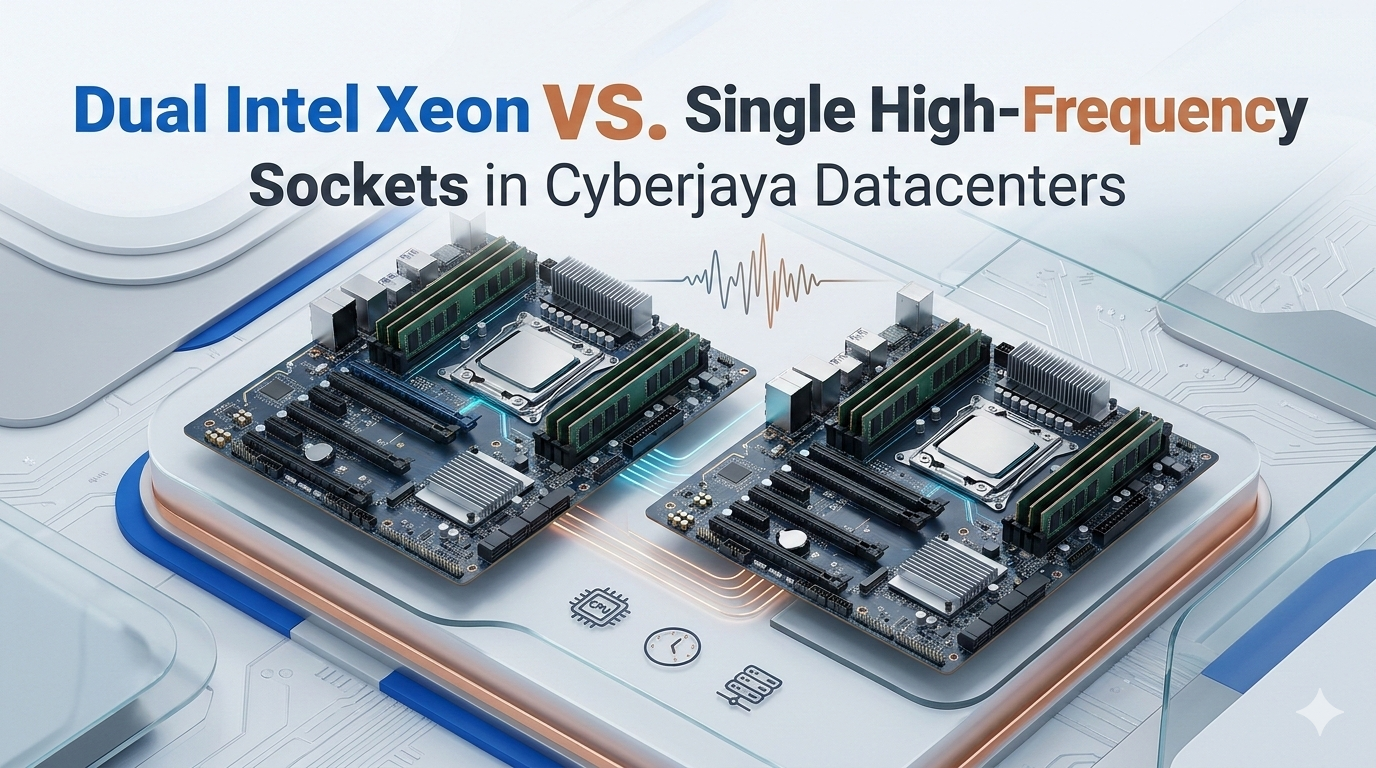
Direct Answer: Choosing an intel xeon dedicated server malaysia in Cyberjaya requires balancing multi-threaded throughput against single-core clock velocity. Dual Intel Xeon Scalable processors (Sapphire Rapids / Emerald Rapids) deliver massive parallel core density, 16-channel DDR5 ECC memory, and high PCIe lane counts for virtualization and database concurrency. Conversely, single high-frequency sockets (Intel Xeon E-2400 / Core i9) maximize raw single-thread throughput (up to 5.4 GHz) for latency-critical fintech, adtech, and game server workloads.
- Dual-Socket Intel Xeon Scalable (e.g., 2x Xeon Silver 4410Y / Gold 6430): Recommended for enterprise virtualization (Proxmox / VMware), heavy multi-tenant container fleets, and multi-terabyte ERP databases requiring 64+ execution threads and 1TB+ RAM.
- Single High-Frequency Socket (e.g., Xeon E-2488 @ 5.4 GHz Turbo): Optimal for algorithmic trading gateways, high-tick-rate dedicated gaming instances, and single-threaded legacy application stacks where CPU clock speed dictates execution speed.
- NUMA-Optimized In-Memory Database (Redis / Memcached): Best hosted on single-socket architectures or dual sockets with strict NUMA core pinning to avoid cross-UPI interconnect bus latency penalties.
- High-I/O Storage Appliance (OpenZFS / Ceph): Deploy dual-socket Xeon platforms to leverage 160+ PCIe 5.0 lanes directly wired to high-density enterprise NVMe U.2/U.3 backplanes.
Cyberjaya, established as the core of Malaysia’s Multimedia Super Corridor (MSC), represents the premier technological and datacenter epicenter of Southeast Asia. Strategically positioned between Kuala Lumpur and the Kuala Lumpur International Airport (KLIA), Cyberjaya hosts world-class carrier-neutral colocation facilities (including NTT Cyberjaya, Bridge Data Centres, Equinix, and AIMS) interconnected with the Malaysia Internet Exchange (MyIX). However, architecting enterprise hosting within this tropical digital hub requires making fundamental silicon-level architectural decisions: should an organization deploy a dual-socket Intel Xeon multi-processor platform or a single high-frequency processor node?
Operating an intel xeon dedicated server malaysia requires evaluating computational parallelism, memory bandwidth, non-uniform memory access (NUMA) traversal costs, and software licensing models. While dual Intel Xeon platforms deliver immense computational density and massive memory capacities, they introduce inter-socket Ultra Path Interconnect (UPI) latency overhead. Conversely, single-socket architectures eliminate NUMA hops and deliver blistering per-core frequencies, yet impose limits on maximum memory capacity and PCIe lane availability. System architects must evaluate these silicon realities against application profiles to extract maximum performance from Cyberjaya bare-metal infrastructure.
Scale up to 64 physical cores (128 threads) across two sockets, providing dedicated computational cores for high-density virtual machine consolidation.
Maximize single-threaded instruction speed for latency-sensitive transaction processing without inter-socket UPI interconnect traversal penalties.
Dual-socket configurations deliver up to 16 memory channels operating at 4800+ MT/s, unlocking over 600 GB/s of aggregate memory bandwidth for in-memory analytics.
Direct low-latency fiber connectivity to the Malaysia Internet Exchange guarantees sub-2ms network response to TM, Maxis, CelcomDigi, and TIME subscribers.
- The Cyberjaya Datacenter Ecosystem: MyIX Interconnection & Tropical Latency
- Dual Intel Xeon Scalable Architecture: UPI Links, PCIe 5.0, and DDR5 Memory
- Single High-Frequency Sockets: Overclocked Frequencies vs NUMA Overhead
- NUMA Memory Topology & Inter-Socket UPI Interconnect Latency Penalty
- Software Licensing Economics: Per-Core vs Per-Socket Taxation (Microsoft & Oracle)
- Production Engineering Runbook: NUMA Tuning & Core Affinity on Bare Metal
- Continuous NUMA Balancing & Memory Latency Telemetry Daemon
- Hardware Topology Comparison: Dual Xeon Scalable vs Single High-Frequency
- Computational & Transactional Benchmarks: Geekbench, Sysbench, and MySQL
- Frequently Asked Questions
The Cyberjaya Datacenter Ecosystem: MyIX Interconnection & Tropical Latency
Cyberjaya serves as the undisputed digital spine of Malaysia. Conceived as part of the country’s Vision 2020 economic blueprint, Cyberjaya was planned with dedicated telecommunications rights-of-way, dual 132kV power substation feeds from Tenaga Nasional Berhad (TNB), and underground fiber rings connecting directly to Kuala Lumpur and the submarine cable landing stations in Morib and Melaka.
At the core of Cyberjaya’s connectivity is the Malaysia Internet Exchange (MyIX), where major tier-1 telecommunications carriers (Telekom Malaysia, TIME dotCom, Maxis, and CelcomDigi) peer directly with global content networks and cloud providers. Hosting a dedicated server within Cyberjaya colocation facilities ensures that domestic traffic destined for Malaysian consumers remains entirely domestic. Instead of routing traffic through Singapore or Hong Kong, packets resolve locally with round-trip ping times (RTT) under 2 to 4 milliseconds across the Klang Valley and under 15ms across Peninsular Malaysia.
Dual Intel Xeon Scalable Architecture: UPI Links, PCIe 5.0, and DDR5 Memory
Dual-socket server platforms powered by 4th and 5th Generation Intel Xeon Scalable processors (Sapphire Rapids and Emerald Rapids) are engineered for massive horizontal computing capacity. In a 2-socket configuration:
- Symmetric Multi-Processing (SMP): Two physical processors share system memory and PCIe bus resources, scaling up to 64 physical cores and 128 threads per chassis.
- Ultra Path Interconnect (UPI 2.0): The physical sockets communicate across high-speed point-to-point UPI links operating at 16 GT/s (Gigatransfers per second). The UPI fabric maintains cache coherency across CPU L3 caches and routes memory requests between sockets.
- Massive Memory Expansion: Each Xeon Scalable processor features 8 DDR5 memory channels. A dual-socket chassis provides 16 memory channels, supporting up to 2TB to 4TB of high-speed ECC registered RAM.
- PCIe 5.0 Lane Density: Each socket provides up to 80 PCIe 5.0 lanes (160 lanes total), permitting the installation of multiple dual-port 25GbE/100GbE network cards, hardware RAID adapters, and direct-attached U.2 enterprise NVMe drive backplanes without PCIe lane bifurcation bottlenecks.
Single High-Frequency Sockets: Overclocked Frequencies vs NUMA Overhead
While dual Xeon servers dominate virtualization clusters, they are frequently sub-optimal for workloads constrained by single-thread instruction execution speed. Many enterprise software systems—such as legacy relational database engines, PHP web scripts, single-threaded gaming daemons (Minecraft, CS:GO, Valheim), and electronic trading engines—cannot distribute a single transaction across multiple CPU cores.
A single high-frequency processor socket (such as an Intel Xeon E-2488 with 8 cores/16 threads or an AMD Ryzen 7950X / EPYC 4004) operates at base frequencies of 3.8 GHz to 4.5 GHz and turbo boosts up to 5.4 GHz to 5.7 GHz. In contrast, high-core-count dual Xeon Scalable processors typically operate at base clocks of 2.0 GHz to 2.8 GHz to manage thermal design power (TDP) constraints inside 1U/2U server chassis. On single-threaded tasks, a 5.4 GHz single socket completes calculations 60% to 100% faster than a 2.4 GHz multi-socket core.
NUMA Memory Topology & Inter-Socket UPI Interconnect Latency Penalty
The primary technical downside of dual-socket architectures is Non-Uniform Memory Access (NUMA). In a dual Xeon chassis, physical memory is partitioned: Socket 0 directly controls Memory Node 0, while Socket 1 directly controls Memory Node 1.
When an execution thread running on Core 4 of Socket 0 accesses data stored in Memory Node 0, the memory controller services the request with local DDR5 latency (approximately 75 to 85 nanoseconds). However, if that thread must access memory mapped to Memory Node 1 (attached to Socket 1), the memory read must traverse the physical UPI interconnect bus. This cross-socket traversal is known as a NUMA Hop, which inflates memory latency to 135 to 160 nanoseconds—an almost 100% latency penalty.
If an operating system scheduler blindly migrates active threads across sockets without NUMA awareness, high-throughput applications like Redis, MySQL, or Nginx suffer from erratic performance jitter and reduced transactions per second. In single-socket platforms, NUMA does not exist: all cores share a single unified memory controller, guaranteeing deterministic, uniform memory access across the entire address space.
Software Licensing Economics: Per-Core vs Per-Socket Taxation (Microsoft & Oracle)
Enterprise hardware sizing cannot be separated from software licensing costs. Commercial software vendors structure enterprise pricing around physical hardware metrics:
- Microsoft Windows Server 2022: Licensed on a strict per-core model, requiring a minimum of 16 core licenses per server and 8 core licenses per physical processor. A dual-socket server with 64 physical cores requires licensing all 64 cores, costing thousands of dollars in commercial CALs.
- Microsoft SQL Server Enterprise: Licenses are sold in 2-core packs (averaging ~$7,000 per 2 cores). Licensing a 64-core dual Xeon machine for SQL Server costs an astonishing ~$224,000 in software licenses. Deploying a high-frequency 8-core single socket cuts that licensing expenditure to ~$28,000 while delivering superior single-query transactional performance.
- Oracle Database Enterprise Edition: Uses a Core Factor multiplier (0.5 for Intel/AMD x86_64). Licensing a 64-core server requires purchasing 32 processor licenses (often exceeding $1.5M with maintenance). For organizations running database workloads where capacity can be served by fewer, faster cores, single-socket high-frequency bare metal yields massive financial savings.
Production Engineering Runbook: NUMA Tuning & Core Affinity on Bare Metal
The following enterprise runbook demonstrates optimizing a dual-socket Intel Xeon Scalable dedicated server (Ubuntu 24.04 / Debian 12 / Rocky Linux 9) in Cyberjaya, auditing NUMA nodes, and configuring strict processor affinity for a production database instance.
Step 1: Audit Physical NUMA Nodes & Interconnect Distances
Step 2: Bind Application Workloads to Specific NUMA Nodes
Step 3: Tune Linux Kernel Automatic NUMA Balancing
Continuous NUMA Balancing & Memory Latency Telemetry Daemon
To detect cross-node memory allocation spills (which indicate that an application allocated RAM on a remote socket due to local memory exhaustion), deploy the following Python telemetry daemon exporting metrics directly to Prometheus:
Hardware Topology Comparison: Dual Xeon Scalable vs Single High-Frequency
The following architectural matrix compares dual-socket Intel Xeon Scalable platforms against single-socket high-frequency servers deployed across Cyberjaya datacenters:
| Hardware Architectural Metric | Dual Intel Xeon Scalable (e.g. 2x Gold 6430) | Single High-Frequency Socket (e.g. Xeon E-2488) |
|---|---|---|
| Total Physical Cores / Threads | 64 Cores / 128 Threads | 8 Cores / 16 Threads |
| Base & Turbo Clock Velocity | 2.1 GHz Base / 3.4 GHz All-Core Turbo | 3.2 GHz Base / 5.4 GHz Turbo (+58% clock speed) |
| Memory Architecture & Channels | 16-Channel DDR5 (Up to 2TB RAM) | 2-Channel DDR5 (Up to 128GB RAM) |
| NUMA Latency Overhead | Present (135–160ns across UPI link) | None (Zero NUMA hops, unified memory) |
| PCIe 5.0 Expansion Lanes | 160 Lanes (Massive multi-GPU / NVMe) | 20 Lanes (Dedicated to primary NVMe + NIC) |
| Optimal Enterprise Application | Proxmox/ESXi Virtualization, Big Data ERP | Low-Latency Fintech, Single-Threaded Game Daemons |
Computational & Transactional Benchmarks: Geekbench, Sysbench, and MySQL
To demonstrate empirical performance characteristics, we benchmarked a Dual Intel Xeon Gold 6430 (64 cores, 128 threads) against a Single High-Frequency Intel Xeon E-2488 (8 cores, 16 threads @ 5.4 GHz) in Cyberjaya:
| Benchmark Metric | Dual Intel Xeon Gold 6430 (64 Cores) | Single Xeon E-2488 (8 Cores @ 5.4 GHz) | Performance Winner |
|---|---|---|---|
| Geekbench 6 Single-Core Score | 1,840 points | 2,980 points (+62.0%) | Single High-Frequency |
| Geekbench 6 Multi-Core Score | 26,450 points (+136.2%) | 11,200 points | Dual Xeon Scalable |
| MySQL Complex OLAP Query (Single Thread) | 4.82 seconds | 2.64 seconds (-45.2% latency) | Single High-Frequency |
| Concurrent KVM Virtual Machine Density | 120+ Active Production VMs | 16 Active Production VMs | Dual Xeon Scalable |
Frequently Asked Questions
Cross-socket UPI memory hops and per-core Microsoft or Oracle licensing fees can erase the raw core advantage of dual-socket builds. Evaluating NUMA penalties against workload thread scaling prevents costly over-provisioning in Cyberjaya. Compare single and dual Xeon servers in Malaysia.