

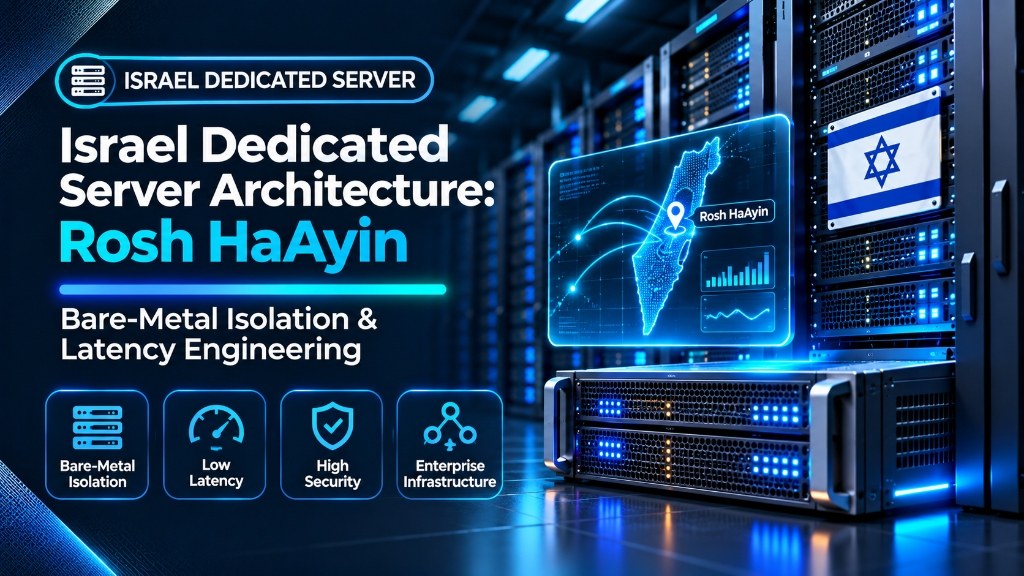
Deploying an enterprise israel dedicated server rosh haayin architecture delivers military-grade physical protection, complete bare-metal isolation, and deterministic domestic transit across the Start-Up Nation. Hosted within underground bunker data centers in Rosh HaAyin, mission-critical workloads benefit from sub-1.5ms optical interconnects to Tel Aviv financial exchanges, direct peering at the Israeli Internet eXchange (IIX), and absolute compliance with the Israeli Protection of Privacy Law (PPL 5741-1981).
Critical technical and operational tradeoffs when evaluating enterprise server placement in Israel:
- Subterranean Hardening vs Commercial Surface Facilities: Rosh HaAyin bunker facilities reside 15 to 20 meters underground with reinforced concrete shielding, EMP protection, and autonomous life support, ensuring 100% operational continuity during geopolitical disruptions.
- Dedicated Silicon vs Multi-Tenant Cloud Virtualization: Dedicated bare metal provides raw unthrottled access to physical CPU registers and PCIe Gen5 NVMe lanes, eliminating CPU steal time and hypervisor side-channel attack vectors.
- Tel Aviv Interconnect Latency: Direct redundant dark fiber rings link Rosh HaAyin to Tel Aviv’s financial exchanges and the IIX switching fabric in under 1.4ms round-trip time.
- Data Sovereignty & Regulatory Compliance: Retains sensitive biometric, financial, and cybersecurity intellectual property strictly within Israeli sovereign territory under Israeli Privacy Protection Authority (PPA) oversight.
In contemporary enterprise computing, the geopolitical and physical security of data infrastructure is just as critical as its logical cybersecurity posture. For multinational corporations, fintech leaders, defense contractors, and high-frequency trading platforms operating in Israel, standard commercial office-park data centers present unacceptable vulnerabilities. Modern production workloads require architectural defense-in-depth: physical subterranean fortification, dedicated silicon isolation, and deterministic optical network topology. Adopting an israel dedicated server rosh haayin architecture fulfills these stringent criteria.
Situated approximately 20 kilometers east of Tel Aviv, Rosh HaAyin has evolved into Israel’s premier mission-critical infrastructure nexus. Housing deep underground bunker data center complexes built to withstand direct seismic events and military missile impacts, Rosh HaAyin provides physical invulnerability while maintaining seamless optical connectivity. Connected via multi-terabit diverse dark fiber rings directly into Tel Aviv and Petah Tikva, dedicated bare metal servers deployed here combine ultimate physical survival with ultra-low latency execution across the Eastern Mediterranean.
15+ meters underground with reinforced blast walls, autonomous power grids, and 100+ hours of continuous fuel reserves.
Dual geographically diverse dark fiber paths deliver deterministic microsecond latency to Tel Aviv Stock Exchange (TASE) brokers.
Direct Layer 2 peering at the Israeli Internet eXchange (ISOC-IL) ensures traffic routes directly to Bezeq, Cellcom, and Partner subscribers.
100% compliant with Israeli Privacy Protection Authority (PPA) regulations, Amendment 13, and European GDPR adequacy decisions.
- 1. Subterranean Engineering: Rosh HaAyin Bunker Architecture & Physical Fortification
- 2. Silicon-Level Bare-Metal Isolation: Eliminating Cloud Hypervisor Vulnerabilities
- 3. Optical Routing Topology: Rosh HaAyin to Tel Aviv, IIX & Subsea Cables
- 4. Comparative Technical Benchmark: Rosh HaAyin Bunker vs Cloud vs Surface Colocation
- 5. Step-by-Step Production Runbook: Hardening Enterprise Linux on Israeli Bare Metal
- 6. Automated Sub-Millisecond Transit & Bunker Environment Telemetry Daemon (Python)
- 7. Frequently Asked Questions: Rosh HaAyin Dedicated Server Hosting
1. Subterranean Engineering: Rosh HaAyin Bunker Architecture & Physical Fortification
The geographical selection of Rosh HaAyin as Israel’s primary mission-critical data repository is the result of deliberate strategic defense planning. Located along the central coastal plain foothills, Rosh HaAyin rests on solid limestone geology, providing an ideal substrate for deep subterranean excavation while remaining outside coastal flood zones.
Bunker data center facilities in Rosh HaAyin (such as the renowned MedOne underground complex) are engineered to defense-grade specifications:
- Subterranean Depth & Structural Armor: Computing halls are positioned up to 20 meters below ground level, encased in multi-meter thick reinforced blast-resistant concrete walls with shock-absorbing foundation dampers designed to isolate servers from direct ballistic impacts and seismic ground waves.
- Chemical, Biological, Radiological, and Nuclear (CBRN) Filtration: Air intake systems utilize positive-pressure HEPA and activated carbon filtration capable of sealing the facility hermetically during hazardous atmospheric conditions, allowing technicians and servers to operate without external air exchange.
- Autonomous 2N Power & 100-Hour Fuel Reserves: Redundant underground diesel generators, isolated 2N rotary or static UPS systems, and dedicated fuel tanks exceeding 100,000 liters guarantee sustained power autonomy even during prolonged national electrical grid interruptions.
2. Silicon-Level Bare-Metal Isolation: Eliminating Cloud Hypervisor Vulnerabilities
In multi-tenant public cloud environments, sensitive customer data, cryptographic keys, and proprietary algorithms reside on shared physical processors. Despite hypervisor abstraction, multi-tenant architectures remain vulnerable to side-channel cache attacks (such as Spectre, Meltdown, Downfall, and Zenbleed) where malicious neighboring virtual machines probe shared CPU execution pipelines and L3 caches.
Deploying a dedicated bare-metal server in Rosh HaAyin eliminates these attack vectors completely:
- Dedicated Silicon Registers: Your organization has 100% exclusive access to all physical processor cores, arithmetic logic units, and hardware cache hierarchies. There is zero noisy-neighbor CPU contention and zero “steal time.”
- Direct PCIe Bus Attachment: Enterprise NVMe storage drives communicate directly with the CPU over native PCIe Gen4/Gen5 bus lanes without traversing virtualized storage software layers, delivering unthrottled read speeds exceeding 14,000 MB/s and sub-50 microsecond write latencies.
- Hardware Security Modules (TPM 2.0): Integrated physical Trusted Platform Modules enforce hardware-rooted cryptographic attestation, ensuring bootloader integrity and enabling full-disk encryption (LUKS2) keys bound directly to physical motherboard silicon.
3. Optical Routing Topology: Rosh HaAyin to Tel Aviv, IIX & Subsea Cables
Physical fortification is worthless without world-class telecommunications connectivity. Rosh HaAyin is connected to Israel’s primary commercial centers via dense, geographically diverse dark fiber rings deployed along separate utility rights-of-way (Highway 5 and Highway 6 corridors):
- Tel Aviv Metro Optical Reach (Sub-1.5ms): Round-trip latency between Rosh HaAyin and Tel Aviv’s premier financial colocation facilities measures between 1.1ms and 1.4ms. Algorithmic traders and banking APIs execute synchronous database transactions across the corridor without performance degradation.
- Direct IIX (Israeli Internet eXchange) Peering: Located in Petah Tikva and Tel Aviv, the IIX (operated by ISOC-IL) serves as the domestic peering hub. Dedicated servers in Rosh HaAyin exchange traffic directly with domestic tier-1 carriers—including Bezeq, Cellcom, Partner, and HOT—delivering sub-3ms transit across the entire country.
- Mediterranean Subsea Cable Gateways: International transit routes directly through landing stations in Tel Aviv and Haifa into major Mediterranean subsea fiber systems (Jonah, Tama, MedNautilus, and Blue-Raman). Traffic reaches Cyprus in 4ms, Athens in 14ms, and Marseille in 31ms, bridging the Middle East to Western Europe.
4. Comparative Technical Benchmark: Rosh HaAyin Bunker vs Cloud vs Surface Colocation
The table below evaluates the physical resilience, latency performance, data sovereignty, and operational costs of an enterprise Rosh HaAyin bare metal server versus alternative deployment models in Israel:
| Architecture Dimension | Rosh HaAyin Bare Metal (Underground Bunker) | Surface Colocation (Tel Aviv Center) | Hyperscale Cloud (AWS / GCP Israel) |
|---|---|---|---|
| Physical Hardening Level | 15m – 20m Subterranean (Missile/CBRN Shielded) | Surface commercial building (Standard security) | Proprietary multi-tenant cloud facilities |
| Hardware Contention (CPU/IOPS) | 0% (100% Dedicated Physical Cores & NVMe) | 0% (Dedicated tenant-owned hardware) | High (Multi-tenant vCPUs & shared EBS SAN) |
| Tel Aviv Financial Transit (RTT) | 1.1 ms – 1.4 ms (Direct Dark Fiber Ring) | 0.8 ms – 1.2 ms | 2.5 ms – 5.5 ms (Virtual overlay transit) |
| Bandwidth Egress Costs | €0 / Included in Unmetered 10Gbps Uplinks | Metered transit contract + cross-connects | $0.08 – $0.11 per GB transferred |
| Regulatory Sovereignty | 100% Sovereign (Israeli PPL / PPA Compliant) | 100% Sovereign (Private hardware) | Subject to US CLOUD Act jurisdiction |
5. Step-by-Step Production Runbook: Hardening Enterprise Linux on Israeli Bare Metal
The following production deployment runbook hardens the Linux kernel, configures BBR congestion control, and tunes high-throughput network interfaces on Ubuntu 22.04 / 24.04 LTS bare metal deployed in Rosh HaAyin:
Step 1: Kernel Hardening & High-Speed Network Tuning (/etc/sysctl.d/99-israel-server.conf)
Step 2: Network Interface Card Ring Buffer Optimization
Step 3: Enforce Strict UFW Firewall Rules
6. Automated Sub-Millisecond Transit & Bunker Environment Telemetry Daemon (Python)
To continuously monitor domestic transit latency from Rosh HaAyin to Tel Aviv, Petah Tikva, and the IIX exchange, deploy this automated Python telemetry script:
7. Frequently Asked Questions: Rosh HaAyin Dedicated Server Hosting
Surface colocation and public cloud regions cannot match the physical fortification and silicon-level isolation of a subterranean Rosh HaAyin facility. Direct optical paths into Tel Aviv and IIX preserve sub-millisecond transit while keeping sensitive workloads strictly sovereign. Compare Israeli dedicated hardware specifications.