

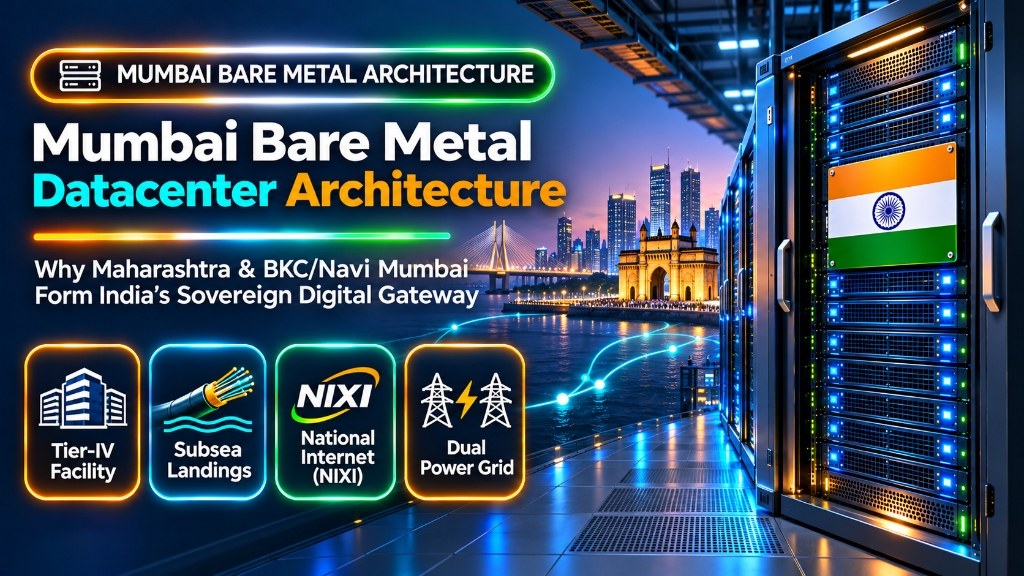
Direct Answer: Enterprise mumbai dedicated server architecture leverages Mumbai’s position as India’s primary subsea cable landing hub, terminating over 70% of the nation’s international bandwidth across SEA-ME-WE-4, SEA-ME-WE-5, AAE-1, and BBG cables. Deployed in Tier-IV Navi Mumbai and Chandivali campuses with direct NIXI and Extreme IX peering, it guarantees sub-5ms domestic transit and full RBI data localization compliance.
- Choose Navi Mumbai / Chandivali Bare Metal: Ideal for banking, financial services, insurance (BFSI), and high-frequency trading (BSE/NSE) demanding sub-millisecond local cross-connects and dual-grid MSEDCL utility power.
- Choose Dual-Homed 10Gbps Uplinks with Extreme IX & NIXI: Recommended for OTT streaming, gaming platforms, and large-scale SaaS applications distributing traffic across Reliance Jio, Bharti Airtel, and Vodafone Idea.
- Deploy Dedicated NVMe Storage Arrays: Essential for transactional e-commerce (WooCommerce/Magento) and enterprise ERP databases requiring over 1,000,000 IOPS without cloud hypervisor throttling.
- Comply with RBI & DPDP Act 2023: Guarantees 100% domestic Indian data sovereignty, satisfying Reserve Bank of India payment data localization directives and CERT-In log retention mandates.
India is experiencing the fastest digital transformation in global economic history. Driven by the proliferation of 5G mobile networks, the Unified Payments Interface (UPI) processing billions of monthly transactions, and massive enterprise cloud adoption, the demand for high-performance compute and storage infrastructure has surged exponentially. Within this digital expansion, the state of Maharashtra—and specifically the Mumbai metropolitan region—has solidified its undisputed status as the digital gateway and datacenter capital of the Indian subcontinent.
While public cloud providers maintain local availability zones in India, enterprise engineering teams frequently encounter prohibitive limitations: virtualized CPU contention, throttled disk I/O operations per second (IOPS), and punitive bandwidth egress surcharges that penalize data-intensive businesses. Deploying dedicated bare-metal hardware on an Onlive Server mumbai dedicated server architecture provides an uncompromised alternative. Operating directly on physical silicon within enterprise campuses across Navi Mumbai, Chandivali, and BKC, organizations gain raw hardware performance, unmetered multi-gigabit bandwidth, and direct Layer 2 peering into every major Indian consumer telecommunications provider.
Direct physical cross-connects into 12+ international subsea fiber cables terminate over 70% of India’s global internet traffic right in Mumbai.
Direct Layer 2 peering via Extreme IX, NIXI, and DE-CIX India delivers packets directly to Jio, Airtel, and Vi eyeballs with near-zero latency.
Full domestic compliance with RBI payment data localization rules, DPDP Act 2023 mandates, and CERT-In 180-day security logging standards.
Direct PCIe Gen4 NVMe arrays deliver 1.2M+ sustained IOPS with zero cloud IOPS burst buckets or artificial throttling penalties.
- 1. Mumbai as India’s Telecommunications & Subsea Cable Capital
- 2. Subsea Fiber Architecture: SEA-ME-WE-5, AAE-1 & Next-Gen IAX Cables
- 3. Dual-Grid Utility Power & Tier-IV Facility Engineering in Maharashtra
- 4. Metro Exchange Topologies: NIXI Mumbai, Extreme IX & DE-CIX India
- 5. High-Density Compute Topologies: 15kW+ Racks & Precision Thermal Dynamics
- 6. Comparative Regional Matrix: Mumbai vs Delhi NCR vs Bangalore vs Singapore
- 7. Step-by-Step Production Runbook: LACP Bonding, MTU 9000 & BBR Congestion Control
- 8. Legal & Regulatory Compliance: DPDP Act 2023, RBI Directives & CERT-In Audits
- 9. Frequently Asked Questions (Technical FAQs)
1. Mumbai as India’s Telecommunications & Subsea Cable Capital
Geography and regulatory history have positioned Mumbai as the epicenter of India’s internet infrastructure. More than 60% of India’s enterprise data center capacity and over 70% of its international subsea cable bandwidth converge on the coastal shores of Mumbai:
- Landing Station Proximity: Key cable landing stations (CLS) located in Versova, Prabhadevi, and BKC connect directly to our datacenter facilities in Navi Mumbai (Airoli / Mahape) and Chandivali via dark fiber optical rings. This eliminates terrestrial backhaul latency across multiple states.
- Financial Capital Density: Mumbai hosts the Reserve Bank of India (RBI), the Bombay Stock Exchange (BSE), the National Stock Exchange (NSE), and the corporate headquarters of every major Indian commercial bank. Dedicated hosting in Mumbai provides sub-millisecond execution times for financial messaging networks, algorithmic trading systems, and real-time payment clearing.
- Telecommunications Carrier Headquarters: Reliance Jio (Jio Infocomm), Bharti Airtel, and Vodafone Idea (Vi) operate their core network engineering and backbone switching centers in Navi Mumbai and Lower Parel, ensuring direct fiber interconnectivity.
2. Subsea Fiber Architecture: SEA-ME-WE-5, AAE-1 & Next-Gen IAX Cables
International reachability from India is determined by subsea cable landings. Mumbai anchors the premier subsea systems connecting India to the Middle East, Europe, Africa, and Southeast Asia:
- SEA-ME-WE-5 (South East Asia-Middle East-Western Europe 5): Delivers 24 Tbps design capacity over 20,000 km, connecting Mumbai directly to Marseille, France and Singapore with sub-85ms European latency.
- AAE-1 (Asia-Africa-Europe 1): Over 25,000 km of optical fiber offering 40 Gbps design capacity, providing redundant terrestrial routing across Egypt to protect against maritime cable snags.
- BBG (Bay of Bengal Gateway): Ultra-low-latency direct optical path connecting Mumbai and Chennai to Singapore, Malaysia, and the Middle East, delivering sub-30ms round-trip latency to Southeast Asian business centers.
- Next-Gen India-Asia-Xpress (IAX) & 2Africa: New high-capacity multi-pair fiber systems coming online terminating directly in Mumbai, expanding national bandwidth capacity by over 200 Terabits per second.
3. Dual-Grid Utility Power & Tier-IV Facility Engineering in Maharashtra
Electrical power reliability is the primary vulnerability for server operations in developing digital economies. Maharashtra’s power transmission infrastructure—managed by Maharashtra State Electricity Distribution Company Limited (MSEDCL) and Tata Power—is historically the most stable in India:
- Dual Independent Substation Utility Feeds (N+N): Datacenter facilities receive high-voltage electrical feeds from two physically separate power substations traversing diverse underground utility conduits.
- Rotary and Static UPS Topology: Enterprise Uninterruptible Power Supply (UPS) systems in 2N configuration condition power continuously, isolating server hardware from harmonic distortion, voltage sags, and frequency fluctuations.
- Massive On-Site Diesel Fuel Autonomy: On-site bulk diesel fuel storage tanks guarantee 72 to 120 hours of continuous full-load generator operation without civilian refueling, backed by SLA-guaranteed priority fuel replenishment agreements.
- Seismic Zone III Hardening: Datacenter facilities are engineered to withstand Seismic Zone III seismic events, utilizing reinforced concrete slab construction, base isolators, and structural steel bracing.
4. Metro Exchange Topologies: NIXI Mumbai, Extreme IX & DE-CIX India
Peering directly with domestic internet service providers is vital to avoid the “tromboning” effect where local Indian traffic routes through Singapore or Europe before returning to India:
- National Internet Exchange of India (NIXI Mumbai): India’s premier government-backed internet exchange, interconnecting government networks, educational institutions (ERNET), state-owned BSNL/MTNL, and private ISPs.
- Extreme IX Mumbai: The largest carrier-neutral commercial internet exchange in India, processing multi-terabits of domestic traffic. Connecting to Extreme IX enables direct Layer 2 peering with Reliance Jio, Bharti Airtel, ACT Fibernet, Hathway, and regional fiber operators at sub-3ms latency.
- DE-CIX India & AMS-IX India: International-grade carrier-neutral peering fabrics providing distributed Layer 2 switching across multiple Mumbai datacenter campuses.
5. High-Density Compute Topologies: 15kW+ Racks & Precision Thermal Dynamics
Modern compute nodes—such as dual AMD EPYC 9654 processors (192 physical cores and 384 threads per chassis) or GPU-accelerated AI inference servers—generate intense thermal loads reaching 15kW to 30kW per standard 42U rack. In Mumbai’s tropical coastal climate where external ambient temperatures exceed 38°C with high relative humidity during summer months, precision datacenter thermal engineering is non-negotiable:
- Closed-Loop Cold Aisle Containment: Fully sealed cold aisles prevent the mixing of 20°C supply air with 40°C server exhaust air. By maintaining uniform static air pressure across all rack units, hot spots are eliminated, keeping server fans running at energy-efficient lower RPMs and achieving an overall facility Power Usage Effectiveness (PUE) below 1.35.
- Variable Speed EC Fans & CRAH Units: Computer Room Air Handler (CRAH) units equipped with electronically commutated (EC) fans dynamically modulate airflow based on real-time temperature and differential pressure sensor arrays beneath the 800mm raised access floor.
- Chilled Water Loop Redundancy (2N Configuration): Dual independent closed-loop chilled water distribution pipes backed by continuous thermal energy storage tanks ensure cooling continues uninterrupted even during transient chiller compressor power transfers.
- Automated Environmental Telemetry: Rack-level environmental sensor probes continuously report temperature, humidity, and dew point metrics via SNMP and Modbus into centralized Building Management Systems (BMS), alerting facilities engineers before thermal thresholds are approached.
6. Comparative Regional Matrix: Mumbai vs Delhi NCR vs Bangalore vs Singapore
The following engineering comparison highlights why Mumbai remains the superior bare-metal hosting hub for all-India reachability:
| Infrastructure Parameter | Mumbai Bare Metal (Onlive Server) | Delhi NCR / Noida | Bangalore (Bengaluru) | Singapore (Overseas) |
|---|---|---|---|---|
| Subsea Cable Terminations | 12+ Direct Cable Landings (Primary Hub) | 0 (Inland; 1,400km terrestrial backhaul) | 0 (Inland; backhaul to Chennai/Mumbai) | 20+ Subsea Cable Landings |
| Pan-India Average Latency | 18ms – 28ms (Optimal Central Balancing) | 25ms – 45ms (High latency to South India) | 28ms – 42ms (High latency to North India) | 45ms – 85ms Cross-Border Latency |
| Internet Exchange Density | Extreme IX, NIXI, DE-CIX, AMS-IX | NIXI Noida, Extreme IX Delhi | Extreme IX, NIXI Bangalore | Equinix IX, SGIX |
| RBI & DPDP 2023 Compliance | 100% Domestic Sovereign Territory | 100% Domestic Sovereign Territory | 100% Domestic Sovereign Territory | Violates RBI Payment Localization |
| Egress Bandwidth Pricing | Unmetered 1Gbps / 10Gbps Dedicated | Unmetered 1Gbps / 10Gbps Dedicated | Unmetered 1Gbps Dedicated | $0.08 – $0.12 per GB Cloud Egress |
7. Step-by-Step Production Runbook: LACP Bonding, MTU 9000 & BBR Congestion Control
Execute this production runbook to configure dual 10Gbps optical interfaces with LACP bonding, jumbo frames, and Google BBR TCP congestion control on a Mumbai dedicated bare-metal server.
Step 1: Configure Dual 10Gbps LACP Bonding in /etc/netplan/01-netcfg.yaml:
Step 2: Apply Netplan and Verify Bond Status:
Step 3: Tune Linux Kernel Network Sockets and Activate Google BBR (/etc/sysctl.conf):
Step 4: Reload Kernel Parameters and Verify BBR Activation:
8. Legal & Regulatory Compliance: DPDP Act 2023, RBI Directives & CERT-In Audits
Deploying dedicated bare-metal infrastructure in Mumbai ensures full adherence to India’s regulatory frameworks:
- Digital Personal Data Protection (DPDP) Act 2023: Mandates strict data fiduciary accountability, lawful processing grounds, and security safeguards. Hosting within sovereign Indian borders prevents illegal cross-border data transfers to blacklisted jurisdictions.
- RBI Payment Data Localization Directive (Circular DPSS.CO.OD No. 2785/06.08.005/2017-18): Requires all payment system providers, banks, and fintech gateways (UPI, credit/debit cards, prepaid instruments) to store complete end-to-end payment transaction data exclusively in India.
- CERT-In Cyber Security Directions (April 2022): Mandates that all system service providers maintain comprehensive ICT system logs within the Indian jurisdiction for a rolling 180-day period, synchronize clocks to standard NTP (National Physical Laboratory), and report cybersecurity incidents within 6 hours.
9. Frequently Asked Questions (Technical FAQs)
Below are authoritative answers to common technical inquiries regarding Mumbai dedicated server datacenter hosting:
Terminating SEA-ME-WE-5 and AAE-1 cables directly in Maharashtra gives Mumbai servers lower international latency than inland Indian metros. Dual-grid utility power and 15kW+ high-density cooling support sustained compute loads without thermal throttling. Review dedicated bare-metal configurations deployed across India.
Indian Tier-IV bare-metal configurations