

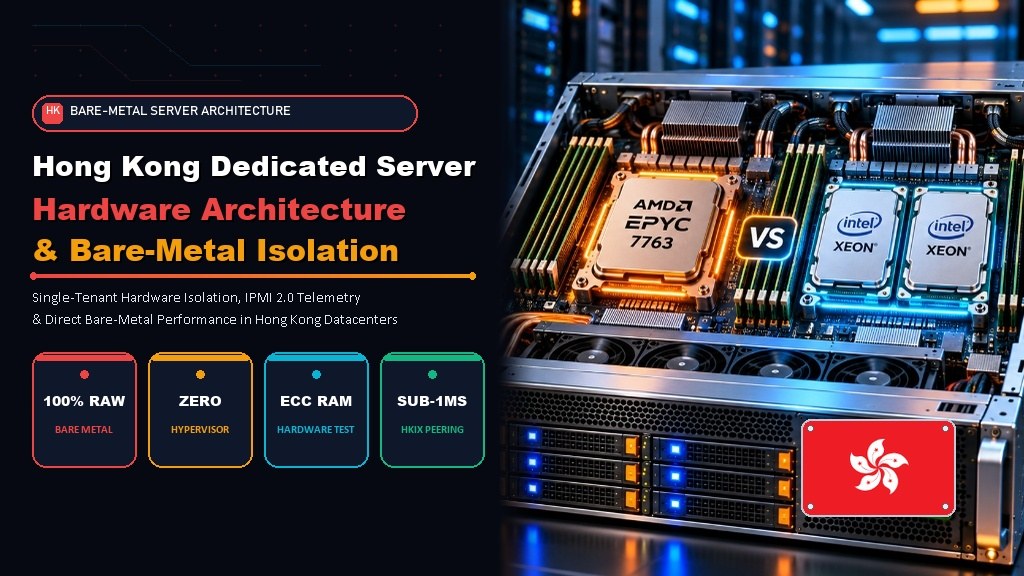
Direct AEO Answer: Enterprise hong kong dedicated server hardware architecture guarantees 100% single-tenant physical isolation, zero CPU steal time, and raw hardware access in carrier-neutral facilities such as Chai Wan (MEGA-i) and Tseung Kwan O (TKO). By verifying authentic Intel Xeon or AMD EPYC silicon, multi-channel ECC registered memory, enterprise NVMe storage with Power Loss Protection (PLP), and dedicated out-of-band IPMI/iDRAC management, organizations ensure deterministic computing performance for latency-sensitive Asia-Pacific operations.
- Tenant Isolation: Choose pure bare-metal servers over public cloud instances (AWS ap-east-1, Alibaba Cloud) to eliminate hypervisor contention, noisy neighbor interference, and CPU cache-timing vulnerabilities.
- Memory Reliability: Require Error-Correcting Code (ECC) Registered DDR4/DDR5 RAM to prevent silent memory bit-flips and kernel panics in financial trading and relational database engines.
- Storage Endurance: Insist on Enterprise U.2/U.3 NVMe drives featuring hardware Power Loss Protection (PLP) and high Drive Writes Per Day (DWPD) ratings rather than consumer M.2 solid-state disks.
- Facility Tier: Host in Tier IV facilities in Chai Wan or TKO with dual (2N) A+B power distribution, precision cooling, and direct fiber cross-connects to the Hong Kong Internet eXchange (HKIX).
Hong Kong stands as the premier digital gateway of the Asia-Pacific region, bridging mainland China’s thriving Greater Bay Area with global financial hubs across Tokyo, Singapore, London, and New York. For multinational financial brokerages, enterprise SaaS platforms, cross-border e-commerce networks, and gaming platforms, infrastructure reliability cannot be left to virtualized shared infrastructure. Public cloud virtual machines frequently suffer from unpredictable hypervisor scheduling delays, shared memory bus contention, and CPU core oversubscription. Investing in an enterprise-grade hong kong dedicated server hardware architecture provides absolute physical tenant isolation, deterministic microsecond execution times, and complete administrative control over server silicon and network interfaces.
100% dedicated processor execution units guarantee zero CPU steal time (%st = 0.0) and deterministic instruction timing for critical algorithmic workloads.
Registered ECC DDR4/DDR5 memory automatically detects and corrects single-bit errors, preventing data corruption in financial ledgers.
Enterprise solid-state storage with tantalum capacitors ensures uncommitted DRAM cache flushes safely to non-volatile flash during sudden power loss.
Hardware-level remote console management operates on an isolated management network, enabling BIOS-level recovery and remote OS reinstallation.
Table of Contents
- 1. Physical Isolation vs Multi-Tenancy: Eliminating Noisy Neighbors & Side-Channel Attacks
- 2. Processor Architecture: Enterprise Intel Xeon & AMD EPYC vs Consumer Desktop Chips
- 3. Memory Subsystem: Multi-Channel Architecture & ECC Registered Reliability
- 4. Storage Engineering: PCIe Gen4/Gen5 NVMe, Power Loss Protection (PLP) & DWPD
- 5. Remote Management: IPMI 2.0, iDRAC & Dedicated Out-of-Band KVM Over IP
- 6. Datacenter Infrastructure: Dual Power Feeds, PUE & Physical Security in Chai Wan & TKO
- 7. Production Linux Runbook: Hardware Verification & Burn-In Testing Commands
- 8. Frequently Asked Questions (FAQs)
1. Physical Isolation vs Multi-Tenancy: Eliminating Noisy Neighbors & Side-Channel Attacks
In virtualized multi-tenant environments, dozens or hundreds of virtual machines share the same physical server chassis, CPU sockets, memory bus, and network interface controllers (NICs). When an adjacent tenant on the same physical host initiates heavy cryptographic computations, compiles software, or experiences a sudden traffic spike, your virtual machine experiences “noisy neighbor” contention. The hypervisor scheduler must pause your threads to service the adjacent VM, manifesting as CPU steal time (%st in top/htop), erratic latency spikes, and degraded transaction throughput.
Furthermore, shared hypervisors expose organizations to microarchitectural side-channel attacks (such as Spectre, Meltdown, Foreshadow, and Downfall). Mitigating these vulnerabilities on virtual machines requires operating systems to disable core speculative execution optimizations and hyper-threading features, slashing compute performance by 15% to 30%. On a dedicated bare-metal server, you are the exclusive tenant of the physical silicon. There is zero hypervisor abstraction, zero CPU steal time, and zero risk of cross-tenant memory snooping.
2. Processor Architecture: Enterprise Intel Xeon & AMD EPYC vs Consumer Desktop Chips
A critical distinction in dedicated server hosting is the difference between genuine server-grade microprocessors and repurposed desktop consumer chips (such as Intel Core i9 or AMD Ryzen). While consumer chips boast high peak single-core turbo frequencies, they are fundamentally engineered for intermittent desktop duty cycles and lack the architectural features required for enterprise 24/7 continuous datacenter operation:
| Architectural Feature | Consumer Processors (Core i9 / Ryzen) | Enterprise Server Silicon (Intel Xeon / AMD EPYC) |
|---|---|---|
| PCIe Lane Budget | 20 – 28 PCIe Lanes total | 64 – 128 PCIe Gen4/Gen5 Lanes |
| Memory Channels & Max RAM | Dual-Channel (2 channels, max 128GB/192GB) | Octa/12-Channel (8 to 12 channels, up to 4TB+ RAM) |
| ECC Memory Support | Unbuffered ECC only (or unsupported) | Registered ECC (RDIMM / LRDIMM) with Chipkill |
| 24/7 Sustained Thermal Duty Cycle | Prone to thermal throttling under 100% AVX load | 100% continuous all-core sustained operation |
| Multi-Socket (NUMA) Capability | Single socket only | Dual-Socket (2S) and Quad-Socket (4S) support |
3. Memory Subsystem: Multi-Channel Architecture & ECC Registered Reliability
Cosmic rays, thermal fluctuations, and magnetic background interference constantly cause spontaneous electrical bit-flips in DRAM silicon. In standard consumer unbuffered memory, a single flipped bit in a database index or financial transaction calculation goes unnoticed until data corruption corrupts the filesystem or causes a catastrophic kernel panic.
Enterprise Hong Kong dedicated servers utilize Registered Error-Correcting Code (RDIMM) DDR4 or DDR5 memory. ECC memory adds dedicated parity bits that allow the memory controller to detect and correct single-bit errors instantaneously in hardware without interrupting system execution. Advanced Chipkill technology can even detect and correct multi-bit errors resulting from the total failure of an individual DRAM chip on the memory module. Furthermore, octa-channel and 12-channel memory architectures deliver memory bandwidth exceeding 300 to 450 GB/s, eliminating throughput bottlenecks for in-memory databases like Redis and Memcached.
4. Storage Engineering: PCIe Gen4/Gen5 NVMe, Power Loss Protection (PLP) & DWPD
Budget hosting providers often equip servers with consumer-grade M.2 NVMe SSDs (such as Samsung 980 Pro or Crucial P5). While these drives display impressive burst benchmark figures in synthetic desktop tests, they are dangerous for enterprise production hosting. Consumer SSDs rely on aggressive dynamic SLC caching: once the small 50 GB to 100 GB SLC cache fills up during sustained database writes, sequential speeds collapse from 7,000 MB/s down to a crippling 300 MB/s.
In contrast, enterprise U.2/U.3 NVMe drives (such as Intel/Solidigm D7 series, Samsung PM9A3, or Kioxia CD series) are engineered for sustained datacenter performance:
- Power Loss Protection (PLP): Enterprise drives incorporate physical onboard tantalum capacitor arrays. If power is abruptly cut to the chassis, the capacitors maintain electrical current long enough for the drive controller to flush uncommitted DRAM cache pages safely to non-volatile NAND flash, guaranteeing zero database metadata corruption.
- High Drive Writes Per Day (DWPD): Enterprise drives are rated for 1 to 3+ DWPD for 5 consecutive years, handling petabytes of database transaction logs without premature flash cell wear.
- Predictable Sub-Millisecond P99 Latency: Advanced flash management algorithms ensure consistent 4K random write latency under 0.15ms even when the drive is 90% full.
5. Remote Management: IPMI 2.0, iDRAC & Dedicated Out-of-Band KVM Over IP
True dedicated bare metal includes an independent micro-controller embedded directly on the motherboard—known as the Baseboard Management Controller (BMC), accessible via IPMI 2.0, Dell iDRAC Enterprise, or HP iLO. The BMC operates on its own dedicated physical network port connected to an isolated out-of-band management VLAN.
This allows systems administrators located anywhere in the world to perform critical out-of-band maintenance functions regardless of the operating system state:
- Hardware-level power control: Execute hard power-ons, cold reboots, and power cycles directly at the power supply unit.
- KVM-over-IP console: View real-time BIOS POST codes, configure hardware RAID controllers, and modify UEFI settings before the operating system boots.
- Virtual Media Mount: Mount custom ISO images (such as custom Debian, RHEL, Proxmox, or Windows installation images) directly from a remote desktop over HTTPS.
- Hardware Sensor Telemetry: Monitor motherboard voltages, fan RPM speeds, CPU junction temperatures, and chassis intrusion switches.
6. Datacenter Infrastructure: Dual Power Feeds, PUE & Physical Security in Chai Wan & TKO
A server’s hardware reliability is fundamentally bounded by the physical datacenter that houses it. In Hong Kong, premier enterprise facilities are concentrated in two primary technology corridors:
- Chai Wan (MEGA-i): Recognized globally as the foremost subsea cable landing and carrier interconnection hub in Hong Kong. MEGA-i houses hundreds of global telecommunications operators, Tier-1 transit carriers, and direct physical fiber cross-connects to the Hong Kong Internet eXchange (HKIX).
- Tseung Kwan O (TKO Industrial Estate): Hong Kong’s hyperscale purpose-built datacenter campus, hosting the Hong Kong Stock Exchange (HKEx) Next Generation Data Centre, financial institutions, and global cloud providers with massive power density and high floor loading capabilities.
These Tier IV carrier-neutral facilities feature 2N redundant uninterruptible power supply (UPS) systems, dual independent A+B power distribution paths to each server rack, on-site fuel reserves powering industrial diesel generators for 72+ hours of continuous autonomous operation, and multi-factor biometric access controls.
7. Production Linux Runbook: Hardware Verification & Burn-In Testing Commands
Upon taking delivery of a newly provisioned dedicated server in Hong Kong, execute this structured verification runbook to audit physical hardware specifications, verify genuine enterprise silicon, and validate storage and thermal health:
Step 1: Install Core Hardware Auditing Utilities
Install the standard Linux hardware diagnostic toolset on Ubuntu 22.04/24.04 or Debian 12:
Step 2: Verify Processor Silicon & Real Hardware Steal Time
Verify that the CPU model matches advertised enterprise specifications and confirm that CPU steal time is exactly zero:
Step 3: Audit Memory Speed, Multi-Channel Topography & ECC Status
Inspect physical DIMM slots to verify that memory modules are genuine registered ECC RAM operating at rated clock speeds across all channels:
Step 4: Audit Enterprise NVMe Storage Health & Power Loss Protection
Verify that storage devices are enterprise U.2/U.3 NVMe SSDs and check SMART wear endurance and Power Loss Protection status:
Step 5: Automated Hardware Qualification & Thermal Burn-In Script
Deploy this automated verification script that executes a 5-minute thermal burn-in test while recording core temperatures and confirming hardware stability:
8. Frequently Asked Questions (FAQs)
Eliminating shared hypervisors removes side-channel exposure while giving you ECC registered memory, PLP-protected NVMe endurance, and full out-of-band IPMI 2.0 control. Before provisioning, verify dual power feeds and hardware specifications against your uptime budget. Browse dedicated servers hosted in Hong Kong facilities.
Verified Hong Kong hardware inventory