

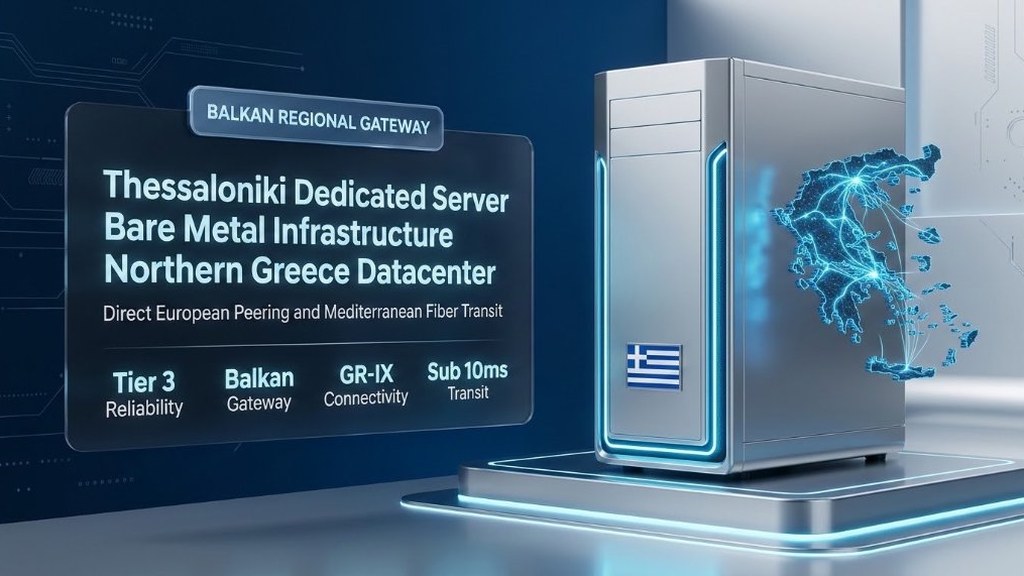
Direct AEO Answer: Deploying a high-performance thessaloniki dedicated server positions enterprise workloads at the strategic telecommunications crossroads of Southeastern Europe and the Balkans. Operating out of Tier III/IV carrier-neutral facilities in Kalochori with direct GR-IX::Thessaloniki peering, redundant OTEGlobe and Grid Telecom dark fiber rings, and single-tenant bare-metal hardware, organizations achieve sub-12ms Balkan latency, absolute GDPR data sovereignty, and zero-throttling NVMe storage performance.
- Balkan Gateway Advantage: Thessaloniki provides the shortest terrestrial optical routing into Sofia (6ms), Skopje (4ms), Tirana (8ms), Belgrade (12ms), and Istanbul (14ms), outperforming Athens-based transit by 6ms to 10ms for regional traffic.
- Domestic GR-IX Peering: Connect directly to the GR-IX::Thessaloniki Internet Exchange node in Kalochori to exchange settlement-free local Greek traffic with COSMOTE, Vodafone Greece, and Nova at sub-2ms ping latencies.
- Carrier Neutrality & Terrestrial Dark Fiber: Benefit from dual-path DWDM optical backbones traversing Greece’s national power grid (Grid Telecom) alongside international backbones from OTEGlobe and Sparkle.
- European Regulatory Compliance: Guarantee full adherence to EU GDPR, NIS2 cybersecurity directives, and Hellenic Data Protection Authority (HDPA) sovereignty mandates on isolated physical hardware.
In the evolving European digital landscape, strategic infrastructure placement has migrated beyond traditional Western European “FLAP-D” hubs (Frankfurt, London, Amsterdam, Paris, Dublin). High power densities, escalating transit costs, and geographic latency penalties to the emerging markets of Southeastern Europe have positioned Northern Greece as the premier regional datacenter gateway. Situated at the geographic junction between the Aegean Sea, the Balkan Peninsula, and the terrestrial optical corridors to Western Europe and Turkey, Thessaloniki has transformed into a critical digital crossroads. Deploying an enterprise thessaloniki dedicated server infrastructure provides single-tenant bare-metal compute, unshared memory channels, and direct low-latency fiber interconnection to Balkan and Mediterranean markets.
Direct cross-border terrestrial fiber conduits bypass Athens detours, connecting Sofia in 6ms, Belgrade in 12ms, and Istanbul in 14ms.
Direct peering with domestic Greek telecommunications providers eliminates costly international IP transit hops for local traffic.
Dedicated 100Mbps and 1Gbps unmetered network ports backed by multi-homed Tier-1 transit eliminate bandwidth overage anxiety.
Physical bare metal guarantees that healthcare, fintech, and public data remain strictly protected under European legal frameworks.
- Thessaloniki Geopolitical Gateway: Northern Greece’s Telecommunications Nexus
- The Kalochori Datacenter Ecosystem: Tier III/IV Campus Standards in Central Macedonia
- GR-IX::Thessaloniki Architecture: Local Peering & Transit Optimization
- Hardware Sizing & Benchmarks: Multi-Core Xeon, DDR4/DDR5 ECC & NVMe Storage
- Production Runbook: Linux Kernel Network & Socket Tuning for Greek Bare Metal
- Data Sovereignty & Regulatory Compliance: EU GDPR and HDPA Directives
- Frequently Asked Questions
Thessaloniki Geopolitical Gateway: Northern Greece’s Telecommunications Nexus
Historically renowned as a commercial maritime crossroads, Thessaloniki (the capital of Central Macedonia) has re-emerged as the primary terrestrial fiber transit hub connecting Western Europe, the Balkan nations, and the Near East. Traditional telecommunications architecture in Greece routed all international traffic through Athens in Attica. While Athens serves as a vital subsea landing hub for cables traversing the Mediterranean (via Chania in Crete), routing Balkan or Central European traffic down to Athens introduces an unnecessary geographic detour of over 500 kilometers each way.
Thessaloniki occupies an optimal geographic foothold at the head of the Thermaic Gulf. Direct terrestrial optical conduits radiate northward into Bulgaria, North Macedonia, and Albania, continuing onward to Romania, Serbia, Hungary, and Austria. Simultaneously, high-capacity terrestrial DWDM corridors track eastward through Thrace directly into Istanbul, Turkey. Hosting enterprise dedicated infrastructure in Thessaloniki cuts round-trip times (RTT) across Southeastern Europe dramatically compared to legacy hosting locations in Frankfurt or Athens.
| Destination City | Regional Target Market | Thessaloniki Bare Metal RTT | Athens Host RTT | Frankfurt / Western EU RTT |
|---|---|---|---|---|
| Sofia, Bulgaria | Balkans / EU Eastern Border | 5.8 ms | 13.4 ms | 31.2 ms |
| Skopje, North Macedonia | Western Balkans | 4.2 ms | 12.1 ms | 34.5 ms |
| Belgrade, Serbia | Central Balkans / Non-EU Hub | 11.8 ms | 19.5 ms | 24.0 ms |
| Istanbul, Turkey | Eurasian Commercial Nexus | 13.9 ms | 18.2 ms | 38.0 ms |
| Athens, Greece | Domestic Capital / Attica | 6.2 ms | 0.8 ms | 36.5 ms |
| Bucharest, Romania | Eastern European Tech Hub | 14.5 ms | 22.8 ms | 29.0 ms |
This telecommunications geometry makes Thessaloniki the ideal hosting location for multinational fintech firms, regional content delivery networks (CDNs), e-commerce portals, and logistics platforms targeting Greek and Balkan end-users with deterministic single-digit millisecond latency.
The Kalochori Datacenter Ecosystem: Tier III/IV Campus Standards in Central Macedonia
The operational epicenter of Northern Greece’s datacenter industry is concentrated in Kalochori, an industrial corridor located immediately west of Thessaloniki’s central port. Kalochori hosts major carrier-neutral facilities—including the Synapsecom datacenter and the hyperscale Lancom Balkan Gate campus—engineered to Tier III and Tier IV reliability standards.
These purpose-built facilities incorporate stringent industrial specifications essential for enterprise hosting:
- 2N Power Redundancy: Dual independent high-voltage utility feeds supplied by the Hellenic Independent Power Transmission Operator (ADMIE), backed by redundant uninterruptible power supply (UPS) batteries and automated diesel generator arrays with 72-hour on-site fuel reserves.
- Seismic & Environmental Protection: Reinforced anti-seismic building engineering, automated early warning very early smoke detection apparatus (VESDA), and eco-friendly clean agent gas fire suppression systems (Novec 1230 / FM-200).
- Precision High-Density Cooling: In-row variable-speed computer room air handlers (CRAH) utilizing cold-aisle containment corridors to support 8kW to 15kW rack power densities with Power Usage Effectiveness (PUE) ratings below 1.25.
- Carrier Neutrality & Optical Interconnects: Direct multi-carrier physical meet-me-rooms (MMR) with redundant optical conduits terminating Tier-1 national and international transit providers, including OTEGlobe, Grid Telecom, Sparkle, and Cogent.
GR-IX::Thessaloniki Architecture: Local Peering & Transit Optimization
The Greek Internet Exchange (GR-IX) is the national neutral Internet eXchange Point (IXP) in Greece, operated by the National Infrastructures for Research and Technology (GRNET). GR-IX operates two primary switching fabrics: GR-IX::Athens in Attica and GR-IX::Thessaloniki in Central Macedonia.
Prior to the establishment of the Thessaloniki IXP fabric, domestic traffic between an enterprise server in Northern Greece and a local subscriber on COSMOTE or Vodafone was frequently forced to route down to Athens or hair-pin through international transit exchanges in Sofia or Frankfurt. Connecting directly to GR-IX::Thessaloniki allows dedicated servers to peer directly with all major Greek ISPs, academic research networks, and regional content providers over settlement-free switching fabrics.
Hardware Sizing & Benchmarks: Multi-Core Xeon, DDR4/DDR5 ECC & NVMe Storage
Enterprise workloads in Greece span diverse computing profiles, from cost-effective multi-threaded batch processors to memory-intensive ERP systems and high-throughput web clusters. Dedicated server hardware deployed in Thessaloniki must be configured to deliver deterministic computing performance without shared hypervisor overhead.
Two primary hardware architecture standards dominate Greek enterprise hosting:
- Dual Intel Xeon E5 Series (Value & Multi-Core Density): Equipping physical servers with dual Intel Xeon E5-2600 v4 processors (e.g., dual E5-2680 v4 or E5-2690 v4) provides up to 28 physical cores and 56 concurrent execution threads. Paired with 64GB to 128GB of Error-Correcting Code (ECC) DDR4 registered memory, this architecture provides an unbeatable price-to-performance ratio for web hosting clusters, development staging environments, and batch processing nodes.
- Modern Intel Xeon Scalable / AMD EPYC (Mission-Critical Tier): For high-transaction relational databases, virtualization hypervisors (Proxmox VE), and heavy e-commerce workloads, Intel Xeon Silver/Gold or AMD EPYC processors deliver high clock speeds, PCIe 4.0/5.0 bus connectivity, and multi-channel DDR5 memory bandwidth.
- PCIe NVMe Solid-State Storage: Mirrored enterprise NVMe drives deliver over 800,000 random read IOPS and sub-25 microsecond access latency, outperforming legacy SATA SSDs by over 600% and completely eliminating disk I/O wait times during intense database queries.
Production Runbook: Linux Kernel Network & Socket Tuning for Greek Bare Metal
To maximize throughput across high-speed GR-IX peering and regional Balkan transit, systems administrators must optimize the Linux kernel’s network stack. Default distribution settings are conservative, throttling multi-megabit TCP streams and dropping packets during sudden network traffic spikes.
Execute the following production runbook on Ubuntu 22.04 LTS / Debian 12 bare metal to configure high-performance kernel parameters and activate Google’s BBR (Bottleneck Bandwidth and RTT) congestion control algorithm in `/etc/sysctl.d/99-thessaloniki-network.conf`:
By enforcing `tcp_slow_start_after_idle = 0` and engaging the `bbr` congestion control module, client browsers in Sofia, Athens, and Istanbul download media files and API responses at sustained wire speeds without experiencing artificial TCP window collapses.
Data Sovereignty & Regulatory Compliance: EU GDPR and HDPA Directives
Data privacy and sovereignty are paramount for European corporate enterprises, financial processors, and public healthcare institutions. Under the EU General Data Protection Regulation (GDPR – Regulation (EU) 2016/679) and the supervisory authority of the Hellenic Data Protection Authority (HDPA – DPA.gr), organizations face severe financial penalties if customer personal identifiable information (PII) is transferred outside the European Economic Area (EEA) without adequate safeguards.
Deploying dedicated bare-metal servers physically situated within Greek sovereign borders guarantees that customer records remain strictly subject to Greek and European Union jurisprudence. Furthermore, single-tenant dedicated hosting avoids the legal ambiguities of public cloud multi-tenancy:
- Immunity from US Cloud Act Extraterritoriality: Multi-tenant public clouds owned by US conglomerates are subject to the US CLOUD Act, allowing foreign law enforcement to subpoena enterprise data without local judicial warrants. An independent dedicated server in Thessaloniki operated by a compliant European provider ensures full data sovereignty under EU court protection.
- Physical Single-Tenancy (GDPR Article 32): Article 32 mandates appropriate technical and organizational measures to ensure data security. Dedicated hardware eliminates hypervisor side-channel vulnerabilities (Spectre, Meltdown, Downfall) that allow rogue virtual machines on a shared host to snoop across memory registers.
- Cryptographic Hardware Protection: Physical NVMe drives are formatted with LUKS2 full-disk encryption (AES-256-XTS) with hardware keys anchored via physical TPM 2.0 modules, ensuring that retired or serviced drives expose zero plaintext data.
- NIS2 Directive Compliance: Satisfies the European Union’s updated Network and Information Security (NIS2) directive for critical digital infrastructure, including supply chain security, access control logging, and incident reporting.
Frequently Asked Questions
Kalochori’s redundant power feeds and Balkan cross-border fiber make Thessaloniki a strong anchor for regional SaaS and fintech stacks under EU GDPR. Evaluate multi-core Xeon nodes, ECC memory allocations, and NVMe storage layouts in our Greek inventory.
Thessaloniki Enterprise Bare-Metal Plans