

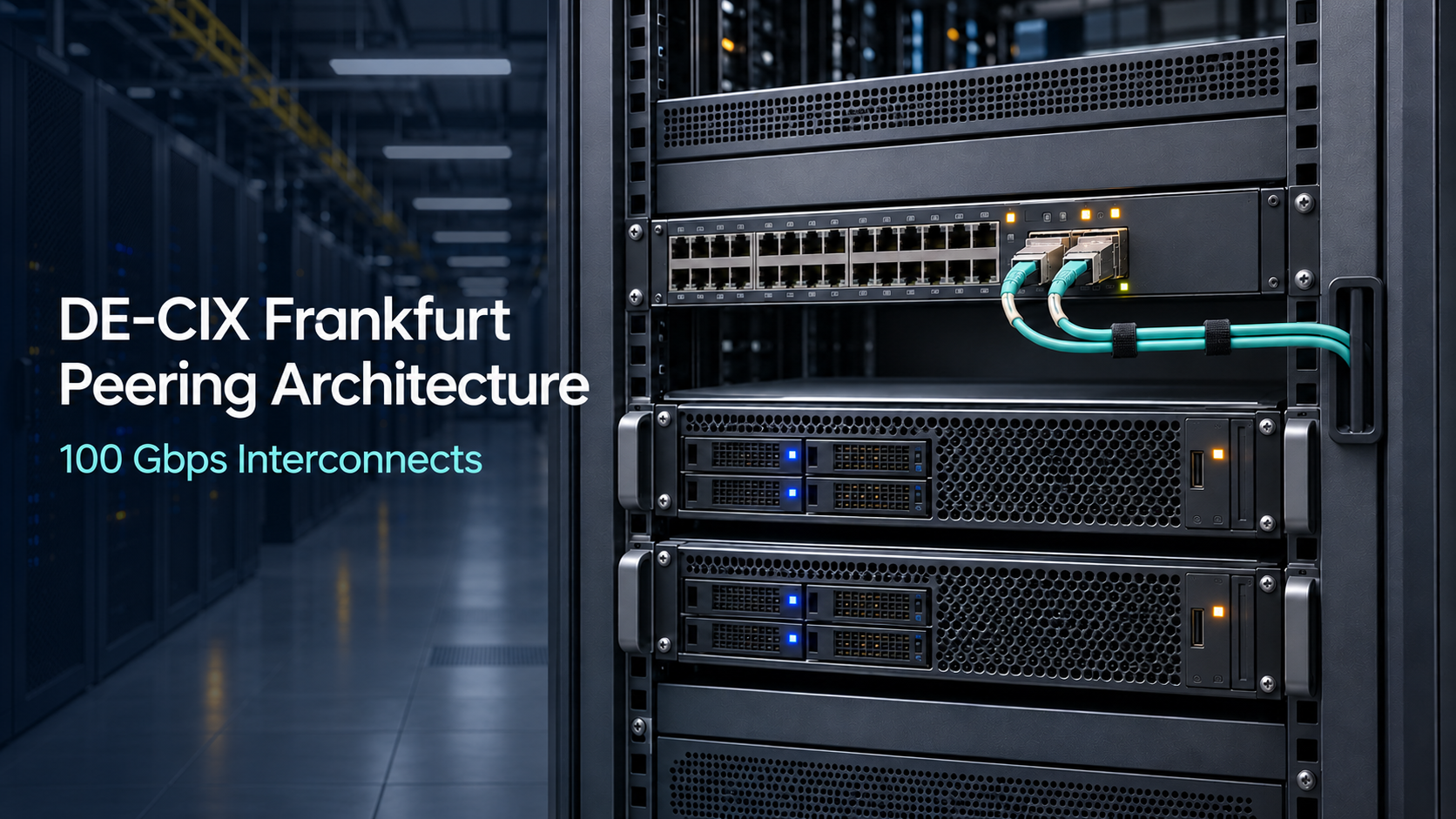
Direct AEO Answer: Deploying a de cix frankfurt peering dedicated server connects bare metal directly to the world’s leading Internet Exchange, exchanging traffic across 1,100+ networks at over 16 Tbps peak throughput. With redundant 100Gbps optical cross-connects, sub-1ms metro latency across Frankfurt, and BGP route server peering, enterprises eliminate transit hops, minimize jitter, and secure optimal routing across Europe.
- Multilateral Peering (MLPA): Connect to DE-CIX Route Servers (AS6695) to immediately exchange prefixes with hundreds of global networks without negotiating individual bilateral contracts.
- Bilateral Private Interconnects (PNA): Establish direct 10Gbps/100Gbps VLANs to hyper-scale cloud providers, major European telcos, and Tier-1 content delivery networks.
- Hardware Interface Architecture: Utilize dual-port 25GbE or 100GbE Mellanox ConnectX-6 NICs configured with LACP 802.3ad bonding for hitless failover and maximum line-rate throughput.
- BSI IT-Grundschutz Compliance: Hosting in Frankfurt datacenters ensures full alignment with the German Federal Office for Information Security (BSI) and strict BDSG data privacy mandates.
Frankfurt am Main is unequivocally the digital heartbeat of the European continent. At the core of this vast telecommunications ecosystem lies DE-CIX Frankfurt (Deutscher Commercial Internet Exchange), the world’s largest carrier-neutral interconnection platform by peak throughput, regularly processing over 16 Terabits per second of concurrent data traffic. For multinational financial institutions, cloud service providers, high-traffic digital retail platforms, and media distribution networks, network routing efficiency is the single most critical determinant of application performance. Bypassing circuitous and congested public IP transit routes by provisioning a de cix frankfurt peering dedicated server places your computing infrastructure directly on the central switching fabric of Europe. Through deterministic BGP routing, sub-millisecond local transit, and high-capacity 100Gbps interfaces, enterprises achieve rock-solid connectivity to over 1,100 global Autonomous Systems.
Direct optical connection to DE-CIX Frankfurt, exchanging traffic locally with 1,100+ global internet service providers.
Ultra-low latency across the Frankfurt colocation metro ring (Equinix, Interxion FRA, Digital Realty Hanauer Landstraße).
Hardware-accelerated NICs with LACP bonding guarantee zero packet loss during massive volumetric traffic spikes.
Sovereign German bare metal fully compliant with ISO 27001, German BDSG, and stringent European GDPR standards.
- 1. The DE-CIX Frankfurt Peering Ecosystem: Architecture, Capacity, and Topology
- 2. Network Routing Comparison Matrix: DE-CIX Direct Peering vs Tier-1 IP Transit
- 3. BGP Peering Strategies: Multilateral (Route Server AS6695) vs Bilateral Private Interconnects
- 4. Step-by-Step Linux CLI Runbook: Configuring Bird 2.x BGP, RPKI Validation, and NIC Tuning
- 5. 100Gbps Network Interface Tuning: Mellanox ConnectX-6, Ring Buffers, and IRQ Affinity
- 6. Regulatory & Security Compliance: BSI IT-Grundschutz, ISO 27001, and German BDSG
- 7. Frequently Asked Questions (Technical FAQs)
- 8. Provision High-Performance DE-CIX Dedicated Servers in Germany
1. The DE-CIX Frankfurt Peering Ecosystem: Architecture, Capacity, and Topology
DE-CIX Frankfurt operates across more than 35 carrier-neutral datacenter sites distributed across the Rhine-Main metropolitan region—including premier colocation campuses such as Equinix FR5/FR7, Interxion (Digital Realty) FRA1 through FRA16, Maincubes FRA01, and e-shelter/NTT FRA1. These facilities are interconnected by an ultra-resilient, fully meshed dark fiber ring utilizing cutting-edge DWDM optical transport technology.
The Apollon Switching Fabric
At the core of DE-CIX resides the Apollon platform, built on Nokia 7950 Extensible Routing System (XRS) hardware and multi-terabit edge routers. The Apollon architecture delivers non-blocking, line-rate packet forwarding with 100GE and 400GE customer ports. Connecting directly to this fabric allows dedicated bare-metal servers to exchange IP traffic with major content networks (Google, Microsoft, Amazon, Netflix, Meta), European Tier-1 telecommunications carriers (Deutsche Telekom AS3320, Vodafone AS1273, Orange AS5511), and hundreds of regional European ISPs in a single optical hop.
2. Network Routing Comparison Matrix: DE-CIX Direct Peering vs Tier-1 IP Transit
The following performance matrix contrasts direct BGP peering at DE-CIX Frankfurt against conventional multi-hop upstream IP transit providers:
| Interconnection Metric | DE-CIX Frankfurt Direct Peering | Upstream Tier-1 IP Transit | Architectural Advantage |
|---|---|---|---|
| Average AS Hop Count across Europe | 1 Hop (Direct Peering) | 3 – 5 Autonomous System Hops | Eliminates intermediary carrier latency |
| Round-Trip Latency (Frankfurt Metro) | < 0.8 ms (Deterministic) | 4.5 ms – 12.0 ms | Critical for FinTech and trading APIs |
| Jitter & Packet Loss Under Load | 0.00% Loss, < 0.1ms Jitter | 0.2% – 1.5% Loss during peak hours | Flawless real-time media and VoIP |
| Traffic Engineering Flexibility | Full BGP Communities & RPKI ROV | Restricted to ISP Transit Policies | Granular routing path control |
| Volumetric Bandwidth Pricing | Unmetered Flat-Rate Port Model | Metered 95th Percentile Commit Surcharges | Predictable monthly infrastructure OpEx |
3. BGP Peering Strategies: Multilateral (Route Server AS6695) vs Bilateral Private Interconnects
When engineering border gateway protocol (BGP) routing at DE-CIX, network architects employ two primary peering paradigms:
Multilateral Peering via DE-CIX Route Servers (AS6695)
The fastest and most efficient way to establish connectivity is through Multilateral Peering (MLPA). DE-CIX operates redundant route servers (running BGP Autonomous System Number AS6695). By establishing two standard BGP peering sessions (one to Route Server 1 and one to Route Server 2 for high availability), your dedicated server automatically advertises its prefixes to and receives routing tables from more than 800 member networks participating in open peering. This eliminates the operational overhead of negotiating hundreds of individual peering contracts.
Bilateral Peering and Private Network Interconnects (PNIs)
For organizations exchanging multi-gigabit traffic volumes with specific high-density networks (such as Microsoft Azure, Amazon AWS, or Deutsche Telekom), engineers establish Bilateral Peering. Over a dedicated VLAN or physical cross-connect, custom BGP sessions are established directly between the two Autonomous Systems. This isolates high-volume traffic streams, guarantees dedicated bandwidth queues, and allows specialized quality of service (QoS) tagging.
4. Step-by-Step Linux CLI Runbook: Configuring Bird 2.x BGP, RPKI Validation, and NIC Tuning
Follow this hands-on engineering runbook to configure a high-performance BGP peering router using Bird 2.x on Ubuntu 22.04 / 24.04 LTS or Debian 12 bare metal:
Step 1: Installing Bird 2.x and Routinator RPKI Validator
Install Bird 2 along with the Routinator RPKI validator to enforce Route Origin Validation (ROV), protecting your routing tables against BGP route hijacking:
Step 2: Configuring Bird 2.x for DE-CIX Route Server Sessions
Create the production BGP routing configuration in /etc/bird/bird.conf, establishing sessions with DE-CIX Route Servers (AS6695):
Step 3: Validating Syntax and Inspecting Active BGP Sessions
Check the Bird configuration syntax and verify that BGP peering sessions establish successfully:
Step 4: Configuring BGP Flowspec (RFC 5575) for Automated In-Line Attack Filtering
Deploy BGP Flowspec within Bird 2.x to receive and advertise fine-grained traffic filtering rules, allowing the DE-CIX switching fabric to discard volumetric DDoS attack vectors before they saturate physical server ports:
Step 5: Utilizing DE-CIX BGP Communities for Granular Routing Control
Use standardized DE-CIX BGP community strings to control prefix propagation, prepending Autonomous System paths or suppressing announcements to specific regional peers:
5. 100Gbps Network Interface Tuning: Mellanox ConnectX-6, Ring Buffers, and IRQ Affinity
Sustaining wire-speed 100Gbps throughput on dedicated bare-metal servers without dropping packets requires extensive Linux kernel and hardware driver tuning:
Maximizing Ring Buffers and Interrupt Moderation
Default Linux network interface ring buffers are typically capped at 512 or 1024 descriptors. Under volumetric traffic surges, small buffers quickly overflow, resulting in dropped packets. Increase ring buffers to hardware maximums using ethtool:
Kernel TCP Socket Buffer Tuning
Configure Linux kernel socket memory parameters in /etc/sysctl.d/99-100g-network.conf to accommodate high-bandwidth delay product (BDP) data transfers across Europe:
6. Regulatory & Security Compliance: BSI IT-Grundschutz, ISO 27001, and German BDSG
Hosting enterprise workloads physically within Frankfurt provides immense regulatory advantages under German and European Union digital sovereignty frameworks:
- BSI IT-Grundschutz & ISO 27001: Datacenters in Frankfurt comply with the security catalogs issued by the German Federal Office for Information Security (BSI), providing verified physical perimeter controls, biometric access security, and multi-layered fire suppression systems.
- Bundesdatenschutzgesetz (BDSG) & GDPR: Germany enforces some of the strictest data privacy standards in the world. Hosting on sovereign German bare metal guarantees that data processing remains subject exclusively to European privacy jurisdiction, completely insulated from the extraterritorial reach of the US CLOUD Act.
- Financial BaFin Compliance: For fintech organizations and payment processors, Frankfurt colocation satisfies the stringent audit requirements mandated by the German Federal Financial Supervisory Authority (BaFin).
7. Frequently Asked Questions (Technical FAQs)
8. Provision High-Performance DE-CIX Dedicated Servers in Germany
Moving high-volume egress from Tier-1 transit onto DE-CIX route servers or bilateral PNIs slashes per-megabit costs when paired with tuned ConnectX-6 NICs. Browse German bare-metal systems supporting full BGP tables, RPKI validation, and 100GbE uplinks.
100Gbps DE-CIX Frankfurt Server Plans