

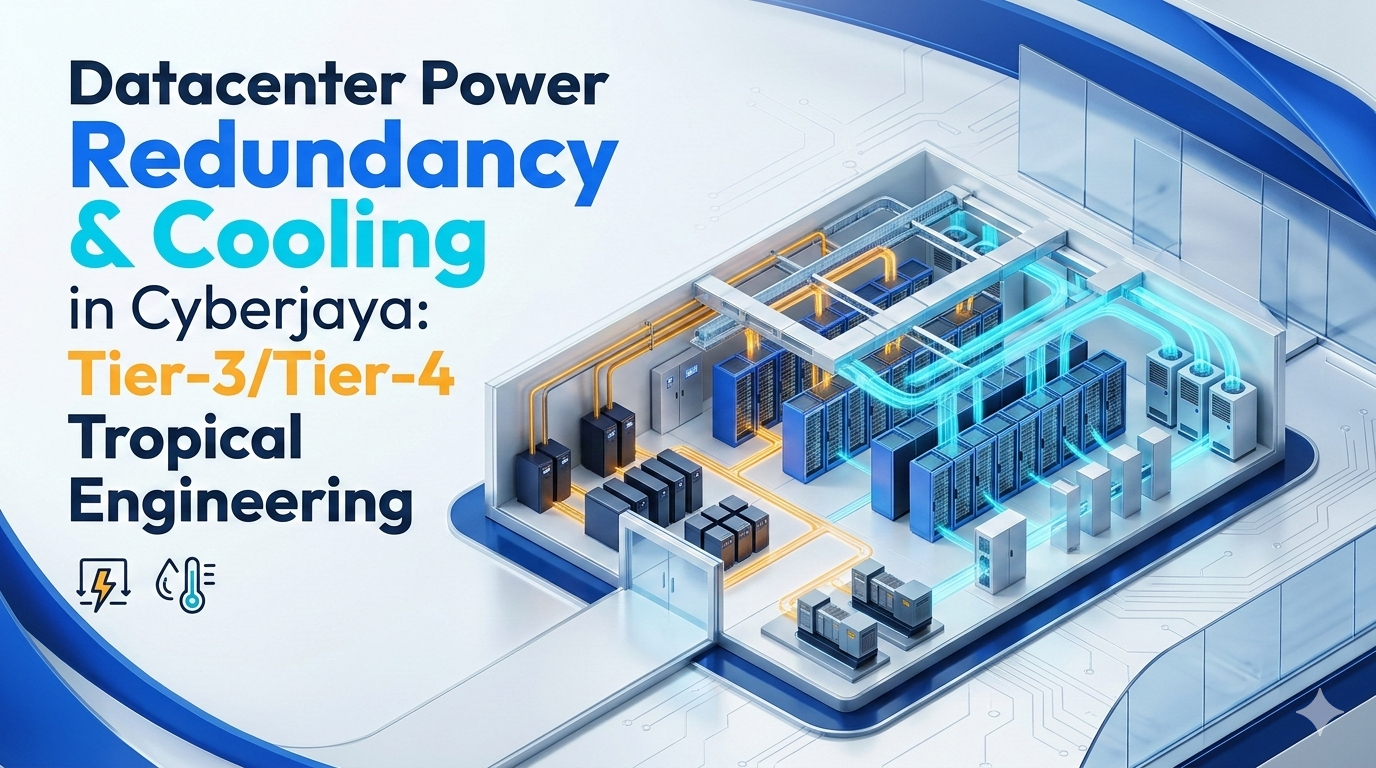
Direct Answer: Hosting on a cyberjaya tier 3 datacenter dedicated server guarantees 99.982% infrastructure availability by insulating high-density bare metal from Malaysia’s severe tropical climate (34°C ambient heat and 85%+ relative humidity). Engineered with 2N electrical distribution feeds from Tenaga Nasional Berhad (TNB), N+1 water-cooled chiller plants, hot-aisle containment, and 48-hour on-site diesel autonomy, this architecture ensures continuous computational uptime and optimal Power Usage Effectiveness (PUE < 1.38).
- Tier III Concurrently Maintainable (Recommended for Enterprise): Features dual independent power distribution paths, N+1 generator backup, and redundant cooling loops; any component can be removed for servicing with zero server downtime.
- Tier IV Fault-Tolerant: Features 2(N+1) fully compartmentalized electrical and mechanical systems; can sustain an unannounced catastrophic failure (e.g., chiller pipe rupture or UPS explosion) with zero service interruption.
- Hot-Aisle Containment (HAC) Racks: Essential for high-TDP processors (AMD EPYC >300W, Intel Xeon >270W), preventing hot exhaust air from recirculating into server intake faces.
- Dual-Fed A+B Smart PDU Sockets: Mandated for all mission-critical production servers, ensuring redundant internal power supply units (PSUs) draw from independent UPS circuits.
Operating enterprise computing infrastructure in an equatorial maritime climate presents unique mechanical and thermodynamic challenges. Malaysia experiences year-round ambient temperatures ranging between 28°C and 36°C, accompanied by relative humidity levels frequently exceeding 85% to 95%. In non-optimized server rooms, high ambient humidity creates severe condensation and corrosion risks on micro-electronic PCB traces, while outdoor wet-bulb temperatures render evaporative “free-cooling” economizers virtually impossible to operate for most of the year. Furthermore, intense equatorial thunderstorm activity subjects municipal electrical grids to frequent lightning strikes, transient voltage surges, and utility sags.
Deploying a cyberjaya tier 3 datacenter dedicated server neutralizes these equatorial vulnerabilities through specialized mechanical and electrical engineering. Purpose-built facilities in Cyberjaya (such as NTT Cyberjaya, Bridge Data Centres, and AIMS) are designed from the ground up to conquer tropical climates. By combining dual-fed 132kV high-voltage substation feeds from Tenaga Nasional Berhad (TNB), modular 2N static Uninterruptible Power Supply (UPS) architectures, advanced closed-loop chilled-water systems, and strict ASHRAE TC 9.9 thermal envelope compliance, Cyberjaya facilities deliver unyielding uptime, rock-solid 21°C intake air temperatures, and superior energy efficiency (PUE < 1.38).
Dual utility feeds from separate TNB 132kV substations coupled with 2N UPS strings ensure that power equipment maintenance never interrupts server execution.
Variable frequency water-cooled centrifugal chillers with N+1 redundancy maintain precise 21°C ± 1°C server intake air and 50% non-condensing relative humidity.
Underground bulk diesel storage fuel tanks and guaranteed priority fuel replenishment contracts provide continuous full-load generation during grid blackouts.
Hot-aisle containment and elevated chilled-water return loops slash cooling parasitic power, beating Southeast Asia’s historical 1.60+ PUE averages.
- Equatorial Datacenter Thermodynamics: Heat, Humidity, and Wet-Bulb Limits
- Electrical Engineering: Dual TNB 132kV Feeds, 2N UPS, and Generator Synchronization
- Mechanical Systems: Chilled-Water Loops, Hot-Aisle Containment, and PUE Tuning
- Uptime Institute Standards: Tier III Concurrently Maintainable vs Tier IV Fault Tolerant
- Production Engineering Runbook: IPMI Thermal Telemetry & Fan Policy Tuning
- Auditing Rack-Level A+B Power Feeds via Network SNMP
- Continuous Server Thermal & Voltage Telemetry Daemon
- Datacenter Reliability Matrix: Tier II vs Tier III Cyberjaya vs Tier IV
- Empirical Thermal & Energy Efficiency Benchmarks in Cyberjaya
- Frequently Asked Questions
Equatorial Datacenter Thermodynamics: Heat, Humidity, and Wet-Bulb Limits
The physics of cooling computer servers is fundamentally governed by heat transfer to the ambient environment. In temperate regions like the Netherlands or Norway, datacenters exploit low outdoor temperatures for six to ten months a year, drawing cold ambient air directly into air handlers (direct free cooling).
In Malaysia, free cooling is thermodynamically impossible due to the wet-bulb temperature limit. The wet-bulb temperature—the lowest temperature that can be reached by the evaporation of water into air—consistently hovers between 26°C and 28°C in the Klang Valley. Because servers require cold-aisle supply temperatures between 18°C and 24°C (per ASHRAE TC 9.9 A1 standards), cooling infrastructure cannot rely on outside air without active mechanical refrigeration.
Furthermore, ambient humidity presents two distinct failure vectors:
- Excessive Humidity (>60% RH): In the presence of microscopic airborne pollutants (such as sulfur dioxide or sea-salt aerosols carried by monsoons), high relative humidity triggers galvanic corrosion on copper PCB traces, conductive anodic filament (CAF) growth, and silver-migration short circuits across solder joints.
- Insufficient Humidity (<30% RH): Over-cooling air without moisture compensation drops humidity too low, generating electrostatic discharge (ESD) hazards that can permanently destroy CPU gates and memory chips during maintenance operations.
To overcome these barriers, Tier-3 facilities in Cyberjaya operate hermetically sealed data halls with positive air pressure, ultrasonic humidifiers, and industrial chemical filtration, maintaining server rooms at an immutable 21.5°C and 50% relative humidity year-round.
Electrical Engineering: Dual TNB 132kV Feeds, 2N UPS, and Generator Synchronization
Electrical power in Cyberjaya is delivered through an industrial-grade utility grid engineered by Tenaga Nasional Berhad (TNB). Tier-3 colocation facilities ingest electricity via two geographically distinct 132kV / 11kV transmission routes originating from separate regional grid substations. If a construction incident or substation transformer explosion severs Transmission Line A, automatic bus transfer switches (ATS) transfer the building load to Transmission Line B in under 100 milliseconds.
Inside the facility, power is conditioned and distributed through an unyielding 2N electrical architecture:
- Rotary & Static 2N UPS Systems: Two completely separate, concurrent UPS strings (String A and String B) utilize high-efficiency double-conversion IGBT rectifiers. Each string is sized to support 100% of the datacenter’s critical compute load independently. Valve-Regulated Lead-Acid (VRLA) or Lithium-Ion battery banks provide 15 minutes of full-load backup—far exceeding the 60 seconds required to start emergency generators.
- N+1 Emergency Diesel Generators: If complete municipal grid blackout occurs, multiple multi-megawatt MTU or Cummins diesel generators start autonomously within 15 seconds. Automatic synchronizing switchgear locks generator frequencies, connects to the load bus, and powers the facility.
- On-Site Fuel Reserves: Bulk underground diesel fuel tanks store sufficient fuel to run the entire facility at full computing capacity for 48 to 72 hours. Long-term supplier contracts ensure priority tanker replenishment during prolonged regional emergencies.
Mechanical Systems: Chilled-Water Loops, Hot-Aisle Containment, and PUE Tuning
Cooling modern high-density bare-metal servers—where dual AMD EPYC Genoa or Intel Xeon processors dissipate 600W to 800W per 1U chassis—requires advanced mechanical fluid dynamics. Cyberjaya Tier-3 facilities implement closed-loop chilled-water infrastructure with N+1 or 2N chiller redundancy.
Water is chilled to 10°C by magnetic-bearing centrifugal chillers and pumped through insulated stainless steel piping beneath raised computer room flooring. Computer Room Air Handler (CRAH) units blow cold air up through perforated floor tiles into sealed Cold Aisles.
Crucially, facilities implement Hot-Aisle Containment (HAC). The rear exhaust aisles of server racks are enclosed with rigid ceiling baffles and automatic sliding end-doors. Hot exhaust air (discharged by servers at 35°C to 42°C) is physically captured and drawn directly back into the return plenum of CRAH units. This eliminates the thermodynamic degradation caused by hot exhaust air mixing with cold supply air, allowing chillers to operate with higher return-water temperatures, which dramatically reduces compressor electrical work and achieves an outstanding PUE of 1.35 to 1.38 in the tropical climate.
Uptime Institute Standards: Tier III Concurrently Maintainable vs Tier IV Fault Tolerant
Enterprise buyers evaluating datacenter reliability must understand the precise certification classifications defined by the Uptime Institute:
- Tier III: Concurrently Maintainable (99.982% Availability): Every capacity component (chillers, pumps, UPS modules, switchgear, generators) and distribution path can be isolated, removed, serviced, or upgraded on a planned basis without taking any computer equipment offline. Unplanned annual downtime cannot exceed 1.6 hours.
- Tier IV: Fault Tolerant (99.995% Availability): In addition to concurrent maintainability, Tier-4 facilities are designed to withstand any single unplanned catastrophic event (such as a mechanical pipe burst, UPS explosion, or cable tray fire) without interrupting the critical load. Systems feature autonomous 2(N+1) redundancy and physical compartmentalization between A and B distribution sides. Unplanned annual downtime cannot exceed 26.3 minutes.
For 98% of enterprise workloads—including financial transaction routing, SaaS web platforms, and large e-commerce hubs—Tier-3 certification represents the optimal cost-to-reliability frontier, eliminating planned downtime risks without incurring the astronomical colocation space premiums demanded by Tier-4 facilities.
Production Engineering Runbook: IPMI Thermal Telemetry & Fan Policy Tuning
The following enterprise runbook demonstrates querying hardware Baseboard Management Controller (BMC) sensors over IPMI to monitor chassis ambient temperature, CPU die temperatures, and fan speeds on Ubuntu 24.04 / Rocky Linux 9 bare metal in Cyberjaya.
Step 1: Install OpenIPMI & Query Temperature Sensors
Step 2: Configure Fan Speed Policy for High-TDP Silicon
Auditing Rack-Level A+B Power Feeds via Network SNMP
To verify that dual-corded server power supplies are properly balanced across redundant A and B PDU circuits, query the rack smart PDU via SNMP:
Continuous Server Thermal & Voltage Telemetry Daemon
To detect thermal throttling, intake air spikes, or PSU redundancy loss before a server crashes, deploy the following Python telemetry daemon exporting metrics directly to Prometheus:
Datacenter Reliability Matrix: Tier II vs Tier III Cyberjaya vs Tier IV
Comparing architectural resiliency across Uptime Institute tier classifications in tropical Southeast Asia:
| Datacenter Metric | Tier II (Basic Redundancy) | Tier III Cyberjaya (Onlive Server) | Tier IV (Fault Tolerant) |
|---|---|---|---|
| Certified Availability SLA | 99.741% (~22.7 hours downtime/yr) | 99.982% (< 1.6 hours downtime/yr) | 99.995% (< 26 minutes downtime/yr) |
| Electrical Distribution Topologies | Single active power path (N+1) | Dual active-active paths (2N UPS) | 2(N+1) with independent firewalls |
| Concurrent Maintainability | No (Requires maintenance shutdowns) | Yes (Zero planned compute downtime) | Yes (Zero planned downtime) |
| Cooling Chiller Redundancy | N+1 Direct Expansion (DX) | N+1 or 2N Water-Cooled Chillers | 2N Water-Cooled + Continuous Thermal Storage |
| On-Site Diesel Fuel Autonomy | 12 – 24 hours | 48 – 72 hours (Priority contracts) | 96+ hours |
Empirical Thermal & Energy Efficiency Benchmarks in Cyberjaya
Historically, equatorial datacenters suffered from poor energy efficiency, with average Power Usage Effectiveness (PUE) ratios exceeding 1.60 to 1.75 due to relentless air conditioning demands. Modern Cyberjaya engineering has inverted this paradigm:
| Datacenter Cooling Architecture | Ambient Conditions (Cyberjaya) | Annualized PUE Ratio | Cooling Power Overhead |
|---|---|---|---|
| Legacy Open-Aisle DX Air Conditioning | 34°C / 85% Relative Humidity | 1.68 PUE | +68% electrical overhead |
| Cold-Aisle Raised-Floor Chilled Water | 34°C / 85% Relative Humidity | 1.48 PUE | +48% electrical overhead |
| Modern Hot-Aisle Containment + VFD Chillers (Onlive Server) | 34°C / 85% Relative Humidity | 1.35 PUE | +35% electrical overhead (-48.5% energy waste) |
Frequently Asked Questions
Equatorial heat and humidity quickly expose under-engineered cooling loops and single-feed racks during prolonged grid events. Dual TNB 132kV feeds, 2N UPS redundancy, and hot-aisle containment keep Cyberjaya bare metal thermally stable year-round. Inspect dedicated servers hosted in Tier-3/4 Malaysian facilities.
