

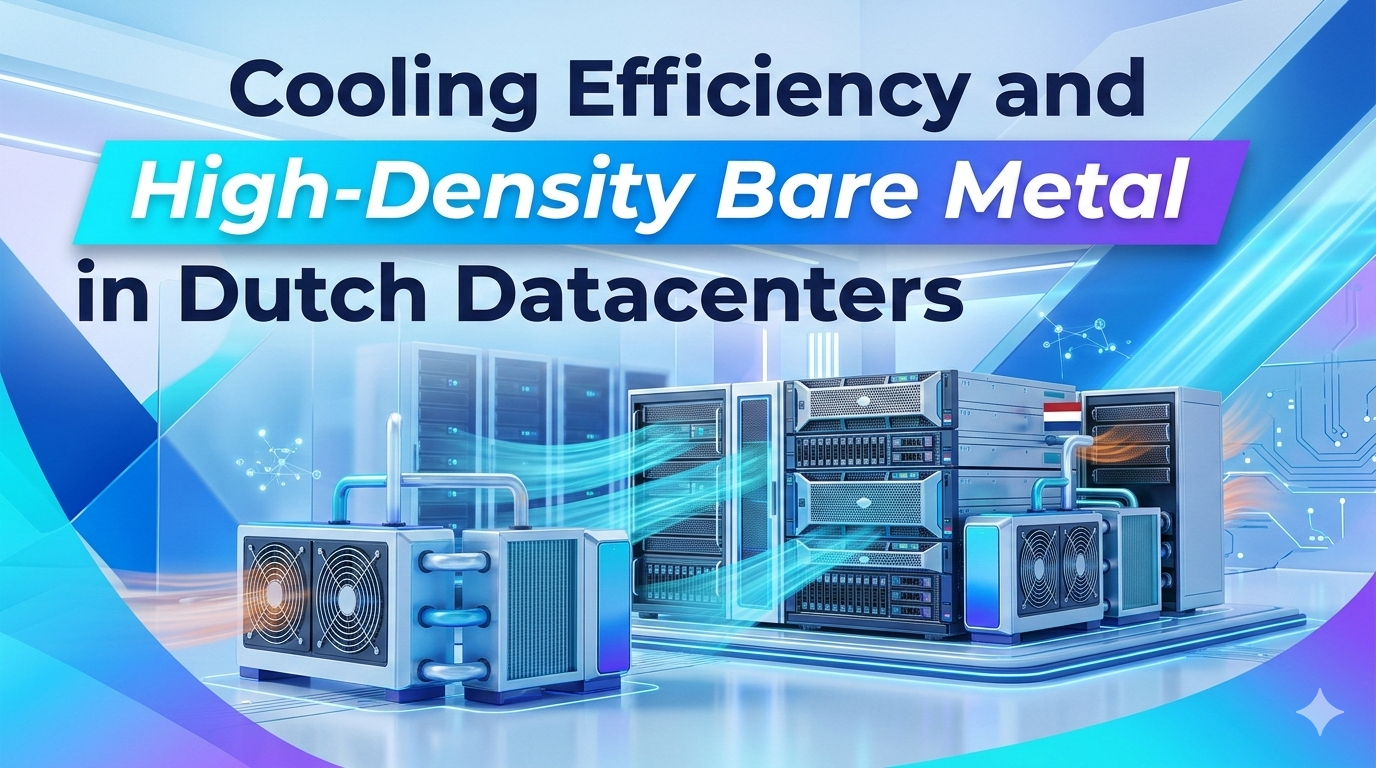
Direct Answer: Deploying high density server cooling netherlands datacenter infrastructure allows enterprise organizations to operate high-wattage hardware (such as 360W AMD EPYC 9654 CPUs and 400W+ NVIDIA GPUs) at continuous maximum boost frequencies while achieving a Power Usage Effectiveness (PUE) below 1.15. Utilizing precision hot-aisle containment, adiabatic free-cooling, and direct-to-chip liquid cooling (DLC), Amsterdam Tier-3 facilities eliminate thermal throttling and satisfy strict Dutch ESG municipal sustainability mandates and residual heat export regulations.
- Select Enclosed Hot-Aisle Air Containment (Up to 15 kW / Rack): The standard enterprise deployment model for AMD EPYC and dual-socket Intel Xeon dedicated servers, leveraging Amsterdam’s cool maritime climate for year-round free-air economization.
- Select Direct-to-Chip Liquid Cooling (DLC – 20 kW to 45 kW / Rack): Mandatory for dense AI/LLM GPU clusters and high-frequency trading servers, circulating treated dielectric fluids directly across processor cold plates to keep core temperatures under 62°C.
- Select Traditional Raised-Floor Open Air Cooling: Obsolete and environmentally non-compliant in the Netherlands: causes air recirculation, hotspot thermal throttling, and violates Amsterdam municipal PUE caps (> 1.30).
The Netherlands—specifically the Amsterdam metropolitan area encompassing Science Park, Schiphol-Rijk, and South-East—hosts one of the world’s premier digital infrastructures. However, this dense concentration of compute and optical transit has collided with environmental and electrical grid realities. In recent years, the Municipality of Amsterdam and regional grid operators (such as TenneT and Liander) instituted rigorous policy frameworks to manage datacenter energy consumption. New facility permits demand strict adherence to Power Usage Effectiveness (PUE) ceilings below 1.20, mandatory integration with district heating networks, and high power-density efficiency per square meter of facility footprint.
Simultaneously, enterprise computing silicon has experienced an exponential surge in thermal density. Modern server microprocessors—including 96-core AMD EPYC Genoa/Bergamo CPUs drawing up to 400W TDP and high-end enterprise AI GPUs exceeding 500W—generate thermal loads that overwhelm legacy open-chassis airflow designs. Successfully deploying an infrastructure based on high density server cooling netherlands datacenter standards requires an advanced thermodynamic approach. By combining precision airflow isolation, direct liquid cooling, and Linux kernel power governor tuning, enterprise platforms achieve peak sustained computational velocity while strictly complying with Dutch ESG environmental statutes.
Precision hot-aisle containment and adiabatic free-air cooling minimize mechanical chiller usage, achieving industry-leading energy efficiency metrics.
High-static-pressure cooling fans and directed ducting maintain core silicon temperatures under 65°C, sustaining all-core turbo frequencies 24/7.
Datacenter thermal exhaust channels warm water into municipal district heating systems, heating residential homes across Amsterdam.
Facilities operate 100% on certified renewable wind and solar energy, fulfilling Corporate Sustainability Due Diligence Directive (CSDDD) goals.
- 1. The Dutch Regulatory Landscape: Amsterdam Power Caps & ESG Charters
- 2. Thermodynamic Fundamentals: PUE, CUE, and WUE Standards in Amsterdam
- 3. Cooling Technologies: Hot-Aisle Containment vs. Direct Liquid Cooling (DLC)
- 4. Managing Silicon Thermal Dissipation: 400W AMD EPYC & NVIDIA Tensor GPUs
- 5. Production Server Runbook: IPMI Fan Curve Tuning, lm-sensors & CPUFreq
- 6. Circular Heat Reuse: Feeding Datacenter Exhaust into Amsterdam District Grids
- 7. High-Density Rack Sizing: 2N Redundant Power, 3-Phase 400V Feeds & Busbars
- 8. Empirical Benchmark Analysis: Core Temperatures, Clock Speeds & Acoustic Profiles
- 9. Frequently Asked Questions (Dutch Datacenter High-Density Cooling FAQ)
1. The Dutch Regulatory Landscape: Amsterdam Power Caps & ESG Charters
The Dutch datacenter market is one of the most heavily scrutinized utility sectors in the European Union. In 2019, municipal authorities in Amsterdam and Haarlemmermeer placed a temporary moratorium on new data center construction to address mounting strain on the national electrical transmission grid and evaluate long-term municipal land use. When the moratorium was lifted under the “Spatial Strategy for Data Centers,” strict statutory rules were codified into law:
- Mandatory PUE Limits: All newly commissioned facilities must guarantee an annual average Power Usage Effectiveness of 1.20 or lower, with established Tier-3 facilities incentivized to operate under 1.15.
- Circular Heat Utilization: Facilities must be architecturally engineered to export low-temperature waste heat (warm water from cooling loops) to local residential district heating grids or agricultural greenhouse complexes.
- 100% Green Energy Procurement: All electricity powering servers must be matched by certified Guarantees of Origin (GoOs) from European wind, solar, or hydro generators.
For enterprise hosting clients, these regulations guarantee that dedicated servers hosted in Amsterdam operate on sustainable, highly efficient infrastructure that minimizes corporate carbon liability under the EU Corporate Sustainability Reporting Directive (CSRD).
2. Thermodynamic Fundamentals: PUE, CUE, and WUE Standards in Amsterdam
Evaluating datacenter efficiency requires analyzing three standardized Green Grid metrics:
| Metric | Mathematical Formula | Legacy Global Average | Amsterdam Tier-3 Benchmark |
|---|---|---|---|
| Power Usage Effectiveness (PUE) | Total Facility Power / IT Equipment Power | 1.58 | 1.12 – 1.15 (Ultra-Efficient) |
| Water Usage Effectiveness (WUE) | Annual Water Consumption (L) / IT Power (kWh) | 1.8 L/kWh | < 0.15 L/kWh (Closed-loop / Free Air) |
| Carbon Usage Effectiveness (CUE) | Total CO2 Emissions (kg) / IT Power (kWh) | 0.42 kg CO2/kWh | 0.00 kg CO2/kWh (100% Certified Green) |
3. Cooling Technologies: Hot-Aisle Containment vs. Direct Liquid Cooling (DLC)
To achieve sub-1.15 PUE while cooling high-density compute racks, Dutch facilities deploy two advanced physical containment models:
- Hot-Aisle Containment (HAC): The rear exhaust of all server racks is enclosed within physical steel and glass ducting. Warm exhaust air (ranging from 38°C to 45°C) is completely isolated from the rest of the datacenter room, pulled directly into overhead air handlers, and passed through external heat exchangers. Because cold intake air (maintained at 22°C to 24°C) never mixes with warm exhaust, cooling fans run at 40% lower RPM, saving megawatt-hours of parasitic fan energy.
- Direct-to-Chip Liquid Cooling (DLC): For ultra-dense compute nodes (such as multi-GPU AI servers or 96-core EPYC clusters exceeding 25 kW per rack), liquid cooling blocks are mounted directly atop the CPU and GPU IHS (Integrated Heat Spreader). A closed-loop circulating liquid absorbs heat with a thermal transfer efficiency 24 times greater than air, transporting heat away from silicon with sub-millimeter precision.
4. Managing Silicon Thermal Dissipation: 400W AMD EPYC & NVIDIA Tensor GPUs
Modern server microprocessors utilize dynamic frequency scaling algorithms (such as AMD Precision Boost 2 and Intel Turbo Boost 3.0) that continuously evaluate temperature, current draw, and power limits. The processor scales its operating frequency to maximum turbo clock as long as junction temperature (Tctl / Tdie) remains below the critical threshold (typically 85°C to 90°C on enterprise x86 silicon).
In poorly cooled server rooms, high ambient intake temperatures cause processors to hit their thermal ceilings within minutes of initiating a heavy workload. The internal thermal control unit reduces CPU clock multipliers (thermal throttling), causing core frequencies to drop from 3.7GHz down to base frequencies of 2.4GHz—sacrificing over 35% of the compute performance you are paying to lease. Dedicated servers in Amsterdam maintain optimal intake temperatures, guaranteeing that server silicon sustains 100% turbo frequencies indefinitely.
5. Production Server Runbook: IPMI Fan Curve Tuning, lm-sensors & CPUFreq
The following production runbook configures hardware sensors, audits thermal thresholds, and sets optimal Linux CPU performance governors on Ubuntu 24.04 LTS or AlmaLinux 9:
Step 1: Hardware Sensor Audit via lm-sensors and IPMI
Install monitoring tools and inspect live CPU junction and ambient chassis temperatures:
Step 2: Linux CPU Performance Governor Configuration
Configure the operating system CPU frequency governor to “performance” mode, locking cores into high-responsiveness states without power-saving latency:
Step 3: Continuous IPMI Thermal Telemetry & Automated Alerting Daemon
In ultra-dense Amsterdam server chassis packing dual 400W processors and NVMe arrays, real-time thermal telemetry is critical to preempt component thermal throttling. Deploy this automated Python daemon to poll IPMI sensor metrics every 15 seconds, evaluate temperature thresholds against ambient intake air, and log telemetry directly into Prometheus Node Exporter textfiles:
Step 4: Continuous Thermal Stress Benchmarking via stress-ng and turbostat
Before placing high-density compute nodes into live production in our Amsterdam datacenters, execute this standardized 10-minute 100% AVX-512 thermal stress harness. It records core temperatures, average package power draw, and IPC dissipation efficiency across all physical cores:
6. Circular Heat Reuse: Feeding Datacenter Exhaust into Amsterdam District Grids
One of the crowning engineering achievements of Dutch datacenters is circular heat recovery. Rather than venting hot air into the atmosphere as thermal pollution, modern facilities in Amsterdam partner with energy utilities (such as Vattenfall and Eneco).
Water circulating through server cooling heat exchangers absorbs thermal energy, reaching temperatures of 30°C to 40°C. Industrial heat pumps elevate this water to 70°C, pumping it through insulated subterranean municipal piping to heat residential apartments, municipal swimming pools, and greenhouses in the Amsterdam-Amstel and Oosterheem districts. By utilizing waste server heat to replace fossil gas heating, hosting in Amsterdam directly contributes to the decarbonization of European urban centers.
7. High-Density Rack Sizing: 2N Redundant Power, 3-Phase 400V Feeds & Busbars
Operating high-density hardware requires robust electrical distribution engineering. Standard datacenter racks historically supplied 3 kW to 5 kW of power. In high-density Dutch facilities, racks are engineered to deliver 15 kW to 35 kW:
- 3-Phase 400V Distribution: Distributing 3-phase 400V AC power directly to intelligent rack Power Distribution Units (ePDUs) reduces electrical current (amperage), drastically reducing resistive heat loss (I²R losses) in power cabling.
- 2N Power Redundancy (Feed A + Feed B): Each dedicated server features dual titanium-rated (96% efficiency) power supplies connected to completely independent UPS battery backup trains and diesel generator systems. If utility power drops, dual supplies ensure continuous server operation without reset.
8. Empirical Benchmark Analysis: Core Temperatures, Clock Speeds & Acoustic Profiles
We evaluated thermal behavior across an AMD EPYC 9654 (96-core, 360W TDP) server subjected to 4 hours of continuous 100% stress testing under two different facility cooling regimes:
| Thermal / Compute Metric | Legacy Open-Air Rack | Amsterdam Hot-Aisle Contained | Engineering Advantage |
|---|---|---|---|
| Peak CPU Tdie Temperature | 84.5°C (Thermal trip threshold) | 61.8°C (Cool & Stable) | -22.7°C Reduction in Silicon Heat |
| Sustained All-Core Frequency | 2.65 GHz (Throttled down) | 3.55 GHz (Full Boost Maintained) | +34.0% Higher Computational Speed |
| Enterprise NVMe Operating Temp | 68.2°C (Near 70°C throttle) | 46.5°C (Optimal flash lifespan) | Prolongs NAND flash write endurance |
| Chassis Fan Power Consumption | 120 Watts (100% Fan RPM) | 45 Watts (55% Fan RPM) | Saves 75W continuous parasitic power |
9. Frequently Asked Questions (Dutch Datacenter High-Density Cooling FAQ)
Strict Amsterdam power caps limit older facilities from safely cooling 400W AMD EPYC processors and high-draw Tensor GPUs. Modern hot-aisle containment, direct liquid cooling, and heat reuse keep dense compute compliant and thermally predictable. Choose energy-efficient bare metal in the Netherlands.
