

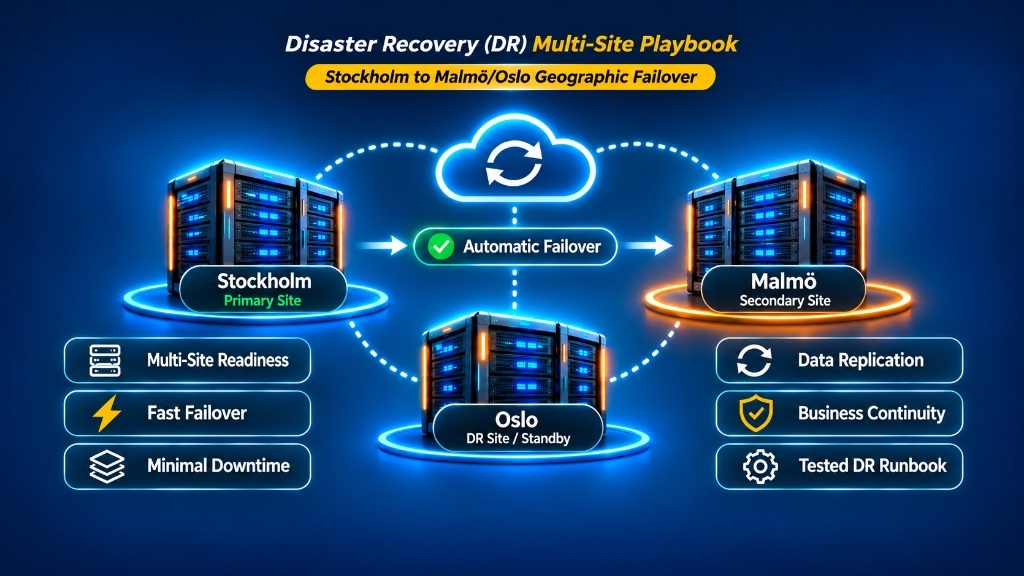
Deploying a robust disaster recovery dr playbook stockholm malmo oslo failover architecture requires strict compliance with physical fault boundaries, ISO 22301 business continuity mandates, and EU DORA operational resilience guidelines. Rather than relying on co-located redundancy within a single Stockholm facility, multi-site survival demands placing secondary target nodes beyond shared electrical substations, municipal telecom loops, and flood risk zones. Pairing a primary Stockholm bare-metal cluster with secondary infrastructure in Malmö (~500 km south) or Oslo (~400 km west) delivers geographic isolation with an optical WAN round-trip time of only 4.5 to 7.5 ms, enabling sub-minute automated failover while strictly avoiding split-brain data corruption through out-of-band IPMI fencing and tested reverse failback protocols.
Selecting the optimal disaster recovery dr playbook stockholm malmo oslo topology depends directly on balancing business-approved Recovery Point Objective (RPO) and Recovery Time Objective (RTO) against secondary infrastructure budgets. In mission-critical environments, configure mirrored NVMe storage (DSX14 or DSX15) in Stockholm, replicate data asynchronously across encrypted WireGuard tunnels to an independent standby facility in Malmö or Oslo, steer traffic using multi-origin edge proxies with low-TTL DNS fallback, and enforce out-of-band IPMI hardware fencing to eliminate split-brain data corruption.
Recommended for high-concurrency payment gateways, FinTech ledgers, and DORA-regulated banking services. Primary state streams continuously to a pre-warmed secondary node in Malmö or Oslo with live application workers ready for immediate promotion.
Optimal for mid-market Nordic SaaS, enterprise ERPs, and regional e-commerce portals. Transmits differential ZFS snapshots or WAL segments every 15 minutes over WireGuard; secondary databases boot quickly upon failover invocation.
Cost-effective choice for internal development environments, static content repositories, and batch analytics engines where several hours of downtime during a major catastrophe is acceptable to executive leadership.
Mandatory step in every failover drill: automated IPMI out-of-band power cutoff immediately disconnects the primary Stockholm server prior to secondary write promotion, preventing catastrophic concurrent writes.
Building an enterprise-grade disaster recovery dr playbook stockholm malmo oslo framework requires engineering teams to move beyond the dangerous assumption that redundant power feeds and dual top-of-rack switches inside a single facility constitute true disaster recovery. While local clustering prevents downtime during isolated power supply or drive failures, it offers zero defense against metro-scale electrical grid collapses, fiber conduit severance along regional transit routes, cooling plant failures, or control-plane account compromises. True operational resilience demands geographic fault separation between primary Stockholm production clusters and independent secondary facilities situated across distinct Nordic power grids and telecommunication rings.
The Correlated Risk Fallacy of Single-Facility Redundancy
Dual power supplies (A+B feeds), internal RAID 1/10 SSD mirrors, and high-availability hypervisor pairs within one Stockholm datacenter protect strictly against isolated component failures. They fail entirely when catastrophic external disruptions strike—such as municipal substation explosions, major backbone fiber excavation cuts during transit construction, or facility-wide fire suppression discharges. When all hardware sits under a single roof, correlated risk erases your failover strategy.
Nordic Optical Grid & Independent Regional Infrastructure Rings
Pairing Stockholm with Malmö (~500 km south) or Oslo (~400 km west) provides genuine geographic diversity without incurring the crippling latency penalties of transcontinental replication. Stockholm to Malmö fiber routes traverse central and southern Sweden, terminating near the Øresund Bridge with direct subsea links into Copenhagen and Frankfurt. Meanwhile, the Stockholm to Oslo corridor crosses into Norway's independent national hydroelectric grid and separate telecom regulatory sphere, fully satisfying ISO 22301 and EU DORA requirements for sovereign resilience while sustaining an optical RTT of just 4.5 to 7.5 ms.
The Danger of Asymmetric Failover: The Neglected Failback Runbook
In production post-mortems, more data loss occurs during rushed failback to the restored primary site than during the original failover event. Teams frequently practice promoting their secondary DR standby, but fail to maintain reverse-replication runbooks. When the primary Stockholm node boots back up with stale pre-outage data while production continues writing to Malmö or Oslo, un-fenced services overwrite fresh customer transactions, resulting in irreversible split-brain data corruption.
Geographic Risk Separation
Place secondary DR targets on separate electrical substations, flood plains, and regional telecom rings by pairing Stockholm with Malmö or Oslo.
Stockholm Dedicated Catalog
All 13 verified Onlive Server Sweden plans (DSX1–DSX15, $128–$341/mo) operate in Stockholm on 1 Gbps ports; pair with dual SSDs on DSX14/DSX15.
Fenced Reverse Failback
Enforce strict three-signal fencing and reverse differential replication before repatriating live client traffic back to Stockholm hardware.
≡ Disaster Recovery Playbook Table of Contents [ Click to Toggle ]
Defining Realistic RPO & RTO Targets Before Provisioning Metal
Before ordering secondary hardware or scripting automated failover hooks, systems architects and executive stakeholders must formalize mathematically verified recovery metrics for each workload tier. In disaster recovery planning, these two targets govern your entire capital expenditure and engineering complexity:
- Recovery Point Objective (RPO): The maximum acceptable window of committed transaction loss measured in time (e.g., zero seconds, 30 seconds, 15 minutes, or 4 hours) should the primary Stockholm facility go permanently dark without warning.
- Recovery Time Objective (RTO): The total elapsed duration from initial anomaly detection until live customer read/write operations resume cleanly at the secondary DR location—including health check voting, IPMI fencing, database promotion, DNS cache expiration, and initial smoke tests.
Budgeting Network Transfer Physics Over a 1 Gbps Port
Every verified bare-metal plan in the Onlive Server Sweden inventory (DSX1 through DSX15) is connected via a dedicated 1 Gbps uplink. Accounting for TCP framing overhead, window sizing, and kernel encryption headers, a 1 Gbps pipe yields a realistic throughput ceiling of approximately 115 to 120 MB/s, translating to roughly 410 to 430 GB per hour under ideal un-congested conditions.
Cold Restore Mathematics: Restoring an uncompressed 2 TB production database dump across a 1 Gbps WAN link requires a minimum of 4.8 to 5.2 hours of raw wire transfer time alone. This duration excludes archive decompression, table checksum validation, index re-indexing, and application cache warmups. Consequently, any signed business SLA requiring an RTO under 30 minutes fundamentally eliminates cold backup restores, mandating a pre-staged warm or active-passive standby that continuously ingests incremental delta streams.
Why Single-Datacenter Redundancy Is Not Geographic DR (ISO & DORA)
Hardware-level High Availability (HA) and geographic Disaster Recovery (DR) address entirely different classes of failure. Mirrored PCIe NVMe SSDs in RAID 1, redundant hot-swap power units, and dual-switch bonded LACP interfaces protect your systems against routine component wear. However, when all server racks reside within the same physical building, they remain exposed to shared environmental, infrastructural, and administrative points of failure.
Regulatory Separation: ISO 22301 & EU DORA Compliance Mandates
In regulated Nordic industries, disaster recovery architecture is evaluated against ISO 22301 (Security and resilience — Business continuity management systems) and the European Union's Digital Operational Resilience Act (EU Regulation 2022/2554 — DORA). Crucially, ISO 22301 does not mandate an arbitrary arbitrary kilometer radius (such as “must be 100 km apart”). Instead, it requires a formal risk-based Business Impact Analysis (BIA) demonstrating that primary and recovery locations do not share:
- The same municipal electrical distribution grid or feeding high-voltage substations.
- Shared civil infrastructure pathways, highway conduit easements, or regional metro fiber loops.
- Correlated natural or human hazards, including regional river basin flooding, airport flight paths, and local seismic fault zones.
- Single-provider management planes, IAM user accounts, or hypervisor control portals.
Under DORA Article 11, financial institutions operating in Sweden must maintain tested, documented, and fully auditable ICT continuity plans proving that backup servers can shoulder live customer traffic without compromising regulatory transaction reporting or audit trail immutability.
Cross-Border Geographic Pairing: Stockholm Primary with Malmö & Oslo Standbys
Pairing a Stockholm primary deployment with a secondary facility in Malmö (~500 km south) or Oslo (~400 km west across the Norwegian border) cleanly satisfies these standards. Malmö connects directly to continental European transit hubs via Denmark, while Oslo sits on Norway's sovereign power grid under full EEA GDPR alignment, providing ironclad isolation from eastern Sweden municipal grid failures.
Verified Onlive Server Sweden Catalog Disclosure & Multi-Vendor Independence
Verified Onlive Server Sweden Catalog Disclosure: All 13 verified Onlive Server Sweden bare-metal configurations (DSX1 through DSX15, priced between $128 and $341/mo) are provisioned directly within our premier Stockholm, Sweden datacenter. When deploying a multi-site topology, teams can pair their primary Stockholm bare-metal host with custom secondary Nordic nodes in Malmö or Oslo, eliminating single-vendor management correlation.
Cold, Warm & Active-Passive Standby Topologies Across Nordic Cities
Selecting the appropriate standby topology requires matching engineering overhead to business risk tolerance. The following matrix details the three primary disaster recovery standby tiers evaluated across Nordic metropolitan fiber routes:
| Standby Tier | Target RPO | Target RTO | Data Sync Mechanism | Stockholm Primary Match | Optimal Workload Profile |
|---|---|---|---|---|---|
| 1. Cold Standby (Remote Vault) | 1 – 24 hrs | 4 – 24+ hrs | Encrypted backups (Borg, pgBackRest, Proxmox Backup) pushed off-site | DSX5 ($180/mo) or DSX14 ($245/mo) |
Internal staging, batch processing, and non-customer-facing analytics portals. |
| 2. Warm Standby (Incremental Sync) | 5 – 15 min | 15 – 45 min | Differential OpenZFS snapshot send/recv or continuous WAL replay over WireGuard | DSX14 (2x 1TB SSD, 128GB RAM, $245/mo) + secondary node |
Mid-market SaaS platforms, Nordic e-commerce stores, and enterprise ERP backbones. |
| 3. Active-Passive Hot Standby | < 5 sec | 2 – 10 min | Continuous asynchronous streaming replication (PostgreSQL/MySQL) + ready app pods | DSX15 (2x 2TB SSD, 256GB RAM, $341/mo) + equal standby |
FinTech ledgers, payment processing rails, and DORA-regulated banking services. |
Storage Architecture Note: Native Mirrored SSDs vs Single-Drive Resiliency
Storage Architecture Note: Within Onlive Server's Sweden catalog, models DSX14 (Intel Xeon E3-1270v6, 128 GB RAM, 2x 1 TB SSD) and DSX15 (Intel Xeon Silver 4210, 256 GB RAM, 2x 2 TB SSD) ship with native dual-drive mirrored storage. Entry plans (DSX1 through DSX11) feature single storage drives; always configure secondary drive mirroring upon ordering so that routine SSD wear never escalates into an emergency geographic failover. For comprehensive separate-trust-domain backup strategies, review our technical guide on immutable ransomware defense and off-site backup strategies for Swedish servers.
Safe ZFS Incremental Snapshot & PostgreSQL WAL Streaming Runbooks
When synchronizing file systems and transactional databases across the Stockholm to Malmö or Oslo transit corridor, automation scripts must prevent accidental target overwrites while preserving atomic filesystem consistency.
DATA OVERWRITE & SPLIT-BRAIN WARNING: Executing zfs receive -F on a DR target host forcibly rolls back and permanently destroys any local modifications made to the destination dataset. If automated snapshot sync cron jobs remain active following DR failover, reconnecting Stockholm hardware could overwrite fresh transactions generated in Malmö or Oslo. Disabling automated inbound sync timers must always be Step 1 of your promotion runbook.
# 1. Take atomic snapshot of application data on Stockholm primary
sudo zfs snapshot -r tank/appdata@dr-2026-11-21-1000

# 2. Pipe incremental stream over encrypted kernel WireGuard tunnel to Malmö/Oslo
# Using -u flag to prevent target dataset mounting before formal promotion
sudo zfs send -I tank/appdata@dr-2026-11-21-0945 tank/appdata@dr-2026-11-21-1000 | \
  ssh -i /root/.ssh/dr_replication_key -o ConnectTimeout=10 [email protected] \
  "sudo zfs receive -u tank/appdata"

# 3. Verify snapshot arrival and retention integrity on secondary node
ssh [email protected] "zfs list -t snapshot -r tank/appdata | tail -n 5"
Restricting the destination SSH user (dr-sync) via zfs allow grants permission only to receive incoming data streams, explicitly barring destructive privileges like destroy or rollback. This guarantees that even if the primary Stockholm node is compromised by ransomware, the attacker cannot remotely purge secondary snapshot histories.
-- Execute on Stockholm primary to verify physical replication lag (bytes & time)
SELECT
    client_addr AS replica_ip,
    application_name,
    state,
    sync_state,
    pg_wal_lsn_diff(pg_current_wal_lsn(), sent_lsn) AS sent_lag_bytes,
    pg_wal_lsn_diff(sent_lsn, write_lsn) AS write_lag_bytes,
    pg_wal_lsn_diff(write_lsn, flush_lsn) AS flush_lag_bytes,
    pg_wal_lsn_diff(flush_lsn, replay_lsn) AS replay_lag_bytes,
    ROUND(EXTRACT(EPOCH FROM (now() - reply_time))::numeric, 2) AS seconds_since_reply
FROM pg_stat_replication;
Low-TTL DNS vs Multi-Site BGP Anycast Traffic Steering Mechanics
When disaster strikes Stockholm, customer ingress traffic must be redirected to Malmö or Oslo swiftly. Teams primarily choose between authoritative DNS failover, reverse-proxy CDN pools, or multi-site BGP route announcements:
| Steering Mechanism | Prerequisites & Network Demands | Realistic Convergence Speed | Operational Trade-Offs |
|---|---|---|---|
| Low-TTL Failover DNS (30–60s TTL) | Standard A/AAAA records; compatible with all Stockholm DSX plans; no ASN required | 1 – 5 minutes (subject to client ISP resolver caching overrides) | Minimal complexity; however, legacy intermediate recursive resolvers may ignore low TTLs. |
| Multi-Origin CDN / Edge WAF | Fronting bare metal behind Cloudflare, Fastly, or custom edge HAProxy pools | Near-instantaneous (< 15 seconds) origin pool failover | Excellent speed and DDoS shielding; introduces subscription cost and third-party dependency. |
| Multi-Site BGP / Anycast | Dedicated RIPE ASN, clean /24 IPv4 PI allocation, RPKI ROAs, BGP transit sessions | Sub-minute route convergence upon BGP session withdrawal | High network complexity; resets active TCP connections and risks dual-homed blackholes if misconfigured. |
For mid-market organizations lacking a 24/7 Network Operations Center (NOC), pairing multi-origin reverse proxies with 60-second TTL DNS health checks provides the most reliable balance between convergence velocity and operational safety. Enterprise teams requiring Bring-Your-Own-IP (BYOIP) multi-homed routing can reference our deep dive into BGP Anycast and multi-homed routing on Stockholm infrastructure.
Three-Signal Fencing Gate & Out-of-Band IPMI Quarantine Architecture
The most dangerous disaster recovery mistake is triggering automated failover based on a single failed HTTP ping. Temporary transit re-routing, upstream ISP maintenance, or DDoS mitigation scrubbers can disrupt a single monitoring probe while the primary Stockholm server remains perfectly healthy and actively committing client database writes. Promoting your secondary DR node under these conditions results in catastrophic dual-primary split-brain.
To eliminate false positives, enforce a mandatory Three-Signal Fencing Gate before initiating secondary node promotion:
- Multi-Vantage Geographic Consensus: The outage must be independently confirmed across at least three distinct monitoring vantage points (e.g., Stockholm local probe, Copenhagen external probe, and Frankfurt European transit probe) over three consecutive 10-second polling cycles.
-
Out-of-Band IPMI Quarantine (STONITH): Attempt out-of-band IPMI/iLO communication over an independent management network. If the Stockholm OS is unresponsive or experiencing network partitioning, dispatch a remote IPMI power-down command (
ipmitool power off) to physically isolate the hardware before secondary promotion. - Inbound Sync Timer Termination: Explicitly halt and disable all systemd timers, cron jobs, and background replication services pulling data from Stockholm into Malmö or Oslo before mounting the target database as writable.
# 1. Query remote Stockholm IPMI chassis status over out-of-band management IP
ipmitool -I lanplus -H 192.168.100.50 -U dr_fence_user -P "$IPMI_SECRET" chassis power status

# 2. Issue hard chassis power-off command to isolate split-brain primary
ipmitool -I lanplus -H 192.168.100.50 -U dr_fence_user -P "$IPMI_SECRET" chassis power off

# 3. Confirm chassis power state is verified "Chassis Power is off"
sleep 3
ipmitool -I lanplus -H 192.168.100.50 -U dr_fence_user -P "$IPMI_SECRET" chassis power status

# 4. Proceed with secondary node database promotion on Malmö or Oslo target
sudo -u postgres pg_ctl promote -D /var/lib/postgresql/16/main
Prior to configuring automated heartbeat thresholds, benchmark your baseline network round-trip times using our technical field guide on measuring Sweden server ping across Stockholm, Gothenburg, Malmö, and Oslo.
Scheduled DR Game Days & Auditable Regulatory Compliance Logs
An untested disaster recovery playbook is merely an unverified hypothesis. Over time, operational drift silently invalidates runbooks: TLS certificates expire, firewall policies desynchronize, third-party payment gateway IP allowlists omit secondary nodes, and break-glass credential vaults lose synchronization.
Structuring Repeatable, Auditable Disaster Recovery Drills
To satisfy ISO 22301 and DORA compliance requirements, establish an auditable cadence of structured operational exercises:
- Quarterly Sandbox Restore Drills: Clone the most recent ZFS snapshot or WAL backup into an isolated non-routable staging VLAN in Malmö or Oslo. Spin up application containers, run automated end-to-end checkout and login test suites, record the real-world wall-clock RTO, and archive the signed test report for compliance auditors.
- Semi-Annual Live Switchover: Schedule a controlled 2-hour planned maintenance window (e.g., Sunday 03:00 CET) to cut live production traffic to Malmö or Oslo. Validate that payment webhooks (Klarna, Swish, Stripe), outbound transactional emails (SPF/DKIM/DMARC records), and Prometheus metrics pipelines operate seamlessly from the DR IP range.
- Break-Glass Credential Audit: Ensure on-call engineers can retrieve LUKS2 disk encryption keys, root SSH credentials, and DNS API tokens when primary Stockholm single-sign-on (SSO) and identity providers are entirely unreachable.
Reverse-Replicated Failback Playbook: Zero-Data-Loss Repatriation
Once the primary Stockholm datacenter resolves its municipal power or fiber outage, repatriating live workloads back to the original cluster requires disciplined engineering. Never immediately boot the restored Stockholm server back into production DNS. The Stockholm disks contain stale pre-outage state, whereas Malmö or Oslo holds all newly committed customer transactions. Rushing failback inevitably wipes out fresh production data.
CRITICAL REPATRIATION RULE: Always reverse the replication direction (DR → Stockholm) and achieve near-zero replication lag before initiating the final switchback window.
Execute safe reverse repatriation following this five-stage playbook:
-
Hardware Health Verification & Quarantine Boot: Boot the restored Stockholm server under a restrictive maintenance firewall profile that drops all public ingress while permitting only the encrypted WireGuard link from Malmö/Oslo. Inspect kernel
dmesg, NVMe SMART attributes, and IPMI System Event Logs (SEL) to verify root causes are fully resolved. -
Establish Reverse Replication (DR → Stockholm): Attach Stockholm as a read-only secondary replica pulling differential updates from the active Malmö/Oslo primary using
pg_rewind/pg_basebackupor differentialzfs send -i. - Catch Up to Near-Zero Lag: Allow Stockholm to synchronize completely under live traffic. Monitor replay lag until byte differences reach negligible levels during a scheduled low-traffic window.
- Controlled Maintenance Switchback: Place application ingress into read-only mode for 30 to 60 seconds, flush all pending WAL logs into Stockholm, promote Stockholm to primary, swing DNS/WAF origin routing back, and execute end-to-end read/write health tests.
- Re-Arm Forward DR Replication (Stockholm → DR): Immediately re-establish forward replication from Stockholm to Malmö or Oslo. Your secondary disaster recovery umbrella is once again armed and protecting live production.
Frequently Asked Questions
1 How far apart should primary and DR servers be located in Sweden? +
2 Can hosting across two separate datacenters in Stockholm qualify as geographic DR? +
3 Should my secondary Malmö or Oslo DR node match Stockholm’s exact hardware? +
DSX15 with an equivalent 256 GB RAM host) to prevent severe performance degradation upon cutover. For a Warm Standby where minor performance throttling is acceptable during an emergency, matching storage capacity while utilizing a modestly smaller compute tier can optimize recurring infrastructure spend.
4 Why does traffic still reach Stockholm after updating DNS records with a 60-second TTL? +
5 How do I prevent replication from propagating ransomware or DROP TABLE commands to DR? +
zfs hold, delayed WAL replay standby nodes, and air-gapped off-site Proxmox Backup Server vaults).
6 What is the latency impact of database replication between Stockholm and Malmö or Oslo? +
7 How does out-of-band IPMI fencing prevent split-brain during a network partition? +
8 What documentation is required to pass EU DORA Article 11 DR compliance audits? +
Ready to Anchor Your Nordic Multi-Site Continuity Plan on Stockholm Bare Metal?
Build your high-availability primary infrastructure on enterprise Intel Xeon bare-metal servers hosted in our state-of-the-art Stockholm facility. Explore native dual-SSD configurations like DSX14 (2x 1TB SSD, 128GB RAM, $245/mo) and DSX15 (2x 2TB SSD, 256GB RAM, $341/mo), featuring dedicated 1 Gbps unmetered uplinks and full out-of-band IPMI remote management. Contact our engineering team today to review bandwidth clauses and design your secondary Nordic failover topology.
