

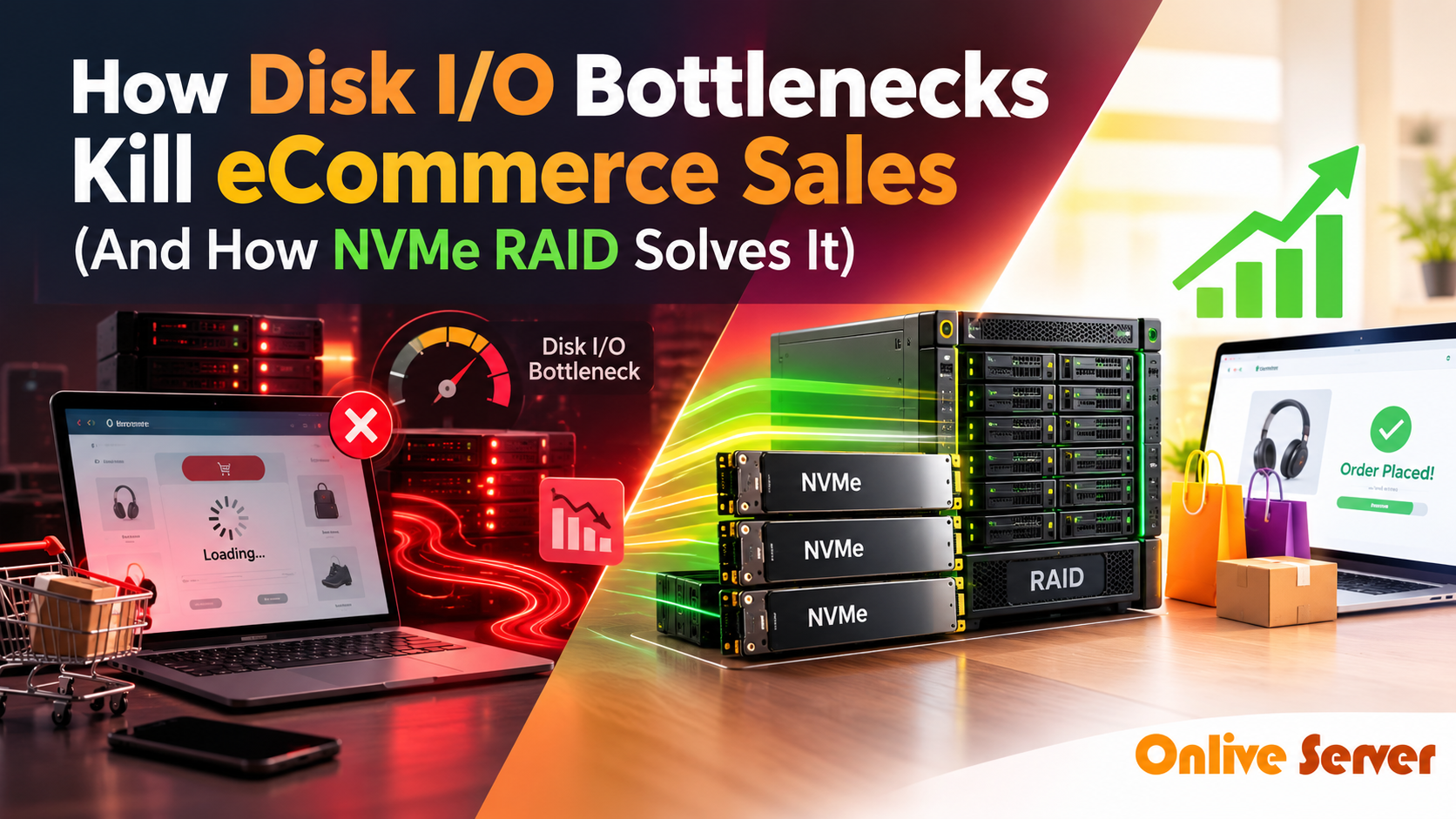
Disk I/O bottlenecks during peak eCommerce flash sales cause shopping cart abandonment by forcing database write-ahead logs and session updates into high wait states (`%iowait`). Upgrading storage infrastructure to an enterprise NVMe RAID 10 array delivers hundreds of thousands of random write IOPS, eliminating checkout queues and guaranteeing sub-second transaction commits.
In online retail, every second of checkout delay directly degrades conversion rates. Industry analytics demonstrate that a single second of page delay reduces customer satisfaction by 16% and cart conversions by 7%. For verified technical specifications and deployment parameters, consult the official Linux Kernel Documentation.
During seasonal promotions or marketing campaigns, shoppers flood product pages and checkout funnels. While front-end caching can serve static product pages swiftly, the checkout funnel requires real-time, non-cacheable database writes for inventory deduction, customer sessions, and payment authorization.
When storage disks cannot process random write operations quickly enough, incoming transactions pile up in disk wait queues. Deploying your online store on dedicated NVMe bare-metal servers provides the dedicated PCIe data highways required to prevent checkout stalls.
The Anatomy of a Flash Sale Checkout Crash
Online store checkout flows rely on ACID transactions. When a customer clicks “Place Order,” the database engine locks row records, verifies stock quantities, updates orders, and executes an `fsync` system call to guarantee durability.
On legacy SATA SSDs or virtual cloud disks with artificial IOPS limits, each `fsync` takes several milliseconds. When hundreds of shoppers check out simultaneously, database connection pools exhaust, web servers return 504 Gateway Timeouts, and abandoned carts skyrocket.
Storage Media Checkout Latency Benchmark
| Storage Configuration | Random Write IOPS | Average fsync Latency | Checkout Queue Capacity |
|---|---|---|---|
| Standard SATA SSD | ~35,000 – 50,000 IOPS | 1.5ms – 3.2ms | Stalls at > 150 concurrent orders |
| Shared Cloud Virtual Disk | Throttled (3,000 – 10,000 IOPS) | 4.0ms – 12.0ms | Heavy queuing and timeouts during surges |
| Enterprise NVMe RAID 10 | 300,000 – 800,000+ IOPS | 0.05ms – 0.15ms | Effortlessly handles 2,500+ concurrent orders |
Why NVMe RAID 10 Is the Ultimate eCommerce Solution
Enterprise NVMe drives communicate directly with the host CPU over PCIe lanes, bypassing legacy AHCI storage bus limits. Pairing four or more enterprise NVMe drives in a striped mirror array (RAID 10) combines extreme speed with hardware fault tolerance.
RAID 10 eliminates the heavy parity calculation write penalties found in RAID 5 and RAID 6 configurations. If a drive experiences a hardware fault during a promotional event, mirrored rebuilds occur smoothly without choking customer checkout transactions.
For emerging eCommerce brands or mid-tier merchants preparing for holiday promotions, migrating to high-performance virtual private servers equipped with enterprise NVMe storage provides a cost-effective upgrade from crowded shared hosts.
Three Server Optimizations to Complement Fast Storage
While upgrading storage drives delivers immediate relief, pairing hardware with database tuning produces the most resilient shopping platform:
1. Move User Sessions to Redis: Storing active eCommerce shopping cart sessions inside MySQL or WooCommerce databases triggers thousands of redundant writes. Relocating session management to an in-memory Redis store eliminates unnecessary disk churn.
2. Tune InnoDB Flush Behavior: Adjusting `innodb_flush_log_at_trx_commit` or expanding the InnoDB log buffer size allows the database to aggregate small write updates before executing bulk writes to disk.
3. Proactive Systems Architecture: Engaging a dedicated Linux system administrator to monitor disk iowait metrics, configure Linux I/O schedulers (such as Kyber or None for NVMe), and perform load simulations guarantees peak readiness.
eCommerce Storage Bottleneck Resolution Checklist
| Action Item | Implementation Focus | Business Impact |
|---|---|---|
| Upgrade to PCIe NVMe | Replace SATA SSDs with enterprise U.2/U.3 drives | Cuts checkout latency by over 80% |
| Implement RAID 10 Array | Striped mirrors with dual-fault tolerance | Zero write penalty; non-blocking drive rebuilds |
| Offload Cart Sessions | Persist shopping carts to Redis RAM instance | Prevents database table bloat during traffic surges |
| Tune I/O Scheduler | Switch Linux scheduler to ‘none’ or ‘kyber’ | Removes legacy kernel queuing overhead for NVMe |
Connection Queue Cascades and Checkout Timeouts
When storage disks become saturated with write operations, transactions take hundreds of milliseconds to complete. Because incoming checkout requests continue arriving at normal rates, database worker connections remain held for longer durations.
This quickly exhausts the database `max_connections` limit. Once the connection pool saturates, upstream PHP-FPM and web server worker processes freeze while waiting for database sockets, triggering widespread HTTP 504 Gateway Timeout errors across your entire digital storefront.
Summary and Key Recommendations
Spending advertising budgets to drive prospective buyers to an eCommerce store only to lose them at the checkout page is catastrophic for business growth. In most cases, these checkout stalls are caused by disk I/O bottlenecks.
By moving database infrastructure to an enterprise NVMe RAID 10 array, offloading user sessions to Redis, and eliminating shared cloud disk limits, online retailers guarantee seamless, instant checkouts that convert traffic into revenue.
NVMe Storage Queuing and Linux Kernel I/O Schedulers
During flash sales and holiday shopping events, ecommerce databases process thousands of concurrent cart additions, stock reservations, and payment confirmations. Under heavy concurrency, disk I/O wait (iowait) represents the primary bottleneck that brings ecommerce checkout pipelines to a complete halt.
Modern enterprise NVMe drives utilize the Non-Volatile Memory Express protocol, providing up to 64,000 independent hardware queues each capable of holding 64,000 commands. However, default Linux configurations designed for spinning disks often route traffic through legacy single-queue elevator schedulers.
System engineers configure the Linux block I/O scheduler to none for NVMe devices via /sys/block/nvme0n1/queue/scheduler. Setting the scheduler to none bypasses OS scheduling layers, allowing database worker threads to dispatch I/O commands directly to hardware queues at microsecond bus latency.
InnoDB Buffer Pool Sizing and Flush Optimization
MySQL InnoDB relies on its in-memory buffer pool to cache frequently accessed table pages and index trees. When database queries read data that resides within the buffer pool, transactions execute in nanoseconds without generating physical disk I/O.
For dedicated ecommerce database servers, administrators size the buffer pool to allocate between 70% and 80% of total physical RAM. Furthermore, tuning dirty page flush parameters in my.cnf prevents aggressive checkpoint stalls:
- innodb_buffer_pool_instances: Configured to 8 or 16 separate instances to eliminate lock contention on the memory buffer pool during concurrent checkout operations.
- innodb_io_capacity: Increased from the default 200 to 5,000 or 10,000 on enterprise NVMe storage to allow background flush threads to write dirty pages aggressively.
- innodb_io_capacity_max: Raised to 20,000 to provide emergency write burst capacity during intense shopping cart transaction surges.
Preventing On-Disk Ephemeral Tables and Query Optimization
Complex ecommerce SQL queries—such as multi-attribute product filtering, sales tax calculations, and category faceted counts—often require temporary tables to process intermediate result sets. If intermediate data exceeds memory limits, MySQL writes temporary tables directly to physical disk.
Writing temporary tables to disk generates massive random I/O read/write contention, choking database throughput. Administrators increase tmp_table_size and max_heap_table_size to 256MB or 512MB, ensuring complex queries process entirely within RAM.
Additionally, modern MySQL deployments leverage the TempTable storage engine with memory mapping, allowing temporary result sets to expand in memory efficiently before falling back to physical disk, keeping checkout execution speeds blazing fast.
Production Checklist for Eliminating Database I/O Bottlenecks
Maintaining responsive ecommerce database performance under holiday peak traffic requires disciplined technical governance:
- Deploy enterprise NVMe storage in RAID10 delivering over 500,000 sustained random write IOPS with dedicated Power Loss Protection.
- Mount database filesystems using XFS with the
noatime,nodiratimemount options to eliminate unnecessary disk metadata writes. - Enable MySQL doublewrite buffer optimizations or align storage block sizes (4K or 16K) to prevent partial page write hazards.
- Isolate transaction logs (redo log and binary log) onto a separate physical NVMe volume to prevent head contention with table page flushes.
- Monitor disk queue depth and I/O latency metrics using Prometheus Node Exporter, alerting if read/write latencies exceed 2 milliseconds.
Read-Replica Clustering and Read/Write Splitting
On high-traffic ecommerce websites, catalog browsing and search traffic outnumbers checkout purchases by more than 50 to 1. Allowing millions of read-only browsing queries to execute on the primary write database saturates disk controllers and starves transactional checkouts.
Infrastructure architects implement intelligent database proxies (such as ProxySQL or MySQL Router) that inspect incoming SQL traffic. The proxy automatically routes read-only catalog queries to a cluster of asynchronous read replicas, shielding the primary database chassis.
Reserving the primary bare-metal database node exclusively for transactional shopping carts and order processing guarantees near-zero disk queuing, allowing the checkout pipeline to process thousands of orders per minute without latency degradation.
Conclusion: Scaling Ecommerce Databases for Uncapped Concurrency
Eliminating disk I/O bottlenecks is essential for protecting ecommerce revenue during critical holiday sales events and high-traffic marketing campaigns. Leveraging unconstrained enterprise NVMe storage, tuning Linux kernel I/O schedulers, and sizing the InnoDB buffer pool prevents disk wait stalls.
By pairing hardware storage performance with intelligent read/write splitting and in-memory temporary table configurations, online retailers achieve rock-solid database throughput. Robust database architecture ensures your ecommerce checkout operates flawlessly under the most extreme shopper traffic surges.
⚖️ Workload Decision Matrix: When to Use vs. When NOT to Use
✓ When Should You Use This?
- Deploying production web applications with 25,000 to 500,000+ monthly visits requiring guaranteed RAM & CPU.
- Hosting high-concurrency databases (MySQL, PostgreSQL) demanding low-latency NVMe PCIe read/write IOPS.
- Environments requiring dedicated IP addresses, custom kernel modules (WireGuard, Docker), and root access.
✕ When Should You NOT Use This?
- Massive Big Data analytics clusters or real-time 8K video transcoding requiring raw physical GPU/PCIe lanes (Deploy Dedicated Bare Metal instead).
- Simple hobby blogs or static brochure websites with under 1,000 visits/month (Shared hosting or static CDN hosting is more cost-effective).
Target Audience / Persona: SaaS startups, full-stack developers, e-commerce store operators, and digital marketing agencies running multi-site client hosting.
Common Failure Mode & Quick Fix: Linux Out-Of-Memory (OOM) Killer terminating processes: Prevent sudden MySQL terminations by creating a 2GB–4GB NVMe swap file (sudo fallocate -l 4G /swapfile && sudo mkswap /swapfile && sudo swapon /swapfile) and setting vm.swappiness=10.
Frequently Asked Questions
What is disk iowait and why does it cause checkout crashes?
Disk iowait indicates the percentage of time CPU cores are stalled waiting for storage drives to read or write data. High iowait during checkouts causes user requests to queue up until the web server times out.
Why does front-end caching fail to speed up checkout pages?
Checkout pages are inherently dynamic and personalized. They must verify inventory, process payments, and record unique order numbers, meaning every checkout request must execute live database writes.
Why is RAID 10 better than RAID 5 for eCommerce databases?
RAID 10 mirrors data without calculating complex parity blocks. RAID 5 requires four disk I/O operations for every single write, which degrades checkout throughput when hundreds of orders occur simultaneously.
How does Redis session storage relieve database disk load?
Every page view by a shopper updates their cart session. Moving sessions to in-memory Redis handles these updates in RAM, removing tens of thousands of write operations from the primary storage disks.
Can cloud virtual disks match bare-metal NVMe RAID performance?
Rarely. Cloud virtual disks transmit data across internal networks and impose strict IOPS billing tiers. Bare-metal NVMe drives are directly connected to motherboard PCIe lanes, delivering much higher throughput with lower latency.
Conclusion: Driving Business Growth with Enterprise VPS Hosting
Deploying mission-critical applications on high-performance Enterprise VPS Hosting infrastructure provides the dedicated processing power, network speed, and reliability demanded by modern web users.
Whether managing high-traffic e-commerce portals, streaming media, or corporate databases, Onlive Server delivers enterprise-grade hardware, 24/7 technical support, and competitive pricing for global success.

