

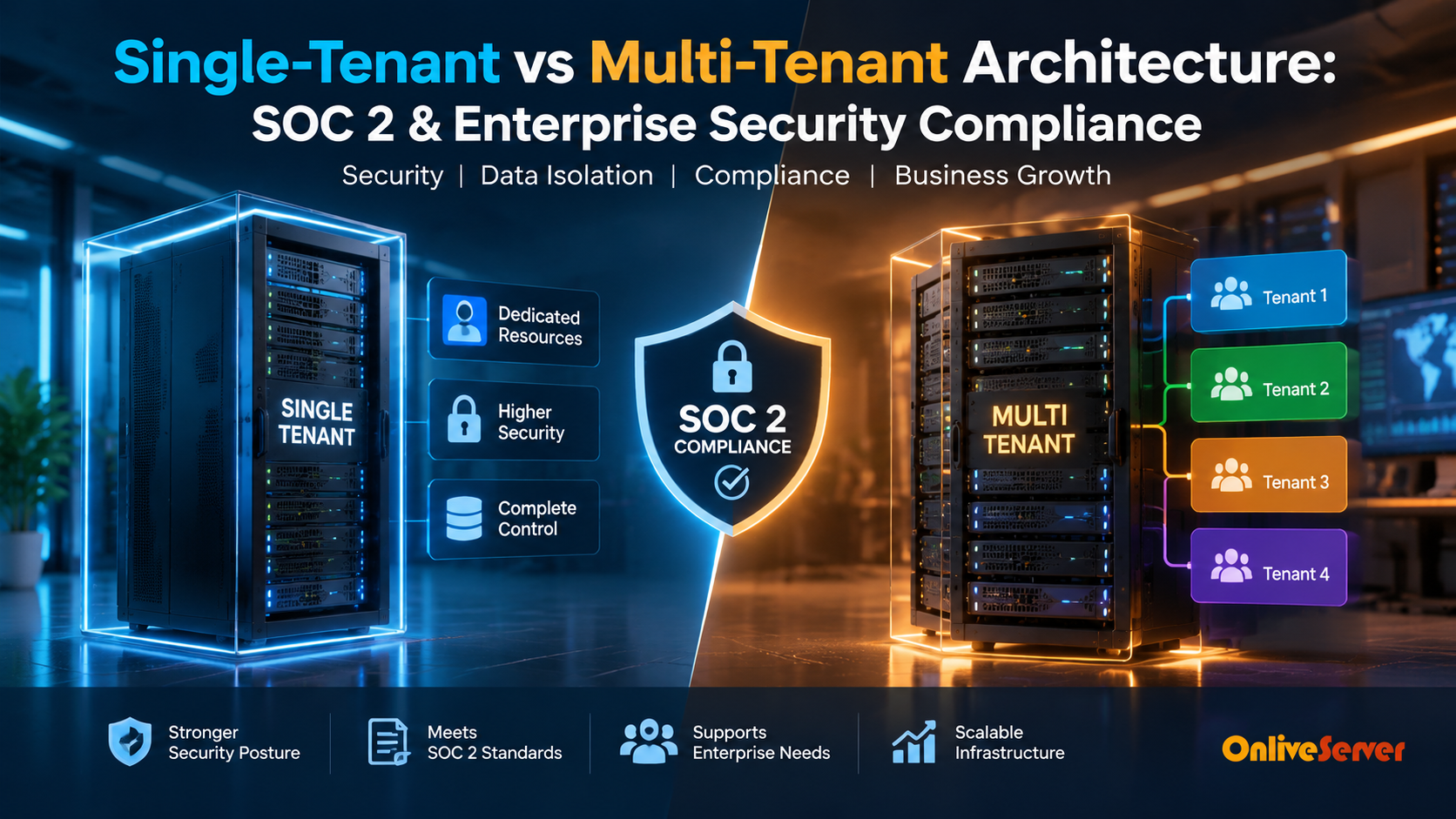
While multi-tenant architectures can achieve SOC 2 compliance through complex software logical partitioning and strict row-level security policies, single-tenant dedicated server architecture provides physical air-gapped isolation, drastically simplifies audit scope, eliminates the threat of hypervisor cross-tenant data leaks, and delivers the strict data sovereignty demanded by Fortune 500 enterprise buyers.
As B2B SaaS companies scale, moving upmarket to sell to enterprise customers and financial institutions inevitably triggers rigorous security vetting. Enterprise buyers mandate compliance with SOC 2 Type II, ISO 27001, and stringent data isolation frameworks. For verified technical specifications and deployment parameters, consult the official Linux Kernel Documentation.
Founders and engineering leaders face a crucial architectural crossroad: should they maintain a multi-tenant cloud environment with software-level boundaries, or deploy single-tenant dedicated infrastructure for compliance-sensitive clients?
Deploying dedicated environments on single-tenant dedicated hosting infrastructure provides physical hardware isolation, eliminating hypervisor vulnerabilities and radically reducing annual security audit overhead.
Architectural Distinctions: Logical vs. Physical Isolation
In a multi-tenant architecture, multiple customer accounts share the same application compute processes, database instances, and operating system kernels. Isolation relies entirely on application code filtering queries with `tenant_id` clauses.
A single coding bug or misplaced database query can accidentally expose one customer’s private financial data to another user. Furthermore, shared hypervisors remain susceptible to side-channel processor exploits like Spectre and Meltdown.
In a single-tenant model, each enterprise customer receives dedicated physical or virtual servers, independent database storage, and private virtual networks. Physical isolation guarantees that even if a catastrophic exploit compromises one tenant, adjacent tenants remain entirely unaffected.
SOC 2 Architecture Audit Comparison Matrix
| Compliance Dimension | Single-Tenant Architecture | Multi-Tenant Cloud Architecture |
|---|---|---|
| Data Isolation Verification | Physical separation (Verified at hardware level) | Logical software controls (Row-Level Security) |
| Audit Scope Complexity | Narrow and straightforward to demonstrate | Vast; requires extensive policy and code review |
| Cross-Tenant Blast Radius | Zero (Confined strictly to compromised host) | High (Breach can expose shared database tables) |
| Enterprise Sales Cycle Speed | Fast (Satisfies strict InfoSec questionnaires) | Protracted legal and technical security reviews |
Navigating the SOC 2 Trust Services Criteria
SOC 2 audits assess organizations against five Trust Services Criteria: Security, Availability, Processing Integrity, Confidentiality, and Privacy. The choice of hosting architecture significantly alters how these criteria are verified.
In multi-tenant systems, proving Confidentiality requires extensive penetration testing, static code analysis, and complex database access logs to demonstrate that tenant data never leaks across boundaries.
In single-tenant deployments, physical and network boundary diagrams provide unambiguous proof of isolation. All incoming and outgoing data transfers are cleanly secured using trusted enterprise SSL certificates and private encrypted interconnects.
Data Residency and Dedicated Storage Compliance
Enterprise procurement teams frequently mandate geographic data residency. Under GDPR, HIPAA, and national banking regulations, customer financial and medical data must not leave specified jurisdictions or be commingled in global cloud lakes.
Single-tenant hosting makes compliance simple by hosting tenant data in designated regional facilities. Storage volumes, database backups, and audit archives are retained on isolated isolated dedicated storage repositories, ensuring complete sovereignty and transparent audit trails.
Architecture Selection by Regulatory Mandate
| Regulatory Standard | Key Compliance Mandate | Recommended Architecture Model |
|---|---|---|
| SOC 2 Type II | Confidentiality and continuous operational security | Hybrid (Multi-tenant standard, Single-tenant enterprise) |
| HIPAA / HITECH | Protected Health Information (PHI) strict isolation | Single-Tenant Dedicated Server Infrastructure |
| PCI-DSS Level 1 | Cardholder Data Environment (CDE) air-gapping | Isolated Single-Tenant Bare Metal with Hardware Firewall |
| FedRAMP / ITAR | Defense and governmental sovereign workload control | Dedicated Single-Tenant Sovereign Nodes |
Enterprise Deal Velocity and Commercial Margins
While operating dedicated infrastructure involves higher baseline server expenses than sharing a multi-tenant cluster, enterprise SaaS pricing models turn this into a major profit center. Enterprise clients routinely pay a 2x to 5x price premium for dedicated single-tenant deployments.
Moreover, single-tenant architecture drastically accelerates enterprise sales velocity. Lengthy security questionnaires that typically stall enterprise deals for three to six months can be resolved in weeks because physical isolation eliminates shared database security concerns.
By offering single-tenant dedicated deployments as a premium tier, SaaS vendors expand contract values while dramatically simplifying ongoing SOC 2 compliance verification.
Additionally, single-tenant hosting grants enterprise clients total autonomy over software upgrades and maintenance windows. Enterprise customers can schedule schema migrations during their specific off-peak regional hours without coordinating against a shared multi-tenant release schedule.
Summary and Strategic Decision Framework
Achieving SOC 2 Type II compliance is mandatory for any SaaS company targeting enterprise contracts. While multi-tenancy provides operational simplicity for consumer or small-business tiers, enterprise InfoSec teams frequently reject shared database models.
Offering a dedicated single-tenant deployment tier unlocks enterprise revenue, accelerates vendor security sign-offs, and guarantees robust hardware-level data isolation that satisfies even the strictest compliance auditors.
Logical vs. Physical Tenant Isolation Under SOC 2 Trust Services Criteria
Achieving and maintaining SOC 2 Type II compliance requires software companies to demonstrate rigorous security, availability, and confidentiality controls. When serving enterprise clients in healthcare, finance, or government sectors, data isolation architecture represents a primary audit focus area.
Multi-tenant architectures enforce logical isolation, where multiple client organizations share the same application runtime, web servers, and relational database tables, separated only by tenant ID columns in SQL schemas. A single application bug or unauthenticated SQL query can inadvertently expose sensitive data across tenants.
Single-tenant architecture provides physical or dedicated hypervisor-level isolation. Each enterprise customer receives dedicated bare-metal server infrastructure, dedicated network subnets, and isolated storage volumes, establishing physical hardware boundaries that eliminate cross-tenant data leakage risks completely.
Customer-Managed Encryption Keys (BYOK) and Hardware Security Modules
Enterprise procurement teams increasingly demand Bring Your Own Key (BYOK) encryption capabilities before onboarding SaaS platforms. In shared multi-tenant databases, encrypting individual tenant rows with independent cryptographic keys introduces massive computational complexity and index degradation.
Single-tenant dedicated infrastructure simplifies cryptographic isolation significantly. Each client instance connects to a dedicated Key Management Service (KMS) or physical Hardware Security Module (HSM) holding unique customer-managed encryption keys.
If an enterprise customer terminates their service contract or detects a potential credential compromise, they can revoke their cryptographic master key remotely. Revoking the key instantly renders all customer data volumes cryptographically inaccessible, providing verifiable cryptographic erasure satisfying SOC 2 and GDPR standards.
Blast Radius Containment and Dedicated Audit Logging
In multi-tenant platforms, security compromises or denial-of-service attacks impact all hosted customers simultaneously. If a malicious actor exploits a vulnerability in one tenant account, they gain a foothold from which to attempt lateral privilege escalation across the shared server environment.
Deploying dedicated single-tenant nodes confines security incidents to a discrete, isolated hardware perimeter:
- Blast Radius Limitation: A breach or rogue process on one customer instance is physically quarantined, incapable of affecting neighboring client infrastructure.
- Dedicated Audit Trails: Immutable system audit logs capture user actions exclusively for that specific client organization, streamlining compliance audits.
- Custom Patching Windows: Critical security patches and database schema updates can be scheduled according to individual customer maintenance windows.
Production Architecture Checklist for SOC 2 Isolation Compliance
Designing compliant dedicated infrastructure requires rigorous technical governance across every architectural layer:
- Isolate each tenant environment within private VLAN subnets protected by dedicated network firewalls and intrusion prevention daemons.
- Enforce strict role-based access control (RBAC) with hardware multi-factor authentication (FIDO2 / YubiKey) for all infrastructure administrative access.
- Implement centralized, tamper-proof audit log streaming to WORM (Write Once, Read Many) cloud object storage with 7-year retention policies.
- Execute automated annual penetration testing and vulnerability scanning across all dedicated tenant perimeters.
- Document formal disaster recovery and incident response protocols with verified Recovery Time Objectives (RTO) under 15 minutes.
Total Cost of Ownership (TCO) and Enterprise Pricing Models
While multi-tenant SaaS offers maximum computational density, enterprise customers are universally willing to pay substantial premium pricing for dedicated single-tenant infrastructure. Offering dedicated hosting tiers allows SaaS companies to command annual contracts worth five to ten times standard tiered subscriptions.
Deploying dedicated bare-metal servers allows SaaS providers to deliver high-performance dedicated isolation without paying astronomical public cloud virtual machine markups. Fixed monthly hardware costs ensure predictable profit margins as enterprise customer volume scales.
Furthermore, isolating heavy enterprise workloads on dedicated bare-metal nodes shields your core multi-tenant application from resource-intensive custom reporting queries, preserving overall system stability.
Conclusion: Winning Enterprise Deals with Compliant Infrastructure
Choosing between single-tenant and multi-tenant architectures is both an engineering decision and a core business strategy. Offering dedicated, physically isolated single-tenant environments eliminates the most challenging security and compliance objections during enterprise sales cycles.
By pairing dedicated bare-metal hosting with robust customer-managed encryption and isolated audit trails, SaaS providers achieve effortless SOC 2 compliance. Disciplined infrastructure isolation empowers software companies to close lucrative enterprise deals and establish long-term market leadership.
⚖️ Workload Decision Matrix: When to Use vs. When NOT to Use
✓ When Should You Use This?
- Hardening production Linux servers handling sensitive user credentials, customer databases, or transactional payment gateways.
- Mitigating zero-day vulnerabilities, brute-force SSH attacks, and web application injection threats (SQLi, XSS).
- Meeting rigorous cybersecurity audit benchmarks (NIST, CIS Benchmarks, ISO 27001 compliance).
✕ When Should You NOT Use This?
- Applying aggressive paranoia-level WAF rules blindly without testing staging traffic (Can trigger false-positive blocks on legitimate API webhooks).
- Relying solely on software firewalls while leaving underlying hypervisor, BIOS, or IPMI firmwares unpatched.
Target Audience / Persona: DevSecOps engineers, Linux systems administrators, security compliance auditors, and webmasters protecting commercial web assets.
Common Failure Mode & Quick Fix: Accidental SSH lockouts from firewall/fail2ban rules: Always keep an active secondary terminal session open when updating iptables / ufw, and whitelist your static administrative IP in /etc/hosts.allow and fail2ban ignorelist.
Frequently Asked Questions
Can a multi-tenant SaaS application achieve SOC 2 Type II certification?
Yes. Multi-tenant systems can pass SOC 2 by demonstrating robust logical separation, automated role-based access control, encrypted database columns, and routine third-party penetration testing.
Why do enterprise customers prefer single-tenant hosting?
Enterprise InfoSec teams prioritize single-tenant hosting because it eliminates the risk of human programming errors leaking data to other tenants and prevents noisy-neighbor performance degradation.
What is blast radius in enterprise cloud security?
Blast radius describes the extent of damage a single security exploit or crash can inflict. In multi-tenant systems, one breached database affects all tenants. In single-tenant systems, the damage is strictly confined to one customer.
Is single-tenant hosting dramatically more expensive to operate?
While infrastructure costs are higher per instance, SaaS providers typically charge enterprise clients a significant premium for dedicated single-tenant tiers, making it a highly profitable commercial offering.
How does single-tenant architecture simplify security audits?
Auditors can easily verify physical and network boundaries through architecture diagrams and firewall configurations, avoiding the complex code audits required to prove logical data separation in multi-tenant databases.
Conclusion: Driving Business Growth with Enterprise VPS Hosting
Deploying mission-critical applications on high-performance Enterprise VPS Hosting infrastructure provides the dedicated processing power, network speed, and reliability demanded by modern web users.
Whether managing high-traffic e-commerce portals, streaming media, or corporate databases, Onlive Server delivers enterprise-grade hardware, 24/7 technical support, and competitive pricing for global success.

