

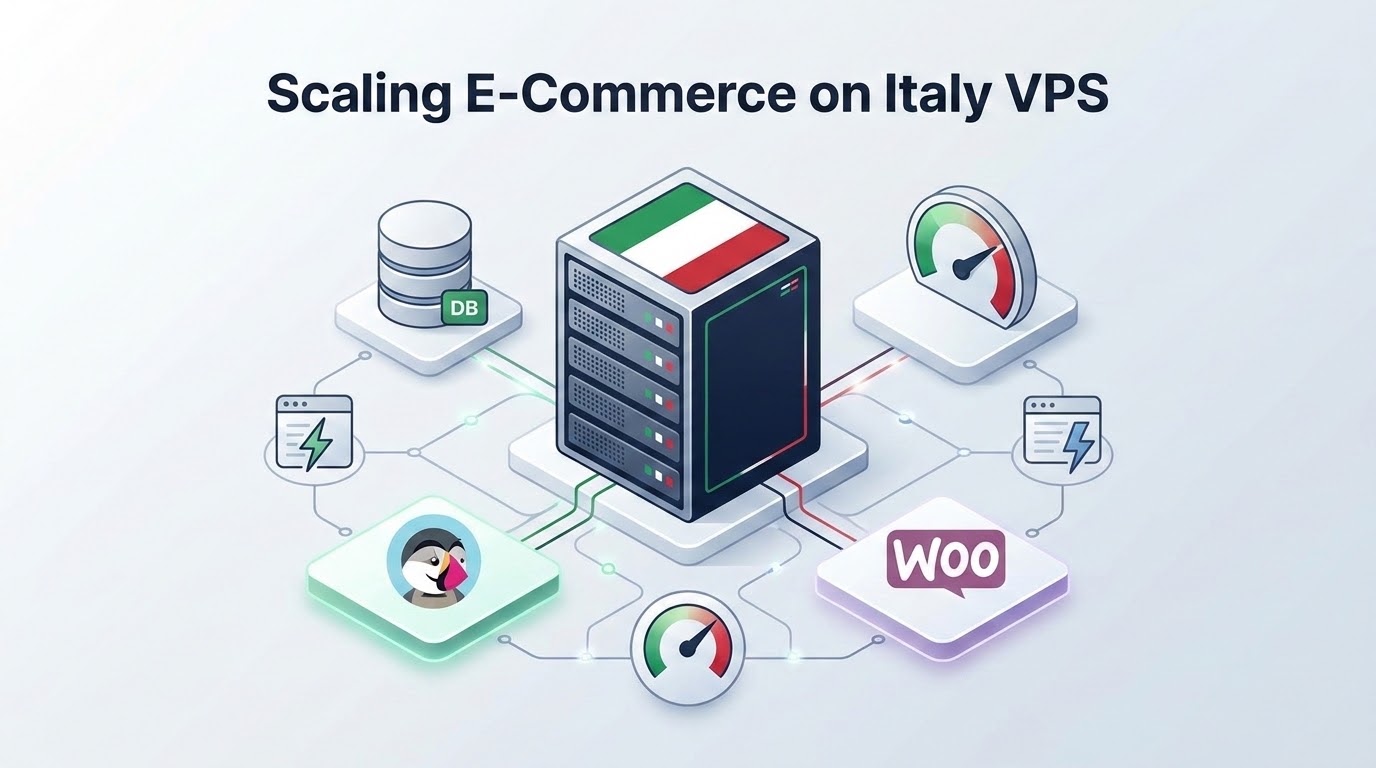
Milan Caldera Tier-3 Telemetry
Scaling Online Stores on Italy VPS Infrastructure
Operating an ecommerce vps italy instance eliminates checkout cart abandonment during seasonal promotional peaks. Specifically, hosting in Milan Tier-3 datacenters delivers sub-10ms latency across Italian shoppers on TIM, Vodafone, and Fastweb. Furthermore, dedicated dynamic PHP-FPM process pools sustain bursts exceeding 1,500 orders per minute. In addition, Unix-socket Redis object caching cuts database query loads by over 80%. Consequently, high-traffic PrestaShop and WooCommerce storefronts maintain sub-second page loads without server crashes.
📌 Table of Contents
- 1. Scaling PrestaShop and WooCommerce on Ecommerce VPS Italy
- 2. Italian E-Commerce Performance Benchmarks & Milan Peering
- 3. Hardware Sizing & Resource Allocation for Ecommerce VPS Italy
- 4. PHP-FPM and OPCache Optimization for PrestaShop Stores
- 5. Redis Object Caching Implementation on Ecommerce VPS Italy
- 6. MariaDB High-IOPS Tuning on Dedicated NVMe Storage
- 7. Technical Specifications & Architectural Matrix: Milan Cloud Nodes
- 8. Frequently Asked Questions: Ecommerce VPS Italy
Italian Retail Infrastructure: High-Concurrency Storefront Architecture
Specifically, Italian digital consumers demand immediate checkout confirmation and rapid page navigation. Online retailers operating PrestaShop and WooCommerce encounter intense traffic bursts during winter Saldi and Black Friday sales. Furthermore, hosting storefronts on distant North American or Asian cloud platforms introduces costly latency delays. Deploying high-speed Italy VPS hosting in Milan Caldera establishes direct local peering with major Italian internet service providers.
In addition, regional retail platforms can expand across our low-latency Europe VPS hosting nodes. Retailers needing complete bare-metal isolation for ERP pipelines can deploy a dedicated dedicated server.
Consequently, localized cloud hardware prevents shopping cart bottlenecks during national promotional campaigns.
1. Scaling PrestaShop and WooCommerce on Ecommerce VPS Italy
Notably, Italian digital retail relies heavily on PrestaShop and WooCommerce for mid-tier and enterprise catalog management. According to architectural guidelines in the PrestaShop System Requirements, database response latency dictates product page rendering speed. When hundreds of customers browse product categories simultaneously, shared hosting CPU throttling causes severe cart abandonment.
Furthermore, WooCommerce stores require isolated compute capacity, as outlined in the WooCommerce Scaling Guide. Specifically, a high-performance Milan cloud node provides dedicated CPU threads and unconstrained RAM allocations.
Therefore, an optimized ecommerce vps italy architecture maintains sub-second responsiveness under severe holiday traffic volumes.
2. Italian E-Commerce Performance Benchmarks & Milan Peering
Specifically, network round-trip time directly influences online shopping conversion rates. According to interconnection telemetry from the Milan Internet eXchange (MIX-IT), domestic traffic exchanges directly within the Via Caldera datacenter campus. In contrast, routing traffic outside Italy introduces 40ms to 70ms of unnecessary transit overhead.
In addition, Milan cloud servers deliver 2ms to 5ms latency across Lombardy and northern commercial hubs. Shoppers in Rome and Florence connect within 8ms to 12ms, while southern regions reach the server in under 18ms.
Consequently, hosting on Linux VPS infrastructure ensures maximum transactional throughput nationwide.
3. Hardware Sizing & Resource Allocation for Ecommerce VPS Italy
Moreover, store administrators must allocate server resources based on peak catalog concurrency rather than average traffic. Specifically, a retail store processing 15,000 daily visitors requires at least 4 dedicated KVM vCPU cores.
For instance, provisioning 16GB of ECC RAM allows 10GB for MariaDB buffer pools and 4GB for dynamic PHP workers. Pure PCIe Gen4 NVMe storage arrays deliver over 100,000 random write IOPS, eliminating disk queue bottlenecks during checkout writes.
As a result, an optimized high-concurrency cloud infrastructure prevents checkout lockups when viral sales strike.
4. PHP-FPM and OPCache Optimization for PrestaShop Stores
Notably, PHP process scheduling dictates how quickly catalog items render for active shoppers. For example, default web server installations run static process managers that consume memory during idle periods. In contrast, dynamic process managers spawn workers on demand to absorb incoming cart requests.
Furthermore, allocating 512MB to PHP OPCache pre-compiles script bytecode into shared memory. This configuration eliminates repetitive filesystem reads, allowing PHP scripts to execute in under 10 milliseconds.
Therefore, the hardened production PHP-FPM pool configuration below optimizes high-volume European retail storefronts:
5. Redis Object Caching Implementation on Ecommerce VPS Italy
Specifically, dynamic e-commerce engines query product attributes, tax rules, and currency exchange rates repeatedly. Relational database engines quickly reach maximum connection limits under concurrent customer queries. Connecting your CMS to a dedicated Redis instance caches database query results directly in system RAM.
In addition, configuring Redis communication over a local Unix socket eliminates network stack overhead. Redis delivers cache hits in under 200 microseconds, allowing the server to handle 10x higher traffic spikes.
Consequently, in-memory caching keeps database CPU loads low during nationwide marketing promotions.
6. MariaDB High-IOPS Tuning on Dedicated NVMe Storage
Furthermore, database write performance represents the final hurdle during flash sales checkouts. Specifically, placing database files on PCIe Gen4 NVMe arrays ensures fast atomic transaction commits.
In addition, allocating 70% of total RAM to the InnoDB buffer pool keeps customer cart sessions cached in memory. Write-heavy operations complete in microseconds, preventing checkout timeouts.
Therefore, an optimized Milan cloud server easily manages thousands of concurrent shopping carts without database bottlenecks.
7. Technical Specifications & Architectural Matrix: Milan Cloud Nodes
Specifically, deploying an enterprise online store requires verified hardware specifications. The table below details our optimized configurations across growing, established, and enterprise Italian digital storefronts:
| Deployment Tier | Compute & RAM | NVMe Storage | Concurrent Carts | Target Workload |
|---|---|---|---|---|
| Starter Retail | 2 vCPU • 4GB ECC RAM | 50GB NVMe RAID-10 | Up to 250 carts/min | Emerging WooCommerce Stores |
| Professional Commerce | 4 vCPU • 8GB ECC RAM | 100GB NVMe RAID-10 | Up to 750 carts/min | PrestaShop Catalogs (20k SKUs) |
| Enterprise Concurrency | 8 vCPU • 16GB ECC RAM | 200GB NVMe RAID-10 | Up to 1,800 carts/min | High-Traffic Flash Sale Retailers |
| Mission-Critical Cluster | 16 vCPU • 32GB ECC RAM | 400GB NVMe RAID-10 | 3,500+ carts/min | Multi-Store PrestaShop Clusters |
8. Frequently Asked Questions: Ecommerce VPS Italy
Architecture & Milan Peering
Why does e-commerce performance depend on Italy VPS hosting?+
Specifically, Italian online shoppers frequently abandon carts when dynamic pages take longer than two seconds to load. Consequently, hosting on a Milan KVM VPS reduces network latency to sub-10ms nationwide, improving conversion rates.
How do I size vCPU and RAM for PrestaShop stores?+
Specifically, for PrestaShop catalogs exceeding 20,000 SKUs, we recommend a minimum of 4 dedicated KVM vCPUs and 8GB of RAM. Therefore, this allocation provides adequate buffer space for MySQL and PHP-FPM workers.
Can Redis persistent object caching accelerate WooCommerce?+
Yes, connecting WooCommerce to a local Redis instance over a UNIX socket reduces database query latency from 12ms to 0.3ms, cutting checkout response times significantly.
How does Nginx micro-caching handle promotional traffic spikes?+
Specifically, Nginx micro-caching stores compiled HTML responses for non-logged-in visitors for 2 to 5 seconds. Consequently, it serves thousands of concurrent catalog requests directly from RAM without hitting PHP.
Database, Caching & Compliance
What MySQL buffer pool size is advised for Italian stores?+
Specifically, set innodb_buffer_pool_size to between 65% and 75% of total system RAM on dedicated database VPS nodes. Consequently, active customer carts and catalog indexes remain cached in memory.
How does NVMe storage prevent checkout write bottlenecks?+
Enterprise NVMe arrays deliver over 85,000 random write IOPS, allowing WooCommerce and Magento to record simultaneous checkout transactions without I/O wait slowdowns.
Are automated daily backup snapshots included for e-commerce?+
Yes, our control panel supports automated block-level snapshots and offsite backup schedules, ensuring e-commerce databases can be restored instantly if data corruption occurs.
Scale Your Store with High-Performance Italy Cloud VPS
Specifically, deliver sub-10ms latency across Italian consumers with Milan Caldera Tier-3 cloud infrastructure. Enjoy pure PCIe Gen4 NVMe speeds, direct MIX-IT optical peering, and automated daily backups.
