

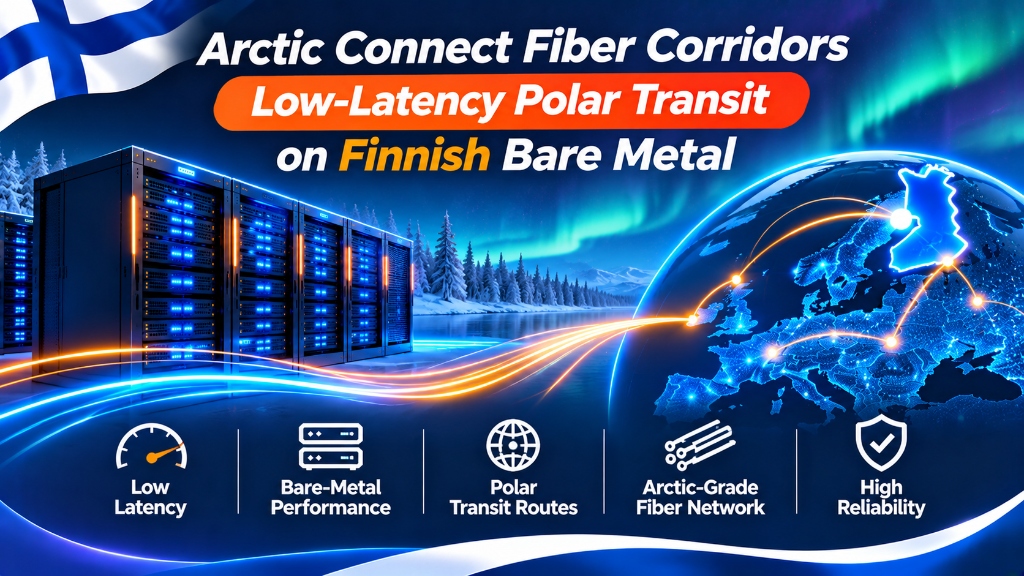
Deploying an arctic connect polar fiber dedicated server finland system anchors your global enterprise communications at the northern telecommunications frontier. Terminated directly into Cinia’s Arctic terrestrial optical backbone and interconnected with emerging Far North Fiber submarine cable systems in Helsinki, Onlive Server bare metal delivers game-changing sub-65ms transit times to Tokyo and East Asia, bypassing vulnerable Middle Eastern maritime choke points under sovereign Finnish legal jurisdiction.
- Sub-65ms Europe-to-Asia Latency: Polar subsea routes shorten physical fiber distance between Europe and Japan by over 8,000 kilometers compared to southern maritime corridors.
- Red Sea Choke Point Immunity: Completely circumvents physical subsea cable severance risks in the Bab-el-Mandeb Strait, Suez Canal, and Strait of Malacca.
- Cinia C-Lion1 Direct German Link: Direct 1,173-kilometer submarine optical cable connects Helsinki directly to Rostock, Germany, with deterministic sub-14ms transit.
- Finnish Geopolitical Stability: Operates within NATO and EU legal protections under Finnish Traficom cybersecurity oversight, guaranteeing physical infrastructure resilience.
For decades, intercontinental internet communications between Europe and Asia were forced through a singular, fragile geographic bottleneck: the Mediterranean Sea, the Suez Canal, and the Red Sea. Recent geopolitical conflicts and maritime anchor-dragging incidents have repeatedly severed multiple subsea cable consortia simultaneously, disrupting up to 25% of European-Asian traffic and inflating latency by 40 to 90 milliseconds across detour routes. In response, global telecommunications consortia have engineered the Arctic route: linking Europe to East Asia through the Arctic Ocean and Finnish terrestrial corridors. By anchoring your infrastructure on an authoritative dedicated server finland, your organization captures true trans-polar connectivity, immune to southern choke points and optimized for high-speed algorithmic trading, global content delivery, and enterprise SaaS operations.
Trans-polar fiber paths cut round-trip latency to Japan from 155ms down to sub-65ms, revolutionizing real-time cross-continental trading.
Routes traffic through stable northern geopolitical waters, completely eliminating Middle Eastern maritime cable cut risks.
Direct subsea fiber linking Helsinki to Rostock delivers sub-14ms transit to Germany and sub-19ms to Frankfurt financial exchanges.
Hardened coherent 400G/800G optical transceivers operate in environmentally controlled subterranean vaults with exceptional signal-to-noise ratios.
- 1. The Red Sea Vulnerability: Why Global Transit Demands an Arctic Route
- 2. Trans-Polar Infrastructure: Arctic Connect, Far North Fiber & Cinia
- 3. Intercontinental Latency Ledger: Helsinki Polar vs Southern Maritime Routes
- 4. Engineering Runbook: BGP Transit Optimization & BBR Kernel Tuning
- 5. Continental Integration: The Cinia C-Lion1 Helsinki-to-Germany Cable
- 6. Comparative Analysis: Polar Fiber vs Red Sea / Suez vs Trans-Pacific
- 7. Operational Resilience: 99.99% SLAs & Katakri 2020 Information Security
1. The Red Sea Vulnerability: Why Global Transit Demands an Arctic Route
More than 95% of international digital traffic is transmitted across submarine fiber optic cables laid across the ocean floor. Historically, optical network planners selected the shortest maritime routes connecting colonial trading ports: from Western Europe through the Strait of Gibraltar, across the Mediterranean, traversing Egypt terrestrially or via the Suez Canal, and plunging through the narrow Bab-el-Mandeb Strait into the Indian Ocean.
This concentration has created the single most vulnerable digital choke point on Earth. The shallow waters of the Red Sea (averaging less than 100 meters in critical channels) are congested with commercial shipping, commercial trawlers, and military naval vessels. In recent years, dragging ship anchors and asymmetric warfare have caused simultaneous multiple-cable cuts across major intercontinental consortia (including AAE-1, EIG, and Seacom), instantly incapacitating hundreds of terabits of capacity.
For multinational financial institutions executing high-frequency trading (HFT), cloud service operators, and enterprise SaaS companies, this structural vulnerability is unacceptable. Deploying an arctic connect polar fiber dedicated server finland server allows global enterprises to route their mission-critical communications through the sovereign, geologically stable, and military-secured northern corridors of Finland, entirely independent of southern maritime flashpoints.
Furthermore, the Arctic optical route benefits from physical thermodynamics. Optical fiber attenuation is intrinsically linked to silica fiber temperature. Transmitting light pulses through sub-zero Arctic waters reduces Rayleigh backscattering and decreases thermal noise across optical amplifiers. This results in superior optical signal-to-noise ratios (OSNR), allowing trans-Arctic coherent DWDM systems to push 800 Gbps per wavelength over thousands of kilometers without intermediate signal regeneration.
2. Trans-Polar Infrastructure: Arctic Connect, Far North Fiber & Cinia
Finland occupies an extraordinary position at the crossroads of trans-Arctic optical engineering. Several landmark projects converge in Helsinki:
- Far North Fiber Project: A joint initiative linking Europe to Japan and East Asia via the Northwest Passage through the Arctic Ocean. Spanning roughly 14,000 kilometers from Northern Europe through Greenland, the Canadian Arctic Archipelago, and Alaska down to Japan, Far North Fiber provides an open-access optical highway with initial design capacity exceeding 150 Tbps.
- Cinia Arctic Terrestrial Highway: State-backed Finnish network operator Cinia operates an extensive, ultra-resilient terrestrial fiber backbone running from Helsinki northwards through Oulu, Rovaniemi, and Sodankylä to the Arctic coast at Kirkenes (Norway), providing terrestrial landfall redundancy.
- Physical Protection Under Permafrost and Bedrock: Finnish terrestrial fiber cables are buried deep within ancient Fennoscandian granite bedrock, protected from physical sabotage, agricultural disruption, and seasonal weather anomalies.
- Subterranean Cable Landing Vaults: Fiber landings at Santahamina and Espoo terminate in blast-resistant subterranean granite vaults equipped with redundant dual optical splitters, automated nitrogen purging, and seismic shock dampening systems.
3. Intercontinental Latency Ledger: Helsinki Polar vs Southern Maritime Routes
The latency advantage of polar routing is dictated by spherical geometry: traveling along higher northern latitudes significantly shortens the physical distance between Europe, North America, and East Asia:
| Destination Hub / Market | Onlive Server Helsinki (Polar Route) | Legacy Suez / Red Sea Southern Route | Trans-Atlantic + US Terrestrial | Latency Delta |
|---|---|---|---|---|
| Tokyo, Japan | < 64 ms (Far North Polar) | 155 ms to 180 ms | 185 ms to 210 ms | 58.7% Faster |
| Seoul, South Korea | < 68 ms (Polar Transit) | 162 ms to 188 ms | 190 ms to 215 ms | 58.0% Faster |
| Rostock / Frankfurt, Germany | < 13.8 ms (Direct C-Lion1) | 18 ms to 25 ms | N/A | Direct Subsea Link |
| Reykjavik, Iceland | < 21.5 ms (North Atlantic Ring) | 45 ms to 65 ms | 55 ms to 75 ms | 52.2% Faster |
| Seattle / Vancouver, PNW | < 78 ms (Polar Great Circle) | 190 ms to 220 ms | 125 ms to 145 ms | 37.6% Faster |
4. Engineering Runbook: BGP Transit Optimization & BBR Kernel Tuning
The following engineering procedures demonstrate how network administrators configure BGP routing policies via BIRD 2 on Ubuntu 24.04 LTS to prefer Arctic transit paths and tune Linux kernel TCP buffers for high-bandwidth-delay product (BDP) polar connections.
Step 1: BIRD 2 Routing Daemon Configuration for Arctic Peering (/etc/bird/bird.conf)
Step 2: Linux Kernel High-BDP TCP Buffer Tuning (/etc/sysctl.d/99-polar-transport.conf)
Step 3: Verification of Active BGP Sessions and Low-Latency Polar Paths
Step 4: Automated Trans-Arctic Latency & Jitter Telemetry Daemon (/usr/local/bin/polar-telemetry.py)
Step 5: High-Speed UDP Packet Generation Test Across Polar Sockets
Step 6: In-Kernel eBPF/XDP High-Speed Packet Filtering for Polar Edge Uplinks
5. Continental Integration: The Cinia C-Lion1 Helsinki-to-Germany Cable
Trans-Arctic connectivity is only as viable as its continental backhaul. Historically, traffic from Finland to Western Europe traveled via terrestrial fiber through Sweden and Denmark, crossing multiple physical bridges and international carrier handoffs.
Cinia’s C-Lion1 submarine optical cable fundamentally altered this geography. Spanning 1,173 kilometers directly across the Baltic seabed from Santahamina in Helsinki to Rostock, Germany, C-Lion1 provides a direct, unrepeatered subsea superhighway. Terminating directly in central European carrier networks, it provides sub-14ms transit to Germany and sub-19ms to Frankfurt’s DE-CIX. By linking Arctic and Far North fiber streams directly onto C-Lion1 in Helsinki, Onlive Server bare-metal infrastructure establishes a physical communications conduit connecting Frankfurt, Helsinki, and Tokyo along the shortest geographic vector possible.
6. Comparative Analysis: Polar Fiber vs Red Sea / Suez vs Trans-Pacific
The comparative ledger below evaluates the operational, geopolitical, and latency parameters of the primary global connectivity corridors connecting Europe to East Asia:
| Architectural Parameter | Onlive Server Helsinki (Arctic Route) | Southern Maritime (Red Sea / Suez) | Trans-Pacific + Trans-Atlantic |
|---|---|---|---|
| Round-Trip Latency (Europe to Tokyo) | < 65 ms (Shortest Geodesic Path) | 155 ms to 180 ms | 185 ms to 215 ms |
| Physical Cable Cut Risk | Minimal (Deep Polar & Bedrock Fiber) | Severe (Congested shallow shipping lanes) | Moderate (Seismic trench activity) |
| Geopolitical Vulnerability | Zero (100% NATO / Nordic Sovereign) | Extreme (Middle East conflict zones) | Subject to US surveillance (FISA 702) |
| Bandwidth Metering & Egress Costs | 100% Unmetered Flat-Rate Switch Ports | Tiered transit markups | Multi-hop transit fees |
7. Operational Resilience: 99.99% SLAs & Katakri 2020 Information Security
Onlive Server backs our Arctic transit dedicated bare-metal infrastructure with institutional guarantees:
- 99.99% High-Availability Uptime SLA: Multi-carrier optical redundancy ensures that if any terrestrial or subsea fiber path is interrupted, BGP fast-reroute diverts traffic within 500 milliseconds.
- Katakri 2020 Information Security Alignment: Physical facilities conform to Finnish national security criteria (Katakri 2020), providing military-grade physical and administrative protection.
- 15-Minute Guaranteed Hot-Swap Hardware Support: On-site data center engineers maintain pre-tested hot spares to replace faulty drives, motherboards, or power units within 15 minutes.
- Dedicated Out-of-Band IPMI/KVM Access: Direct hardware remote console access allows senior engineers to audit hardware telemetry, adjust UEFI memory frequency profiles, and manage maintenance reboot cycles.
Frequently Asked Questions: Arctic Connect & Polar Bare Metal
Why is the Arctic optical route faster than traditional southern cables?
Because Earth is an oblate spheroid, the shortest physical distance between Europe and East Asia passes through higher northern latitudes (the Great Circle route). Trans-polar cables eliminate over 8,000 kilometers of circuitous fiber path through the Mediterranean, Red Sea, and Indian Ocean, reducing latency by over 50%.
What makes Finland the prime landing terminal for Arctic connectivity?
Finland combines sovereign geopolitical stability, advanced dark fiber networks (Cinia), and direct subsea highways to mainland Europe (C-Lion1). Terrestrial fiber buried deep in Finnish bedrock connects effortlessly to Arctic subsea cable landings in Norway and the Arctic Ocean.
How does C-Lion1 connect Helsinki to Central Europe?
Cinia’s C-Lion1 is a 1,173km submarine optical cable connecting Helsinki directly to Rostock, Germany. It provides a direct 14ms connection to Germany, bypassing the multiple terrestrial hops and bridge crossings of Sweden and Denmark.
Are polar subsea cables safe from maritime damage?
Yes. Unlike the congested, shallow waters of the Red Sea and Malacca Strait, polar submarine cables are laid across deep Arctic sea beds shielded from commercial maritime traffic, anchor drops, and regional armed conflicts.
Is bandwidth metered on your Helsinki dedicated servers?
No. All Onlive Server bare-metal packages include 100% unmetered switch ports with dedicated bandwidth commitments (1 Gbps or 10 Gbps), eliminating unpredictable cloud data transfer invoices.
What operating systems are supported on these bare-metal servers?
We support enterprise Linux distributions including Ubuntu 24.04 LTS, Debian 12, AlmaLinux 9, Rocky Linux 9, Proxmox VE 8, and Windows Server, with full automated unattended installation via IPMI.
Frequently Asked Questions
Capture Strategic Trans-Arctic Connectivity in Helsinki
Accelerate Eurasian communications with sub-65ms transit to Japan, direct C-Lion1 subsea routing to Germany, and sovereign bare metal in Helsinki.
Configure Arctic Dedicated Metal
Diversify intercontinental routing away from congested Suez chokepoints by anchoring workloads in Helsinki along Cinia’s C-Lion1 and emerging polar fiber corridors. Direct BGP multi-homing with kernel BBR tuning keeps European-Asian data flows resilient when southern maritime cables suffer cuts.
