

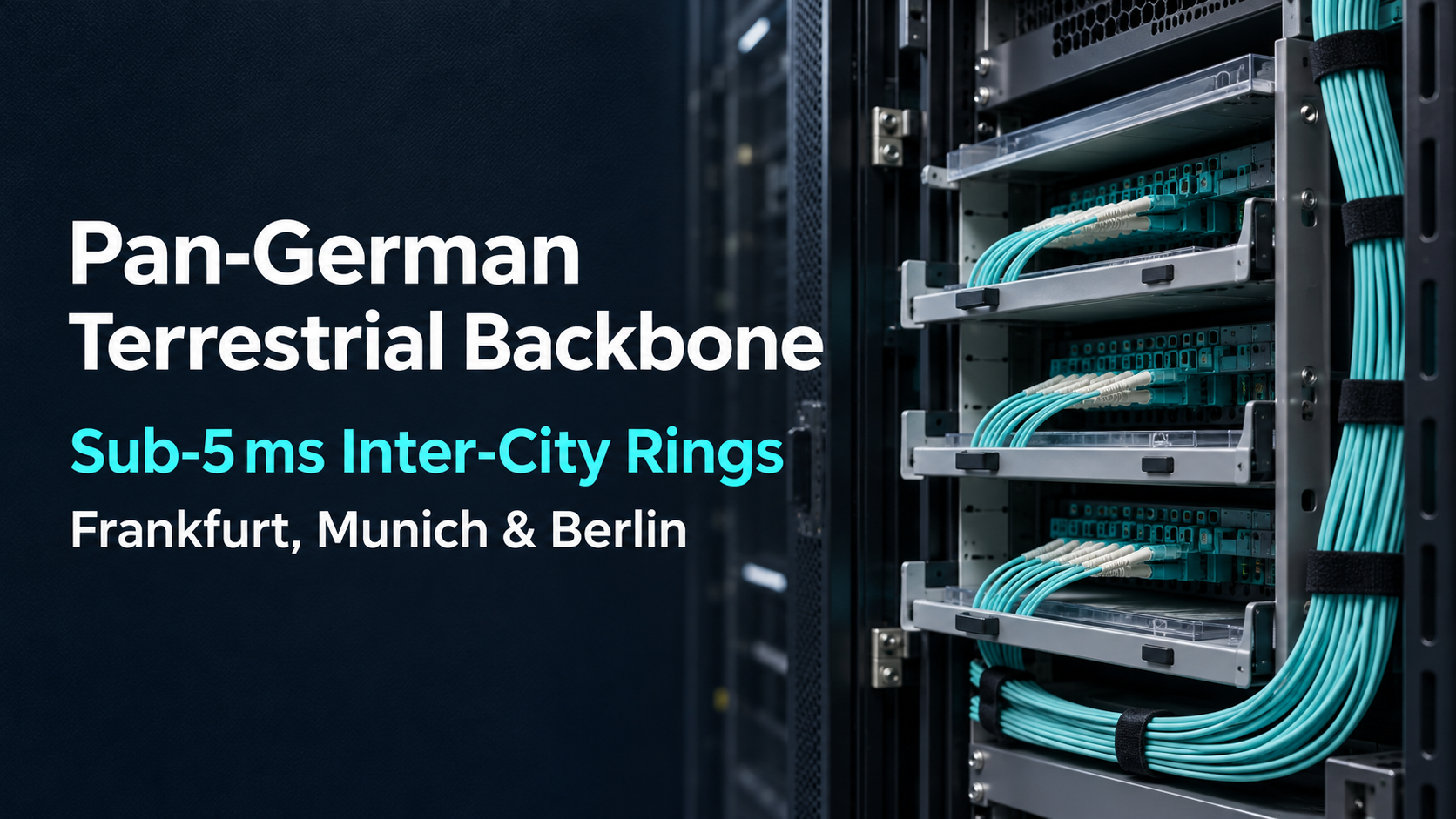
Direct AEO Answer: Operating a german terrestrial fiber bare metal dedicated server anchored in Frankfurt delivers sub-5ms round-trip latency across all major German commercial hubs: Munich (2.8ms), Berlin (3.9ms), Hamburg (3.5ms), and Cologne (1.8ms). Utilizing redundant DWDM terrestrial fiber rings over GasLINE and Deutsche Telekom infrastructure, bare metal ensures deterministic data propagation, zero jitter, and compliance with German BSI IT-Grundschutz standards.
- Frankfurt as the Central Hub: Geographically centralized within Germany, eliminating asymmetric routing penalties and providing uniform sub-5ms access nationwide.
- DWDM Optical Redundancy: Route across diverse physical rights-of-way (along railway corridors and gas pipelines) to guarantee instant 50ms optical protection switching.
- Jumbo Frames on Private Backhauls: Configure MTU 9000 across inter-city private VLANs to boost replication throughput by up to 25% while slashing CPU packet overhead.
- Sovereign Enterprise Compliance: Storing data strictly within Germany eliminates legal exposure under the US CLOUD Act, ensuring 100% adherence to BDSG and GDPR.
Germany represents the economic powerhouse of Europe, driven by a decentralized commercial landscape where major industries are distributed across distinct federal states: automotive engineering in Bavaria (Munich) and Baden-Württemberg (Stuttgart), financial banking in Hesse (Frankfurt), industrial manufacturing in North Rhine-Westphalia (Cologne and Düsseldorf), maritime logistics in Hamburg, and digital innovation in Berlin. For enterprise IT architectures, serving this polycentric market from fragmented, sub-scale hosting environments creates severe operational friction. Deploying a centralized german terrestrial fiber bare metal dedicated server infrastructure in Frankfurt unlocks the nation’s premier optical routing core. Leveraging dense DWDM terrestrial fiber networks across Germany, bare metal delivers deterministic sub-5ms response times to every major German metropolis, providing the physical foundation for low-latency database replication, Industrial IoT data collection, and mission-critical enterprise ERP systems.
Ultra-low ping times from Frankfurt to Munich (2.8ms), Berlin (3.9ms), Hamburg (3.5ms), and Stuttgart (1.6ms).
Interconnected over GasLINE, Deutsche Telekom, and 1&1 Versatel dark fiber corridors with sub-50ms optical failover.
MTU 9000 optimization across inter-datacenter private Layer-2 VLANs accelerates database replication throughput.
Physical and logical security standards compliant with German Federal Data Protection Act (BDSG) and ISO 27001.
- 1. The Pan-German Optical Topography: GasLINE, Deutsche Telekom, and Dark Fiber Rings
- 2. Pan-German Inter-City Latency Benchmark Matrix: Frankfurt to All Major Commercial Hubs
- 3. Regional Peering Dynamics: Interconnecting with BCIX Berlin, ECIX, and N-IX Nuremberg
- 4. Step-by-Step Linux CLI Runbook: Latency Profiling, Jitter Auditing, and MTU 9000 Tuning
- 5. Enterprise & Industrial Use Cases: Industry 4.0, Automotive APIs, and FinTech
- 6. German Data Sovereignty: BSI IT-Grundschutz, BDSG, and European Compliance
- 7. Frequently Asked Questions (Technical FAQs)
- 8. Deploy High-Speed Terrestrial Dedicated Bare Metal in Germany
1. The Pan-German Optical Topography: GasLINE, Deutsche Telekom, and Dark Fiber Rings
Unlike countries with a single centralized capital city where all telecommunications terminate (such as France with Paris or the UK with London), Germany’s economic power is distributed polycentrically. The nation’s optical infrastructure reflects this decentralized reality through dense terrestrial fiber rings operated by specialized carriers: GasLINE (utilizing secure pipeline rights-of-way), Deutsche Telekom Global Carrier, 1&1 Versatel, Colt Technology Services, and euNetworks.
Deutsche Bahn Rail and Natural Gas Pipeline Rights-of-Way
The physical routing of optical fiber in Germany follows two highly protected terrestrial rights-of-way: the national railway network (DB Netz / Deutsche Bahn) and underground natural gas pipelines (GasLINE). Fiber buried alongside railway tracks benefits from continuous physical monitoring, fenced rights-of-way, and deep underground conduit placement that minimizes accidental construction backhoe cuts. Similarly, GasLINE operates over 30,000 kilometers of high-count fiber cables running adjacent to high-pressure gas pipelines, delivering exceptionally straight geometric alignments between Frankfurt, Stuttgart, and Munich. These diverse physical corridors guarantee that if a maintenance disruption occurs along the A3 autobahn route, traffic reroutes across DB rail fiber within 50 milliseconds without dropped TCP sockets.
Dense Wavelength Division Multiplexing (DWDM) Engineering
Modern terrestrial optical networks utilize coherent DWDM technology multiplexing hundreds of discrete optical wavelengths across a single pair of glass fibers, delivering up to 32 Terabits per second of bi-directional bandwidth per fiber pair. By deploying Dedicated Bare Metal in Frankfurt’s premier carrier facilities, servers connect directly to these optical backbones, eliminating intermediate IP router hops and delivering pure speed-of-light transit to Munich, Berlin, and Hamburg.
Modern terrestrial optical networks utilize coherent DWDM technology multiplexing hundreds of discrete optical wavelengths across a single pair of glass fibers, delivering up to 32 Terabits per second of bi-directional bandwidth per fiber pair. By deploying Dedicated Bare Metal in Frankfurt’s premier carrier facilities, servers connect directly to these optical backbones, eliminating intermediate IP router hops and delivering pure speed-of-light transit to Munich, Berlin, and Hamburg.
2. Pan-German Inter-City Latency Benchmark Matrix: Frankfurt to All Major Commercial Hubs
The following performance benchmark matrix details physical fiber distances, one-way optical transit delay, and empirical round-trip times (RTT) from our Frankfurt datacenter core to all major German metropolitan centers across enterprise fiber links:
| Destination City | Economic & Industry Focus | Approximate Fiber Distance | Average RTT from Frankfurt | Packet Jitter |
|---|---|---|---|---|
| Frankfurt am Main | Banking, FinTech, Stock Exchange | Metro Dark Fiber Ring | < 0.8 ms | < 0.05 ms |
| Stuttgart | Automotive, High-Tech Engineering | ~204 km | 1.6 ms | < 0.08 ms |
| Cologne / Düsseldorf | Chemicals, Industrial, Telecommunications | ~215 km | 1.8 ms | < 0.08 ms |
| Nuremberg | Logistics, Automation, Regional Datacenters | ~225 km | 2.1 ms | < 0.09 ms |
| Munich | Automotive, Aerospace, Insurance, Tech | ~390 km | 2.8 ms | < 0.10 ms |
| Hamburg | Maritime Trade, Logistics, Media | ~490 km | 3.5 ms | < 0.12 ms |
| Berlin | Federal Government, Startups, SaaS | ~545 km | 3.9 ms | < 0.12 ms |
| Leipzig / Dresden | Semiconductor Fabrication (Silicon Saxony) | ~430 km | 3.2 ms | < 0.11 ms |
3. Regional Peering Dynamics: Interconnecting with BCIX Berlin, ECIX, and N-IX Nuremberg
While DE-CIX Frankfurt serves as the primary aggregation point for German traffic, regional Internet Exchanges play a crucial role in localized last-mile routing. Dedicated servers at Onlive Server leverage multi-homed BGP routing that peers directly with:
- BCIX (Berlin Commercial Internet Exchange): Exchanging local northern and eastern German ISP traffic without forcing packets through redundant Rhine-Main loops.
- ECIX (European Commercial Internet Exchange): Active in Düsseldorf, Berlin, and Frankfurt, optimizing distribution to western industrial networks.
- N-IX (Nuremberg Internet Exchange): Delivering ultra-low-latency peering for Franconian and northern Bavarian enterprise hubs.
4. Step-by-Step Linux CLI Runbook: Latency Profiling, Jitter Auditing, and MTU 9000 Tuning
Execute this production runbook to audit network round-trip times, measure packet jitter across German cities, and configure Jumbo Frames for inter-datacenter replication:
Step 1: Measuring Inter-City Latency and Jitter via MTR
Profile network routing paths to Munich, Berlin, and Hamburg to verify sub-5ms propagation and zero packet loss:
Step 2: Configuring Jumbo Frames (MTU 9000) for Private Backhaul VLANs
When replicating large database tables or ZFS snapshots between datacenters (e.g., Frankfurt to Nuremberg or Munich), increasing the Maximum Transmission Unit (MTU) from 1500 to 9000 bytes reduces packet fragmentation and slashes CPU interrupt overhead by up to 30%:
Step 3: Enforcing TCP BBR Congestion Control for Low-Latency Transit
Ensure that the Linux kernel uses Google’s BBR congestion control algorithm to maximize bandwidth efficiency across pan-German fiber backbones:
Step 4: Microsecond Jitter and Latency Profiling via sockperf
Measure ultra-fine-grained network jitter and latency distribution across pan-German fiber rings using sockperf in ping-pong and under-load modes:
Step 5: Configuring BGP Equal-Cost Multi-Pathing (ECMP) Across Dual Fiber Rings
Balance network egress traffic dynamically across redundant terrestrial fiber rings (GasLINE and Deutsche Telekom paths) using Linux kernel Equal-Cost Multi-Pathing:
5. Enterprise & Industrial Use Cases: Industry 4.0, Automotive APIs, and FinTech
The practical necessity of sub-5ms pan-German connectivity is demonstrated across key national industry verticals:
Industry 4.0 and Smart Manufacturing
German manufacturing giants (Mittelstand leaders and global conglomerates) operate automated smart factories across North Rhine-Westphalia, Baden-Württemberg, and Saxony. Industrial robotics, computer vision quality inspection cameras, and SCADA telemetry systems stream millions of sensor readings per minute to central analytical databases. Sub-3ms latency guarantees real-time anomaly detection, preventing manufacturing line halts and optimizing supply chain throughput.
Financial Trading and Banking APIs
In Frankfurt’s financial district, microsecond execution times dictate trading profitability across Eurex and Deutsche Börse platforms. Hosting dedicated bare metal directly adjacent to these financial engines ensures automated trading algorithms execute orders ahead of off-site competitors while complying fully with BaFin regulatory logging mandates.
Case Study: Tier-1 Automotive Sensor Ingest from Stuttgart & Bavaria
An enterprise automotive component manufacturer headquartered in Stuttgart operates manufacturing plants in Regensburg, Ingolstadt, and Leipzig. Production machinery streams high-frequency vibration, thermal, and acoustic sensor telemetry to detect milling bit wear in real time. On an overseas cloud instance in Ireland, network packet jitter caused telemetry queues to back up, triggering false alarm emergency shutdowns. Transitioning the ingest pipeline to dedicated bare metal in Frankfurt connected over direct pan-German terrestrial fiber resolved the issue: network ping times dropped to sub-2.2ms across all plants, Apache Kafka clusters sustained 450,000 incoming messages per second with zero drop, and ClickHouse analytical databases executed predictive maintenance queries in under 80 milliseconds.
6. German Data Sovereignty: BSI IT-Grundschutz, BDSG, and European Compliance
Operating dedicated servers physically located within Germany satisfies the world’s most rigorous data sovereignty criteria:
- BSI IT-Grundschutz Standards: Datacenter facilities adhere to the baseline protection methodologies established by the German Federal Office for Information Security, ensuring strict logical segmentation, physical biometric zoning, and resilient dual-grid power supplies.
- Bundesdatenschutzgesetz (BDSG): Under the German Federal Data Protection Act, sensitive personnel records, healthcare data, and financial transactions must be protected against unlawful third-party access. Sovereign German bare metal eliminates the risk of extraterritorial subpoenas under foreign cloud jurisdiction.
7. Frequently Asked Questions (Technical FAQs)
8. Deploy High-Speed Terrestrial Dedicated Bare Metal in Germany
Connecting Industry 4.0 telemetry and automotive APIs across Frankfurt, Munich, and Berlin relies on predictable terrestrial fiber rings and jumbo-frame switching. Review German dedicated servers built for MTU 9000 workloads under BSI IT-Grundschutz and BDSG rules.
Germany Enterprise Bare-Metal Hosting