

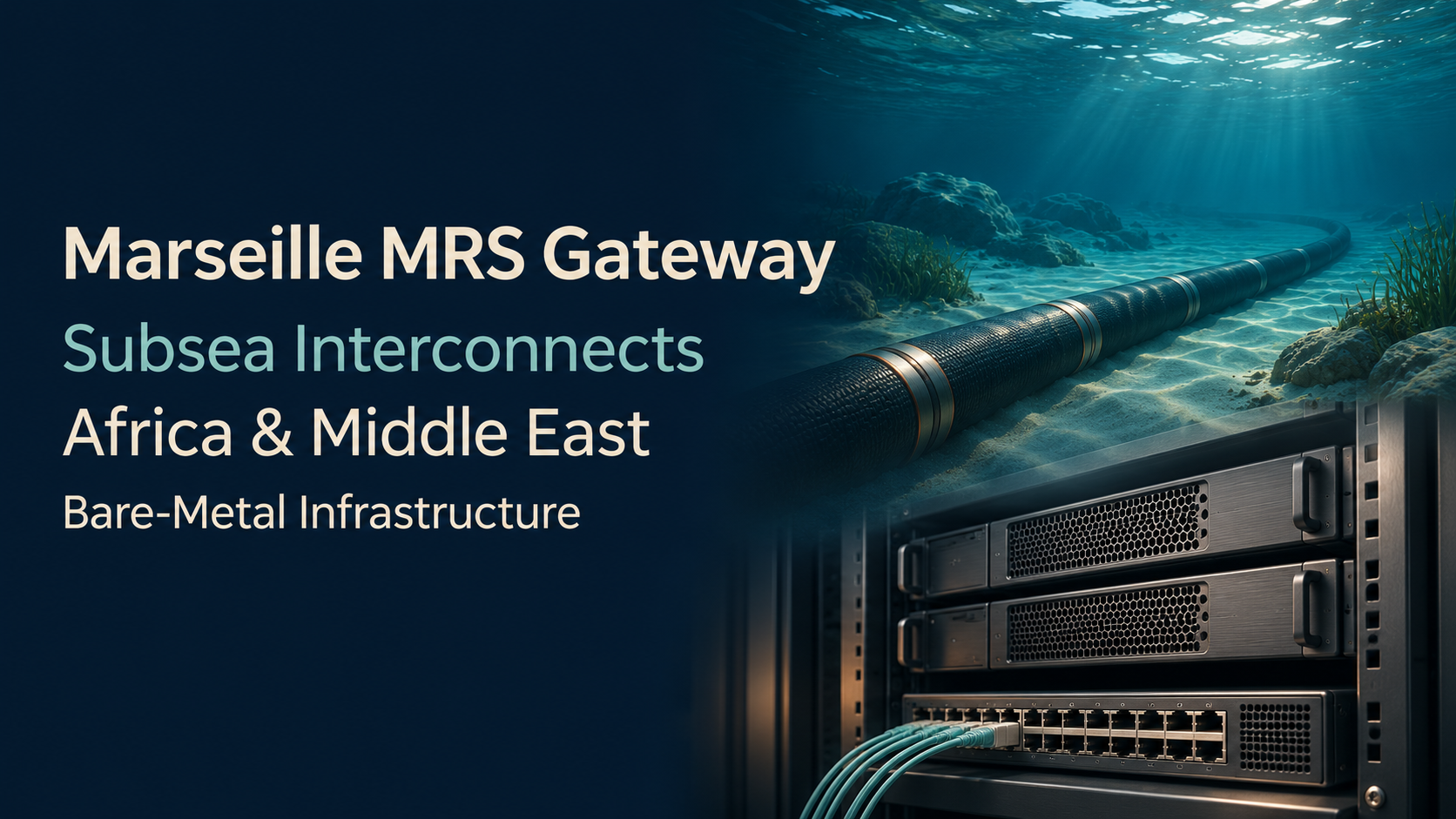
Direct Technical Answer: Marseille Subsea Interconnect Gateway
Deploying a marseille subsea cable dedicated server leverages the Mediterranean’s leading submarine telecommunications hub across Interxion/Digital Realty MRS1–MRS4 facilities. Direct cross-connects into 16+ active subsea cable systems (including 2Africa, SeaMeWe-5, AAE-1, and Peace Cable) deliver sub-18ms round-trip latency to North Africa, sub-45ms to the Middle East, and sub-9ms transit to Paris, terminating on single-tenant bare-metal silicon with carrier-grade hardware DDoS scrubbing.
Quick Decision Framework: Marseille Interconnect Topology
- Subsea Cable Landings: 2Africa, SeaMeWe-4/5, AAE-1, IMEWE, Peace Cable, and Medusa landing directly inside Marseille coastal terminal stations.
- Datacenter Hubs: Interxion/Digital Realty MRS1, MRS2, MRS3 (former WWII submarine base Martha), and MRS4, providing direct Meet-Me-Room optical cross-connects.
- Peering Exchanges: Direct Layer-2 access to France-IX Marseille and NL-ix with low-latency peering across Mediterranean telecommunication backbones.
- Compute Acceleration: Enterprise AMD EPYC 9004 and Dual Intel Xeon Scalable processors with 25GbE Mellanox NICs optimized for high-throughput packet routing.
In global digital distribution architectures, geographic positioning relative to physical transoceanic optical waveguides dictates packet transmission physics. While Paris and Frankfurt dominate Central and Western European data exchanges, Marseille has emerged as the uncontested digital gateway linking continental Europe with Africa, the Middle East, and South Asia. Routing North African or Middle Eastern user requests through Northern European datacenters adds 25ms to 60ms of unnecessary optical path propagation and multiple transit handoffs. Deploying an enterprise marseille subsea cable dedicated server places your compute tier at the literal landing point of over 16 global subsea cables, allowing multinational financial platforms, global gaming providers, and streaming media services to serve over 4.5 billion connected individuals with unmatched latency and reliability.
Direct fiber patch access to 2Africa, SeaMeWe-5, AAE-1, Peace Cable, and IMEWE without long-haul terrestrial backhaul penalties.
Direct optical paths across the Mediterranean Sea deliver sub-18ms latency to Algiers, Tunis, and Casablanca, and sub-45ms to the Arabian Gulf.
Housed within Interxion MRS3 (the former Martha U-boat bunker with 5.5-meter reinforced concrete walls), offering unmatched physical protection.
Dual-port Mellanox ConnectX-6 Dx networking interfaces provisioned with active BGP multihoming and multi-terabit volumetric anti-DDoS filtering.
Table of Contents: Marseille Subsea Architecture & Peering Guide
- 1. The Marseille Digital Gateway: Global Subsea Cable Convergence Hub
- 2. Comprehensive Subsea Cable Inventory: Capacities, Routes & Latencies
- 3. The Interxion MRS Campus: Physical Infrastructure & Martha Bunker Engineering
- 4. Engineering Runbook: Multi-Homed BGP Routing via France-IX Marseille
- 5. Trans-Mediterranean & Middle East Latency Benchmarks
- 6. High-Capacity Volumetric DDoS Scrubbing on Mediterranean Backbones
- 7. Hardware Sizing & Workload Matching for Intercontinental Gateway Servers
1. The Marseille Digital Gateway: Global Subsea Cable Convergence Hub
Historically known as France’s commercial gateway to the Mediterranean, Marseille has undergone an unprecedented transformation into one of the top five telecommunications interconnections in the world. As transoceanic optical cables traverse the Red Sea, the Suez Canal, and the Mediterranean basin, Marseille serves as the closest European landfall with direct high-capacity terrestrial dark fiber highways terminating into Paris, Frankfurt, Zurich, and Milan.
Operating a marseille subsea cable dedicated server eliminates the latency tax imposed by northern routing detours. When a mobile subscriber in Casablanca, Tunis, or Cairo initiates an API call or requests live streaming video, routing the packet directly into a dedicated server in Marseille saves between 20ms and 50ms of latency compared to routing via Frankfurt or London. For latency-sensitive workloads—including financial forex arbitrage, real-time gaming, and interactive WebRTC communications—this reduction is the difference between seamless user immersion and catastrophic session dropout.
2. Comprehensive Subsea Cable Inventory: Capacities, Routes & Latencies
Marseille is the physical landing site for an extraordinary portfolio of undersea optical fiber infrastructure. The table below details the major subsea cable systems terminating directly within the Marseille datacenter perimeter:
| Subsea Cable System | Total Design Capacity | Route Trajectory | Landing Datacenter | Key Regional Latency (from MRS) |
|---|---|---|---|---|
| 2Africa | 180 Tbps (16 fiber pairs) | Pan-African Circumference + Middle East | Interxion MRS3 / MRS4 | Lagos: ~58ms | Cape Town: ~110ms |
| SeaMeWe-5 | 24 Tbps | Southeast Asia – Middle East – Western Europe | Interxion MRS1 / MRS2 | Cairo: ~26ms | Mumbai: ~78ms |
| AAE-1 (Asia-Africa-Europe 1) | 40 Tbps (5 fiber pairs) | Hong Kong to Marseille via Indian Ocean | Interxion MRS2 | Dubai: ~42ms | Singapore: ~118ms |
| Peace Cable (Pakistan & East Africa) | 96 Tbps (200G WDM) | China/Pakistan via Red Sea to France | Interxion MRS3 | Karachi: ~72ms | Mombasa: ~82ms |
| Medusa Submarine Cable | 480 Tbps (24 fiber pairs) | Trans-Mediterranean (Spain, Algeria, Tunisia, Egypt) | Interxion MRS4 | Algiers: ~14ms | Tunis: ~17ms |
3. The Interxion MRS Campus: Physical Infrastructure & Martha Bunker Engineering
The physical security and operational continuity of Onlive Server’s Marseille infrastructure are rooted in the Interxion (Digital Realty) campus. Of particular significance is Interxion MRS3, an extraordinary datacenter facility constructed inside the historic World War II submarine base known as “Martha”. Built with reinforced concrete walls measuring 5.5 meters in thickness, the facility is virtually indestructible from external ballistic or environmental hazards.
Beyond military-grade physical protection, MRS3 features advanced thermodynamic engineering. Utilizing a River Cooling system drawn from a decommissioned industrial water gallery (the *Galerie de la Mer*), MRS3 achieves an exceptional Power Usage Effectiveness (PUE) of ≤ 1.18, circulating chilled water with zero mechanical chilling during winter months. This green energy architecture fulfills the stringent environmental mandates of the French government and the European Green Deal.
4. Engineering Runbook: Multi-Homed BGP Routing via France-IX Marseille
To orchestrate traffic flows across both local Mediterranean eyeball networks and transatlantic subsea backbones, bare-metal servers run an active BGP multi-homing configuration utilizing FRRouting (FRR). In this setup, the server peers concurrently with France-IX Marseille route servers and regional tier-1 transit carriers.
Step 1: Network Interface VLAN Configuration (Netplan on Ubuntu 24.04 LTS)
Step 2: FRR BGP Multi-Homing Configuration (/etc/frr/frr.conf)
Step 3: Linux TCP BBR & Socket Tuning for Long-Fat Networks (LFN)
Step 4: Operational Route Audit via FRR CLI
5. Trans-Mediterranean & Middle East Latency Benchmarks
The empirical advantage of terminating intercontinental traffic in Marseille rather than traversing the continent to Frankfurt or Amsterdam is demonstrated in live network round-trip time measurements:
| Destination City | Subsea Cable Path | From Marseille (MRS3) | From Frankfurt (FRA) | Marseille Latency Improvement |
|---|---|---|---|---|
| Algiers, Algeria | Medusa / Medex Subsea | 13.8 ms | 34.2 ms | -20.4 ms (59.6% faster) |
| Tunis, Tunisia | Didon / Hannibal Subsea | 16.5 ms | 37.8 ms | -21.3 ms (56.3% faster) |
| Casablanca, Morocco | Atlas Offshore / EurAfrica | 18.2 ms | 41.5 ms | -23.3 ms (56.1% faster) |
| Dubai, UAE | AAE-1 / SeaMeWe-5 | 42.1 ms | 64.5 ms | -22.4 ms (34.7% faster) |
| Mumbai, India | SeaMeWe-5 Express Route | 78.4 ms | 104.2 ms | -25.8 ms (24.8% faster) |
6. High-Capacity Volumetric DDoS Scrubbing on Mediterranean Backbones
Because Marseille aggregates massive international data streams, it represents an attractive target for distributed volumetric denial-of-service (DDoS) campaigns. Unprotected bare-metal servers can quickly succumb to multi-hundred gigabit SYN floods, UDP amplification bursts, and DNS reflection vectors originating from compromised consumer botnets across developing telecommunications regions.
Onlive Server addresses this vulnerability through an automated multi-terabit inline scrubbing architecture. Datacenter edge routers continuously sample NetFlow and IPFIX telemetry. When an anomaly threshold is breached, BGP Flowspec (RFC 5575) dynamically diverts malicious flows into localized hardware scrubbing centers in Marseille and Paris. Cleaned legitimate traffic is reinjected via internal GRE tunnels, ensuring that enterprise applications, API endpoints, and database clusters continue processing uninterrupted even during massive 1.5+ Tbps adversarial barrages.
Automated BGP Flowspec Mitigation Rule Example
By programmatically signaling filtering actions to upstream transit switches across the Marseille terrestrial backbones, packet floods are dropped at the edge of the Mediterranean optical network before reaching local rack switches. This protects host CPU caches and eliminates line contention across internal 25GbE interfaces.
7. Hardware Sizing & Workload Matching for Intercontinental Gateway Servers
Deploying bare-metal servers at an intercontinental network crossroads demands configurations optimized for high-bandwidth concurrency, deep memory caches, and resilient NVMe storage. Standard compute sizing recommendations for Marseille deployments include:
- Trans-Mediterranean CDN Edge & Streaming Origin: AMD EPYC 9354 (32 Cores / 64 Threads), 256GB DDR5 ECC RAM, 4x 3.84TB PCIe Gen4 NVMe in RAID 10, Dual 25GbE Mellanox ConnectX-6 Dx uplinks.
- High-Throughput Financial & Gaming API Gateway: AMD Ryzen 9 7950X (16 Cores / 32 Threads @ 5.7GHz boost), 128GB DDR5 ECC RAM, 2x 1.92TB NVMe RAID 1, Dual 10GbE SFP+ uplinks with DPDK acceleration.
- Regional Database & Data Warehousing Core: Dual AMD EPYC 9654 (192 Cores / 384 Threads), 1.5TB DDR5 ECC Registered RAM, 8x 7.68TB Enterprise U.3 NVMe, Redundant 100GbE bonded uplinks.
Frequently Asked Questions (FAQ)
Landing traffic at Marseille’s subsea hub trims tens of milliseconds off routes to North Africa and the Gulf while keeping DDoS scrubbing close to ingress. Compare French bare-metal builds with multi-homed BGP and high-capacity Mediterranean transit.
French Subsea-Gateway Bare Metal