

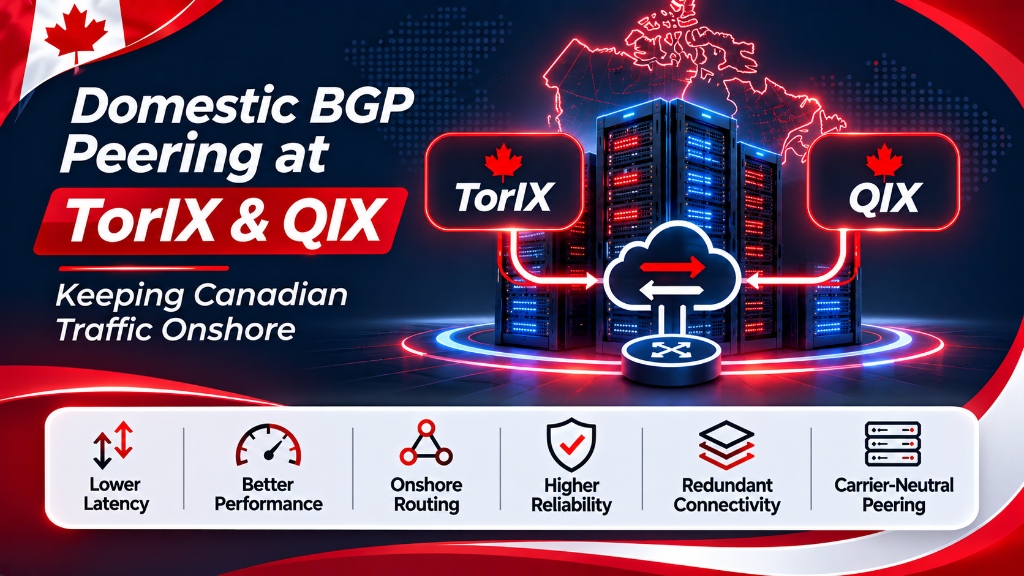
Direct Answer: Implementing torix qix peering dedicated server canada solves the infamous Canadian transit paradox by establishing direct, settlement-free domestic interconnection between enterprise computing infrastructure and Canadian consumer broadband networks. By peering directly at the Toronto Internet Exchange (TorIX at 151 Front Street West) and the Montreal Internet Exchange (QIX/CANIX at 625 René-Lévesque), bare-metal dedicated servers eliminate US cross-border hairpins through New York or Chicago, shaving 25ms to 45ms off round-trip times while ensuring domestic packets remain strictly under Canadian sovereign legal jurisdiction.
Architectural Highlights of TorIX & QIX Domestic Peering:
- The Hairpin Elimination: Direct bilateral and multilateral peering routes Toronto-to-Montreal packets over domestic optical fiber in sub-7ms, avoiding US transit routes.
- Exchange Scale & Gravity: TorIX connects 250+ networks with over 2.5 Tbps peak traffic; QIX connects 100+ networks serving Quebec and Eastern Canada.
- Sovereignty Mandates: Satisfies PIPEDA, Bill C-27, and Québec Law 25 compliance by keeping sensitive personal, medical, and banking data within Canadian borders.
- BGP Route Optimization: Multi-homed BGP-4 routing utilizing automated BIRD / FRRouting daemons with AS-path prepending and community tagging.
Canada occupies a unique and often problematic position in global telecommunications geography. Despite spanning six time zones and boasting one of the world’s most digitally connected populations, Canadian internet traffic has historically been routed according to commercial wholesale carrier economics rather than geographic proximity. For decades, when a customer in Ottawa sent a payment request to a server in Toronto, or when a hospital in Montreal accessed an electronic health records database hosted in Ontario, the digital packets were routinely dumped onto international transit backbones. These packets crossed the border into the United States, traversed commercial routing exchanges in Ashburn (Virginia), New York, or Chicago, and then journeyed back north across the border into Canada. This phenomenon, known across network engineering circles as “traffic hair-pinning,” is both a technical performance disaster and a grave legal vulnerability. For organizations committed to peak performance and data integrity, selecting a dedicated dedicated server in Canada equipped with native TorIX and QIX BGP peering is essential.
Onlive Server dedicated bare-metal infrastructure in Toronto and Montreal directly confronts and solves the Canadian transit paradox. Situated natively within 151 Front Street West in Toronto and premier carrier facilities in Montreal, our bare-metal servers peer directly with the route servers of the Toronto Internet Exchange (TorIX) and the Montreal Internet Exchange (QIX/CANIX). By exchanging traffic directly with Canadian Tier-1 internet service providers (including Bell Canada, Rogers Communications, Telus, Videotron, Cogeco, and Shaw/Freedom Mobile), your applications ensure that domestic Canadian traffic never leaves Canadian soil. This architectural approach delivers lightning-fast sub-millisecond local latency, bulletproof data sovereignty under Canadian privacy law, and dramatic reductions in transit costs.
Stop routing domestic Canadian packets through New York, Chicago, or Ashburn, eliminating 25ms to 45ms of unnecessary transit latency.
Guarantee that personal medical, banking, and citizen data never traverses US fiber cables, completely bypassing US FISA Section 702 surveillance.
Direct high-speed DWDM optical transport between TorIX and QIX switching fabrics enables real-time synchronous multi-city database replication.
Transfer hundreds of terabytes of content directly to major Canadian eyeball networks over unmetered 10Gbps/25Gbps ports with zero bandwidth surcharges.
Table of Contents: Domestic TorIX & QIX BGP Peering Architecture
- 1. The Canadian Transit Paradox: Why Domestic Packets Cross the US Border
- 2. Anatomy of TorIX & QIX: Physical Switching Fabrics & Connected Carriers
- 3. Technical Comparison: Direct IX Peering vs Upstream IP Transit vs Public Cloud Routing
- 4. Linux BGP Peering Runbook: Configuring BIRD & FRRouting for TorIX and QIX
- 5. Route Verification: MTR, Traceroute & Looking Glass Telemetry Runbook
- 6. Sovereign Data Compliance: PIPEDA, Bill C-27 & Québec Law 25 Legal Safeguards
- 7. Enterprise Peering SLAs, Port Sizing & Frequently Asked Questions
1. The Canadian Transit Paradox: Why Domestic Packets Cross the US Border
The root cause of traffic hair-pinning lies in the operational design of the global Border Gateway Protocol (BGP-4) and the commercial pricing of Tier-1 wholesale internet transit. Under standard BGP “hot-potato routing,” a transit carrier’s primary goal is to pass a packet off its own network as quickly as possible to minimize internal backbone transport costs.
In Canada, major telecommunications carriers (such as Bell, Rogers, and Telus) maintain historical peering disputes and restrictive private peering policies. Rather than freely exchanging settlement-free traffic domestically, they frequently force third-party networks to purchase expensive IP transit. Consequently, when an enterprise hosts an application in a generic datacenter with single-homed or non-peered transit, an interaction between a Rogers mobile user in Toronto and a Bell DSL user in Montreal is handed off to an American wholesale carrier (such as Cogent, Lumen, or NTT). The carrier routes the traffic south across the US border to the nearest massive commercial interconnection point—typically Equinix NY4 in Secaucus, New Jersey, or Equinix CH1 in Chicago—exchanges the packet, and hauls it back into Canada.
This round-about journey inflates round-trip latency from a clean 7 milliseconds up to 35 to 55 milliseconds. For real-time applications—such as VoIP telephony, financial market data streaming, multi-player gaming, and API-driven microservices—this artificial latency degradation is devastating.
2. Anatomy of TorIX & QIX: Physical Switching Fabrics & Connected Carriers
Internet Exchange Points (IXPs) are non-profit or cooperative physical switching fabrics that allow participating network operators to exchange traffic directly on a settlement-free basis. In Canada, two primary exchanges anchor the national optical backbone:
Toronto Internet Exchange (TorIX): Established in 1997 and headquartered at 151 Front Street West, TorIX is Canada’s premier exchange. Operating over redundant Arista high-density 100GbE and 400GbE switching fabrics, TorIX interconnects more than 250 unique Autonomous Systems (ASNs), handling peak traffic exceeding 2.5 Terabits per second. Participating members include national telcos, global content providers (Google, Netflix, Akamai, Cloudflare, Microsoft, Amazon), and regional ISPs. Connecting to TorIX puts your server within a single Layer 2 switching hop of over 70% of Canadian residential and commercial broadband subscribers.
Montreal Internet Exchange (QIX / CANIX Montreal): Headquartered inside the historic carrier hotels at 625 and 717 René-Lévesque Boulevard West in downtown Montreal, QIX serves as the digital gateway for the province of Quebec, Eastern Canada, and transatlantic subsea cable arrivals. With over 100 member networks, QIX is the essential hub for reaching French-speaking Canadian consumers, municipal government networks, and Montreal’s booming artificial intelligence research ecosystem.
3. Technical Comparison: Direct IX Peering vs Upstream IP Transit vs Public Cloud Routing
The comparative engineering matrix below illustrates the dramatic technical and legal differences between network routing options in Canada:
| Network Routing Dimension | Onlive Server Native TorIX/QIX Peering | Generic Canadian Commercial Transit | AWS Canada Central (ca-central-1) |
|---|---|---|---|
| Domestic Routing Path | 100% Onshore Domestic Fiber Routes | Subject to US Border Hairpinning (NYC/CHI) | AWS Edge PoPs (Proprietary Backhaul) |
| Toronto-to-Montreal Latency | Sub-7.2ms (Direct DWDM Optical Path) | 28ms to 48ms (When Hairpinned via US) | 12ms to 18ms (Virtual VPC Interconnect) |
| Direct Eyeball ISP Reach | Single-Hop Peering to Bell, Rogers, Telus, Vidéotron | Multi-Hop Upstream Carrier Handoffs | Multi-Hop via Amazon AS16509 |
| Bandwidth Cost Structure | Unmetered 10Gbps/25Gbps (Zero Transfer Fees) | Metered 95th Percentile Billing Charges | $0.090 per GB Outbound Internet Egress |
| US Surveillance Exposure | 0% (Packets Never Touch US Territory) | High (Subject to NSA/FISA 702 Interception) | Subject to US CLOUD Act Legal Jurisdiction |
4. Linux BGP Peering Runbook: Configuring BIRD & FRRouting for TorIX and QIX
On bare-metal Linux servers in Toronto running Debian, Ubuntu, or Rocky Linux, BIRD (BIRD Internet Routing Daemon) or FRRouting (FRR) is the standard software engine for negotiating BGP peering with TorIX and QIX route servers. Below is the production BIRD 2.x configuration for establishing dual multi-lateral peering sessions:
After reloading the configuration with `birdc configure`, verify the session state with `birdc show protocols`. Once the BGP session transitions to `Established`, your server receives over 150,000 domestic routes directly from Canadian operators, routing all domestic traffic across the local exchange fabric without hitting upstream transit providers.
5. Route Verification: MTR, Traceroute & Looking Glass Telemetry Runbook
To verify that domestic packets are staying onshore and that traffic hair-pinning has been eliminated, systems administrators should execute continuous MTR (My Traceroute) diagnostics targeting major Canadian carrier endpoints:
If traceroute output shows intermediate hops traversing IP addresses belonging to American wholesale providers or displaying latency spikes exceeding 20ms, traffic is being leaked to transit. Implementing BGP AS-path prepending or setting community tags (`852:0` to withdraw announcements from specific transit peers) immediately forces traffic back onto the domestic TorIX fabric.
6. Sovereign Data Compliance: PIPEDA, Bill C-27 & Québec Law 25 Legal Safeguards
The legal implications of traffic hair-pinning are profound. Under the federal Personal Information Protection and Electronic Documents Act (PIPEDA), the forthcoming Consumer Privacy Protection Act (Bill C-27), and Quebec’s stringent Law 25 (Loi 25), Canadian organizations bear strict legal liability for protecting personal information against unauthorized foreign access.
When unpeered server traffic accidentally hairpins across the US border, it traverses physical infrastructure subject to Section 702 of the Foreign Intelligence Surveillance Act (FISA) and Executive Order 12333. Under US law, foreign intelligence agencies can intercept and monitor electronic communications belonging to non-US persons without individual warrants. Furthermore, storing data in US-headquartered cloud providers exposes that data to the extraterritorial subpoena powers of the US CLOUD Act.
By hosting on Onlive Server bare metal peered directly at TorIX and QIX, Canadian enterprises establish an airtight legal perimeter. Data remains physically in Ontario and Quebec, routes exclusively across domestic Canadian optical paths, and remains subject solely to the jurisdiction of Canadian courts.
7. Enterprise Peering SLAs, Port Sizing & Frequently Asked Questions
Onlive Server backs our Canadian peering infrastructure with industry-leading operational commitments tailored for enterprise reliability:
- 100% Core Network Uptime SLA: Dual-homed fiber links, redundant Arista routing fabrics, and diverse optical entries guarantee continuous peering connectivity.
- 15-Minute Hardware Hot-Swap Guarantee: Enterprise NVMe storage, DDR5 memory modules, Mellanox 25GbE NICs, and redundant titanium power supplies are held on site for 15-minute emergency replacement.
- Zero Cloud Data Egress Surcharges: Transfer hundreds of terabytes of database backups, streaming media, or client telemetry across contracted 1Gbps, 10Gbps, or 25Gbps unmetered uplinks without billing surprises.
- 100% Canadian Data Sovereignty: Dedicated bare-metal servers reside entirely within Canada, guaranteeing complete immunity from foreign surveillance and strict adherence to PIPEDA and Law 25.
Eliminate US Hairpins with Domestic Canadian Peering
Keep your packets onshore. Direct BGP peering at TorIX and QIX, unmetered 10Gbps/25Gbps ports, sub-7ms Toronto-Montreal transit, and 100% PIPEDA compliance.
Configure Peered Dedicated Server in Canada
Stop paying upstream transit premiums or letting local packets hairpin across US borders by peering directly via BIRD or FRRouting on budget-conscious bare metal. Full hardware control lets you verify onshore paths with MTR and maintain PIPEDA and Law 25 alignment at predictable monthly rates.
